# Digitally Connected Urban Mines, Toward a Society of Endless Resources
URL: https://route06.com/insights/1
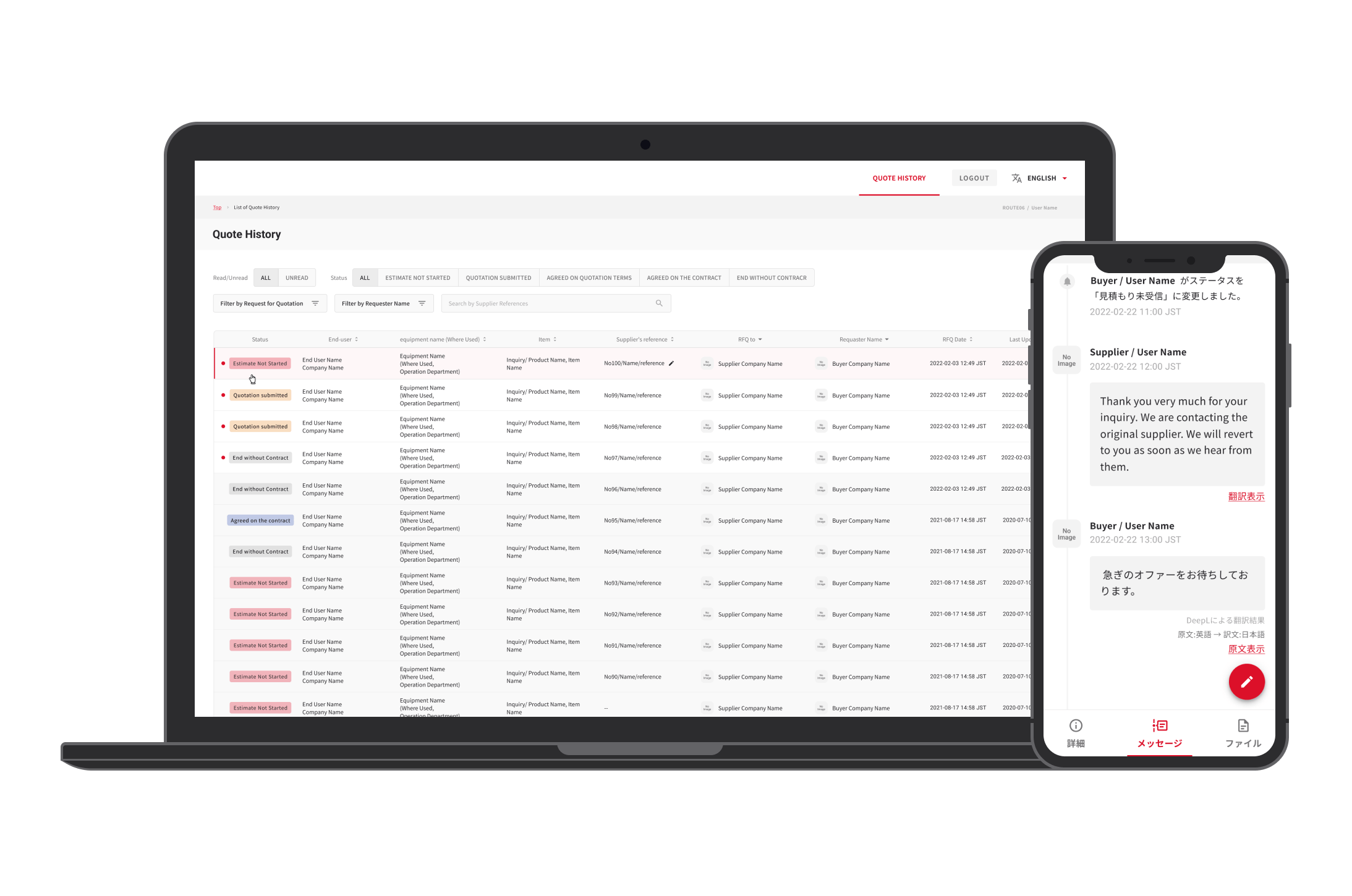
Today's press conference and press release announced the launch of MEX, an e-scrap trading platform operated by Mitsubishi Materials Corporation. As a partner company of MMC, I had the opportunity to attend the press conference and explain MMC's digitalization strategy, MMDX (Mitsubishi Materials Digital Business Transformation), and the potential of MEX.
I never imagined that in our second year of ROUTE06's existence, I would be invited to participate in a press conference with the management team of Mitsubishi Materials Corporation, a company with a 150-year tradition since its founding. I would like to express my sincere gratitude to CDO Kameyama and other members of the DX Promotion Division, Mr. Sakai and other members of the Metals & Materials Company, and all other related parties for believing in ROUTE06, which was a start-up company with little experience since its establishment, and for welcoming us as an equal partner.
__For the full text of this article, please visit this [website](https://note.com/tkendou/n/n34749cb7af70). __
---
# The Rise of SaaS: How Salesforce and Marc Benioff Revolutionized Marketing Strategy
URL: https://route06.com/insights/10
Salesforce established a SaaS (Software as a Service) business model that delivers software services via the Internet. While it is best known for business applications like CRM and SFA, Salesforce has significantly broadened the scope of the entire enterprise software market. Founded when the term 'cloud' was not yet in use, Salesforce now serves over 150,000 customers, with its distinctive marketing strategy playing a crucial role in its rapid growth. In this article, we will look back at the history of the software industry in the 1990s when Salesforce was founded, and discuss how Salesforce's marketing has defied industry conventions to grow into a global company.
*In this article, the current company name: Salesforce will be used in the same manner.
## Salesforce led the global SaaS market
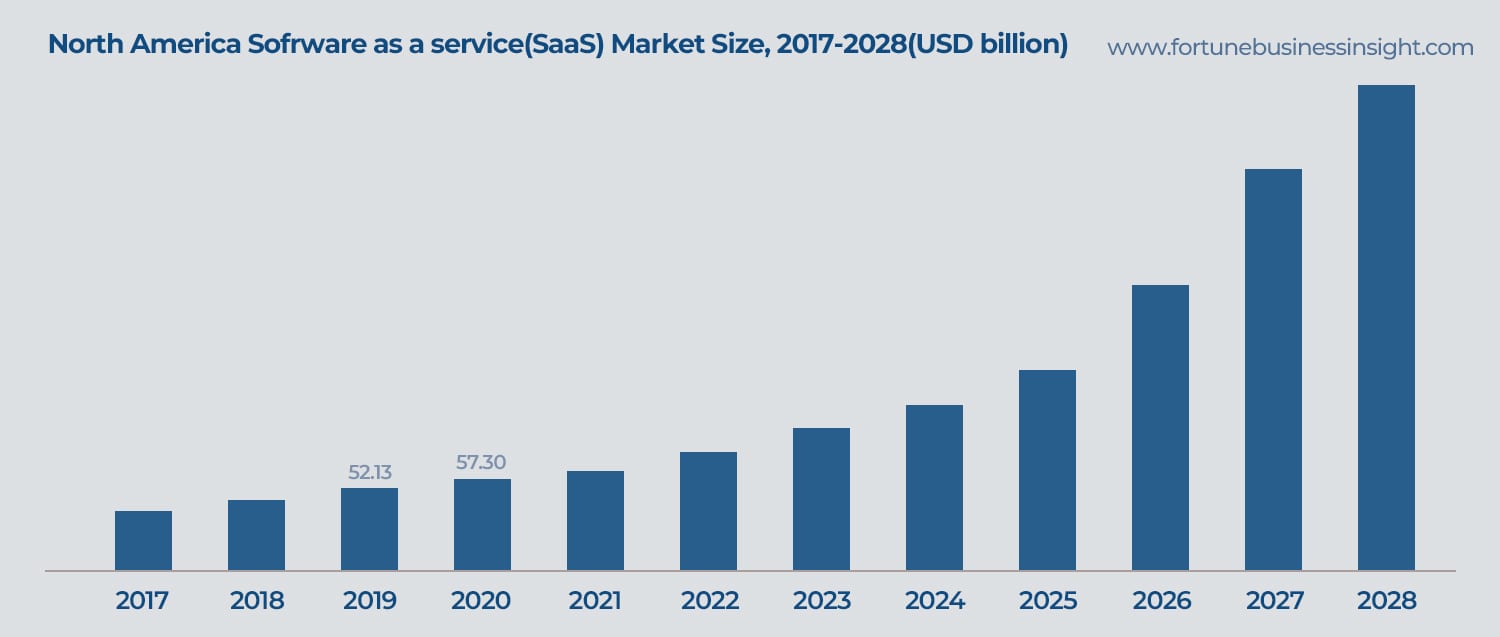
According to a Fortune Business Insights report[^1], the global SaaS market, which has been growing rapidly in recent years, is expected to reach $114 billion in 2020 and grow to $716 billion by 2028. Salesforce's revenue for the fiscal year ending January 31, 2020 was approximately $17 billion, which, based on the figures in this report, would give us an approximately 14% share of the SaaS market.
In the 1990s, most of the software offered for business use was installed on CD-ROMs (packaged software). Around that time, Marc Benioff (35 years old at the time), the youngest VP ever at Oracle, saw an opportunity to offer business software as a SaaS (software-as-a-service) rather than as installed software. In his book[^2], Marc Benioff wrote the following about the background of the company's founding.
```
"The dream was to make it easier to buy and use software, to make it more democratic, without complicated installation, maintenance, and periodic upgrades. At the time, enterprise software took six to twelve months to install, required significant investment in hardware and networks, and software packages delivered on CD-ROM cost millions of dollars. ...(omission)...In the 1990s, the total cost of a low-priced CRM product for 200 employees in the first year alone was $1.8 million. What is even more outrageous is that after all this money spent to implement and manage the software, the vast majority of the software is "shelfware," meaning that it is an asset that is owned but rarely used. According to research firm Gardner, as much as 65% of Siebel's licenses go unused."
```
In 1999, Marc Benioff founded Salesforce, a CRM provider via the Internet. A new era of enterprise software was dawning.
ASP (Application Service Provider), which is similar to SaaS in terms of providing browser-based applications via the Internet, began to spread in the 1990s. The difference is that ASP is "single-tenant" (providing a dedicated environment for each user), while SaaS is "multi-tenant" (multiple users share a common software environment).
## "NO SOFTWARE" marketing strategy led by Marc Benioff
Shortly after its founding, Salesforce embarked on its own marketing strategy to draw attention to its new service model.
#### Clear positioning and brand definition
Salesforce positioned itself as a challenger to industry leaders, crafting a narrative that criticized traditional, inefficient software delivery models and defined its mission as 'delivering new and better software for our customers.
In 2000, Salesforce's service launch event was a device that embodied that story. The bottom floor of the venue was made to resemble "hell," where traditional installed software was portrayed and an actor playing a salesman trapped in a cage shouted "Help me! and a whack-a-mole game in which a software CD-ROM was thrown into a toilet and a mole with the logos of other software companies on the mole. The trick was for invited guests to go through hell and then reach "heaven," the top floor where Salesforce's products were lined up amidst harp music. Founder Marc Benioff donned a combat uniform and played the role of a revolutionary, embodying his fight against the existing software industry.
#### Differentiation through the "End of Software" campaign
To develop his brand strategy, Marc Benioff consulted Bruce Campbell, a top advertising executive who had worked on President Reagan's television campaign, leading to the launch of the 'End of Software' advertising campaign. The campaign was to strongly emphasize the difference between the company and previous software products by placing a large "NO SOFTWARE" logo on all promotional materials. The campaign was so differentiated from its competitors that it was covered by the Wall Street Journal.
Despite the seemingly radical nature of these campaigns, Marc Benioff wrote the following about the concept of branding[^2].
```
A company's brand must be consistent to be effective. To consistently communicate the best parts of the company externally requires a total mobilization of employees, products, and messages. ...(omission)...A bank that advertises ``We value our customers'' cannot have 20 customers queuing up for two ATMs. Brands cannot break that promise. If you break your promise, customers will stop trusting you. If that happens, it's the end. ...(omitted)...What a company can own is its individuality as a company. We stand for NO SOFTWARE, not because other companies will not imitate it. It's because we are the first company to believe it matters to our customers."
```
The NO SOFTWARE campaign continued in the following years, with multiple guerrilla tactics that directly took advantage of rival companies' events. At Siebel Systems, the market leader in CRM at the time, they hired a large number of bicycle cabs in front of the San Diego Convention Center, where the event was being held, and handed out coffee and marketing materials about their company to visitors; at the European Users Week, they rented all the taxis from Nice airport to Cannes, and At the European User Week, they rented all the cabs from Nice airport to Cannes and promoted Salesforce inside the company with the NO SOFTWARE logo. This thorough and unexpected approach to its rival forced Siebel Systems to comment on Salesforce, then just a small venture, and the press became interested in the rivalry between the two companies. Salesforce, as the industry challenger, gained the support of the media and gradually increased its presence in the software industry. Today, SaaS is commonplace, but at the time, the idea of SaaS was so rare that it was probably difficult to get customers to understand the difference without a campaign of this magnitude.
In 2003, Siebel Systems, the market leader in CRM, announced that it was launching an on-demand service, essentially SaaS, and was acquired by Oracle in 2005. SaaS software companies. Marc Benioff has said that he drew on the marketing classic "Positioning Strategy" for his tactics against these rivals.

## Community measures to involve users
As Salesforce grew, it shifted its marketing focus from attacking competitors to appealing to the value of its services.
#### Hosting events where fans invite fans
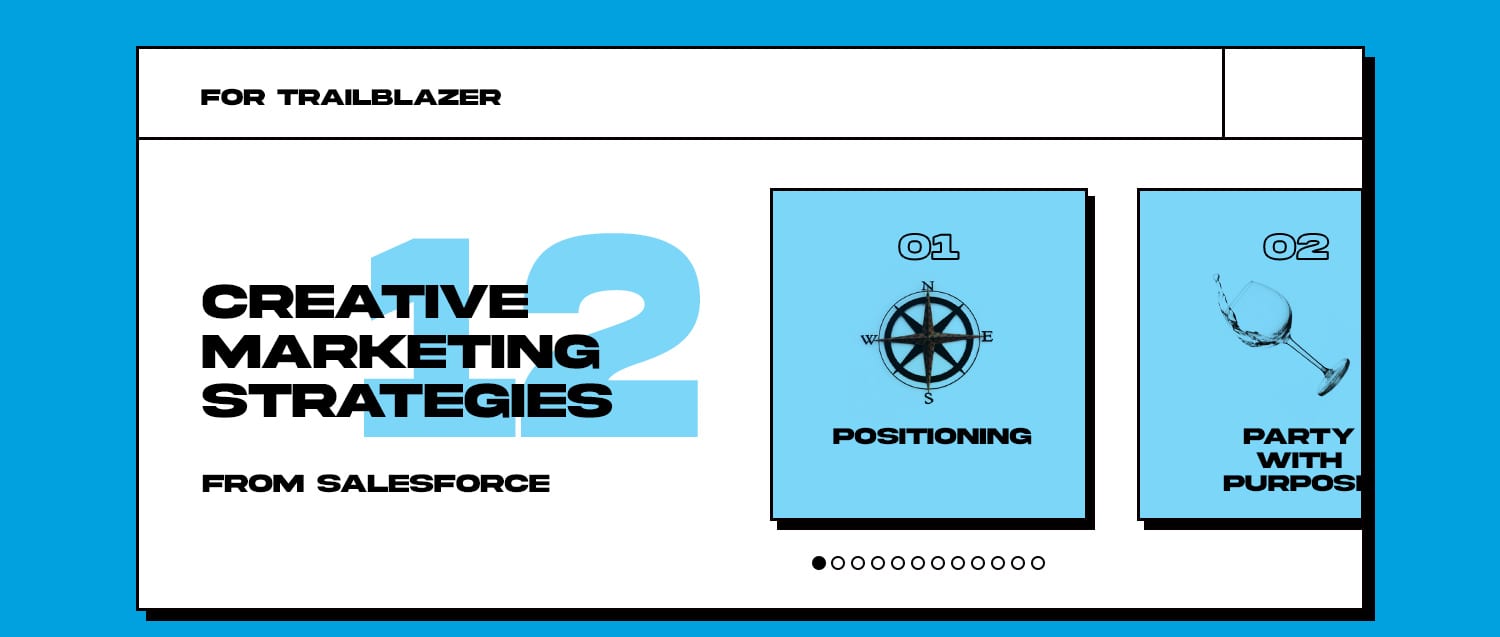
While other software companies were targeting the executive class with their budgets, Salesforce focused on end-user-focused events. Salesforce dubbed its customers 'Trailblazers,' who became the passionate 'fans' driving the success of these events. Salesforce named its customers "Trailblazers" and actively supported them with flyers and advertisements at events.
The SaaS model differs from software that is bought-and-paid-for in that the essence of the SaaS model is for the customer to continue using the service, thereby contributing to the success of the customer's business. Salesforce, which was strongly focused on "customer success" from its inception, encouraged its customers to share their own stories of how they had made their businesses successful, and word-of-mouth communication from Trailblazer, who actually attended the event, became an important approach to prospective customers. Trailblazers became loyal advocates of Salesforce by participating in events where they shared their experiences and interacted with other users.
What started as a 15-person Salesforce user event led to the annual "Dreamforce" event, which now attracts 170,000 attendees from around the world. Marc Benioff always mentions Trailblazer at the beginning of his keynote at this huge event, which shows how much Salesforce cares about Trailblazer.
## SaaS platforming with AppExchange
On June 23, 2004, the day Salesforce conducted its IPO, its stock price rose 54.6%. The IPO was introduced in CNET Japan at the time as follows[^3], showing the anticipation for the changes that Salesforce and SaaS would bring to the software industry.
> "The IPO is being touted as an experiment in a new business model that could reshape the software industry: Salesforce's approach of selling enterprise CRM software on a subscription basis, an approach that is growing in popularity among corporate buyers. Analysts believe that if Salesforce's subscription-based model and similar methods are successful, they could pose a challenge to software companies that sell traditionally, such as SAP, Siebel Systems, PeopleSoft, and Oracle."
Having worked hard to define the value of the SaaS model in its first few years of existence, Salesforce's next step is to build an application economy. The idea for this application economy was conceived by Steve Jobs, who was Marc Benioff's mentor[^4].
The AppExchange, which gave form to this idea, was released in 2006, allowing software services developed by other developers to be downloaded through Salesforce. The AppExchange created an ecosystem for accessing other applications through Salesforce, and Salesforce evolved from an on-demand CRM provider to a SaaS platform. The AppExchange has also enabled Salesforce to know in a timely manner which applications are needed by its customers, giving it an advantage in investment decisions and feature development.
Today, more than 5,000 apps and SaaS are distributed on the AppExchange worldwide. This ecosystem has also led to the adoption of Salesforce for building internal workflows, making it an entry point beyond CRM, which is one of Salesforce's strengths today. In addition, CVC "Salesforce Ventures" is investing in new startups using AppExchange, and the combined scale of the Salesforce economy is expected to reach $1.6 trillion worldwide by 2026, creating 9.33 million new jobs. million new jobs are expected to be created[^5].
## All for "Customer Success"
In less than 20 years since its founding, Salesforce has become the world's leading software company, and the SaaS model it pioneered is now commonplace in the software industry, with the aforementioned community initiatives and platform building such as AppExchange serving as models for all SaaS companies. The SaaS model that Salesforce pioneered has now become a standard in the software industry.
In an interview in 2020, when Salesforce's market capitalization overtook that of Oracle, Marc Benioff, when asked "Who has been your biggest competitor over the last 20 years?" replied, "Nothing is more important than customer success."[^6] This obsession with unlocking inconvenient and expensive enterprise software that was only available to a small number of companies, and with making customers successful, has been Salesforce's strength.
[^1]:Fortune Business Insights, "The software as a service market."
[^2]:Marc Benioff, "The Birth of the Cloud" (Diamond Inc.)
[^3]:CNET Japan, "Salesforce posts first day IPO at $17.20, up 56.4% over offering price."
[^4]:Salesforce blog, "How Advice from Steve Jobs Inspired the AppExchange"
[^5]:ASCII.jp "The Rapidly Expanding Market and Jobs Created by Salesforce: Where is the Ecosystem's Strength?"
[^6]:The Market Is Opan "The Rise of Salesforce (Behind the Cloud Giant)"
---
# The Evolution and Digital Strategy of Inditex, the World's Largest Apparel Company Behind ZARA
URL: https://route06.com/insights/11
Inditex (Industria de Diseño Textil, S.A.), one of the largest apparel companies globally and the owner of the ZARA brand, exemplifies the SPA (Specialty store of Private label Apparel) model, where it designs, manufactures, and sells its own products. Besides ZARA, the company owns other brands such as Pull & Bear, Massimo Dutti, Bershka, Stradivarius, Oysho, ZARA HOME, and Uterqüe.
Although Inditex was impacted by the COVID-19 pandemic, particularly in its key markets of Europe and the United States, the company's robust digital strategy has helped it maintain a market capitalization of approximately 9.3 trillion yen (as of September 30, 2022). Inditex continues to hold a leadership position in the industry.
In this article, we will discuss the business strategies that Inditex has implemented to build a strong value position and how the company is pursuing its digital strategy in the era of after-corona.
## Inditex's business strategy that created ZARA
ZARA, a Spanish brand founded by Amancio Ortega in 1975, became part of Inditex when the company was established in 1985. This marked the beginning of significant brand development, including international expansion to cities like New York and Paris[^1]. ZARA has succeeded in winning the hearts and minds of its customers by selling mainly trendy fashions at affordable prices. Today, ZARA has grown into one of the world's largest apparel companies with approximately 6,700 stores in 88 countries (ZARA and ZARA HOME account for approximately 70% of the Inditex Group's total sales).
To grow to its current scale, Inditex has focused on the following specific initiatives:
### 1. Utilizing information from the field to shorten product planning cycles
ZARA has succeeded in meeting customer expectations and increasing the frequency of store visits by offering new products in a range of sizes in its stores twice a week on a fixed day without fail. In order to increase the speed and accuracy of its product planning, ZARA has focused on building an operation that gathers quantitative data such as sales and POS as well as information on customer response from store staff around the world to the Spanish headquarters. The more new products are introduced, the more feedback information is accumulated from stores around the world, making it possible to plan and sell products that better reflect customer opinions.
### 2. Production system that emphasizes speed
Inditex has expanded its scale by locating production bases in neighboring regions such as Spain, Portugal, and Morocco, rather than in areas with relatively low labor costs. In order to send goods to stores around the world in a timely manner, we have worked to speed shipping to anywhere in the world within 48 hours, including the use of air freight at the expense of costs for shipping outside of neighboring European countries. We also built a production system that emphasizes speed over cost, including early adoption of automatic sorting and picking systems, which are now being introduced.
### 3. Investment in in-store branding
With the policy that stores are the greatest advertisement, especially during the growth process of the brand, we have prioritized opening large stores in favorable locations in global cities and landmark areas rather than spending large amounts of money on promotions. In order to keep customers coming back to the stores more often and to keep them engaged, the company frequently changes the product layout in the stores and invests aggressively in window displays and upscale décor.
The company's short-cycle merchandising (merchandising), which is said to take two to four weeks, has been recognized as a growth driver for Inditex and ZARA, and its ability to consistently execute everything from planning to production and store operations is also notable. However, the company's ability to execute consistently from planning to production and store operations is also worthy of special mention. As a result, Inditex has not only grown to become the world's largest apparel company in terms of sales, but also boasts a higher profit margin than other SPA-type apparel companies (15% operating margin in FY01/2022)[^2].
## Inditex's digital strategy accelerated by the Corona disaster
The global COVID-19 pandemic significantly impacted Inditex, a company that had traditionally maintained its market position by offering superior value through its brick-and-mortar stores.
Strict lockdowns and behavioral restrictions in major European and U.S. cities, Inditex's key markets, led to a significant drop in store sales throughout 2020, resulting in lower revenues and profits for the fiscal year ending January 2021 [^2].
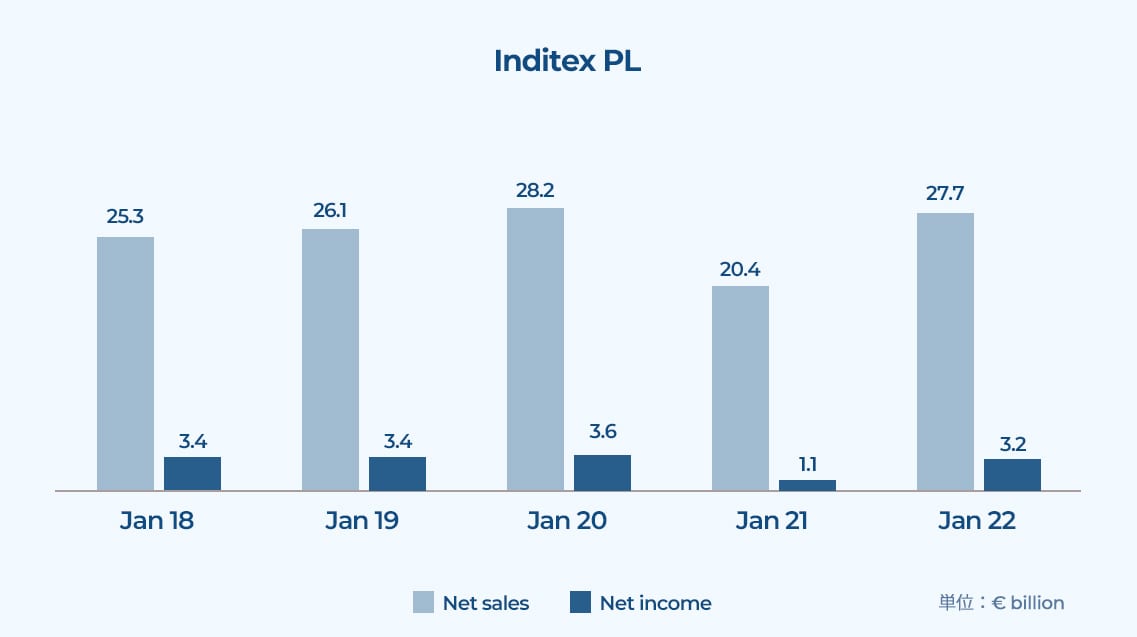
Author's note from Inditex financial results presentation
Despite the inevitable damage caused by Corona, Inditex has accelerated its digital strategy in the face of the Corona disaster. As a result of its previous aggressive investment in e-commerce, the ratio of e-commerce to sales has remained higher than that of Fast Retailing, which is in a similar industry, but since 2020, when the Corona disaster struck, it has grown even more significantly[^2][^3].
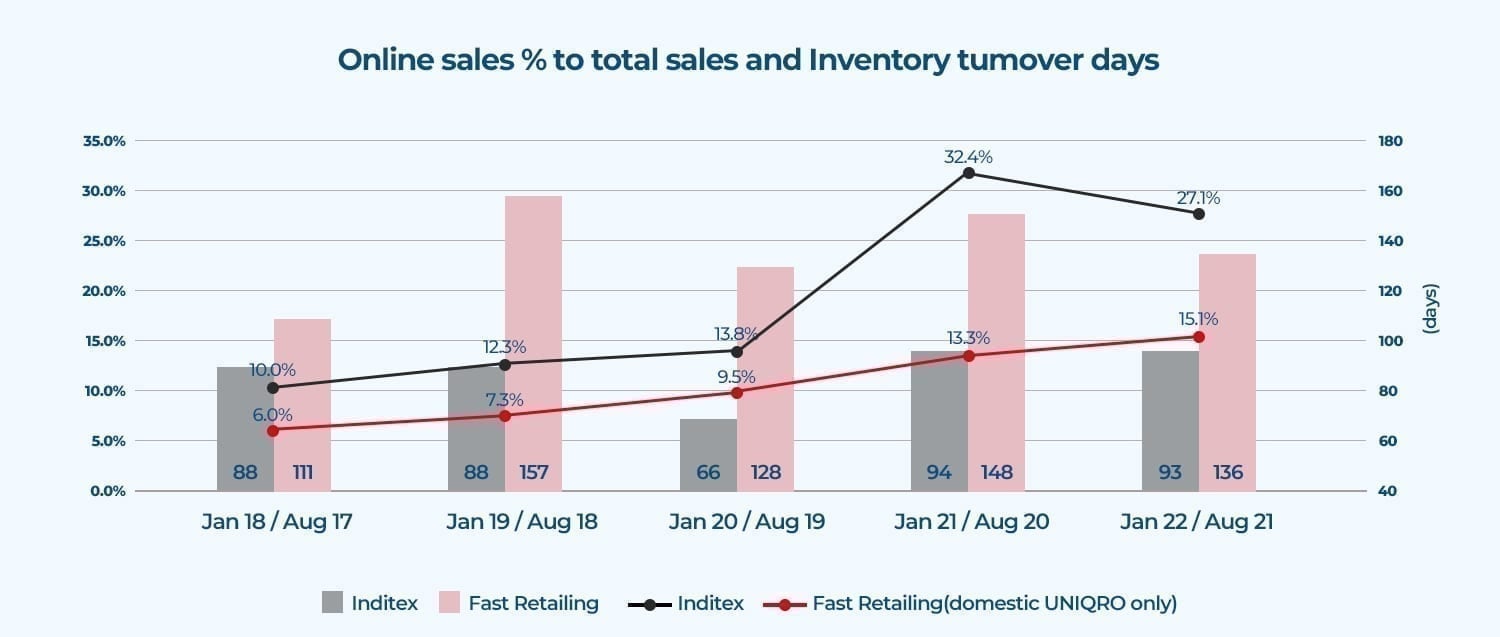
Compiled by the author from the financial statements of Inditex and Fast Retailing. Time series left: Inditex, right: Fast Retailing at the end of the fiscal year.
In June 2020, under the concept of "Global Fully Integrated Store & Online," FAST RETAILING will close 1,000 to 1,200 stores, mainly small stores and stores with overlapping trade areas, to further promote its omni-channel strategy. The company has also indicated its policy to promote its omni-channel strategy more strongly.
In addition, the company announced a DX investment of 1 billion euros (approximately 120 billion yen at the then current exchange rate) between 2020 and 2022, and has announced that it will improve the digital experience using its own apps and strengthen the opening of large stores that can respond to digitalization[^4].
The main digital initiatives that Inditex (ZARA) has implemented in the recent past are as follows.
__Making customer contact seamless through an app__.
- In addition to traditional e-commerce functions, the company has successively expanded functions that can also be used in stores, such as "CLICK & FIND," which allows users to search for product locations by store, and "CLICK & TRY," which allows users to reserve fitting rooms.
- Enhanced measures to encourage store visits, such as "CLICK & GO" (BOPIS = Buy online, Pick up in store), which allows customers to pick up items in stores after ordering via the app, and a mobile payment function.
- Barcodes and QR codes have been added to product tags so that customers can check detailed product information on their smartphones without having to ask a staff member in the store.
## Digitization of in-store operations
- Implemented a service that allows delivery directly from the storefront to the customer, rather than from EC-dedicated inventory and warehouses. In addition to improving operational efficiency by integrating in-store and EC delivery operations, the ratio of same-day and next-day deliveries has been increased.
- Completed the introduction of RFID (Radio Frequency Identification) for all products and achieved SINT (Single Inventory Integration) for stores and EC in each country, further improving inventory efficiency.
- Promoted store renovations to accommodate digitalization, including interactive digital fitting rooms and self-checkout systems

*Created by us with reference to the official ZARA app screen at the time of writing*
In addition to its traditional strengths of engaging in-store experiences and operational excellence, Inditex is making bold and rapid digital investments like the ones described above to create a smooth customer experience that blends online and offline. In the future, we expect to see more and more new OMO (Online Merges with Offline) type store formats like this one, not just from Inditex.
In terms of KPIs and financials, the company's EC ratio was 27% in FY01/02, one year ahead of its original target of 25% by the end of FY2022. In addition, Inditex's app has reached 146 million active members and 228 million social media followers worldwide (as of January 2022)[^2]. Of course, the decline in store sales due to the Corona disaster has had a negative impact on overall sales, which is the denominator, and thus the high EC ratio, but it can be inferred that the online experience and OMO strategy offered by the company has received a certain amount of recognition.
Inditex has set a new target of increasing its EC ratio to more than 30% by 2024, and intends to continue to aggressively pursue its digital strategy and investments.
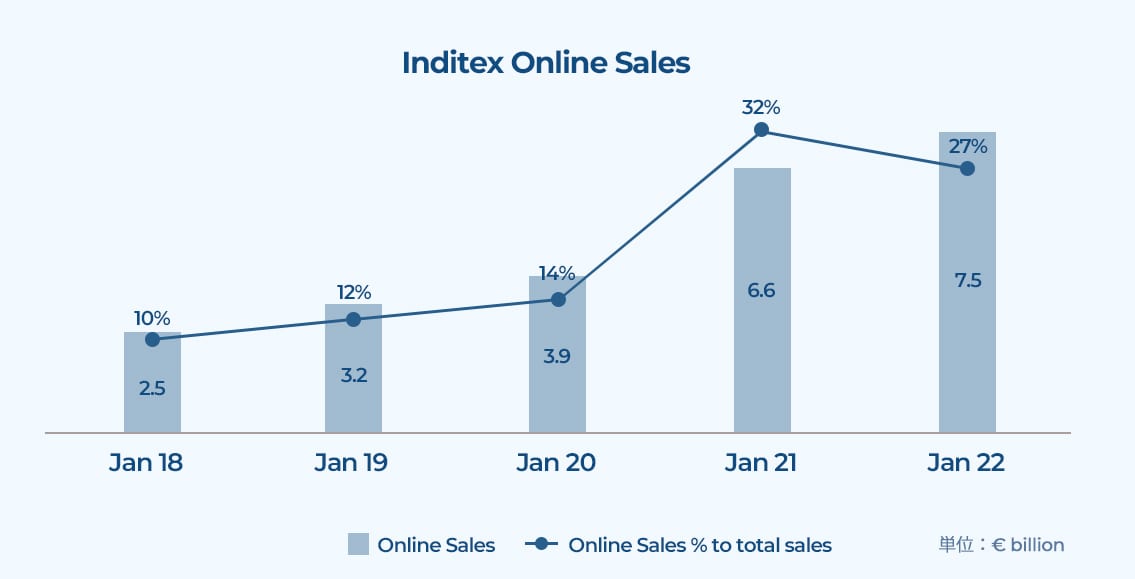
*Author's note from Inditex financial results presentation*
## About Inditex's new initiatives
Inditex has maintained a high growth rate and profitability for many years as a leader in the industry, but in the future, in addition to competition from fashion apparel companies such as Fast Retailing and H&M, we expect to face increasing competition from tech giants such as Amazon, which is planning a full-scale entry into the fashion market, and emerging apparel companies such as SHEIN, which is experiencing rapid growth, especially among the Generation Z. In addition to competition from fashion apparel companies such as Fast Retailing and H&M, competition is expected to intensify with tech giants such as Amazon and emerging apparel companies such as SHEIN, which are growing rapidly, especially among Generation Z consumers. In particular, SHEIN's operating company, Roadget Business, has been growing rapidly, with its enterprise value exceeding that of Fast Retailing and Inditex, and the company's future global expansion is attracting attention to changes in the competitive environment[^5].
In addition, public focus on ESG and sustainability continues to grow, and as an industry leader, the company is expected to address more complex issues, such as transparency in its production and disposal processes. It is undeniable that the casualization of people's lifestyles and fashion, which has changed after Corona, may affect ZARA's value proposition of trendy fashion and office fashion demand.
In response to these challenges, Inditex has undertaken several initiatives, including the use of recycled polyester and linen, the adoption of renewable energy in production facilities, garment recycling, and the implementation of sustainable supply chain programs. A notable new initiative is the creation of the Sustainability Innovation Hub, aimed at promoting sustainability innovation. To date, more than 30 R&D projects are underway in collaboration with around 150 startups (new carbon capture Lanzatech, which has developed a new carbon capture technology, and CIRC, which has a textile recycling technology).
In its most recent financial results for fiscal year 2021, Inditex highlighted that the percentage of renewable energy used by the company was 91%, and that the percentage of products that meet ZARA's "Join Life" sustainability commitment reached 47% of the total. The company is actively engaged in initiatives and information dissemination [^2].
In addition to sustainability initiatives, the company has also launched a new collection of sportswear for athletes called "Athleticz" and the "ZARA Origins" series, a basic yet contemporary line, which, along with the "ZARA HOME" interior design brand, has recently We are making strategic investments in response to changes in the business environment, including a shift from trend fashion brands to lifestyle brands that are more in line with the times and people's lifestyles.
Building on these non-digital strategic initiatives, the omni-channel strategy is expected to accelerate in the future. "[^6] in which he mentions the importance of a global, fully integrated omnichannel.
>Inditex boasts a business model capable of adapting to any environment and an international reach underpinned by a solid strategic approach. inspiring fashions combined with a fully integrated omnichannel offer in each region, and supported by technological innovation, has enabled us to Its inspiring fashions combined with a fully integrated omnichannel offer in each region, and supported by technological innovation, has enabled us to extend our store leadership to the digital world, with online sales now accounting for one-quarter of the total.
In addition, to create new digital experiences, we have collaborated with South Korea's Ader Error to develop avatar clothing through ZEPETO, an avatar creation application, and are working to expand our services in a wide range of digital domains, including the company's first foray into the Metaverse[^7]. 7].
Through cutting-edge digital technology and sustainability innovation, Inditex (ZARA) aims to be a leader in DX and ESG within and outside the industry. We will continue to closely monitor Inditex's future efforts, not only with regard to its digital strategy.
In this article, we have introduced the strategies that have created Inditex's competitive advantage and its DX initiatives. We hope that this article will be of some help to you in your discussions and strategic considerations.

[^1]:Inditex Careers / Inditex - History
[^2]:Inditex's official website and IR information
[^3]:Fast Retailing IR information
[^4]:ZARA to close 1,200 stores, less than 20% of the world's stores, and increase EC ratio to 25%.
[^5]:China-based clothing retailer SHEIN rapidly expands, its corporate value surpassing that of UNIQLO.
[^6]:Inditex Annual Report 2021 CEO's Statement
[^7]:ZARA collaborates with "Ardor Error" from South Korea, first foray into Metaverse with ZEPPET (FASHIONSNAP.COM)
---
# Figma: The Design Platform Bridging Creativity and Technology
URL: https://route06.com/insights/12
Figma, known for its simple shapes and colorful Memphis-style graphics, is widely used by designers, product managers, and engineers alike, creating a unique and evolving ecosystem. The number of users has rapidly expanded. As of this writing, it has over 4 million users and is employed by major companies like Google, Microsoft, and The New York Times. It made headlines in September 2022 when it accepted Adobe's acquisition offer of $20 billion (approximately 2.9 trillion yen), Adobe accepted a huge acquisition offer of $20 billion (approximately 2.9 trillion yen) from Adobe. This article provides background on Figma's growth to date and future potential, created by co-founders CEO Dylan Field and Evan Wallace, CTO and Chief Technology Officer.
## What is Figma, the collaboration tool loved by designers around the world?
Figma is a tool designed to boost the productivity of entire teams involved in product creation, from concept design to prototyping and gathering user feedback. By sharing all the design processes and outputs of the team on Figma, two-way communication between designers and non-designers is facilitated, enabling interface design that is easier for users to use and for engineers to implement. This enables the creation of interfaces that are user-friendly and easier for engineers to implement.
The Biden-Harris administration's creative team made a splash during the U.S. presidential election in the midst of the 2020 pandemic. All output, from the website (JoeBiden.com) to campaign planes, merchandise, and social networking posts, was produced using a single Figma file. The collaboration tool, Figma, was behind the speedy design collaboration with many stakeholders in a remote environment[^2]. In Japan, almost all screens of PayPay Frima have been created with Figma since its release (October 2019)[^3], and there are many examples of introduction of Figma from services of major companies to individual design work.
Conventional design tools are mainly dedicated desktop applications for creating, editing, and outputting design files, and in general, they require the purchase of paid applications for file browsing and simple editing, which is a high barrier for non-designers. On the other hand, Figma aims for "seamless and lossless interaction between everyone involved in the design process without causing friction," and by proactively incorporating new technologies (WebGL, Operational Transforms, CRDT, etc.), it enables users to By actively incorporating new technologies (WebGL, Operational Transforms, CRDT, etc.), we have created an environment in which users can view design files in a browser without stress and without installing special applications. [^1]
>"Design is a team sport. So collaboration is essential."[^1]
### "And design is a team sport"
*Refer to the official Figma website at the time of writing*
### Toward an Internet-native design tool
Figma began as a personal project of founder Dylan Field in 2012. Born in California, Dylan's interest in computer science, art, and design began at an early age and led him to a magnet school with a strong technology education in science, technology, engineering, and mathematics. Later, while studying computer science at Brown University, he met his future business partner, Evan Wallace. Evan had interned at Pixar, where he learned WebGL—a JavaScript API that enables interactive graphics in the browser—which he later applied to the development of Figma's 'browser-first' approach.
After interning at LinkedIn and Flipboard, Dylan co-founded Figma with Evan, a recent college graduate, after being selected for a Thiel Fellowship (Peter Thiel's investment program for young entrepreneurs who have dropped out of college). After exploring various business ideas, including software for drones and meme generators, we finally decided to create a product that would try to replace Photoshop. An article from that time[^4] described the product as "a technology startup that allows users to express themselves creatively online," emphasizing that it was a product for designers.
At first, the product did not launch well and it took several years for the beta version of Figma to be released to the public, and many dissatisfied members left. At that time, Figma mainly offered a free version as an entry model, but it seems that the company went through various trials and errors, such as revising its plan after receiving feedback from one Microsoft user that "free start-up tools are unreliable.
Later, the company changed to a simplified pricing structure inspired by the Australian software company Atlassian, and expanded the features with an emphasis on non-designer users, and finally released the official version in 2016. The official version was finally released in 2016. Then in 2017, we continued to develop and improve the software by adding innovative features, including multiplayer editing, and evolved it into a product that the designer community is enthusiastic about.
### "Browser First" for Non-Designers that accelerated Figma's growth
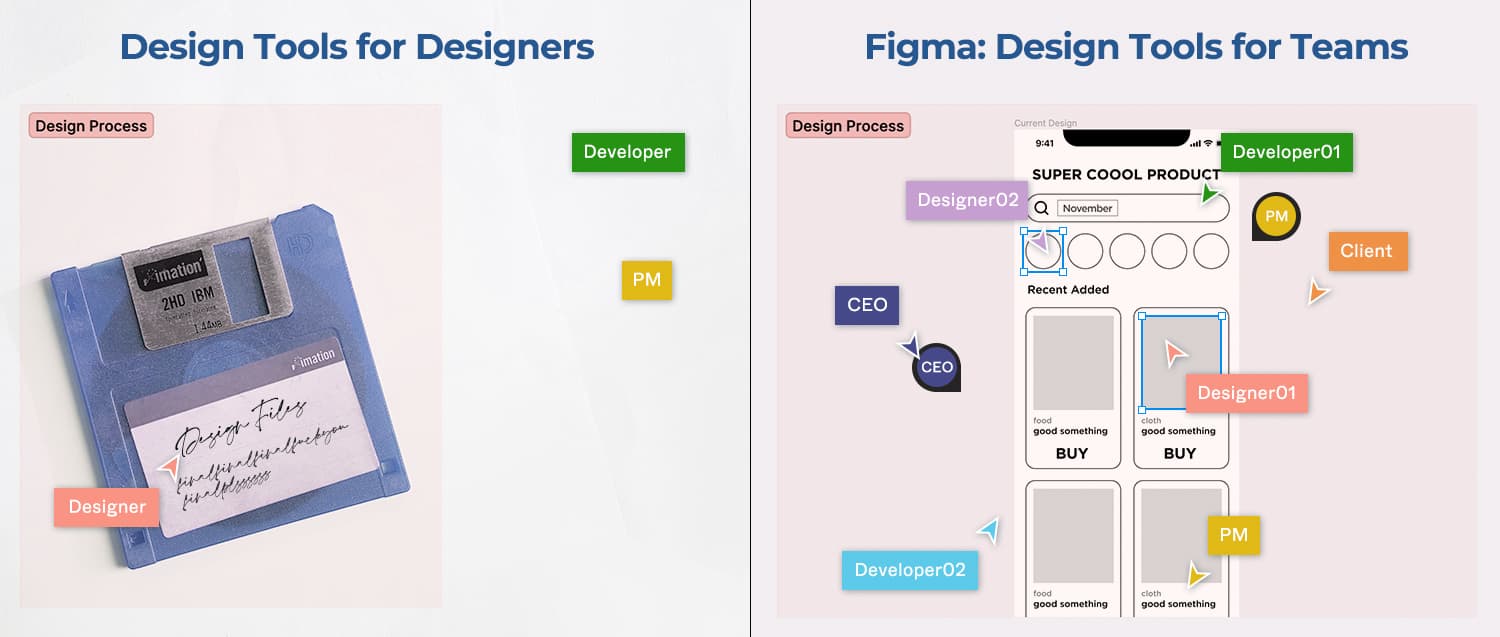
*Created by us*
Adobe and other competing products are great products for designers, and a lot of creativity has been generated through them. In contrast, Figma is a product with a design philosophy that focuses on improving the productivity of not only individual designers but also the entire project team, including non-designers[^5]. Figma has also been sincerely addressing questions and issues that non-designers have during the design process, such as whether this file is up-to-date, which applications must be installed for viewing and editing, and where and how feedback on the design should be provided. I have been working on a number of projects with the same goal.
This is symbolized by the many "browser first" features. While conventional design tools generally require the installation of a paid desktop application in order to view and edit files, Figma allows anyone to open a shared URL in a web browser and collaboratively edit design files in real time in a high-performance work environment. In contrast, Figma allows anyone to collaboratively edit design files in real time in a high-performance work environment by simply opening a shared URL in a Web browser. When Figma was created, web-based design platforms running in a browser were rare. The ability to render complex graphics while maintaining performance, coupled with real-time collaboration for multiple users, was a breakthrough for design tools at the time. The experience of rendering complex graphics while maintaining performance, and the ability for multiple users to participate and edit simultaneously, were also a breakthrough for design tools.
As a result, non-designers can review mockups and creativity early in the design process, and the commenting function within Figma has greatly reduced the barriers to feedback on the design. In conventional digital product development, the design process often starts after business and functional requirements have been determined, and the user experience and interface design are often constrained by these requirements. In recent years, in order to create more user-first products, concept design and mock-up design have been incorporated into the initial product conception process, and designers are increasingly participating in business and development meetings.
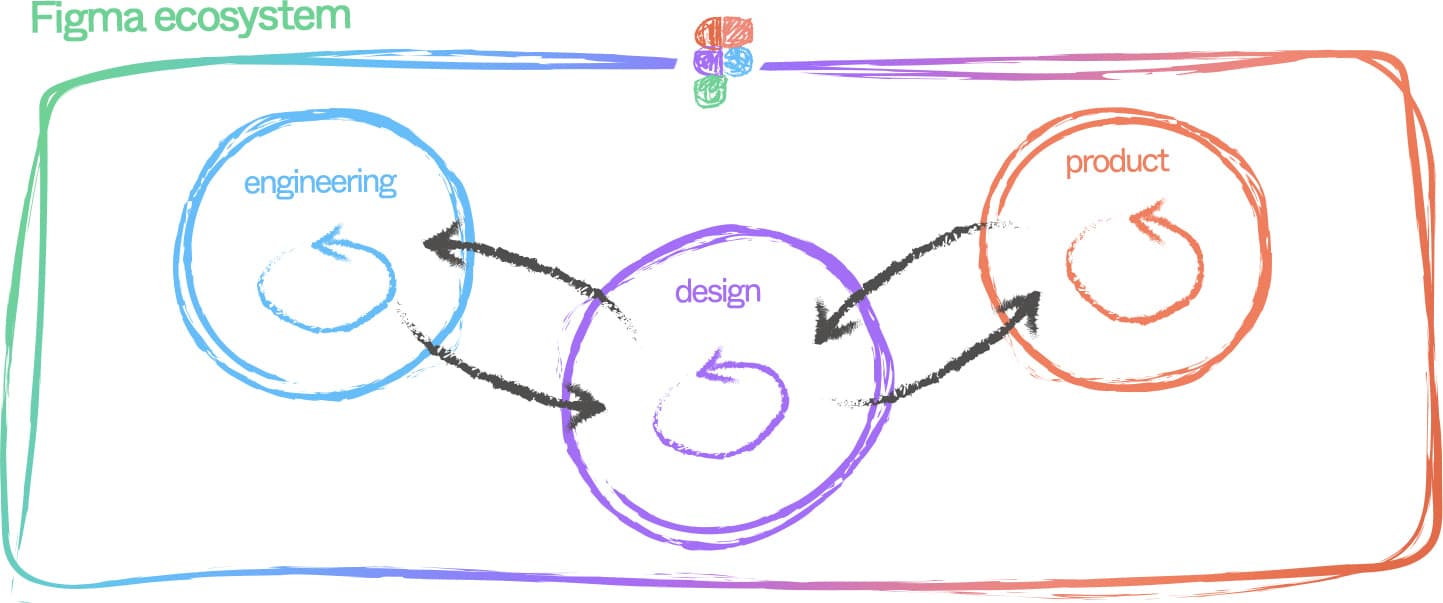
Created by us
The ease of design collaboration has also changed the work of non-designers. Copywriters can now put concept words directly into design files to see how they look and imagine the finished product, and software developers can easily obtain design and code conversion data even if they are not good at design or markup. With an emphasis on the non-designer experience, Figma is evolving into a product that is transforming and influencing not only design, but also the development process and other operations.
### Figma Community as a Design Platform
In addition to its collaborative features for non-designers, another of Figma's great strengths is its enthusiastic fan community: as soon as you install the Figma application and open an account, you have access to a social network service that connects you to Figma's worldwide users. You will have access to our social networking services.
Individuals and companies who are Figma users can easily publish their designs on the Figma community site, and anyone can instantly copy and edit the shared design files in their own workspace. The same kind of sharing of intellectual property (source code) that has been common in open source software development is now possible with design files. In Japan, Figma data was released in March 2020 as design data for the new Corona countermeasure site and became a hot topic[^6]. Various ideas for improvement were submitted as Issues.
While there are many design portfolio sharing sites such as Dribbble, it is not uncommon to see only image files and not the entire design file including layers and components. However, GitHub is a product that improves development efficiency by specializing in the sharing and management of software source code, and the community that Figma has built is a design version of GitHub.
In addition, there are countless plug-ins that enhance the convenience of Figma, and their development is actively conducted within the Figma community. For example, useful plug-ins are constantly being implemented and released by community users to automatically generate dark mode designs, to detect and correct formatting errors in designs by importing external data, and so on.
The proliferation of design files and plug-ins within the community has streamlined design work for all Figma users. The growing user base, which includes not just designers but also software engineers, product managers, and other professionals, has led to the release of new design files and plug-ins. Figma is a platform service that not only provides many useful functions for experienced designers, but also gives beginners the opportunity to learn and emulate the techniques of their predecessors and to communicate in a comfortable atmosphere. Figma is loved by designers and non-designers around the world.

*Created by us*
## History of design tools and positioning of Figma
Adobe, which announced the acquisition of Figma, has been in the spotlight since the 1980s, revolutionizing the design world and bringing the concept of digital design to the forefront. Adobe chose Apple's Macintosh over IBM's PC, which held the lion's share of the market at the time, to enhance its value and remain the absolute mainstream brand in the DTP and printing industries today. Unrivaled in the industry, Adobe released a number of excellent design applications such as Adobe Illustrator and Adobe Photoshop, which are well-known to everyone and have become products that are highly favored by creators and designers. [^8]
Sketch is a vector-based design tool that was developed for the Mac and offers lightweight usability and simplicity in line with the "look and feel" of macOS. Sketch is a new design tool developed for the Mac, featuring lightweight operation and a simple interface in line with the "look and feel" of macOS, and is specialized for application and web production. The emergence of flat design, the rise of SVG, and the ease of modifying layouts have accelerated Sketch's growth, as the superior operability of vector graphics has begun to attract attention. In addition to the fact that vector rendering is less prone to image distortion when manipulating scale and looks good in print, the brand image of the Macintosh as a design-focused tool helped to create the impression that Sketch was a newer, more updated design tool. Sketch was also more cost-effective than Adobe's products, which were in the process of being converted to a subscription-based service. Now Sketch has changed its pricing model to subscription and is focusing on migrating to Sketch Cloud.
Sketch is also a product loved by many designers around the world, but it is a Mac-only tool, so Windows users are not eligible, and at the time, prototyping required a combination of InVision (prototyping software) and other tools. Sketch, like Figma, allows users to add functions by installing plug-ins, but the plug-ins themselves are not managed by Sketch, and must be installed separately from the GitHub page published by the creator. This was a concern, especially for corporate users, in terms of plug-in performance, stability, and security. In addition, the file size tends to be huge, as all users need to install the same plug-ins in advance in order to view and edit Sketch design files, and since editing is done using a local PC application, version control and file management have often been a point of contention. This often led to issues of version control and file management.
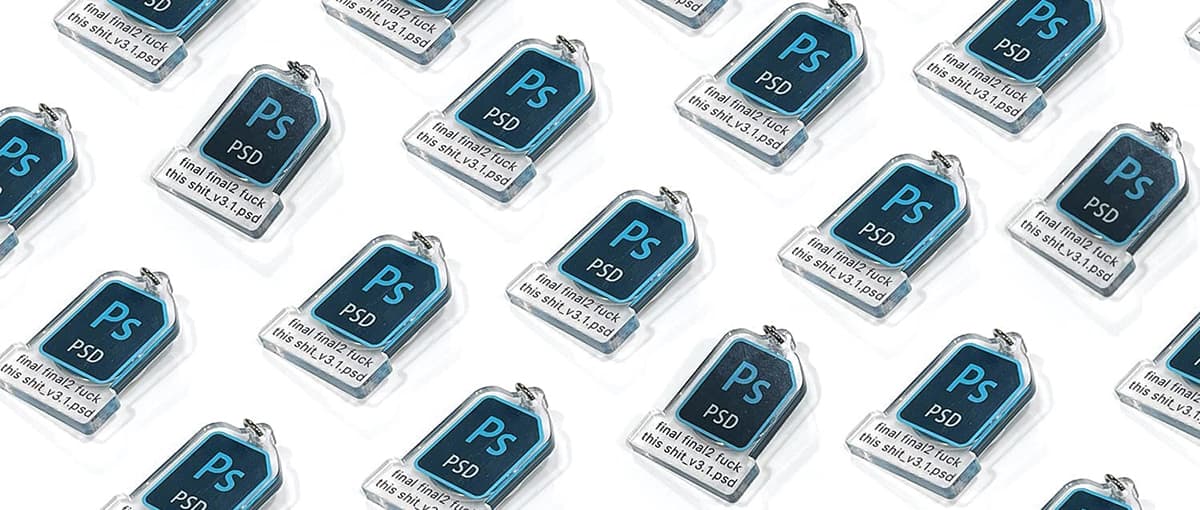
*Taken and created by us*
Against this backdrop, Figma was created as a service to solve various problems with existing products: Figma users always have access to the same design files, eliminating the need to temporarily copy design files to avoid conflicts caused by simultaneous editing by multiple users or to manage version control. This eliminates the need to make temporary copies of design files for version control and to avoid conflicts caused by multiple users editing at the same time. The combination of design, prototyping, file sharing, developer handoff, and other applications also eliminates the need to use different products to prototype screen transitions. As a result, as mentioned above, we have succeeded in evolving a design work tool that was a hurdle for non-designers into a collaboration tool for all project stakeholders.
In 2021, Figma is also releasing a second product, FigJam, a digital whiteboard to further accelerate team collaboration[^1]. However, it had too many functions such as pixel and layout settings for the preliminary stage such as organizing ideas or creating flowcharts. FigJam was created as an online whiteboard tool to facilitate more active meetings, given the background that remote work was increasing at Corona Disaster. FigJam is an online whiteboard tool for active whiteboarding. While the experience is different from the comfort and realism of face-to-face whiteboard brainstorming, it is also unique in that it features a full range of stickers and templates to enhance meetings. In this way, Figma consistently strives to create opportunities for designers and non-designers to cross boundaries.
## Future Possibilities for Figma
### Figma and design engineers
Figma, which has brought a breath of fresh air into a variety of fields, has also contributed to the development and success of design engineers, who straddle the boundaries between designers and engineers. Behind every web design and UI design that users see online is an architecture built on a variety of technologies, including front-end, system infrastructure, and workflow. The diverse and sophisticated technology behind the design is the part that is not paid much attention to (as the fox told the prince of the stars, what you see is very easy to understand).
As mentioned earlier, in many product development efforts, software development and design have been separated as separate processes. Until now, with the lack of a common language and tool barriers, it has often been dependent on the care and effort of individual designers and software engineers on the team to prevent specification omissions, communication errors, etc.
For more information on design engineers, please refer to [another article](https://route06.com/insights/4). To help solve problems at the intersection of design and engineering, Figma provides design engineers with the opportunity to prototype and design more smoothly. Figma provides design engineers with a number of features to facilitate the design process, including prototyping. In addition to making it easy to move the created screen as a mockup, Figma has been actively improving its products to bridge the gap between design and software implementation, including plug-ins for outputting CSS and JavaScript from design files. Figma continues to evolve as an excellent tool for the people who are the link between design and engineering, and will allow us to deliver products to users and validate ideas in a much faster span of time.
>"It might sound a bit silly, but I think computer programming is pretty much the closest thing we have to magic."
Referring to his upbringing in the "Harry Potter" series, Dylan said that programming and technology is akin to the challenge of Muggle magic, "I think it's a bit silly, but I think programming is pretty much the closest thing we have to magic. [^4]
### Figma and Enterprise
The collaboration that Figma generates is not limited to teams within the same company, but is active across the enterprise as well. The process of creating new digital products is no different in large traditional companies or start-ups. However, the former often face higher hurdles and take longer to adopt new SaaS and tools than start-ups. A certain level of security is essential for SaaS adoption in large companies, and it must be explainable to stakeholders.
In contrast, Figma is already SOC 2 Type 1 and Type 2 certified as of 2020, and has announced that it will invest in security to further strengthen the confidentiality of customer data stored in the cloud. The integration of the SAML SSO provider provides a secure environment for enterprise use, with support for quick URL sharing, secure and easy login without the need for dedicated applications, and user access control. In addition to the previously supported Okta, Microsoft Azure Active Directory, and OneLogin, the product now also supports Google SSO and Active Directory Federation Services (ADFS). [^9]
In terms of enterprise adoption, Adobe's acquisition of Figma is expected to help the Adobe brand expand its adoption among large enterprises. In terms of functionality, it is likely that many of the useful features that Adobe has been working on will be included in Figma.
### What is expected of the next generation of design tools
As a catalyst for complex productivity in design, Figma has facilitated the smart creation of complex interaction and animation prototypes, in addition to final design outputs and assets such as components, and the Figma community will continue to expand its reach beyond the platform. Outside of the platform, the collaborative network of everyone involved in the design process will continue to grow. In the author's personal opinion, although already a feature of the higher plans, we hope to see the branch function of GitHub and a diff management system like Sketch+Abstract enhanced in the standard plans as well [^10][^11]. Penbot is also starting to get attention as a new design tool[^12], and a TechCrunch article[^13] mentions a 5,600% jump in signups for the tool after the release of Adobe's acquisition of Figma, and a 400% increase in on-premise deployment. It can be inferred that designers, concerned about being boxed in by Adobe, are acting out of a desire for a more open and flexible collaboration tool.
The demand for collaborative and interoperable software tools like Figma is likely to grow in the future. Just as digital design tools have evolved from Adobe to Sketch and from Sketch to Figma, we can expect to see continued innovation and healthy competition in the industry. As Adobe breathes new life into the movement and new sensibilities that Dylan and Evan have established, Figma will continue to evolve as a better product, more robust and creative in its ties to design engineering and enterprise deployment.
[^1]:Forbes [How Figma Became Design's Hottest Startup, Valued At $10 Billion](https://www.forbes.com/sites/alexkonrad/2021/08/10/how-figma-became-designs-hottest-startup-valued-at-10billion/?sh=4442b9a9726e)
[^2]:Youtube / [Day 1 Closing Keynote - Designing the Biden-Harris campaign - Robyn Kanner (Config 2021)](https://youtu.be/W4f93LiSLIs)
[^3]:Yahoo! JAPAN Tech Blog / [PayPayフリマのデザインをスムーズにするためのFigma運用フロー](https://techblog.yahoo.co.jp/entry/2021080230170781/)
[^4]:BROWN DAILY HERALD / [CS undergrad wins tech fellowship](https://www.browndailyherald.com/article/2012/09/cs-undergrad-wins-tech-fellowship)
[^5]:kwokchain / [Why Figma Wins](https://kwokchain.com/2020/06/19/why-figma-wins/)
[^6]:Tokyo official COVID-19 measure website [UIデザイン](https://www.figma.com/file/V7vt80p2gauhdgTZeVNbgj/UI%E3%83%87%E3%82%B6%E3%82%A4%E3%83%B3?node-id=657%3A788)
[^7]:Adobe.com / [オフィス印刷と商業印刷向けソリューションを提供する最高クラスのRIPテクノロジー](https://www.adobe.com/jp/products/postscript.html)
[^8]:Adobe.com / [Welcome to Adobe's Printing Solution!
[^9]:Figma.com / [Welcome to Adobe's Printing Solution!](https://www.adobe.com/jp/print/postscript/pdfs/welcmps2.pdf)
[^10]:Figma.com / [Keeping your data in Figma safe and secure: SOC 2 Type 2, SSO, and more](https://www.figma.com/ja/blog/keeping-your-data-in-figma-safe-and-secure/)
[^11]:Figma.com / [規模に応じたデザインプラットフォーム](https://www.figma.com/ja/enterprise/)
[^12]:businesswire / [Guide to branching](https://help.figma.com/hc/en-us/articles/360063144053-Guide-to-branching)
[^13]:TechCrunch / [Penpot Raises $8M to Keep Designers and Developers in Sync While They Build Beautiful Products](https://www.businesswire.com/news/home/20220927005980/en/Penpot-Raises-8M-to-Keep-Designers-and-Developers-in-Sync-While-They-Build-Beautiful-Products)
---
# How Digital Transformation is Accelerating Carbon Trading and Carbon Neutrality
URL: https://route06.com/insights/13
As climate change and weather disasters become more severe each year due to global warming, there is a growing focus on greenhouse gas reduction and carbon neutrality initiatives by companies and governments to achieve a decarbonized society.
Under the 2015 Paris Agreement, countries around the world agreed on a long-term goal of limiting global temperature increases to below 2°C by 2030. n response to the IPCC (Intergovernmental Panel on Climate Change) report, Europe, the United States, Japan, and other countries have set a goal of achieving carbon neutrality by 2050 to limit the temperature increase to 1.5°C. The movement toward the realization of a decarbonized society is accelerating worldwide. In Japan, the then Kan Cabinet declared in its policy speech in October 2020 that the country would achieve carbon neutrality by 2050, and indicated that it would focus its maximum efforts on realizing a green society.
Under such circumstances, carbon pricing and emissions trading, which impose a burden on greenhouse gas emissions, have been attracting attention as a method to achieve carbon neutrality. In September of this year, the Tokyo Stock Exchange and the Ministry of Economy, Trade and Industry (METI) launched a demonstration experiment for a carbon credit market, in which J-credits, which the government certifies as reductions from the introduction of renewable energy facilities and CO2 absorption through afforestation, are traded on the market. There are also reports that the government has begun making adjustments toward the full-scale introduction of carbon pricing in the 2030s.
In addition, as examples of companies such as Tesla Inc. (discussed below) making a profit from emissions trading have become prominent, not only major companies but also startups are becoming active in the market.
On the other hand, it is not easy to accurately understand the definitions and the overall picture of this field because there are many academic terms and similar terms (carbon neutral, carbon negative, carbon offset, carbon pricing, etc.), and because updates and new rules are frequently introduced. This article will provide an overview and specific examples of carbon pricing and emissions trading, as well as a discussion of green innovation expected in the future.
## What is Carbon Pricing?
Carbon pricing is a policy approach that encourages emitters to change their behavior by putting a price on carbon. There are various methods of carbon pricing depending on its application, and the following are typical examples [^1].
### Carbon Tax
This mechanism involves taxing CO2 emissions at a set rate by attaching a price to carbon as a tax base. In Japan, a type of carbon tax, the Global Warming Prevention Tax, has already been introduced to tax the use of fossil fuels such as oil, natural gas, and coal according to their CO2 emissions. However, the tax rate is very low, less than 1/10th that of the carbon tax introduced in Europe and other countries. This fall, the introduction of a carbon tax was considered for the 2023 tax reform, but was postponed in order to avoid a further increase in the burden on the public under the current high energy price environment[^2].
### Emissions Trading
This is a mechanism whereby each company sets its own CO2 emissions cap, and "emission credits" are traded between companies that exceed the cap and those that fall below it. The price of carbon emission credits is determined as a market price based on the supply and demand of "emission credits" (details to follow in the next chapter).
### Credit Trading
This involves converting the value of CO2 reductions into certificates that can be traded. In Japan, the Non-Fossil Value Trading, J-Credit System, and JCM (Bilateral Crediting Mechanism) are in operation, and credit trading is also being implemented in the private sector. Similar to the buying and selling of securitized financial instruments, the price of credits is determined by trading either on a negotiated basis or in the market.
### Carbon Border Adjustment Measures
The EU and the U.S. are currently in the process of introducing this system, which requires businesses to bear the CO2 price difference when importing products made in countries with lower CO2 prices. In the EU, which is the leader in this field, a proposal based on the price of emission allowances (EUA: European Union Allowance) under the EU-ETS (European Union Emission Trading System) is being considered[^3].
### Carbon Accounting
Carbon accounting is an initiative to calculate and aggregate the contribution of business activities to the emission or reduction of greenhouse gases. There is a lot of discussion about standardization of accounting standards, such as the GHG Protocol, an international standard, and PCAF, a carbon accounting partnership for financial institutions.
## Emissions Trading System and History
Within the aforementioned carbon pricing, systems and business models related to emissions trading have attracted particular attention. WWF Japan defines emissions trading as follows[^4].
> Emissions trading is a system in which the amount of greenhouse gases that can be emitted by each company, country, etc. is set in the form of emission allowances, and where emissions exceed the allowances, allowances can be purchased from other companies that have actually emitted less than the allowances, so that the emissions can be deemed to have been reduced. The system is called the "emissions cap and trade system". (The English name is "Emissions Trading," which can be translated as "emission rights trading," "emission permit trading," etc., but the meaning is the same.
Emissions trading can be broadly divided into two types of schemes: baseline and credit schemes and cap-and-trade schemes. The baseline and credit system is based on the concept of trading the difference (credits) between the emission reductions achieved by companies through energy conservation and decarbonization efforts and the assumed emissions if these efforts were not implemented (baseline)[^5]. The baseline and credit method is also used in J-credits.
In the cap-and-trade system, the government sets a cap on emissions for companies, and these 'allowances' can be traded among them. Companies whose emissions exceed their allotted caps can purchase the rights to any surplus emission allowances from other companies that have allowances to spare. Companies with high emissions can actively reduce their emissions to cut costs, while companies that have enough allowances can use more renewable energy and install energy-saving equipment to earn profits, thus providing incentives for both parties to reduce greenhouse gases. A typical example is the EU-ETS.
The Emissions Trading Scheme (ETS) was first introduced in the EU in 2005. In China, the world's largest emitter of greenhouse gases (accounting for 28% of global CO2 emissions), the system was introduced in 2013 in some provinces and states, including Beijing and Shanghai, and was later launched on a national level in July 2021. In Japan, the system has been introduced at the prefectural level in Tokyo, Saitama, and other prefectures. According to the World Bank, emissions trading schemes have been introduced in about 30 countries around the world, including Japan [^6].
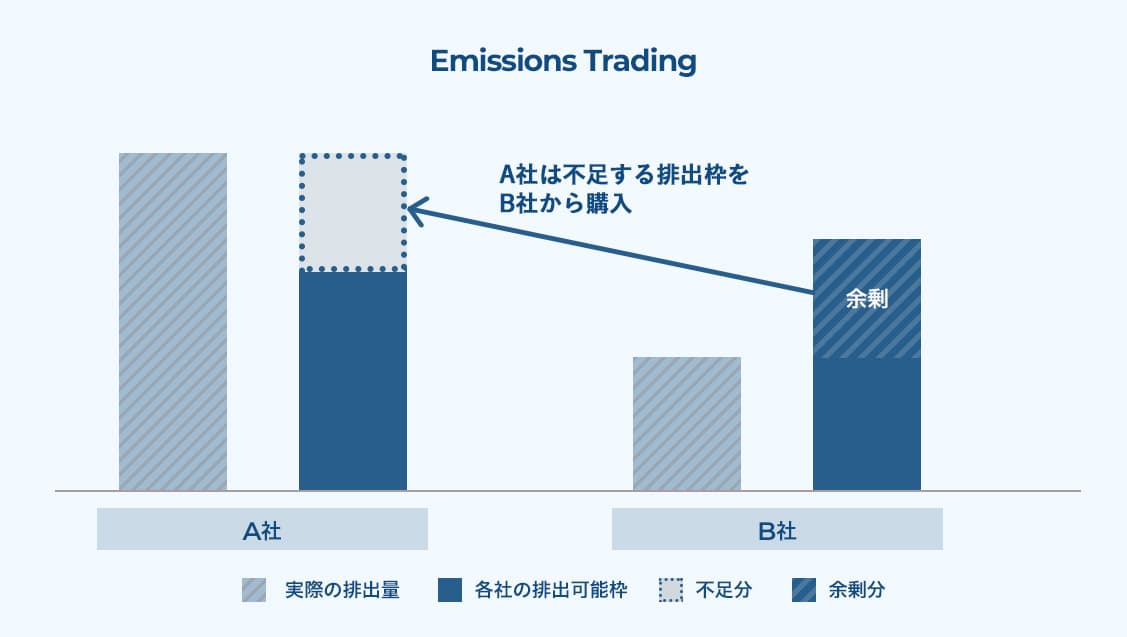
## Market trading of J-credits
In September 2022, Japan Exchange Group and the Ministry of Economy, Trade, and Industry (METI) launched a demonstration experiment for market trading of J-credits, as mentioned earlier in this article. Until now, J-credit trading has been criticized for its lack of price visibility due to the fact that it was based on relative trading, but this experiment aims to make transactions transparent through market participants. As a result, it is expected to increase the number of market participants and encourage companies to reduce their greenhouse gas emissions.
On the other hand, the current market has some liquidity issues in terms of the number of participants and trading volume. Since participation in the current demonstration experiment is voluntary, the number of participating players is limited (as of September, approximately 145 companies and municipalities, mainly large corporations, were participating). The transaction amount on September 22, the first day of the experiment, was a small amount of approximately 1.7 million yen, and expanding the scale of transactions in the market is also an issue for the future[^7]. Some have pointed out that, because emission reductions in Japan are currently voluntary targets, there is insufficient incentive for companies to actively reduce their emissions. The government has indicated that it will study the possibility of introducing a European-style system that would require individual companies to set emission quotas and reduce their emissions.
In fact, in the EU, which accounts for about 90% of the world's emissions trading, companies in target industries are required to participate in the Emissions Trading Scheme (EU-ETS). Since companies are fined if they exceed the pre-approved emission levels, companies that are short of reductions are forced to purchase emission allowances on the market, resulting in active market trading (trading value in 2021 was 682.5 billion euros (approximately 97 trillion yen)) and high emission reduction effects[^7]. The successful attraction of investment money is another reason why emissions trading is growing in the EU. Futures and options trading of emission allowances exist, hedge funds and other players are participating in market trading, and listed investment trusts have appeared, showing the development of emission allowance trading as a financial product[^8]. Although it has been pointed out that the inflow of investment money has the side effect of causing volatility in the price of emission credits and adversely affecting the carbon reduction strategies and efforts of companies, the market has gained depth by having a variety of participants trading in the market, thereby encouraging companies to actively reduce their emissions.
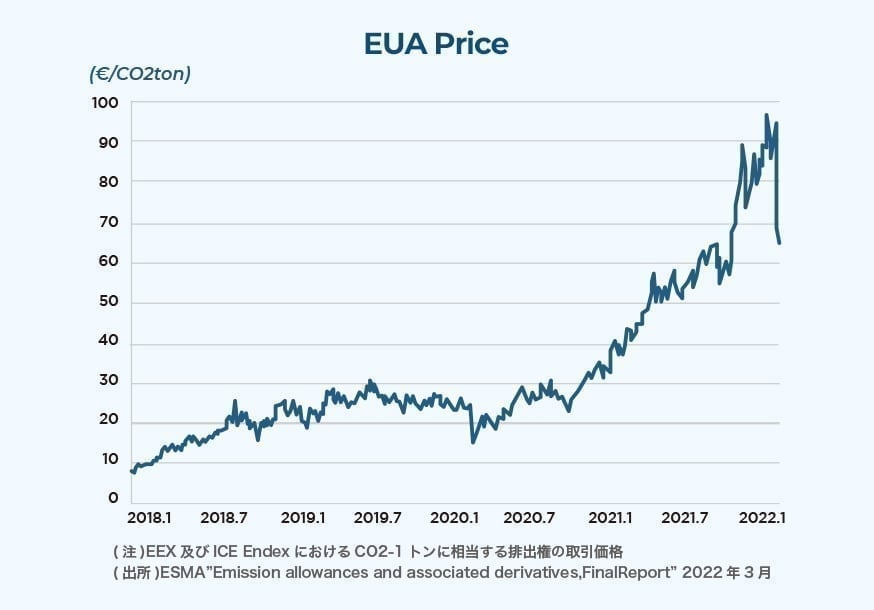
While it is important to create a market that leads to a decarbonized society by encouraging as many companies and investors as possible to participate in Japan's emissions trading, which is expected to be fully implemented in the future, it is often pointed out that Japan is already lagging behind other developed countries in its efforts to introduce such a market, and that it is necessary to move forward with a sense of urgency. It is therefore imperative to move forward with a sense of urgency.
## Carbon credits support Tesla's profitability
A well-known example of the use of emission credits is Tesla, a U.S. manufacturer specializing in electric vehicles (EVs).
In regions such as the EU and the state of California in the U.S., emission regulations are imposed on automakers, such as requiring a certain percentage of zero-emission vehicles (ZEVs)[^9]. However, because development and mass production require a considerable amount of investment and time, it was inevitable that the target values would not be met and fines would have to be paid. Under these circumstances, Tesla seized the business opportunity. Since all of Tesla's vehicles are EVs, Tesla is an important and valuable seller of emission credits, and automakers such as Fiat Chrysler Automobiles (FCA) formed an open pool with Tesla (an alliance of automakers working together to reduce CO2 emissions) to purchase the company's emission credits held by Tesla for a fee in order to meet targets and avoid paying fines. Under current accounting standards, credit revenue is generally reported as profit since it incurs no cost of sales.
Tesla 10-K: Automotive Regulatory Credits[^10].
> We earn tradable credits in the operation of our business under various regulations related to zero-emission vehicles ("ZEVs We sell these credits to other regulated entities who can use the credits to comply with Sales of these credits are recognized within automotive regulatory credits revenue in our Consolidated financial statements included elsewhere in this Annual Report on Form 10-K
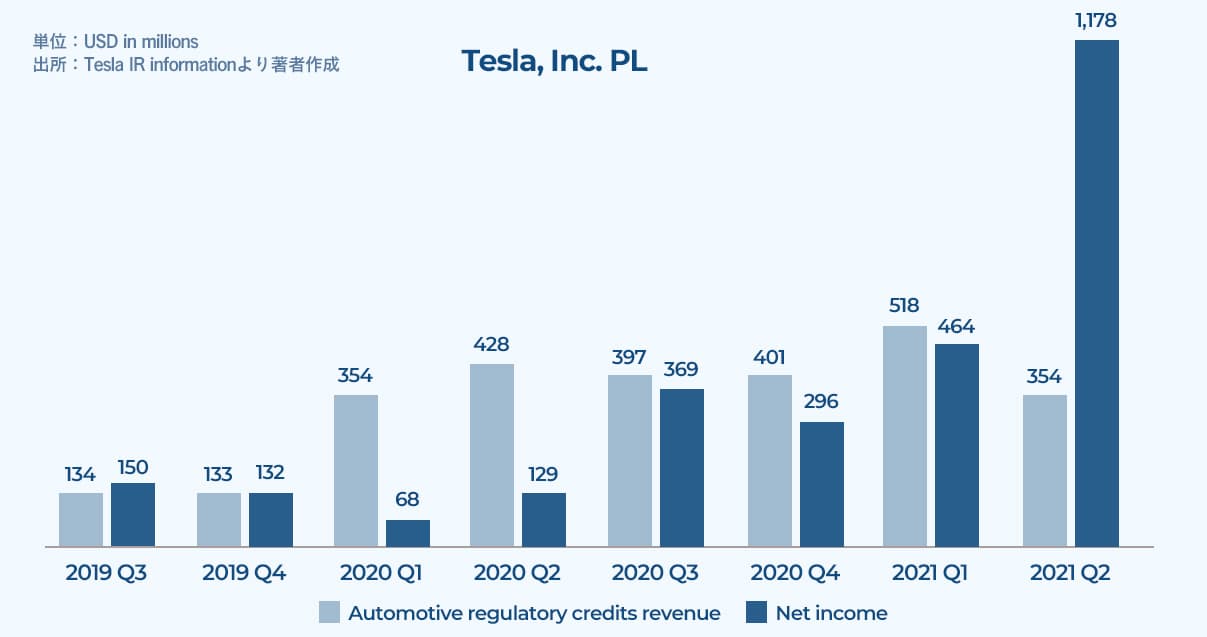
Under current accounting standards, credit revenue has no cost of sales, so the same amount of revenue is generally reported as profit. As the graph above shows, from the fourth quarter of 2019 through the first quarter of 2021, credit revenues have exceeded net income. This indicates that Tesla in the past few quarters could have been in the red if not for the credit income.
CNBC: Tesla's sale of environmental credits help drive profitability[^11]
> Without zero-emission vehicles (ZEVs) and other regulatory credits, Tesla would not have been able to report four consecutive quarters of GAAP profitability, a milestone it reported Wednesday that meets the qualifications for Tesla to join the S&P 500.
FCA and others are said to have purchased tens of billions of yen in emission credits from Tesla at times, and there is no doubt that this was a major cost pressure factor. It is not a good business strategy for automakers to purchase credits from EV-specialized manufacturers, which pose a threat to their own companies in the future, and this is thought to have provided an incentive for automakers to desperately increase production of EVs with low CO2 emissions.
Compared to the pre-2021 period, the current accelerated introduction of EVs, especially by European automakers, is now seeing their own efforts to meet environmental standards, and the benefit of the credit income Tesla has received so far seems to be decreasing. In fact, the company has acknowledged a gradual decrease in credit revenues (Automotive regulatory credits revenue) from $679 million in the first quarter of 2022, down to $286 million in the third quarter of 2022[^ 12][^13]. However, the company's success in using credit revenues to weather the loss phase and alleviate the increasing pressure from shareholders may be a successful example of carbon finance.
## Carbon neutrality driven by climate tech
To solve the extremely large worldwide challenge of achieving carbon neutrality and protecting the future of the earth for future generations, government-led carbon pricing and emissions trading schemes such as those introduced so far are not expected to be sufficient. Against this backdrop, in addition to the growing sustainability and ethical awareness of individuals and the active engagement of prominent business leaders such as Bill Gates in the environmental field, in recent years we have seen many examples of start-ups using innovative technologies and innovations to solve this challenge. Trends in the financial markets are also driving carbon neutrality efforts. Institutional investors nowadays are focusing on the concept of ESG investment, in which they select companies that take into account the three aspects of "environment," "society," and "corporate governance. There are also many examples of major companies collaborating with start-ups and creating innovations and new businesses in a wide range of fields, such as power generation, manufacturing, transportation, and agriculture. Climate tech is now considered one of the most attractive areas for innovation and investment.
This chapter introduces some of the areas of particular interest for the realization of carbon neutrality.
#### Visualization and Management of Greenhouse Gas Emissions
The need to visualize and manage greenhouse gas emissions, including supply chain emissions, is increasing, as companies are increasingly required to disclose the greenhouse gas emissions of not only themselves, but also their supply chain and customers in the near future. Sustainability Standards Board (ISSB), which is responsible for setting standards at the IFRS Foundation, made headlines in October 2022 when it included Scope 3 emissions (e.g., supply chain and customer use of products) in the disclosure requirements it is currently considering for companies. Regulatory authorities in major developed countries such as Europe, the U.K., and the U.S. are preparing the content of disclosure requirements for companies, and there are reports that the above policy by the ISSB may have a significant impact [^14]. In Japan, the Tokyo Stock Exchange (TSE) is requiring prime listed companies to disclose information based on the TCFD (Task Force on Climate-related Financial Disclosure) recommendations in its draft revised Corporate Governance Code, and is also considering making disclosure mandatory for all listed companies[^15]. and Scope 2, while the TCFD recommendation only recommends enhanced disclosure of Scope 3.
It is not easy to understand the amount of greenhouse gas emissions in the supply chain. Many companies that are currently engaged in Scope 3 disclosure ask their suppliers to collect GHG emissions data or collect the data themselves, but there are many problems, such as the heavy burden of responding to surveys from suppliers and the lack of timely reflection of each company's reduction efforts[^16]. In response to these needs, we have been working to develop a system that can be used for the entire supply chain.] In response to these needs, a number of startups have emerged that provide services for collecting, calculating, visualizing, and centrally managing greenhouse gas emissions throughout the supply chain through API and data linkage. Considering the increasing number of companies that will be involved in disclosure in the future, further increase in demand is expected. It is also my impression that many players are using this type of visualization service as an entry point to develop services such as emissions reduction consulting and offsetting using credits.
One of the leading players is Patch Technologies, a U.S. startup that develops APIs for carbon offsetting. Patch Technologies calculates and visualizes emissions from corporate activities based on data such as electricity consumption, air and car travel, and credit card usage history, and provides carbon credits to offset emissions. By incorporating the company's code, companies can track and calculate their own emissions from employee business flights and travel, and purchase and manage carbon credits to offset carbon emissions. [^17]
#### carbon-offset matching platform
An area of interest among various climate change businesses is carbon offset matching platforms. Carbon offsetting is the concept of indirectly absorbing CO2 and other greenhouse gas emissions from a specific location, event, or project by investing in activities that contribute to greenhouse gas reduction, even if the emissions cannot necessarily be reduced within the related company or community alone.
The matching platform lists a variety of offset projects, including reforestation and conservation projects and CO2 capture technologies around the world. Companies can purchase credits created by projects that match their own in order to offset greenhouse gases that they cannot reduce through their own efforts alone. However, the reliability of such offset projects and the fact that many reforestation projects are invested through intermediaries makes project credibility uncertain, carbon credits are double counted and sold, and there is no established method for verifying forest growth and CO2 absorption. How to ensure the validity and accuracy of carbon credits has been said to be a major challenge [^18].
In this context, the U.S. startup Pachama, which operates a marketplace for forest-based carbon offsets, is showing promise. Despite only being in its first year of operation, Pachama has received funding from several investors, including prominent executives such as Microsoft founder Bill Gates (Breakthrough Energy Ventures) and Amazon founder Jeff Bezos (Climate Pledge Fund). The company is a highly regarded startup that has raised a total of $15 million from several investors, including prominent executives such as Microsoft founder Bill Gates (Breakthrough Energy Ventures) and Amazon founder Jeff Bezos (Climate Pledge Fund).
Introducing Pachama Originals, the Next Generation of Nature-Based Projects[^20].
> We started Pachama with the mission of restoring nature to solve climate change, harnessing the latest advancements in satellite data and machine learning to ensure the quality of nature-based projects. With Pachama Originals, you can invest in your very own high-quality forest With Pachama Originals, you can invest in your very own high-quality forest projects from the ground up, secure credits to reach Net Zero, and make a transformative impact on communities and ecosystems for generations to come. Pachama Originals enables real climate leaders to Go Beyond.
Pachama Originals is a technology company that not only operates a marketplace, but also provides a solution to calculate and verify how much CO2 is actually captured in the forests that qualify for carbon credits by using proprietary machine learning to analyze 3D data from sanitary images and drones. Pachama's services contribute significantly to ensuring the credibility and effectiveness of projects [^18]. Restoring and preserving the world's forests is one of the simplest and most effective ways to reduce greenhouse gases in the atmosphere, and Pachama is one of the startups to watch as a leader in this effort. The visionary, impactful, and socially-driven aspects of Pachama's business have attracted talent from global tech companies like Google, Meta, SpaceX, Tesla, and Microsoft. Major companies like Microsoft and Shopify have also become clients. The company is expected to continue to grow in the future[^19].

## Conclusion
This article has provided an overview and specific examples of carbon pricing and emissions trading to realize a decarbonized society. Although there are still issues to be addressed in terms of legal regulations and accounting and taxation in Japan and abroad, it is expected that governments, major companies, and start-ups around the world will accelerate their efforts toward carbon neutrality. We hope that this article will help those who are considering business in related fields to organize their arguments and consider their strategies.
[^1]: Office of Environmental Economics, Industrial Science and Technology Policy and Environment Bureau, Ministry of Economy, Trade and Industry / [J-クレジット制度の概要と最新動向](https://www.kyushu.meti.go.jp/seisaku/recycle/oshirase/220304_1_3.pdf)
[^2]: Nihon Keizai Shimbun / [炭素税導入先送り、23年度税制改正 エネ高騰で](https://www.nikkei.com/article/DGXZQOUA046FT0U2A101C2000000/)
[^3]: JETRO / [炭素国境調整に向けて動き出した米国とEU](https://www.jetro.go.jp/biz/areareports/special/2021/0801/a4aea1715b01718d.html)
[^4]: WWF Japan / [温室効果ガス排出量取引/入門編](https://www.wwf.or.jp/activities/basicinfo/1138.html)
[^5]: National Diet Library ISSUE BRIEF NUMBER 616 / [排出量取引をめぐる動向](https://dl.ndl.go.jp/view/download/digidepo_1000575_po_0616.pdf?contentNo=1)
[^6]: JETRO / [世界で導入が進むカーボンプライシング(前編)炭素税、排出量取引制度の現状](https://www.jetro.go.jp/biz/areareports/special/2021/0401/946f663521dac9af.html)
[^7]: Nihon Keizai Shimbun / [東証、排出量取引で実験 初日売買170万円](https://www.nikkei.com/article/DGXZQOUB201GP0Q2A920C2000000/)
[^8]: Nihon Keizai Shimbun / [排出量取引とは 温暖化ガス削減へ企業間で排出枠売買](https://www.nikkei.com/article/DGXZQODB243T30U1A320C2000000/)
[^9]: nikkei4946.com / [排出枠 きょうのことばセレクション](https://www.nikkei4946.com/knowledgebank/selection/detail.aspx?value=1728)
[^10]: TESLA, Inc. / [ANNUAL REPORT ON FORM 10-K FOR THE YEAR ENDED DECEMBER 31, 2021](https://www.sec.gov/Archives/edgar/data/1318605/000095017022000796/tsla-20211231.htm)
[^11]: CNBC / [Tesla's sale of environmental credits help drive to profitability](https://www.cnbc.com/2020/07/23/teslas-sale-of-environmental-credits-help-drive-to-profitability.html)
[^12]: TESLA, Inc / [IR Information](https://ir.tesla.com/#quarterly-disclosure)
[^13]: Bloomberg / [テスラ、温暖化ガス排出枠の販売先を失う-業績への打撃必至](https://www.bloomberg.co.jp/news/articles/2021-05-05/QSMSY5T1UM1101)
[^14]: ESG Journal / [ISSB、IFRSの気候変動開示基準にスコープ3排出量が含まれることを確認](https://esgjournaljapan.com/world-news/22121)
[^15]: Genesia Ventures / [ESG金融と非財務情報開示の動向](https://www.genesiaventures.com/trends-in-esg-finance-and-non-financial-information-disclosure/)
[^16]: Nomura Research Institute, Ltd. / [野村総合研究所、サプライチェーンにおける温室効果ガスの排出量把握を支援するカーボントレーシングシステムを開発](https://www.nri.com/jp/news/info/cc/lst/2021/1215_1)
[^17]: Chizai Zukan / [企業から個人まで、誰でもカーボンオフセットができるAPIサービス Patch(パッチ)](https://chizaizukan.com/property/604/)
[^18]: GMO Payment Gateway, Inc. / [持続可能な社会の実現に向けた「脱炭素テック企業」の3つのトレンド](https://www.gmo-pg.com/blog/articles/article-0065/)
[^19]: TechCrunch / [As concerns rise over forest carbon offsets, Pachama's verified offset marketplace gets $15 million](https://techcrunch.com/2021/04/30/as-concerns-rise-over-forest-carbon-offsets-pachamas-verified-offset-marketplace-gets-15-million/)
[^20]: Pachama, Inc / [Introducing Pachama Originals, the Next Generation of Nature-Based Projects](https://pachama.com/originals/)
---
# Agile Development in Large Enterprises: Key Considerations for Implementation
URL: https://route06.com/insights/14
As the software environment evolves, so do the needs it addresses. If development proceeds strictly according to an initial plan, without adapting to changes, the final product may be outdated by the time it is released.In recent years, maintaining high development agility has become a critical competitive advantage. Agile methodologies, including Squad, LeSS, and SAFe, are increasingly emphasizing scalability to meet this demand. Given these dynamics, the primary approach to software development is shifting from the traditional waterfall model to agile methodologies. This article focuses on agile development and its implementation in major companies, and explains the key points.
## What is Agile Development?
To understand agile development better, it's helpful to compare it with the traditional waterfall model. The three key variables in the development process are time, resources, and development requirements.
In waterfall development, the development requirements are fixed, and in order to realize those requirements, the necessary assignments are made and a schedule is drawn to proceed with development. In other words, the approach focuses on the completion of development and strictly follows project management. On the other hand, in agile development, a certain amount of time and resources are secured for function development and iterations, and the development is carried out while considering what should be developed within that range. Therefore, we do not draw up a medium- to long-term development plan, but rather decide what to develop and evolve the software in each development unit (mainly from one week to one month), which is called a sprint, in order to realize the product vision.
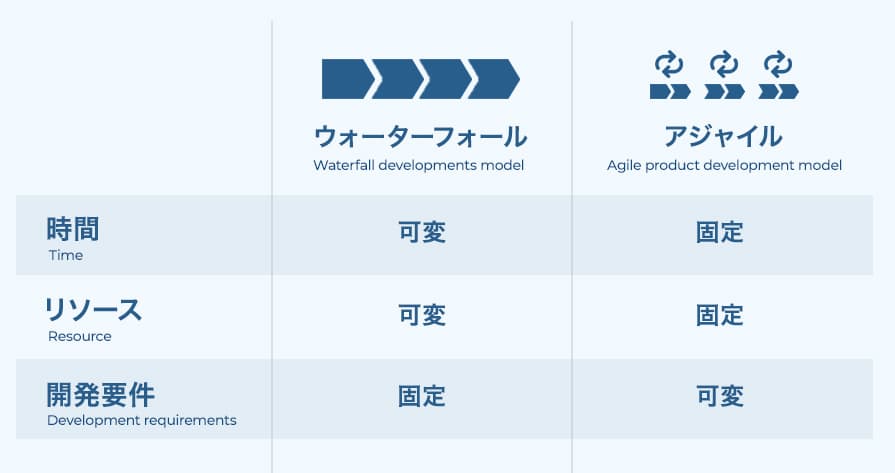
*Comparing Waterfall and Agile Development*
Looking at the above comparison alone, it is easy to see agile development as more advantageous because it is more flexible, but this is not always the case. However, this is not always the case. Waterfall development is suitable if it is not affected by changes in the environment, and if it can be planned in advance and developed with a large amount of time and resources. On the other hand, if you have not yet found the right answer, and you are evolving your product as you search for it, agile development, which sets certain resource and time limits to get closer to the right answer, is more compatible.
## Adoption of agile development in a major company
In general, large companies often have IR and budgeting constraints, so they need to create a detailed business plan and operate their business according to that plan. In Japan, product development is rarely done in-house with engineers, and there is a strong tendency for companies to define requirements in-house and then outsource development. Because of this background, waterfall development, in which plans are made in advance and then implemented, seems to be adopted in many cases.
So, should major companies also adopt agile development? Certainly, waterfall development is suitable for core businesses that major companies have been refining for several decades because of its high predictability.
On the other hand, how about new businesses? Although new businesses are developed in peripheral areas where synergies with core businesses are likely to be generated, the resolution of these businesses is inferior to that of core businesses. In addition, compared to core businesses that are already profitable, most start-up businesses require minimal time and resources. Therefore, agile development is a more appropriate choice because it is more flexible to uncertainties and requires exploration and software development within a certain amount of time and resources.
## Points to consider when introducing Agile development
Waterfall development, which is a strong point of major companies, and agile development clearly differ in their main concepts and goals to be realized. Therefore, simply introducing the framework of agile development will not penetrate the essence of agile development. Here, we summarize and explain five key points for introducing agile development in major companies.
### 1. Management Commitment
Transitioning from waterfall development to agile development is an effort that will drastically change the way you think about development. Therefore, the commitment of the management team is essential from the pilot stage. The first step toward success is to clarify what you want to achieve through agile development, and to ensure that not only the members of the team, but also the management team in charge of the project, understands and is committed to the project.
### 2. Minimize Members and Make Them Dedicated
As an organization grows, specialization increases and organizational silos develop. In such an organization, the number of people involved in any given project increases, forcing a huge amount of project management. On the other hand, in agile development, the principle is to minimize the number of members required for each development project and assign them to dedicated tasks. In other words, by assembling a small, dedicated team, information gaps can be eliminated and development efficiency can be improved.
While this may be a contrary philosophy to the existing organizational design for large companies, it is a path that cannot be avoided by minimizing the number of members and making them dedicated to their work, by introducing it on a pilot basis.
### 3. Simplify Decision-making Flow
As an organization grows, not only does it become more siloed, but the hierarchy also becomes more heavy-handed, and the decision-making flow becomes more complex. If this flow remains complex, even if agile development is introduced, it will not be able to respond to changes in the environment, which is the original purpose of agile development. It is important to ensure that decision making is completed within the basic team and to guarantee the autonomy of the team. Even when dealing with issues that cross teams, the escalation flow from the product owner should be established in as simplified a form as possible.
### 4. Agile Development is Something You Build Up
Agile development is a framework for turning development around, but while adhering to the principles, one of the goals is for the team to gradually customize the planning, retroprospecting, and other processes to suit their own needs. Therefore, it is not the end of the story to introduce agile development according to the textbook. Success can only be achieved by evolving it into a form of agile development that suits each company or team, and by making the concept permeate the entire organization.
### 5. Agile Development is Not a Panacea
As we saw in the comparison with waterfall development, waterfall development may be more suitable than agile development for some projects. At times, agile development is used as an excuse to shelve the unforeseeable and proceed with development without planning. Therefore, not all development should be agile. Rather, depending on the project, waterfall development (planning, securing a budget, making full use of outsourcing, and proceeding with development on time), which has been a strength of major companies, may live on.
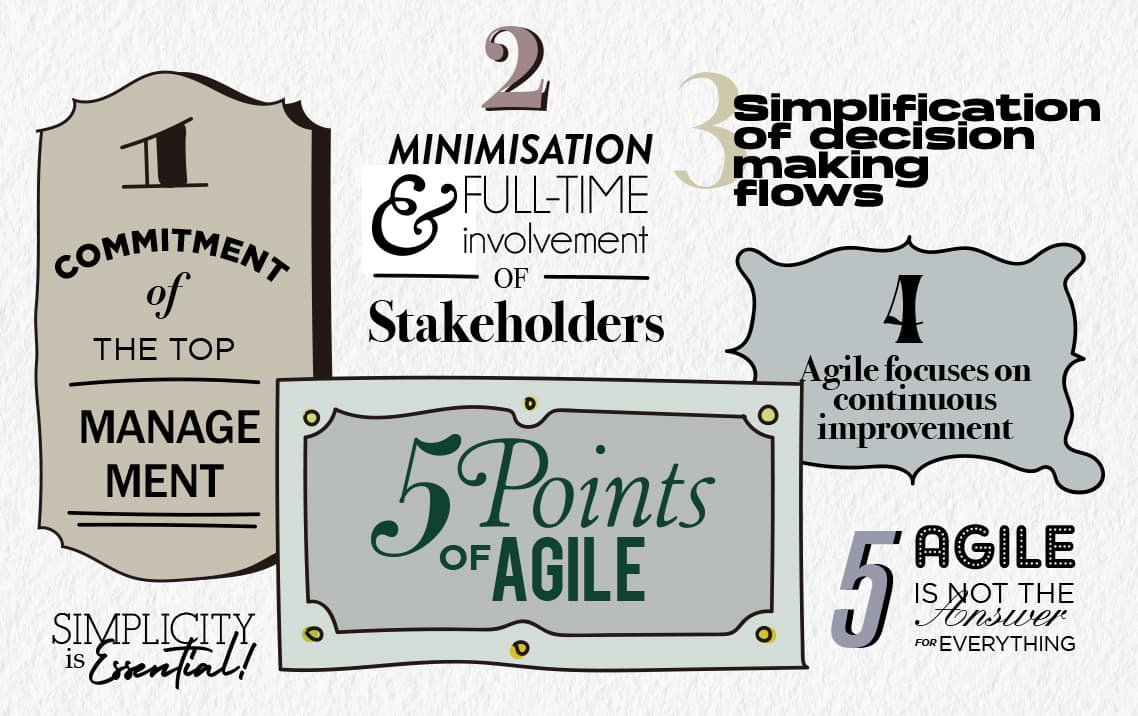
## Summary
The environment for promoting software development and DX is rapidly changing, so it is essential to utilize agile development. Large companies should consider introducing agile development on a pilot basis, starting with projects that have a high affinity with agile development, such as new businesses, rather than suddenly shifting to agile development for all projects. Since the transition from waterfall development to agile development involves a major change in thinking, it is important for top leadership to take the lead in firmly identifying the essence of agile and installing not only the framework but also its thinking in the organization. However, agile development is not a panacea, and waterfall development is not inferior to agile development.
#### References
- Linkedin/ [Agile's Big Problems in Big Companies](https://www.linkedin.com/pulse/agiles-big-problems-companies-paul-o-connor/)
- signature / [Top Agile Pitfalls & Why Agile Fails in Large Enterprises](https://www.sigconsult.com/blog/2019/12/why-agile-fails-in-large-enterprises-and-how-your-team-can-avoid-the-same-fate)
- TechBeacon / [10 companies killing it at scaling agile](https://techbeacon.com/app-dev-testing/10-companies-killing-it-scaling-agile)
- Mckinsey&Company / [How to mess up your agile transformation in seven easy (mis)steps](https://www.mckinsey.com/capabilities/people-and-organizational-performance/our-insights/how-to-mess-up-your-agile-transformation-in-seven-easy-missteps)
- Shoei/ [ALL for SaaS SaaS立ち上げのすべて](https://amzn.asia/d/fUBxwg6)
---
# Apollo GraphQL: The Expansion of Open Source Software and SaaS
URL: https://route06.com/insights/15
In recent years, a variety and large volume of data processing has become common in the operation of products such as web services and mobile applications, not only in large companies but also in startup companies that have just been established. Thanks to advancements in technology, particularly cloud computing, it is now possible to develop and operate web services that handle large volumes of data—such as video and voice—and applications requiring real-time responses and integration with multiple IoT devices, all without the need for specialized system construction or a dedicated team. This is becoming possible.
With the rise of communication technologies and standards like 5G, the volume of data processed has significantly increased. This has also accelerated opportunities to handle new types of data, such as personal data and health logs, via microdevices at high speeds and frequencies on the web. The demand for API integration and efficient data fetching with various external services and system integration across departments and affiliated companies within a company continues to increase, and the need for efficient API access is crucial in enhancing user experiences. Software architecture is becoming more and more complex every year. In addition, the level of demand from users for quick response and stability is high, and the expression of user interfaces, such as dynamic components and personalization, is also becoming more sophisticated. The number of data processing issues, both front-end and back-end, and the solutions to address them, will continue to increase.
Given this context, this article introduces GraphQL, an open-source query language for Web APIs that has gained significant attention in recent years, along with Apollo Graph, a company that develops and operates an application platform built on GraphQL. When it comes to data processing technology, products and technologies of major tech companies such as Google, Amazon, and Microsoft tend to attract attention in general, but various open source software and related services such as Apollo GraphQL are used behind the scenes of all web services. Apollo GraphQL's advanced features, including schema stitching, make it a powerful tool for developers.
## What is GraphQL?
GraphQL is a powerful query language for APIs that provides a strongly typed schema, enabling more efficient and flexible data retrieval. Real-time subscriptions are one of the features that enhance the responsiveness of applications. Developed by Facebook in 2015, GraphQL has quickly become a widely adopted standard for building modern APIs. Unlike traditional REST APIs, GraphQL allows clients to specify exactly what data they need, reducing the amount of data transferred and improving overall performance. This precision in data fetching not only optimizes network usage but also enhances the responsiveness of applications, making it a preferred choice for developers handling complex data interactions, including error handling.
### GraphQL, a new query language for the Web API era
GraphQL is a Web API (Application Programming Interface) standard released by Facebook (now Meta) in 2015, and is used as an open-sourced query language in the development of web services and native applications worldwide It is used as an open-source query language in the development of web services and native applications around the world [1](https://route06.com/insights/15#user-content-fn-1). GraphQL defines schemas using a novel 'graph' concept, allowing data requests to be made to a web server declaratively, similar to SQL. Schema validation ensures data consistency, making it a reliable choice for developers. Compared to RESTful APIs, GraphQL offers better control over the frequency of HTTP requests, responses, and data volume, all through a single, simple endpoint (URI, URL, etc.). The design of multiple endpoints and methods is simple. Compared to the RESTful API, which emphasizes the design of multiple endpoints and methods, the client application developer has a clear learning curve and can be more agile in implementation. One of the advantages of using GraphQL relates to the number of HTTP requests that would be generated when trying to retrieve data of interest via the REST API. As an example, let's take product: you have a product ID and want to retrieve all product data. If we also want to retrieve the images, variants, and metafields for all products, we would have 4 unique HTTP calls. This is because in our REST, everything is a separate endpoint. This uses a tenth of our capacity, and with a recovery rate of 2 calls per second, it takes 2 seconds to recover.
Recent mobile applications often deal with large amounts of nested and interlinked data, and to improve system performance, the minimum amount of data required for a specific function (e.g., news feeds, posts, messages, etc.) module/domain must be referenced and GraphQL is a technology standard that has emerged from an era in which the implementation of functions and data processing on the client/front end of websites and native applications such as iOS/Andorid are becoming more diverse and faster, and in which microservices and API integration among various applications are required. GraphQL is a technology standard that was born from the background of the need for microservices and API integration between various applications, and has recently been adopted not only by Facebook (Meta), but also by other tech companies such as GitHub, Twitter, Shopify, Airbnb, Rakuten, Mercari, and large companies such as Walmart, Starbucks, and the New York Times, in addition to many others. Times, and other large companies, as well as in the development sites of startups around the world[1](https://route06.com/insights/15#user-content-fn-1)
On the other hand, GraphQL is a standard that emphasizes front-end developer experience, such as easy definition of necessary data structures on the client side, and is currently being used differently from REST according to the reliability of data between GraphQL servers and the characteristics of web applications. While it increases the flexibility of front-end implementations, it also has issues such as the complexity of back-end mechanisms such as GraphQL server design and node structures between graphs. To begin with, GraphQL is an open-source query language specification, and on the server side, it is necessary to build an environment in which queries are executed in the GraphQL runtime environment, and of course, security measures such as query request control and data caching mechanisms must be prepared separately. In recent years, Apollo and its development and operation company, Apollo Graph, have been attracting attention as an application platform that addresses such issues. GraphQL optimizes network usage and enhances the responsiveness of applications, helping engineering teams deliver GraphQL solutions at scale. Metrics reporting is another benefit, allowing teams to monitor and optimize API performance effectively.
## What is Apollo, the GraphQL client?
Apollo Graph is a software company that develops and manages a variety of applications designed to support client and server implementations of GraphQL. One of their products, Apollo Client (for front-end), provides various libraries for implementing UI and server data integration with GraphQL, and supports front-end languages such as React.js, Swift, and Kotlin. While GraphQL has issues such as the relative difficulty of caching by CDNs compared to REST APIs, Apollo Client provides functions to facilitate cache data integration and state management[6](https://route06.com/insights/15#user-content-fn-6). Apollo Graph also develops various applications related to GraphQL, including Apollo Server, a library and application for running GraphQL on a JavaScript server. Apollo Graph is a front-end developer's product that facilitates implementation in various languages and frameworks in the GraphQL environment, while server-side developers can build and manage the often complex GraphQL server, infrastructure, and other development environments in a secure and scalable manner. Additionally, the Apollo GraphOS platform enables engineering teams to effectively implement GraphQL at any scale, accelerating feature delivery and enhancing application development. Server-side developers can build and manage the often-complex GraphQL server, infrastructure, and other development environments in a secure and scalable manner. Explorer IDE is another tool provided by Apollo that enhances the development workflow, making it easier for developers to work with GraphQL.
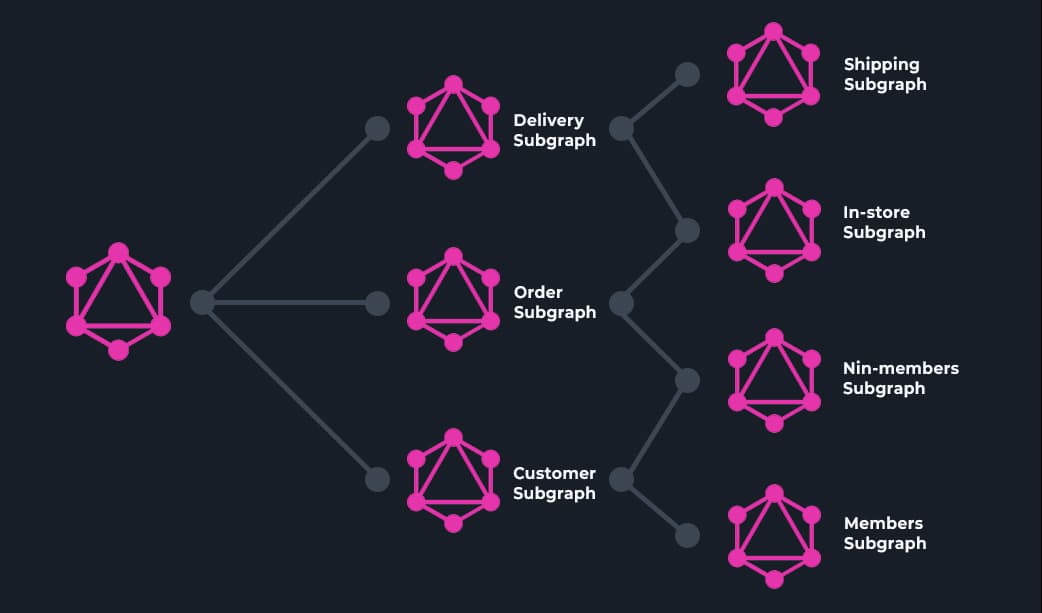
*Created by us based on the diagram in StepZen's "A New Architecture for APIs"*
Apollo Graph is an OSS (Open Source Software) development community, but also a unicorn company that is highly regarded by world-class venture capitalists such as Andreessen Horowitz [7](https://route06.com/insights/15#user-content-fn-7). Their products range from publicly available OSS to paid SaaS offerings, and in recent years, many software companies have adopted a similar business model. Apollo's open source library has grown to over 17 million downloads per month and over 6 billion queries executed daily as of August 2021. Apollo actively engages with the GraphQL community through events and collaborative efforts, fostering innovation and networking opportunities.
According to Apollo Graphics, the company has already been awarded the SOC 2 Type II security certification by Walmart and Starbucks. In 2020, Netflix is expected to adopt Apollo Federation, an architecture for integrated management of multiple GraphQL servers and domain development. In 2020, Netflix will adopt Apollo Federation, an architecture for managing multiple GraphQL servers and domain development,[8](https://route06.com/insights/15#user-content-fn-8) and Apollo products are currently being deployed by Expedia, PayPal, and other large, multi-channel digital service companies. "Apollo Federation will allow us to implement our existing schema linking in a safer, declarative manner, while opening up a whole new level of broader federation opportunities across the level of broader federation opportunities across the wider enterprise". Dan Boerner, Distinguished Product Manager at Expedia Group 9. Created by us based on the diagram in "Expedia Group Transforms Product Development with Apollo".
Walmart had already adopted a BFF (Backend For Frontend) architecture, which was already a microservice and front-end friendly development environment, but it took about 14 months from planning and research to migrate its e-commerce platform to a GraphQL architecture using Apollo. to a GraphQL architecture that leverages Apollo. According to their published materials, the result was the unification of multiple carts, search functions, etc. that had previously existed, highlighting the improved convenience for users as well as the developer experience[10](https://route06.com/insights/15#user-content-fn-10).
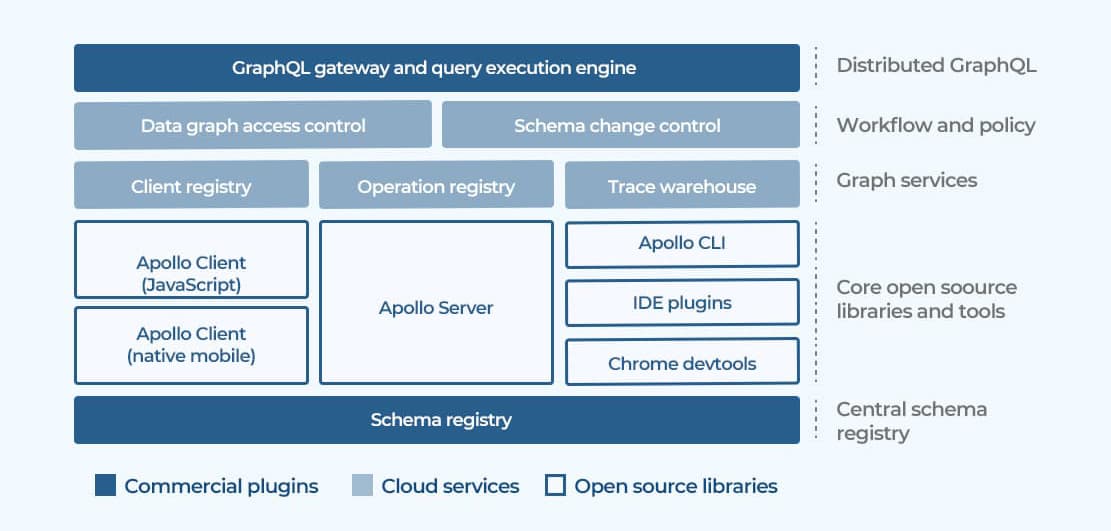
*Created by us based on the diagram in "The Apollo GraphQL platform" by Apollo Graph*
### Benefits of Using Apollo
Apollo stands out as a leading provider of GraphQL tools and libraries, offering numerous benefits for application development:
### Improved Performance
Apollo's advanced caching and optimization features significantly reduce latency, ensuring that your application runs smoothly and efficiently. Additionally, query request control enhances security by managing and validating incoming queries.
### Increased Flexibility
With Apollo's GraphQL client, you can effortlessly switch between different data sources and APIs, making it easier to integrate new features and services into your application. Data caching further improves performance by storing frequently accessed data for quicker retrieval.
### Enhanced Developer Experience
Apollo's suite of tools and libraries provides a seamless and intuitive experience for developers, simplifying the process of building and maintaining complex applications.
### Scalability
Designed to handle large volumes of traffic, Apollo's GraphQL server can scale to meet the demands of even the most extensive applications, ensuring robust performance under heavy loads.
## Apollo Solutions
Apollo offers a comprehensive range of solutions for building, managing, and scaling GraphQL APIs and applications:
### Apollo Client
A flexible and customizable GraphQL client for JavaScript and native platforms, enabling developers to fetch data efficiently and manage application state seamlessly.
### Apollo Server
A spec-compliant and production-ready GraphQL server for Node.js and other platforms, providing a robust foundation for your GraphQL API. It also supports schema stitching, allowing you to combine multiple schemas.
### Apollo GraphOS
A cloud platform that connects any GraphQL API, offering powerful features like metrics reporting, schema validation, and the Explorer IDE to enhance your development workflow. It also supports real-time subscriptions, enhancing data interaction.
### Apollo Federation
A configurable, high-performance routing runtime for building federated GraphQL APIs, allowing you to manage and scale multiple GraphQL services as a single cohesive graph.
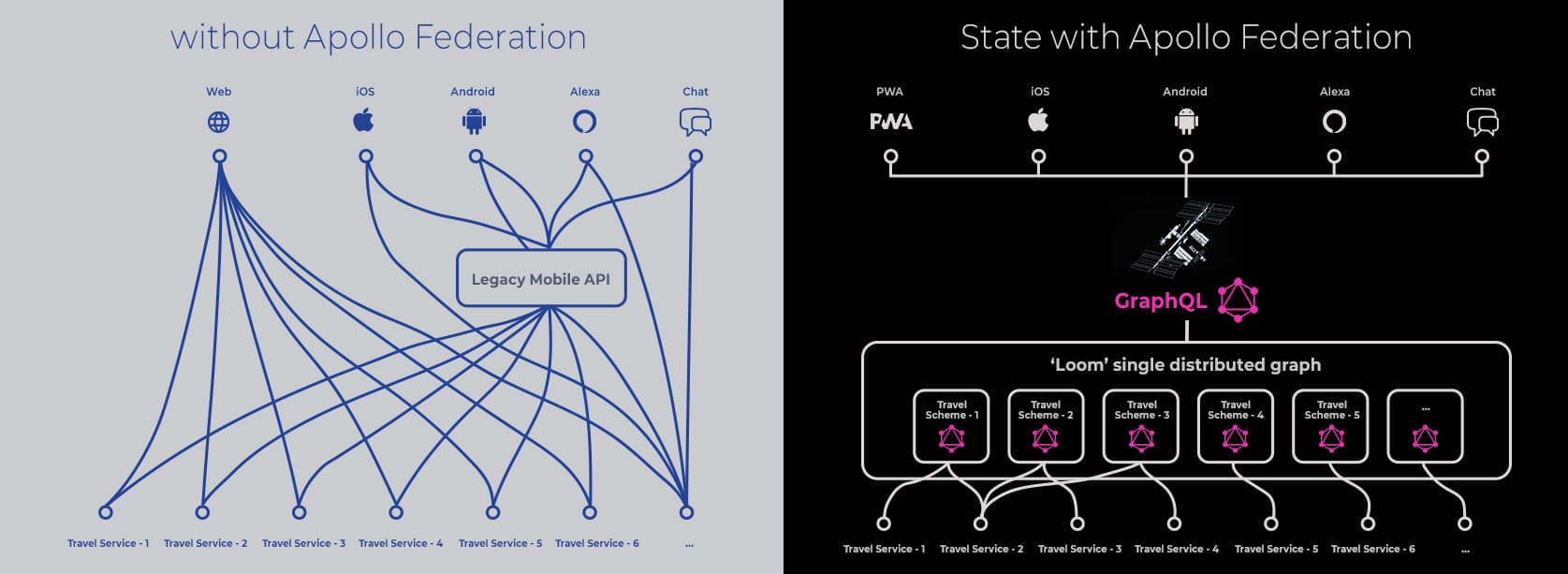
*Created by us based on the diagram in "Expedia Group Transforms Product Development with Apollo"*
> "Apollo Federation will allow us to implement our existing schema linking in a safer, declarative manner, while opening up a whole new level of broader federation opportunities across the level of broader federation opportunities across the wider enterprise". Dan Boerner, Distinguished Product Manager at Expedia Group [^9].
### Getting Started with Apollo
Getting started with Apollo is straightforward. Follow these steps to begin:
__1. Install Apollo Client or Server:__ Use npm or yarn to install the Apollo Client or Server in your project.
__2. Create a New GraphQL Schema:__ Define your data structure using the Apollo Schema Definition Language (SDL).
__3. Schema Validation:__ Ensure your GraphQL schema is correctly validated to prevent errors and maintain data integrity.
__4. Configure Apollo Client or Server:__ Set up the Apollo Client or Server to connect to your GraphQL API, ensuring seamless data fetching and state management.
__5. Metrics Reporting:__ Implement metrics reporting to monitor the performance of your Apollo setup and optimize as needed.
__6. Start Building Your Application:__ Leverage the Apollo Client or Server to build your application, taking advantage of Apollo's powerful features to enhance performance and scalability.
### Features of Apollo
Apollo offers a range of features that make it an ideal choice for building and managing GraphQL APIs and applications:
__Caching:__ Apollo's caching capabilities reduce latency and improve performance by storing frequently accessed data in memory, ensuring quick data retrieval.
__Optimization:__ Apollo's optimization features minimize the amount of data transferred, enhancing performance by optimizing queries and mutations.
__Security:__ Apollo's robust security features protect your GraphQL API from unauthorized access and malicious attacks, ensuring data integrity and privacy. Apollo also meets the __SOC 2 Type II__ certification standard, providing an additional layer of security assurance.
__Scalability:__ Apollo's scalability features enable your application to handle large volumes of traffic, allowing it to grow and meet the needs of even the largest user bases.
__Explorer IDE:__ Apollo includes the __Explorer IDE__, a powerful tool for exploring and testing queries, making it easier for developers to work with GraphQL APIs.
By integrating these sections, the article will provide a comprehensive overview of GraphQL and Apollo, highlighting their benefits, solutions, and features, while maintaining a consistent tone and style.
### GraphQL Server: The Heart of Your GraphQL API
A GraphQL server is the backbone of any GraphQL API, responsible for processing incoming queries and mutations, and delivering the requested data to the client. The efficiency and reliability of your GraphQL server directly impact the performance and scalability of your API. Apollo GraphQL offers a suite of tools and libraries designed to help developers build, manage, and scale robust GraphQL servers. Among these, Apollo Server stands out as a spec-compliant and production-ready JavaScript GraphQL server. It provides a solid foundation for your GraphQL API, ensuring that your data is handled securely and efficiently. With Apollo Server, you can leverage advanced features like schema stitching, real-time subscriptions, and detailed error handling, making it easier to deliver high-quality data experiences to your users.
### GraphOS: The GraphQL Developer Platform
GraphOS is Apollo's cloud platform that revolutionizes the way developers build, manage, and scale their GraphQL APIs. By connecting any GraphQL API, GraphOS offers a plethora of powerful features designed to enhance the developer experience. With metrics reporting, you gain valuable insights into your API's performance and usage patterns, allowing you to make data-driven decisions. Schema validation ensures that your API remains consistent and error-free, while the Explorer IDE provides an intuitive interface for exploring and testing your GraphQL queries. GraphOS simplifies the complexities of managing a GraphQL API, enabling you to focus on delivering new features and improving your application's performance.
### Use Cases and Success Stories
Apollo GraphQL has been instrumental in helping a diverse range of companies and organizations achieve their goals. From small startups to large enterprises, Apollo's tools and libraries have enabled businesses to deliver scalable, performant, and secure GraphQL APIs. For instance, Netflix adopted Apollo Federation to manage multiple GraphQL servers, resulting in a more efficient and cohesive API architecture. Similarly, Walmart leveraged Apollo to unify its e-commerce platform, significantly enhancing the user experience and developer productivity. These success stories highlight the transformative impact of Apollo GraphQL, demonstrating its ability to meet the demands of modern application development and deliver exceptional results.
### Community and Support
One of the standout aspects of Apollo GraphQL is its vibrant and active community. With a wealth of resources at your disposal, getting started with GraphQL has never been easier. Apollo offers comprehensive documentation and tutorials that guide you through every step of your GraphQL journey. The community forums and GitHub repositories are bustling with activity, providing a platform for developers to share knowledge, ask questions, and collaborate on projects. This strong community support ensures that you are always up-to-date with the latest developments in the GraphQL ecosystem and can quickly find solutions to any challenges you encounter.
## OSS and the Potential of SaaS for the Enterprise
In October 2022, Apollo Graph will announce GraphOS, which will support the construction of infrastructure for large-scale systems that bundle multiple GraphQL APIs and groups of servers, with the aim of becoming a marketplace for data access connected to a variety of microservices, from enterprise networks to external API services. Based in San Francisco, Apollo Graph aims to become a marketplace for data access connected to a variety of microservices, from enterprise networks to external API services. It is expected that the company will enhance its enterprise-oriented functions and promote a platform strategy that can be expected to have network effects, in conjunction with the expansion of Apollo's functions as SaaS, as well as the feedback of knowledge to the OSS development community. The evolution and utilization of GraphQL-related technologies will continue to accelerate in the future. One of the key features enhancing security in enterprise environments is query request control, which ensures that only authorized queries are processed, thereby protecting sensitive data.
In the history of software development, not only Apollo Graph, but also MongoDB, GitLab, and other OSS communities have been supported by many technology companies that develop and operate commercial applications for OSS. On the other hand, there are many products such as GitHub for git that were developed as SaaS with different functions and spread, while originating from the OSS technology. Especially in the enterprise domain, commercialized SaaS tends to be preferred in terms of security and development man-hours, and it is expected that more and more OSS in specialized technical areas such as GraphQL will be converted to SaaS for enterprise use in the future. Data caching is another method to improve performance in large-scale systems, ensuring faster access to frequently requested data. We hope this article proves useful for those exploring case studies of GraphQL and Apollo Graph, or for those considering business ventures related to OSS and its SaaS.
For enterprise organizations, GraphQL offers significant advantages, including improved data access, reduced latency, and increased developer productivity. GraphQL enables developers to access data from multiple sources in a single query, minimizing the need for multiple API calls and enhancing application performance. Apollo GraphOS is a cloud platform specifically designed to manage and scale GraphQL APIs at an enterprise level. With Apollo GraphOS, you can handle schema validation, metrics reporting, and performance optimization in a cohesive and efficient manner. The platform also supports the creation and management of GraphQL federations, simplifying the development of complex, distributed systems. By utilizing Apollo GraphOS, enterprises can ensure their GraphQL APIs are robust, scalable, and capable of meeting the demands of modern application development.
In conclusion, GraphQL is a powerful query language for APIs that offers a strongly typed schema and flexible data retrieval capabilities. With tools like Apollo Client, developers can build scalable applications quickly and efficiently, while Apollo GraphOS provides the infrastructure needed to manage GraphQL APIs at scale. Whether you're developing a small application or a complex enterprise system, GraphQL and Apollo offer numerous benefits, including improved data access, reduced latency, and increased developer productivity. By embracing these technologies, you can enhance your application's performance and deliver exceptional user experiences.

[^1]: [The GraphQL Foundation](https://graphql.org/)
[^2]: My First GraphQL|by Eve Porcello and Alex Banks, translated by Saya Ozaki and Yasushi Ando.
[^3]: Shopify|[GraphQLとAPIレート制限について](https://www.shopify.com/jp/blog/partner-graphql-rate-limits)
[^4]: Meta|[GraphQL: A data query language](https://engineering.fb.com/2015/09/14/core-data/graphql-a-data-query-language/)
[^5]: StepZen|[A New Architecture for APIs](https://stepzen.com/blog/new-architecture-for-apis)
[^6]: [Apollo Graph Inc](https://www.apollographql.com/)
[^7]: Andreessen Horowitz|[Apollo GraphQL](https://a16z.com/2019/06/12/apollo-graphql/)
[^8]: Netflix Technology Blog|[How Netflix Scales its API with GraphQL Federation (Part 1)](https://netflixtechblog.com/how-netflix-scales-its-api-with-graphql-federation-part-1-ae3557c187e2)
[^9]: Apollo Graph Inc|[Expedia Group Transforms Product Development with Apollo](https://www.apollographql.com/customers/expediagroup/)
[^10]: Apollo Graph Inc|[How Walmart Global Tech Redesigned and Unified their Customer Experience in Just 11 months](https://www.apollographql.com/events/virtual-event/graphql-summit-october-2022/thank-you/how-walmart-redesigned-and-unified-their-customer-experience-in-just-11-months/)
---
# Key Features of SaaS and a Step-by-Step Guide to Launching
URL: https://route06.com/insights/16
Looking back, SaaS started gaining traction around the year 2000, when Salesforce and other startups recognized the promising business opportunities provided by the subscription model. Initially, SaaS was seen as a solution primarily for SMBs, mainly due to concerns about security and limited customization, but this perception gradually shifted. This led to major software companies such as Adobe moving from packaged software to SaaS.
In Japan, Horizontal SaaS has become widespread, and Vertical SaaS is also becoming highly competitive. In light of this environment, this article will outline the launch of SaaS.
## What is SaaS?
Before launching a SaaS product, let's begin by defining SaaS, which stands for 'Software as a Service' and describes a method of software delivery.
Traditionally, software was sold as packaged products in a one-time purchase model, but SaaS is delivered via the cloud, with usage paid for through a subscription. While SaaS may have limited customization options, it eliminates the need for installation and can be accessed from anywhere with an Internet connection by simply logging in with an ID and password. Also, the subscription fee greatly reduces the initial investment, making it easy to use.
From the provider's perspective, the key difference between packaged software and SaaS is that SaaS allows for the continuous delivery of the latest software updates to users via the cloud. Subscriptions necessitate a delayed revenue recognition and require more financial resilience than the one-time sales model, as billing is based on usage. However, with the evolution of metrics to evaluate SaaS, it is now possible to evaluate that sales will follow, and many venture capitalists in Japan are already offering risk money.
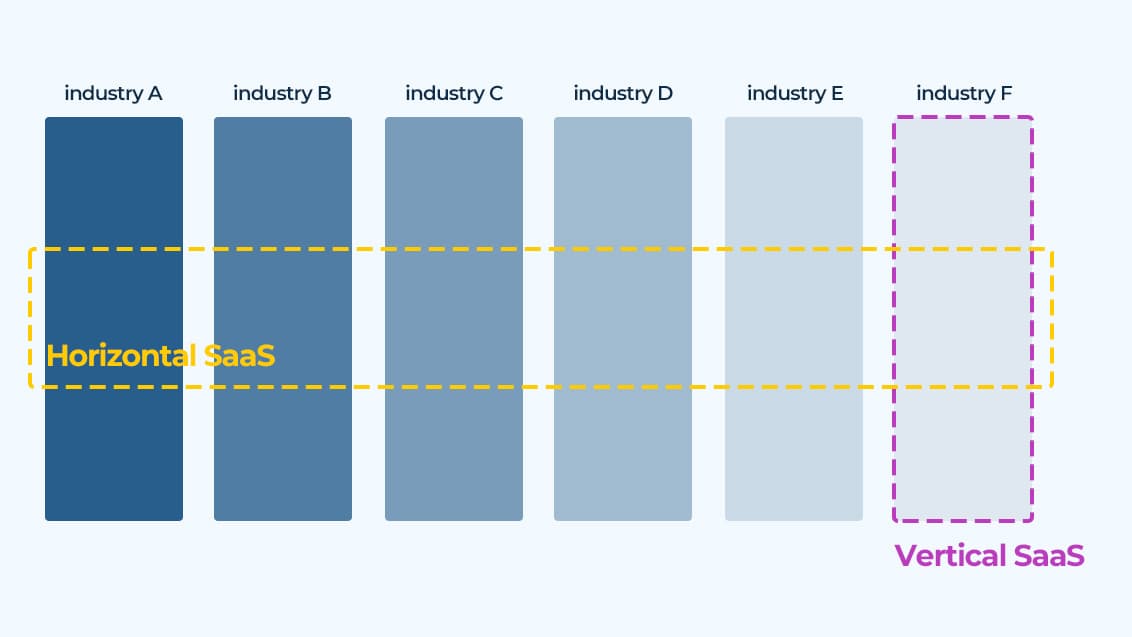
## Launching SaaS
Let's examine the key aspects of launching a SaaS product. The process typically involves four major phases: preliminary research, development, GTM strategy, and release preparation.
#### 1. preliminary research
SaaS is often deployed for BtoB and used for business purposes, so the first step in product development is to understand the business flow in detail.
Compared to BtoC products, SaaS for BtoB is used for business purposes, and through various surveys, issues and needs can be understood in advance in a highly reproducible manner. This means that, even without moving forward with product-focused planning and development, understanding the business flow in detail allows you to identify critical issues and refine the development requirements.
In addition to defining requirements through preliminary research, it is also possible to enhance the completeness of the product at the planning stage by creating a prototype, having the intended users use it in advance, and obtaining feedback.
#### 2. Development
Once the final requirements are determined through prototyping, we will proceed with the development of the product in concrete terms. The first step is to formulate the design, development, and QA policies involved in the development process. For example, this includes setting up guidelines for managing the scrum process during development.
There are also non-functional requirements such as infrastructure that should be addressed before proceeding with the development of the functional requirements designed in the prototype. If any omissions occur at this stage, it will affect the schedule later on, so it is important to thoroughly identify development projects and proceed with them.
#### 3. GTM Strategy
GTM strategy stands for "go-to-market strategy," and refers to the strategy and tactics used when launching a product that has been developed. Specifically, it is the process of deciding how much to sell the product and how to market it, and developing an execution plan.
For BtoC, once an app is developed, it can be easily distributed through platforms like the App Store or Google Play, where users can readily download it. However, in BtoB, there is no equivalent platform for easy distribution.
#### 4. Release Preparation
Based on the GTM strategy, we'll determine the most effective way to release the product. For example, one option is to release the official version of the product right out of the box. Another option is to have a certain number of users as monitors, have them use the product thoroughly, and release the product only after the accuracy of the requirements has been improved to the limit. There is also the method of charging from the very beginning of the release, or of initially developing the product for free while checking the initial trends of users, especially the number and percentage of churns.
In this way, the word "release" can be interpreted in many different ways, and there are a wide variety of options to choose from.
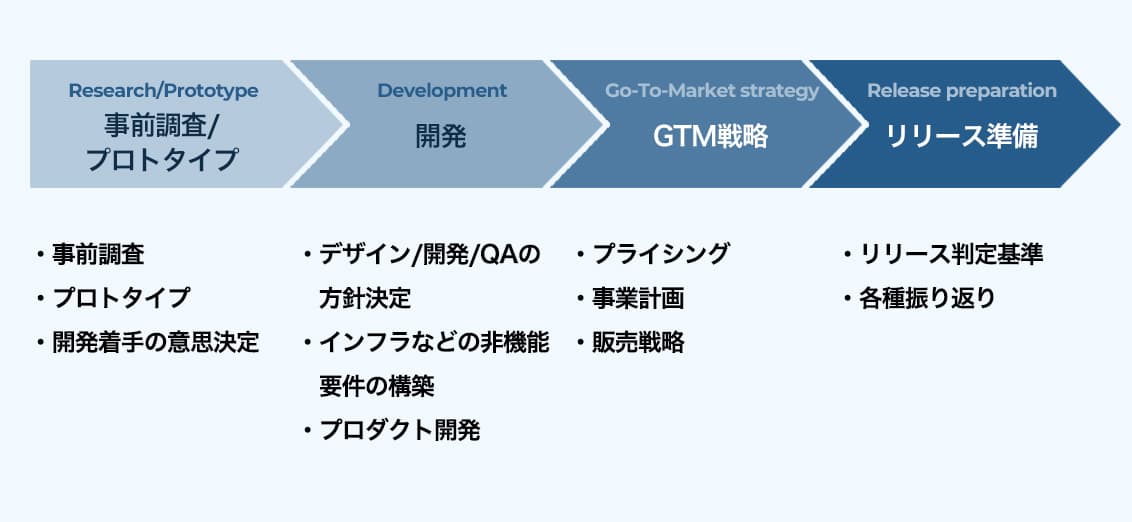
## Summary
The Corona disaster triggered a sudden increase in the need for SaaS in Japan, and there is no end to the number of startups deploying Horizontal SaaS and Veritical SaaS.
Knowledge of SaaS startups, including preliminary research, development, GTM, and release preparation, has been accumulated mainly by startups, and is gradually becoming systematized.
As major companies adopt this systematized approach, the shift to SaaS for core business operations in major companies has the potential to become the next trend. In the near future, we can expect to see more examples in Japan, like Adobe, successfully transitioning from packaged software to SaaS.
#### References
- Shoei-sha/ [ALL for SaaS SaaS立ち上げのすべて](https://amzn.asia/d/fUBxwg6)
- Shoei-sha/ [ビジネスモデル構築の大転換 クラウド化する世界](https://www.shoeisha.co.jp/book/detail/9784798116211)
---
# Avoiding Common Mistakes When Implementing MVPs in Large Enterprises
URL: https://route06.com/insights/17
In today's rapidly evolving society, how can we create products that effectively address users' challenges and needs?
The Minimum Viable Product (MVP) is often highlighted as a powerful solution to this question. The concept of MVP has gained widespread popularity among startups, driving innovation through early identification and iterative learning.
According to a McKinsey report, "On average, large IT projects are 45% over budget and 7% behind schedule. Moreover, they are delivering 56% less value than expected" (author's translation).
In this article, we will review the concept of MVP and its operation, which is indispensable for product creation, and then introduce points to keep in mind when utilizing it in major companies.
## What is an MVP?
If you've been involved in product development, you've likely encountered the term 'MVP.' The concept was detailed in 'Lean Startup,' a book that has become a modern classic and is still widely applied today.
The essence of MVP is not to aim for a perfect product or service initially, but to deliver a minimal version that effectively addresses the customer's problems. This approach allows us to work within a limited budget by restricting development to the minimum necessary for hypothesis testing. It also helps to clarify focus areas and narrow down verification points when launching a new business or startup.
However, if the concept of MVP is misinterpreted, it can become an excuse for avoiding responsibility or for self-protection. It's crucial to revisit the definition of MVP, ensuring a clear understanding of 'Viable' with the primary goal of determining how far the MVP can go to test hypotheses and deliver value to the user.
## Points to keep in mind when introducing an MVP
Traditionally, when launching a business, it has taken a long time to identify risks from various perspectives, and to think through measures to deal with the risks before putting them into a business plan. Therefore, a major shift in thinking is required to introduce MVP. We will introduce the five key points of this shift.
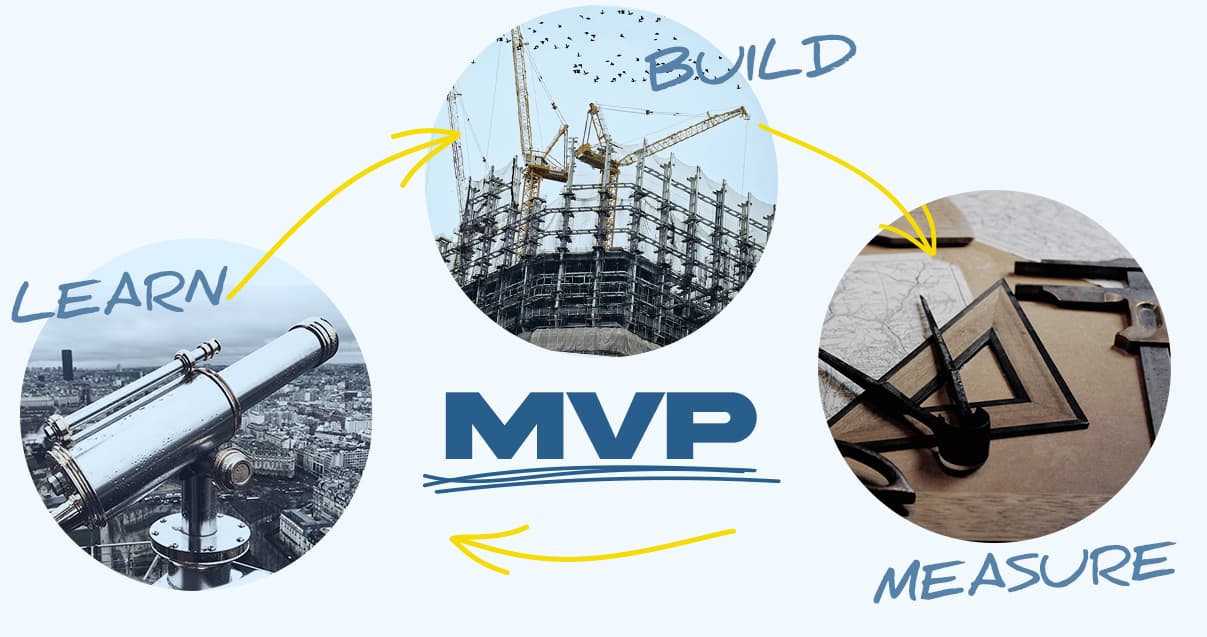
### 1. Stick to the team from the planning stage
In large companies, the organization is often so vast that the most suitable personnel are typically assigned only after the company has determined its objectives on a company-wide scale. However, assigning people after decisions are made often leads to 'make-do' work, which can stifle the enthusiasm crucial for fostering innovation.
Once the theme has been determined, the relevant issues can be identified and incorporated into the MVP. The learning gained from independently thinking through the issues and developing an MVP is far more valuable than merely testing a pre-determined hypothesis.
After defining the theme to be addressed, an MVP should be developed irrespective of internal resource constraints, with careful consideration given to assigning the most suitable personnel for hypothesis testing.
### 2. Focus on learning through the MVP
As the organization grows, new businesses become smaller in scale compared to core businesses, and unless they are a huge success, they do not receive much attention within the company. Not only that, but since new businesses are likely to fail, compared to core businesses that never fail, they can easily lead to negative evaluations, and there is an incentive to build up requirements in a risk-averse manner.
In contrast, startups and new businesses must drive innovation with limited resources. The speed and depth of learning through MVPs will determine the success of the product.
### 3. The answer is not in the office
The core of MVP is not about perfecting the plan, but about testing the underlying hypothesis. While discussions with team members in the office are important, it is essential to face the intended users in order to proceed with hypothesis testing.
Remote work has become the norm due to the COVID-19 pandemic, making online meetings with external parties commonplace. This has made it easier to interview and discuss with prospective users without having to travel. If this opportunity for rapid MVP validation can be realized, it has the potential to become a source of competitive advantage.
### 4. Minimize product
In a siloed organization, attempting to advance a highly novel project often results in receiving varied feedback and requests from different departments. If each of these is addressed individually, the novelty may be lost, and it can become unclear who the product is for and what purpose it serves.
The MVP shouldn't aim to perfectly address feedback from various departments; instead, it should focus on testing hypotheses in a minimal state that addresses the customer's core problems.
### 5. Be open to rapid changes
The purpose of MVP is hypothesis testing, and depending on the results of the test, the current plan may be drastically changed.If the plan cannot be changed, there's no value in testing it. In other words, it is not necessary to identify risks in order to pass a plan, and a plan that has been thoroughly worked out in advance is not necessary.

## Summary
MVP is a concept that maximizes learning through repeated hypothesis testing with limited resources. Unfortunately, as organizations grow larger and become more siloed, the term MVP is often used as an excuse for backhanded behavior due to internal politics and other issues.
To prevent this, it's essential to return to the core principles of MVP, focusing on hypothesis testing with the five points above to foster genuine innovation.
#### References
- [A Proven Methodology to Maximize Return on Risk](https://web.archive.org/web/20160525101214/http://www.syncdev.com:80/minimum-viable-product/)
- [4 Tips for Launching Minimum Viable Products Inside Big Companies](https://hbr.org/2015/09/4-tips-for-launching-minimum-viable-products-inside-big-companies)
- [Delivering large-scale IT projects on time, on budget, and on value](https://www.mckinsey.com/~/media/McKinsey/dotcom/client_service/BTO/PDF/MOBT_27_Delivering_large-scale_IT_projects_on_time_budget_and_value.ashx#)
- [Using an Enterprise Minimum Viable Product Approach](https://www.maxcode.net/blog/using-an-enterprise-minimum-viable-product-approach/)
- [リーン・スタートアップ×経営【第3回】大企業における新規事業を成功へ導く処方箋](https://www.foresight.ext.hitachi.co.jp/_ct/16935442)
- [A Review Of The Minimum Viable Product Approach](https://www.forbes.com/sites/theyec/2021/12/08/a-review-of-the-minimum-viable-product-approach/?sh=488f50cc2e20)
---
# 2023 CEO's Message
URL: https://route06.com/insights/18
Last year saw significant changes in economic and social assumptions, with signs of improvement in economic activity, including the normalization of global supply chains and an increase in inbound demand, driven by infection control measures like COVID-19 vaccination and efforts to ensure continuity of life and business amidst the ongoing pandemic. Meanwhile, the ongoing conflict between Russia and Ukraine led to a rise in resource prices, which, along with a corresponding increase in the consumer price index and tighter monetary policies in various countries, triggered a chain reaction, resulting in heightened volatility across several macroeconomic indicators.
In the stock market, emerging IT stocks experienced significant declines, which negatively impacted the fundraising environment in both public and private markets, leading many investors to adopt a more cautious approach to startup investments compared to the previous year. On the other hand, according to JVCA, the total amount of funding for all startups in Japan in 2022 is expected to exceed 800 billion yen[^1], and the cumulative amount of funding per startup and the number of participating shareholders are also increasing. At the same time, even unlisted companies are facing growing expectations to implement governance systems and achieve profit efficiency comparable to those of listed companies.
In this socio-economic climate, we at ROUTE06 plan to use this fiscal year to lay a foundation for stable growth in corporate value, focusing on establishing systems that will allow us to replicate and refine our unique strengths. We will strive to build an organizational culture that sincerely seeks to accumulate and improve knowledge gained from day-to-day operations, not only of software and various services for client companies, but also of various systems, including our own personnel system. We are committed to moving beyond the confines of a young startup to become a company that is trusted and valued by a broader range of stakeholders than ever before.
## Market Trends Surrounding the Company
Examining industry trends around our company, it seems that many major corporations have prioritized digital transformation even more than in the previous year and continue to invest aggressively in IT, despite growing economic concerns. Real demand in the global economy remains strong, and many major Japanese companies are showing steady progress in sales and profits in their recent financial results. According to IDC Japan, the enterprise IT market in Japan is expected to grow to 11.998 trillion yen by 2023[^2].
DX has also gone beyond a short-term boom and is now recognized as a term that includes not only the streamlining of existing operations through the use of digital technology, but also business model transformation. In DX projects promoted by traditional major companies, we are seeing more and more cases where they have moved from market research and As Is/To Be discussions to concrete "manufacturing" and realized continuous service improvement and business growth through agile product development. However, from a broader perspective, the shortage of skilled professionals capable of executing practical 'Monozukuri,' which is crucial for DX, is becoming increasingly severe each year, and the government has set up the "Basic Policy for the Digital Garden City Nation Concept (approved by the Cabinet on June 7, 2022)" to address this issue. The government has set a goal to develop 2.3 million 'digital promotion professionals,' including business architects, data scientists, engineers, and designers, by the end of FY2026[^3]. Although currently highly dependent on external development partners and vendors, an increasing number of major companies will actively recruit software engineers, designers, and other human resources compared to the previous year, and will focus on building a promotion system with hybrid teams of internal and external personnel.
As for the various systems that form the foundation of DX, SaaS and packages from major global software vendors continue to boast a high market share and influence, but the change in demand for and acceptance of software services by major companies is creating more opportunities for start-ups. However, the demand for and acceptance of software services by large companies is changing, creating more opportunities for startups. In the enterprise space, we are seeing more and more companies selecting tools and vendors based on the balance between usability and cost, customizability, and the agility of the development team, while also taking into account name recognition and track record. With in-house digital specialists and experience of various failures and successes, the DX teams of major companies are demanding higher standards, and the speed of improvement and the overall level of service in terms of design, technology, and business are more important than ever before. The trend of more and more business opportunities being concentrated in companies that can attract "digital drivers" who are serious about manufacturing and produce high quality products and services is expected to accelerate in the future.

## Guiding Principles for the Current Year
This month marks the start of a new fiscal year for our company, ROUTE06, and our fourth year in business. Last fiscal year, we achieved solid growth both in terms of revenue and organization. Starting with a case study of our parts procurement marketplace with Mitsubishi Corporation, we were able to announce the participation of a new shareholder through a Series A round of financing, and later the establishment and appointment of a new CTO. In addition, we have received a variety of new project introductions and inquiries in response to our publicity and recognition, and we have had many opportunities to be introduced to other departments, other projects, business partners, and affiliated companies by people from our client companies. It was a year in which we were able to realize that the manufacturing and service improvements that we have been honestly working on will lead to new opportunities. On the other hand, there were many challenges for both the company organization and the services we provide, and we experienced not a few lost opportunities due to the gap between the forecast of the recruitment plan and the actual results. While taking a sincere look at the current situation, we will work to resolve issues and promote growth for the entire company with the following guidelines so that we can provide more stable value to our stakeholders in the current fiscal year.
#### Manufacturing Culture
ROUTE06's corporate credo is "Be a disruptor" and we have been doing our best to help major companies achieve their digital transformation by leveraging the individuality and strengths of each team member since the early days of the company. While our members come from a variety of backgrounds and the industries and challenges of our clients are diverse, we believe that the common denominator of our organization is a culture of sincere commitment to practical "Monozukuri" that drives change, which is one of our great strengths. We have been committed to creating not only products and services for our clients, but also all kinds of products, services, and systems that emerge from our organization, from internal personnel systems to corporate-related workflows and systems (e.g., [The Day One for new employees Box](https://route06.com/news/13)). In an era of constant change in the business environment and organizational structure of client companies in the DX domain, not limited to the enterprise, expectations for our comprehensive strength and agility in software services continue to rise, while the work styles and areas of expertise of individual employees and partners are also diversifying. In this environment, we have been concentrating on building the company since its early days. In such an environment, we believe that building on our efforts to design a remote-first system, which we have emphasized since the early days of the company, and to establish a company-wide workflow (company-wide use of GitHub) that incorporates the concept of distributed version control in software engineering, will contribute to the development of our customer service, human resource development, operational efficiency, and various other areas. We believe that these efforts will be the source of sustainable value creation and competitive advantage in a variety of areas, including customer service, human resources development, and operational efficiency. In addition to product development, this fiscal year we will focus on expanding the company-wide "Monozukuri" culture through the establishment of various systems and tools, such as our original target system (Company issues/CEO issues) and information sharing tool (Handbook).
#### Services and Software
To enable the vertical launch of digital businesses for major companies—a key theme in DX—ROUTE06 offers [Professional Services](https://route06.com/solutions/service) that support practical agile development, along with foundational [Platform Services](https://route06.com/solutions/product/plain) that provide back-end systems and APIs. Our professional services offer comprehensive support, ranging from UX and operational design, UI design, and system design and implementation, to the growth phase, with in-house product managers, designers, and software engineers working as a cohesive team. We have been providing support from UX and operation design, UI design, system design and implementation, and the growth phase of the client's business. Among these services, we have been particularly appreciated by our clients for our quick operation design in the complex B2B domain, design services that include not only UI and UX but also creative elements such as logos, and our ability to make improvement proposals based on data visualization and analysis. This fiscal year, we will concentrate on expanding and enhancing our systems to elevate the quality of these services and accumulate knowledge that can be shared with our client companies. In the area of platform services, we have made the reinforcement of "Plain," our self-developed SaaS, a top-priority management issue, and have established a new Product Development Division directly under the CTO to further strengthen our engineering structure. In addition to expanding diverse and convenient functions for end users in the manufacturing and trading industries, Plain will focus on architectural design and API development to enhance front-end and design customization. Plain is a product that, like ERP, will be offered across a wide range of industries and operations in the future, so while placing importance on responding quickly to the apparent needs of client companies, it is most important to build up initiatives that will contribute to improving the medium- to long-term velocity of the internal product development team. We believe this will enable us to deliver high customer value in terms of price, quality, and speed.
#### Scalable Organization
In the last fiscal year, along with the Purpose Credo, we have been working to clearly state the guidelines for the work style that we recommend to our employees (Go root / Focus on the core, Connect anywhere / Remote first, 06-committers / Weave as a team). These differ slightly from the typical mission, vision, and values defined in corporate organizations, and, as of now, are not directly tied to goal-setting, personnel evaluations, or work rules; they are officially positioned as recommended guidelines. ROUTE06 emphasizes receptivity to the diverse backgrounds and lifestyles of the team in order to create a scalable organization with an eye on major trends such as industry structure, social culture, and so on. Rather than necessarily increasing the detailing and management of business rules, regulations, and standards, we will build an independent and scalable organizational culture through the clarification of guiding guidelines, transparent disclosure of discussions and decision-making processes, and consistency in output, such as specific systems and measures. In the current fiscal year, all divisions will formulate and improve various systems and measures related to the company's operations, one by one. In addition, with regard to information security, corporate governance, and financial/managerial accounting, we aim to exceed the standards of listed companies and major corporations, and will focus on strengthening our corporate structure and building efficient internal systems.
Based on the above guidelines, we will continue to do our best this year to become a more valuable company for our stakeholders.

[^1]: [一般社団法人日本ベンチャーキャピタル協会](https://jvca.jp/research)
[^2]: [日経新聞 / IDC Japan、国内エンタープライズIT市場予測を発表](https://www.nikkei.com/article/DGXLRSP511284_U9A600C1000000/)
[^3]: [経済産業省 / デジタル人材育成プラットフォームの取組状況について](https://www.meti.go.jp/shingikai/mono_info_service/digital_jinzai/pdf/006_03_00.pdf)
---
# What Large Enterprises Need for Transformation: 'Leadership Capital' | Tomoko Namba of Delight Ventures
URL: https://route06.com/insights/19
As digital technology continues to lower the barriers between industries, the businesses and organizations of the major companies that have driven the Japanese economy must transform to create new business opportunities and economic value. In this series, we will explore what it takes for major companies to transform, from the perspective of a venture capital (VC) partner. In this first installment, we interviewed Tomoko Nanba, Managing Partner of Delight Ventures.
Nanba asserts that 'leadership capital is essential' for the transformation of major companies. What is leadership capital? What are the current challenges faced by major companies and what are the key points of digitalization? We will take a closer look at Ms. Nanba's insights on the transformation of major companies.
## Adapt to change by replacing molecules
#### --From your point of view, what do you think are the challenges facing major Japanese companies?
The Japanese economy is still dominated by traditional major corporations, but I believe this very structure is a significant issue, with many challenges in how these corporations are organized. First of all, there is a lack of mobility of human resources. There is not enough energy to reject the conventional way of doing things and start something new. In the past few years, I have heard the words "DX," "GX," and other such terms of transformation, but the people who are saying them are mainly 30 or 40 year warriors who have been working for the same company for 30 or 40 years. Transformation means to change the form. It is not so easy to change the form of a group of old employees.
DeNA, of which I am the chairman and representative director, has been in business for more than 20 years, but major failures and stagnation have occurred when we have stayed in the same old ways for too long. I have come to realize that if we do not question the way we do things from the moment we start to feel that we are succeeding, we will be hurt later on.
The larger the size of the company, the more difficult it becomes to change the current way of doing things. They dislike things that have never been done before and try to maintain the status quo as much as possible. In a world that is changing so rapidly, this stance will lead to falling further and further behind and eventually being left behind. We must be careful.
What is important is to maintain the culture and climate of the company, but to replace the molecules in the organization, such as human resources and business. In biologist Shinichi Fukuoka's book, "Dynamic Equilibrium: Why Life Lives There" (Kirakusha), he says, "Organisms are able to adapt to changing environments because the molecules in their bodies are constantly being replaced.
It is crucial to refresh the organization by reshuffling the business portfolio in line with changing times and strategies, and by boldly appointing people with diverse backgrounds to executive positions. If we do not do so, we will fall further and further behind in adaptation and be left behind in the changes of the world.
The government is aware of this and has launched various initiatives to promote regulatory reform, but the individual issues are not progressing well. To begin with, the Japanese economy is structured to protect vested interests, and it takes an enormous amount of political capital to bring about major change. In the first place, I believe that the biggest problem of the Japanese economy is that the social and political structure is designed to support "constancy" in the face of so much change in the world.
#### --Against this backdrop, the government recently announced the "Five-Year Plan for Startup Development. It also includes "promoting open innovation.
I feel that we need to be careful because open innovation is often discussed from the perspective of how major companies can take advantage of startups. Of course, there are initiatives that benefit startups, but we need to switch to the perspective of exploding the number of startups that can overcome the large corporations that currently form the core of the Japanese economy. Otherwise, the Japanese economy will not be revived. Dynamic renewal is necessary not just for corporate organizations but for the economy as a whole.
The Keidanren, which is seen as a group of large corporations, has also taken this viewpoint and proposed a vision for a startup breakthrough in March of this year. I believe that the most important thing is to create an environment that welcomes startups that will achieve significant growth and create such entities one after another.
## Leadership capital is needed to transform major companies
#### --What do you think are the key points for major companies to promote digitalization?
I have already mentioned the importance of start-ups, but it goes without saying that it is also important for major companies to maintain and strengthen their global competitiveness, and digitalization is indispensable for this. However, the reality is that digitalization is lagging behind because of the generation gap. Simply put, many decision-makers in companies are not well-versed in the digital domain.
In terms of the digitalization of major companies, the target users are frontline employees, but they lack the authority to make decisions. Such twists in the decision-making process and a lack of understanding by decision-makers is a major problem, isn't it?
First of all, I recognize that no matter how hard I study, I will never be able to catch up with the level of technology understanding of employees 20 to 30 years younger than me who work in the field. Then, I think a wise manager would think about how to prevent his or her own ignorance from distorting the decision-making process.
Of course, I do not believe that the major companies will just continue to sink. I think it will take another 10 years for a GAFAM-class startup to emerge from Japan. In the meantime, I believe that it is major corporations that will support the Japanese economy. Compared to the rest of the world, Japan is a country where major corporations are more vigorous than small and medium enterprises and start-ups. I believe that start-ups are the trump card for economic growth, but large companies have abundant assets that start-ups do not have. I would like to see Japan evolve by utilizing such assets without fearing change.
#### --We are not afraid to change.
It is not enough to simply digitize existing methods; the operations themselves must be optimized. If we do so, there is a possibility that those who have built and protected the existing operations will rebel. But it is not necessarily true that we can leave hundreds of thousands of people unhappy in order to avoid the unhappiness of a very few. The voices of those who think, "I'm a little unhappy, but I just have to put up with it," are not visible because they are the silent majority, but those who have been protecting the operation are in a position to lose their jobs, so their voices will inevitably become louder.
That is where leadership is required. Japanese politics is often unable to deal with the opposition of some people for fear of damaging political capital, and the same is true of corporate organizations.
Just as in politics, thick political capital is needed to make bold changes for the betterment of society, I feel that in a company it is necessary to build sufficient leadership capital and make bold decisions for the success of the company, even if some people may complain.
I would like to believe that such companies are few and far between, but when leaders are in an "up" position, they try to maintain the status quo and finish their terms of office for a few years, not wanting to "end up hated" or "end up in disrepute," and the company continues to decline in a friendly atmosphere, The result is that the whole group is unhappy.
Over the past 30 years, the Japanese economy has been in a steady decline. Even with such low interest rates, the economy has not improved. After all, there is a limit to monetary policy alone, and the key is how to increase industrial competitiveness. However, Japan is a country that is incapable of bold deregulation, which is greatly opposed by some people. As a result, the country has become stiff and outdated. I believe that what is happening in the country is also happening in the company.
#### --What do you think is most necessary for major companies to change?
I think that every company has its own "oddballs," or people with a sharp point of view within the company. I believe it's important to spotlight these individuals and help them thrive. The current situation results from relying too much on people who share similar ideas. I believe the key to transforming major companies is to create an environment where unconventional thinkers are placed at the center of the organization and allowed to flourish.

*Photo by [Hiroaki Otake](https://hiroakiotake.com/)*
---
# 'CHOOSEBASE: The Future of Retail, Driven by People and Department Stores'
URL: https://route06.com/insights/2
Sogo & Seibu and ROUTE06 (ROUTE06) jointly issued a press release on the development of OMO store recently. ROUTE06 opened "CHOOSEBASE SHIBUYA" today 9/2(Thu) at the Seibu Shibuya store, and will be selling a variety of products including AWL and partners including AWL, hey(stores), and Logikura to provide OMO (Online Merges with Offline) system and services.
CHOOSEBASE SHIBUYA is a media-style OMO store that proposes a next-generation store where customers can "encountering meaning and buying will". The store's editorial theme changes every six months, and the inaugural theme was "TIMELIMIT. More than 50 brands (beauty, fashion, food, etc.) that are committed to sustainability are participating in the store.
For the full text of this article, please visit [website](https://note.com/tkendou/n/nc0b92a36e423).
---
# Web Design and Typography
URL: https://route06.com/insights/20
95% of web design is typography "[^1]. You may have heard Oliver Reichenstein, CEO and designer of iA (information Architects), a design firm that has designed information for many major clients such as NHK and Wikipedia, call on designers to do the same. Oliver Reichenstein, CEO and designer of iA (information Architects), a design firm that has designed information for many major clients including NHK and Wikipedia, has a message for designers. Typography is the technology that bridges the gap between writer and reader, enhancing the reading experience. After all, the majority of web content is composed of text.
In the vast amount of content available today, there is an increasing exposure to and absolute volume of text on display rather than in print. Web typography has historically received little attention as a specialized field, largely due to the limited number of fonts available and the narrower range of expression compared to print. As digital transformation is accelerating in various fields these days, technologies and theories related to digital design are constantly evolving. This article explores the history of typography and its growing potential in the digital age as technology continues to evolve.
## What is typography?
### A myriad of sensory and numerical techniques
Typographic theory has long embraced certain laws and mathematical systems, such as numerology, the theory of proportion, and Corbusier's modulor. Typography began as a personal design intuition, gradually refined through countless examples and inherited wisdom into a specialized skill passed down through generations. Recently, academic research has accelerated as its principles have become explainable through numerical analysis.
The grid-based design process has provided designers with a means to be functional, logical, and aesthetically pleasing. Numerical aids bring order to design, support the authenticity of information, and are said to be effective in aiding comprehension and memory of textual content without visual burden for the reader [^2]. On the other hand, while vision sometimes takes precedence over theory and numerical correctness in design, typographic theory can provide an opportunity to solve problems such as optical illusions.

*1-2: Black-and-white squares of the same size, but the white square appears to shine beyond the boundary against the black background, making it appear larger than the square of the same size against the white background. 3-4: The same black circle looks different depending on its planar position. If it is at the top, it appears to float like a balloon; if it is at the bottom, it appears to be heavy. 5-6: When a stick of the same thickness is placed horizontally and vertically, the horizontal line appears to be heavy and solid, while the vertical line appears to be light and dynamic. 7-8: A square of the same length appears to be more vertical in the horizontal line than it is in reality, while it appears horizontal in the vertical line. Source "Typography: A Guide to Typographic Shapes" by Emil Ruder*
.
Numerical ratio systems often become deified as the gold standard. However, it's crucial to create the best reading experience by drawing on the wisdom of predecessors, incorporating the latest typeface technology, and leveraging the designer's unique expressive strengths to create a cohesive whole.
### Influence of typefaces
The choice of typeface is an important part of the designer's job. Understanding the constraints of the medium and choosing a font that fits the context will give the text content a sense of temperature and inflection that will aid the reader's understanding.
Let's compare web design to speech. If the venue corresponds to the web page and the text corresponds to the speech content, what impression does the speaker's attire give the audience?
Some suits are carefully tailored, others are ill-fitting and shabby; a T-shirt and denim may look clean and appropriate for the speaker, or modern and neat.
Beatrice Ward, an American typographic communicator, wrote in her 1955 essay "The Crystal Goblet" that
>They will take a vivid interest in the clothes that the words wear. ."- Beatrice Warde
.
>"People who love ideas must have a love of words. They will take a vivid interest in the clothes that words wear .
Just as clothing can significantly influence first impressions, the choice of typeface can profoundly affect how writing is perceived. Typefaces are like clothes for words, and just as clothes express a person's taste, preference, and atmosphere, typefaces can also evoke a certain region or time period in the reader. From another perspective, the work of multisensory typographer Sarah Hindman has demonstrated that the choice of typeface can also affect the taste of a dish. For the same jelly beans, subjects perceived a sweeter taste when a rounded font was used for its descriptive text, while a hard and sharp font resulted in a sour taste. This effect is linked to the amygdala, where the relationship between impressions and sensations is stored and reinforced through experience. The choice of typeface does not merely convey information or affect sensation, feeling, or emotion; it can also stimulate preconceptions and memories of credibility, tone, and content.

*Positioning rounded and pointed fonts on a jellybean changes the taste of the same one. Source "Web Typography" by Richard Rutter*
## The interface of letters
The production of letters has evolved from handwriting to woodblock printing, typography, manuscripts, and now digital fonts. Lettering is the basis of all typography, which has evolved from early plastic letters to abstract symbols, morphing into a variety of type forms, including Gothic, Italian and German Renaissance, and modern sans serif forms.
Calligraphy, derived from the Greek words 'calli' (beautiful) and 'graphein' (to write), has evolved as both an art form and technique through history and cultural shifts. Roman capitals" were used for Roman inscriptions, "uncials" were developed for ease of writing in manuscripts, "Carolingian" was created to unify typefaces, "Gothic" and "Blackletter" were used with small margins to write down more letters when paper was more expensive, "Italic" was used for faster writing, and "Gothic" and "Blackletter" were used to write in a more compact style when paper was more expensive. Although the invention of letterpress in the 15th century diminished the need for handwriting in everyday life, a recent study by John Hopkins University shows that writing down ideas by hand and keeping a diary are still important for our creativity and mental stability today. However, recent research at John Hopkins University shows that writing down ideas by hand and keeping a journal can contribute to our creativity and emotional stability even today.
### Calligraphy and the Technology Industry
Apple founder Steve Jobs' fascination with the artistic posters of a calligraphy class he saw after dropping out of college and taking the class brought new creativity to the world of technology. In his famous 2005 Connecting the dots speech, Jobs said this about calligraphy, or rather typography
>I learned about serif and sans serif typefaces, about varying the amount of space between different letter combinations, about what makes great typography great. It was beautiful, historical, artistically subtle in a way that science can't capture, and I found it fascinating.
We rely on our vision for the majority of our learning. While we have a finite amount of time and vision, and can learn from others in the same community, examining the creative expressions of our predecessors across different industries can serve as a powerful catalyst for our own creativity. We are all creative, and we can all exercise and develop that creative muscle. Typography is the aesthetic expression we encounter most frequently in our daily lives, and it may be the art form that most powerfully stimulates our imagination.
## Designing "reading".
As typeface designer Hermann Zapf asserted, "Typography is sometimes misunderstood as a form of personal self-expression." While typography is often viewed as an art form, it is fundamentally a craft with a clear purpose and practical use. Typography is rarely perceived as "a means of communicating information to a wide audience in the simplest and most efficient way.
Swiss typography master Emil Ruder, who influenced typographers and graphic designers around the world with his unique exploration of typography in terms of both function and form, defined typography in his 1967 book "Typography: A Guide to Typographic Form" [^3] as Ruder defined typography as follows.
>Typography has a clear obligation to convey information by means of letters. No discussion or consideration can free typography from this obligation. A printed work that cannot be read is a production that has lost its purpose.
Typography has been quantified and utilized on the basis of the sense of our ancestors, countless examples, and inherited wisdom. It is an expression based on technology, precision, and order, and is inherently practical rather than lofty and esoteric art. To facilitate the reader's exploration, categorization, and interpretation of information of interest, the designer selects the most appropriate typeface, keeping in mind the balance between the design components in which the text is incorporated and the page as a whole. Oliver Reichenstein, introduced at the beginning of this article, emphasizes that this process is the same not only for printed materials, but also for digital products. From customer reviews to reports, media articles, books, and posts on social networks, readability is the most important experience in the textual information that we constantly see from our own smartphones. Since the most important thing a user does in any web service is to read, Oliver recommends studying typography as a specialized field that brings together all the skills and know-how needed to convey information efficiently to others.
The knowledge that typographers have gained through their long history of research on the legibility of words and text as a whole, as well as the compositional theory of how the choice of typeface can change the overall impression of a design, are also important lessons for designers of today's digital products. There are a number of design guidelines that emphasize typography and optimize the overall graphic balance, such as the Human Interface Guideline[^4] proposed by Apple Inc. and Material Design[^5], a framework published by Google Inc. The following is a list of some of the most important design guidelines. As hardware specifications such as displays and expression technologies such as front-end engineering have become more sophisticated, typography has recently become a topic of active discussion among not only designers but also usability specialists, information architects, and various other professionals involved in web design. Typography has become a topic of active discussion among not only designers but also usability specialists, information designers, and other professionals involved in web design.
## Impact of the Evolution of the Web
__Adaptation to a medium that puts control in the reader's hands__.
Internet technology, which began with packet communication research in the 1960s, continues to profoundly impact the field of typography today. Since the invention of the printing press, it has been easy for designers and printers to control the entire process of typography, from paper and type size standards to aesthetics and its use. The display of Web design was left to the browser and software used by each user, ultimately leaving the control to the user as the reader.
Although leaving control to the reader might sound negative, it actually offers a significant advantage by allowing users to tailor the interface to their specific needs, even within the same medium. For those who need a magnifying glass, standardized normal-size printed materials are not always the best interface, and in light of the fact that there have been situations where people have had trouble with large-size newspapers spread out on crowded trains, although they are less common today, the importance of digital typography is The importance of digital typography is even more apparent.
The role that typefaces play in the text that makes up the bulk of a website is not only to express the strength or weakness of the writer's message, such as highlighting a headline, but also to support the expression of the non-verbal impression of that message. Just as readers perceive different tones, textures, and textures in handwritten text depending on the writer, typeface selection on the Web also influences the impression readers receive and their receptiveness to the content. Compared to print, where the typeface is fixed, the Web often allows the reader to change the typeface from the browser or application settings. The user interface is becoming increasingly variable, not only in typeface selection but also in dark mode settings, and typography on the Web continues to evolve to adapt to such a highly scalable and flexible media environment.
__Browsers and Web fonts__
With the advent of CSS in the 1990s, Web typographers began to be able to create typographic environments, but few Web fonts were available, and even fewer browsers supported them. The history of Web fonts began in an environment where it was difficult for readers to distinguish between fonts due to the low screen resolution.
While there were many restrictions for Web typographers, the advent of the Internet and the spread of the PC environment had a major impact on the spread of typography itself. Not only has it become easier to create new typefaces than in the traditional printing environment, but it has also become possible to offer a wide variety of fonts for sale to users around the world through online services.
Although CSS2 specifications were added in 1998 and Microsoft developed its own Web font format for Internet Explorer, it was not successful in spreading the technology. Later, DTP (DeskTop Publishing) became popular with the introduction of Apple's Machintosh, and in 2009, Safari released TTF (a web font developed by Apple and Micorosft, which is also supported by Windows as a standard, and is characterized by a beautiful curve independent of the scaling ratio). (TrueType) and OTF (OpenType, a highly functional font format developed jointly by Microsoft and Adobe Systems as an extension of TrueType), which led to the expansion of Web font support to other browsers as well. Web font support is expanding to other browsers as well.
In 2010, the Web Open Font Format (WOFF) was introduced as a standard, and many browsers quickly began supporting it, marking the beginning of the Web font era. WOFF makes it easier to manage the display of typography on the Internet by allowing target fonts to be displayed cleanly in the browser without the need to compress and install TTF and OTF files on the desktop. While font file sizes are relatively lighter than images or complex JavaScript code, they also affect page loading speeds when using multiple typefaces on a page, or when using typefaces with Opentype capabilities. 2014 saw the introduction of a new standard format, WOFF2, with improved compression technology. WOFF2 successfully reduces data volume by an average of 30% compared to WOFF [^6].
In 2016, a new technology began to support OpenType Font Variations (commonly referred to as variable fonts), which allow a single font to diversify its expression as if it were multiple fonts.Adobe, Apple, Google, and Microsoft By simply devising the CSS definitions of font-weight, stretch, style, etc., you can create "regular", "light-condensed", "extra-condensed", "light-condensed", "extra-condensed", "light-condensed", "light-condensed", "light-condensed", and "extra-condensed" fonts. Light Condensed" and "Extra Bold Extended" can now be treated like separate fonts with a high degree of freedom. OpenType Font Variations not only reduces the file size, but also reduces the number of font requests to the server. OpenType Font Variations is a new technology that not only reduces file size, but also allows for highly precise and detailed adjustment of rendered fonts, making it possible to dynamically adapt to readers' ever-changing devices and environments. Two variable fonts are available from the engineer-friendly GitHub: the powerful and versatile Mona Sans, and Hubot Sans, whose more geometric accents have a technical and distinctive feel. [^7]

*Refer to github.com/mona-sans for image*
## Typography and Collaboration
Not only web typography, but any typeface can deliver attractive and highly interesting value to the reader by combining it with text and various design components.
Because Web design contains a greater amount of textual information than print, the use of unique typefaces can enhance the uniqueness of the overall design.
An important aspect of successful Web design is to treat the text itself as a user interface. Web services that are loved by many users, such as [Figma](/insights/12), Google, eBay, and YouTube, which were previously mentioned [in the article], have succeeded in combining a simple interface with a strong identity.
In web design, anyone can become a typographer by devising grids and CSS; CSS defines how to apply the dimensions, values, and proportions necessary for typography in printed materials to different viewports, so that anyone involved in the production of a typographic system Everyone involved in the production of the typographic system will be able to know. One of the achievements of CSS is that it has enabled new collaborations among directors, product managers, and engineers to express their knowledge of typography in a common language, which used to be limited to a few designers in print prototypes. This is one of the achievements of CSS.
[^1]:iA / [Web Design is 95% Typography](https://ia.net/topics/the-web-is-all-about-typography-period)
[^2]:Josef Mueller-Brockmann / [グリッドシステム](https://amzn.asia/d/1YBI77O)
[^3]:Emil Ruder / [タイポグラフィ─タイポグラフィの造形の手引き](https://www.amazon.co.jp/dp/4862464475/)
[^4]:Apple Developper / [Human Interface Guidelines](https://developer.apple.com/design/human-interface-guidelines/guidelines/overview/)
[^5]:Google / [Material Design](https://m3.material.io/)
[^6]:Richard Rutter / [ウェブタイポグラフィ─美しく効果的でレスポンシブな欧文タイポグラフィの設計](https://amzn.asia/d/7COVvvP)
[^7]:GitHub / [TWO VARIABLE, OPEN SOURCE FONTS from GITHUB](https://github.com/mona-sans)
---
# Types and Benefits of XaaS
URL: https://route06.com/insights/21
Starting with SaaS, which delivers software via the Internet, XaaS (Anything as a Service), where everything is offered as a service, has become a significant trend. One of the characteristics of XaaS is that, unlike traditional on-premise software, one of the key characteristics of XaaS is that end users can access services from anywhere using devices like PCs and smartphones. In this article, we will first explore the specific types of XaaS, and then outline the benefits of XaaS from both the provider and user perspectives, with a focus on B2B services.
## Types of XaaS
XaaS is spreading rapidly, to the point where you can find literature that lists and categorizes examples from A to Z. Here, we will highlight some of the most representative examples.
### Servitization of the surrounding environment in providing software.
In [How to launch SaaS and its characteristics](https://route06.com/insights/16), Software as a Service, Platform as a Service, and Infrastracture as a Service" as types of software as a service. Two other typical examples are introduced below.
ID as a Service
- Service that performs identity management.
- Examples: Auth0, Okta
Network as a Service
- Service that supports network construction, server/client configuration and installation, and maintains network performance.
- Example: NTT Docomo
### Servicing of distinctive means
Distinctive functions like analysis and communication have also been converted into services.
Analytics as a Service.
- Data storage, analysis, and statistics services provided through the cloud.
- Example: Tableau
Communication as a Service
- Services related to communication such as videoconferencing, chat, etc.
- Examples: Slack, Zoom
### Industry-specific servitization
Some services are offered through distinctive devices in individual industries.
Mobility as a Service.
- Services that allow users to book and pay for mobility services.
- Examples: Whim, Uber, Lyft
Retail as a Service
- Service that combines technology with accumulated customer and sales data.
- Example: Amazon Go
As you may have noticed, while there is a general definition of XaaS, there is no established classification system for it. In fact, XaaS may be better understood as a term coined for marketing, similar to terms like 'XXX-Tech.
## Benefits of XaaS
So, why do companies promote XaaS, even using it as a marketing term? We will elucidate the reasons by identifying the benefits from each provider/user's perspective.
### Advantages of offering XaaS as a provider
Software and other offerings that are now part of XaaS were traditionally sold under a one-time purchase model. There are two main reasons why providers are now promoting XaaS.
First, it increases the predictability of sales. This model allows for more predictable sales, as revenue is secured through ongoing usage rather than relying on one-time sales each month. Such a PL structure can easily be valued relatively high by the capital market, and it can also be evaluated as a business model that is relatively less susceptible to economic downturns.
Second, it is possible to build a continuous relationship with users through services. Since we expect our services to be used continuously, we naturally need to receive feedback from users on their requests, problems, etc., and make improvements. Through such activities, we can prevent the service from fading away and maintain user satisfaction. It is also easier to guarantee the opportunity to take care of users before they switch to another company's system, rather than having them suddenly contact us to stop using the service.
### Advantages of using XaaS as a user
When evaluating XaaS from the perspective of the users of the service, the advantages can be summarized into four categories.
The first is the ability to reduce the initial investment and pay for the service on a subscription basis. using XaaS reduces the amount of IT infrastructure that would otherwise be incurred, eliminating the need to prepare in-house servers, hard disks, networks, software, etc. for use in the data center. For startups and new businesses with strong cost constraints, XaaS can be a strong ally. Another major advantage of using XaaS is that it can be recorded as an expense rather than an investment.
Second, overhead costs such as maintenance can be reduced. In addition to the initial investment, maintenance is required for IT infrastructure. This allows the company to focus on operations that directly benefit its end users.
The third point is high scalability. For instance, if your business needs to expand rapidly, you can often upgrade your XaaS plan and scale quickly without major organizational changes, XaaS is often divided into different plans based on the features and frequency of use, allowing you to adjust the features and frequency of services according to your business needs.
Finally, XaaS encourages innovation by allowing the service provider to operate as an integrated part of your team, facilitating rapid product and business development. The company that provides XaaS can operate as part of its own team and quickly develop its products and business.
## Conclusion
XaaS, especially SaaS, is starting to become widely adopted. This has benefits for both providers and users. Providers can increase sales predictability through ongoing relationships with users, and users can minimize overhead costs by paying only for what they use while minimizing initial investment.
The rapidly advancing trend toward XaaS is irreversible, and in the extreme, we may be entering an era in which everything other than what is supposed to be used as one's own with a commitment to continue to use it as one's own will be converted to a service.
Amid this ongoing trend, we hope this article will inspire you to rethink how you deliver your own products and services.
#### References
- [A Proven Methodology to Maximize Return on Risk](https://web.archive.org/web/20160525101214/http://www.syncdev.com:80/minimum-viable-product/)
- [4 Tips for Launching Minimum Viable Products Inside Big Companies](https://hbr.org/2015/09/4-tips-for-launching-minimum-viable-products-inside-big-companies)
- [Delivering large-scale IT projects on time, on budget, and on value](https://www.mckinsey.com/~/media/McKinsey/dotcom/client_service/BTO/PDF/MOBT_27_Delivering_large-scale_IT_projects_on_time_budget_and_value.ashx#)
- [Using an Enterprise Minimum Viable Product Approach](https://www.maxcode.net/blog/using-an-enterprise-minimum-viable-product-approach/)
- [リーン・スタートアップ×経営【第3回】大企業における新規事業を成功へ導く処方箋](https://www.foresight.ext.hitachi.co.jp/_ct/16935442)
- [A Review Of The Minimum Viable Product Approach](https://www.forbes.com/sites/theyec/2021/12/08/a-review-of-the-minimum-viable-product-approach/?sh=488f50cc2e20)
---
# Transformation Insights from Southeast Asia's 'Digital Pioneer': A Call for Leadership Commitment | Soichi Tajima, Genesia Ventures
URL: https://route06.com/insights/22
As digital technology breaks down industry barriers, major companies that have long driven the Japanese economy must transform to create new business opportunities and economic value. In this series, we explore what it takes for major companies to transform from a venture capital (VC) partner's perspective. In this second installment, we interview Soichi Tajima, Representative Director/General Partner of Genesia Ventures.
Tajima, who also serves as Vice Chairman of the Japan Venture Capital Association (JVCA) and Chairman of the Large Company Collaboration Committee, shares his views on the transformation of major companies.
## Difference between mission and status quo. Challenges facing major Japanese companies
#### ─ From your point of view, what do you think are the challenges facing major Japanese companies?
In talking with CVC (Corporate Venture Capital) staff at various major companies, I have the impression that many of them are unable to envision how they should transform their businesses. They struggle to see the gap between their goals and their current situation. This inevitably leads to a blurring of the way forward.
For example, consider the three key elements needed to transform a major company: mergers and acquisitions, in-house product development, and collaboration with startups. Since the goal is not in sight, the result is that the company does not know where to M&A, what kind of product to develop, or what kind of startup to collaborate with. This inability to see the difference between the ideal and the reality is a challenge for many large companies.
Conversely, companies with a clear vision and a solid understanding of the gap between that vision and reality are more precise in their tactics and external messaging. As a result, they become the preferred partners for startups. For startups, it is easier to be proactive in realizing business synergies by partnering with a company, rather than simply being an investor. In this sense, a significant difference is emerging between major companies that can create this positive cycle and those that cannot.
Another issue is that surprisingly few management teams adopt a proactive stance, declaring, 'We are going to transform the company. Management should not just evaluate proposals from the field but also take the initiative to actively promote them.
CyberAgent, where I worked in the past, is now a major company, but the management team is taking the initiative to create new businesses. They believe that management's mission is to maximize corporate value, which includes not only nurturing existing businesses but also creating new ones. Such a culture raises the perspective of the entire organization, including middle management, and has a positive effect on the company. If If management only evaluates, no one will take on new challenges. As a result, I think this leads to a sense of stagnation in the organization.
#### ─ In terms of establishing CVC, the government is also developing initiatives such as the "Open Innovation Promotion Tax Credit.
The initiative itself is a good one, but in some places it seems that CVCs are being set up with the idea that "we have to set up CVCs because of the Open Innovation Promotion Tax Credit." When setting up a CVC, the first step is to say, "Let's work with startups as a means to change our own business. Let's aim for it. For that purpose, it is better to have an investment function in a separate organization. Therefore, let's launch a CVC." While the means should be derived by working backward from the goal, it often seems that the means have become the end in themselves.
In such cases, the start-up side realizes that it may not be able to make more interesting efforts with this company than investment. After all, when a startup partners with a major company, they are concerned that they will be "colored" by that company, and if they cannot expect a return greater than the color they are given, they will not want to work with them. This is why it is important for the management team of a large company to first clarify the direction they should aim for.
How committed is the management team of a major company to change? Also, can they seriously face the challenge of properly setting forth their vision and spreading it throughout the organization? The open innovation tax system is only a tool to accelerate change, so it is most important that the management team clarify and commit to the vision it is aiming for before thinking about how to use the tax system.
## Digitalization Demands 'Optimizing Business to Meet User Needs.'
#### ─ Genesia Ventures is also investing in Southeast Asia. What do you feel are the differences in terms of digitalization compared to Japan?
First of all, the environment is very different. Japan already has a declining birthrate and an aging population, and the working population is rapidly shrinking, but Southeast Asia is now in a state similar to Japan's period of rapid economic growth. And this momentum will continue for the next 30 to 40 years. This is the first major difference between Japan and Southeast Asia.
Another difference is that Japanese business is shifting from analog to digital, while Southeast Asian business is starting from scratch on a digital basis. In Japan, many industries have matured on an analog basis, and now the need for DX (digital transformation) is being called for, but in Southeast Asia, business is not as firmly established as in Japan, so businesses are being born from scratch based on digital technology.
Japan, once considered a developed nation, is now seen as 'digitally backward,' while Southeast Asia, once considered an emerging market, is becoming a 'digital pioneer. A major paradigm shift has occurred over the past 10 years. I personally feel a strong sense of urgency about this.
#### ─ What do you think Japan should learn from Southeast Asia?
What's happening in Southeast Asia is straightforward. They are simply facing the needs of their users and optimizing their businesses to meet those needs.
Japan should learn from this attitude. However, in the case of Japan, there is a huge amount of assets that have been accumulated to date that have become sunk costs (i.e., costs that have already been borne and cannot be recovered) and cannot be discarded. More to the point, they are faced with the need to optimize their business for both the silver market and the youth market, which have different IT literacy levels. It appears that we are truly in an innovation dilemma.
I wonder if they can make the decision to give up on their existing assets and take on new challenges because "users are demanding it. I believe that the companies that can continue to thoroughly and genuinely address user needs will ultimately prevail.
## Change management's thinking by consciously creating a "difference
#### ─ What do you think is the key to reforming major companies?
I think it is necessary to consciously create a world where startups choose major companies, rather than a world where major companies choose startups. In today's digital society, large companies that realize the potential of start-ups that utilize the power of digital technology to solve the world's problems will certainly be able to continue to grow. If this happens, the impact on the Japanese economy will undoubtedly be significant.
Instead of trying to develop everything in-house, they should work with start-ups to create new businesses. Rather than telling large companies that are not aware of this potential that they need to be aware of it, the difference in speed and output between companies that are aware of its importance and those that are not will inevitably increase, so I believe that educating people about the results will become even more important in the future. I believe that awareness of the results will become even more important in the future.
#### ─ What should be done first to achieve this?
I think the first thing we need to do is to create an environment in which the management team is willing to take risks and take on challenges on their own. If the top management does not change their way of thinking, the company will not change either. Even if the people on the front lines continue to talk about the need for change from the bottom up, if the top management does not change their thinking, their voices will continue to be rebuffed, and eventually the people who were highly motivated on the front lines will end up working for other companies. If this situation continues, the future of major companies will become increasingly bleak.
What is needed to change the mindset of top management is a "sense of crisis. In this sense, Southeast Asia has a tremendous thirst. Motivated by a sense of crisis and a thirst for a more affluent lifestyle, Southeast Asia is growing rapidly by taking full advantage of the potential of the Internet. On the other hand, Japanese people are in an environment where they have everything they need, so it is difficult for them to develop a thirst compared to Southeast Asians.
However, this is no longer the case. While earning revenue is crucial, it's even more important to consider 'what we want to achieve'. If the management team can properly present the "vision" that lies beyond the vision and mission, the company will be able to change.

*Photo by [Hiroaki Otake](https://hiroakiotake.com/)*
---
# GitLab: Leveraging 'Fully Remote' as a Competitive Advantage in Corporate Design
URL: https://route06.com/insights/23
GitLab Inc. (GitLab), an American technology company that develops/provides GitLab, a DevOps platform for modern software development including version control tools and CI/CD, is a fully remote company with approximately 2,000 employees worldwide.
Remote work has become a widely accepted new way of working in the aftermath of the COVID-19 pandemic. However, there are various issues such as communication breakdown, management difficulties, and employee burnout, and now that the spread of the coronavirus has calmed down, many companies have started to return to the office.
In this article, we introduce GitLab's corporate design and operational methods that support a fully remote and asynchronous work style, offering insights into next-generation organizational models and work practices.
## GitLab History
GitLab began as a personal project of software engineer Dmitriy Zaporozhets (founder). Zaporozhets started developing it as an open source project in 2011.
Sid Sijbrandij (co-founder and current CEO), another software engineer who had long been impressed by the beauty of Zaporozhets' publicly available code, Impressed by Zaporozhets' tweet expressing his desire to work on the GitLab project full-time, Sijbrandij reached out to him. Zaporozhets' tweet that he wanted to work on the GitLab project full time, and contacted him. Their meeting led to the founding of GitLab Inc. in 2014.
In his S-1 at the time of GitLab's listing, Sid Sijbrandij recounted Zaporozhets' pre-founding days as follows.
> In 2011, my co-founder, Dmitriy Zaporozhets, created GitLab from his house in Ukraine. It was a house without running water, but Dmitriy felt that not having a great collaboration tool was a bigger problem than his daily trip to the communal well.[^1]]
The company's GitLab is a DevOps platform for modern software development, including version control, issue management, code review, and CI/CD.
Initially a latecomer compared to the similar 'GitHub' service, GitLab gradually increased its user base, fueled by feature enhancements and a shift of users following Microsoft's acquisition of GitHub. After being selected by the global accelerator Y Combinator and multiple rounds of procurement, the company was listed on the NASDAQ market in October 2021 with a market capitalization of approximately 1.2 trillion yen (exchange rate at the time).
Today, it is a major service with approximately 2,000 employees from over 60 countries and more than 3,000[^2] Code contributors, and is used by many of the world's leading enterprise companies, including Goldman Sachs, NVIDIA, and T Mobile. [^3]
Open Source Software (OSS) for the enterprise is an area where market expansion is expected to continue, and the company is expected to grow further.

## GitLab's distinctive corporate design
GitLab's corporate design and operational approach are distinctly aimed at fostering an autonomous and decentralized organization. In this chapter, we will look specifically at the following
1) All Remote - All 2,000 employees are fully remote
2) Handbook - everything is documented
3) Internal Communication - Slack rather than meetings
4) Minimum Viable Change - break it down into smallest units and get feedback quickly
5) Managers of One - be your own manager
6) Informal Communication - various mechanisms to trigger interaction
#### 1. All Remote - All 2,000 employees are fully remote
Since its founding in 2014, GitLab has consistently operated without an office, and is fully remote. Today, we have approximately 2,000 employees from over 60 countries around the world, but as always, everyone works full remote, including our CEO and other C-level executives.
Everything from hiring and onboarding to firing employees is done remotely, and the only time employees officially meet in person is once a year at the "GitLab Contribute," a multi-day camp where employees gather offline for free. The only time employees officially meet in person is once a year at "GitLab Contribute," an offline camp where employees gather for several days. Before the Corona Disaster, it was held in Greece, Mexico, etc.).
Previous GitLab Contributes (Formerly Summits)
https://about.gitlab.com/company/culture/contribute/previous/
Because employees are distributed around the world with different time zones, there are no set working hours (core hours) and employees are allowed to work when they want. Therefore, asynchronous working is the basic working style, including internal communication as described below.
This fully remote work style, which differs from the traditional office or hybrid models that are more common today, gives GitLab a significant advantage in recruiting talented individuals worldwide, without geographical restrictions. This has also contributed to the diversity of the organization by allowing a diverse workforce from all over the world.
From an individual perspective, it is easier to continue building a career at GitLab without being forced to change jobs or leave for personal reasons, such as a spouse relocating, childcare, or nursing care. It's evident that GitLab's all-remote approach significantly enhances the careers, personal lives, and engagement of its employees.
What makes All remote possible are a number of corporate design and structure features that we will examine in the next section.
#### 2. Handbook - Document Everything
One of the bottlenecks in remote work is a lack of communication that prevents information and practices from being shared, and prevents guidelines and culture from fully penetrating the workforce. GitLab addresses this issue with a wiki-like tool called the 'Handbook'[^4], which all employees can view and edit. The handbook comprehensively documents the company's mission, vision, operating guidelines, work and meeting tips, detailed onboarding guides, payroll information, manuals, and more, totaling over 2,700 pages[^3].
The handbook is also available to the public on the web, and can be viewed by anyone in the world. (It is also possible to propose updates through GitLab's "Merge request" (of the product), and updates are made frequently. The Handbook is a symbol of the company's core culture of information transparency and the OSS philosophy.
In fact, GitLab advocates "working handbook-first" and places great importance on the existence and content of the handbook. The handbook serves as a basis for employees to make decisions when they have problems or concerns, and by having it well documented, new employees and other employees with the same questions can avoid asking the same questions at a later date, which greatly contributes to achieving operations with low communication costs.
OKRs (Objectives and Key Results) set by each department and team are also documented in the handbook and disclosed to all employees, along with the degree of achievement. This allows for a better understanding of the work of other departments and teams, their ideas, and the direction they are aiming for, and facilitates support and collaboration among teams and departments.
Although maintaining and updating documentation requires significant time, the transparency and accessibility of accurate, comprehensive information lead to more efficient and faster workflows in the medium to long term. Thus, GitLab's handbook is a source of competitive advantage for a fully remote and asynchronous way of working.
#### 3. Internal Communication - Slack over Meetings
Internal communication at GitLab is asynchronous and open to the public. Because of time differences and other differences in working hours, "we have a well-established style of working on the assumption that the other person is not in front of a screen," he says. [^5]
Daily communication is encouraged to be text-based (asynchronous) using the company's public Slack channel, rather than videoconferencing such as Zoom or email. Slack usage at GitLab emphasizes minimizing DMs that can't be viewed by others and encourages posting in public channels whenever possible.
With the exception of 1-on-1 meetings (1-on-1 is recommended for chatting and mentoring), the practice of considering whether meetings are necessary in the first place and whether they can be held asynchronously via Slack or GitLab Issues has taken root, and holding meetings is not necessarily recommended. In fact, the handbook includes instructions on how to decline meetings.
When you are thinking carefully about a difficult issue or concentrating on a task, frequent meetings or being approached from the seat next to you interrupts your ability to enter a focused flow state and prevents you from doing quality work." From a "deep work" perspective, GitLab encourages asynchronous communication.
> An asynchronous mindset enables everyone to take a step back and assume that whatever we're doing is done with no one else online. It removes the burden of an endless string of messages you must respond to immediately.
When holding a meeting, the meeting organizer is required to prepare an agenda in advance, and to distribute it to the participants in advance (advocating "No agenda, no attenda"). Participants are also expected to prepare for the meeting by confirming the content and preparing questions in advance.
Naturally, meetings are strictly punctual. It is also interesting to note that Zoom is used for videoconferencing, but the camera is turned on in principle. This is because the more the camera is on, the more information is obtained through the participants' facial expressions and body language, and the higher quality of face-to-face communication facilitates asynchronous communication afterwards. [^5]
Recording meetings is encouraged for those who cannot attend or are in different time zones, and detailed minutes are kept to ensure that anyone who missed the meeting can catch up later.
(The company is careful to keep confidential information, including client names, out of the meetings that are scheduled to be made public.)
In addition to these, the handbook contains other unique meeting rules.
- It is acceptable to do other things during the meeting that prevent you from focusing on the meeting.
- It is acceptable to participate in company meetings during lunch time while eating (but the microphone must be turned off)
- Children, pets, etc. are welcome to be caught on camera to stimulate communication
#### 4. Minimum Viable Change - Break it down to the smallest units and get feedback quickly
As a tech company with many software engineers working at GitLab, the methods and philosophies of software development seem to be ingrained in the way we do all of our work.
The company actively uses GitLab to implement good software development practices, such as the code review and approval process through GitLab's Merge requests, and version control, which keeps track of past changes and updates.
GitLab has a principle called "Minimum Viable Change. The person in charge of a task, such as code or documentation, divides it into smaller units and passes it on to the next person or reviewer, even if it is not time-consuming and not yet finished.
By adopting this approach, the entire workflow is not halted or stalled by waiting for someone in particular to complete their work. It also allows other members of the team to point out problems at an early stage and to incorporate a wide range of knowledge and feedback, thereby continuously and efficiently raising the degree of completion of the product.
> GitLab Values (Iteration) "We do the smallest thing possible and get it out as quickly as possible."[^4]
By committing in small increments and early, other members can see what the person is working on and what they are having trouble with. This will also help prevent conflicts and duplication of efforts. More to the point, it is also expected to have the effect of bringing the necessary confidence and momentum to the team by allowing them to feel the tempo of success and progress, even in small initiatives.
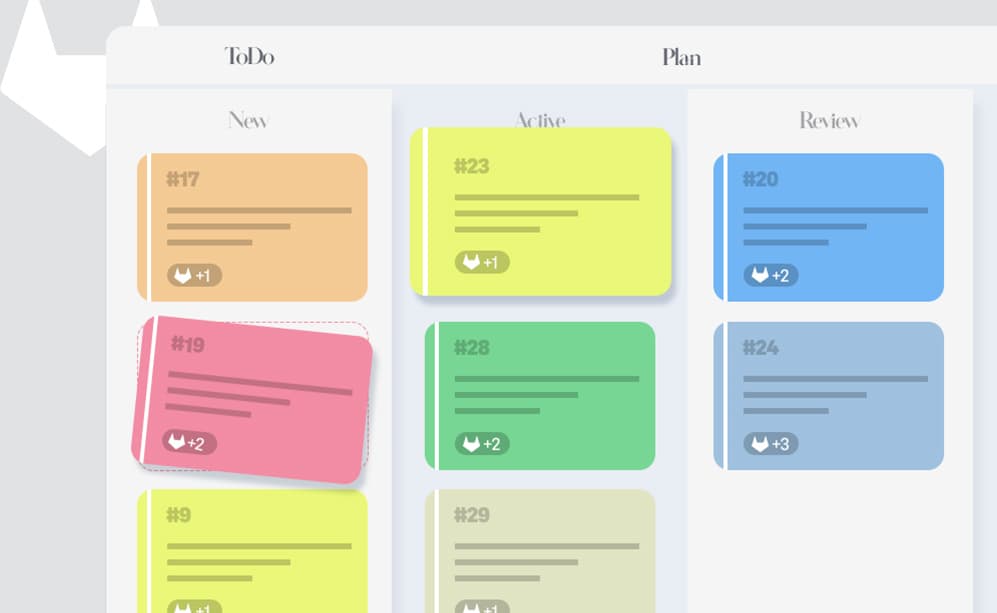
#### 5. Managers of One - Managers themselves
GitLab's management approach is also unique.
Being in a fully remote environment, managers are not able to sit next to their team members and give detailed management and direction. Therefore, each employee is expected to have the mindset that he or she is his or her own manager and to take leadership and ownership of the company. However, the foundation of management lies in the self-leadership and self-direction of each member.
Since employees are evaluated based on their performance, not on the length of their working hours, there are no set rules for how to spend the day, and time management is left to each individual employee. Managers are not expected to micromanage their members, and "managers should not mention working hours unless they are concerned about members working long hours," says CEO Sid Sijbrandij. [^6]
Rather, GitLab managers' primary job is to care for members, encourage and motivate growth, and facilitate asynchronous processes. While the company does not necessarily encourage synchronous meetings, it does recommend weekly 1-on-1s between managers and members, which suggests that the company places a high priority on achieving the above through 1-on-1 consultations and chats.
General management tends to be micromanagement, such as giving instructions to team members and managing tasks based on the premise of synchronous work. However, the most important job of a manager at GitLab, which is asynchronous and fully remote, is to help/support team members, and I feel that servant leadership is required.
#### 6. Informal Communication - Various mechanisms to induce interaction
One of the concerns about working full remotely is employee mental health, such as burnout and isolation, and GitLab consciously incorporates designs that encourage interaction and informal communication among members to prevent these issues.
Examples include
- Coffee chat: We encourage active, casual communication. The pairing application Donut can also be used to randomly pair employees with each other, allowing paired employees to communicate with people they would not normally interact with through 1-on-1 chats and self-introductions.
- Informal Slack channel: Many channels are created in Slack for different hobbies and themes, and communication related to hobbies and themes occurs on a daily basis.
- Social hour: Lunch meetings using Zoom, pizza parties, and question time where people can freely ask questions to the management[^6].
- Team DJ Zoom Room: A DJ room is set up in Zoom. Members who listen to the DJ can gain a sense of unity and communication by listening to common music with other members while immersing themselves in their work.
- Coworking call: People gather online at set times to collaborate on the same task, or to chat while working.
In a remote work environment, communication is often low, and it is difficult to establish on/off boundaries, which can lead to poor communication and overwork. At GitLab, many unique systems encourage communication, interaction, and serendipity outside of work to help prevent these issues.

## Conclusion.
In a 2017 interview, when asked, 'What is the hardest part of running a fully remote company?' Sid Sijbrandij immediately responded, 'Fundraising'. It is interesting to note that when asked, "What is the hardest thing about having everyone work remotely? At the time, many investors were concerned that working fully remotely would be detrimental to the growth of the organization, and they had a very difficult time raising funds. [^7]
Gitlab's Secret to Managing 160 Employees in 160 Locations - Y Combinator
https://www.youtube.com/watch?v=e56PbkJdmZ8
Now that remote work has become a civil right after the Corona disaster, it is presumed that it is accepted differently than it was back then. However, GitLab's advocacy of "all remote" and the corporate design and culture that makes it a reality may not be something that everyone can easily accept and imitate.
For example, many employees will need to be familiar with the concepts of git and branching, GitLab (product) operations, communication tools such as Zoom, and a certain degree of familiarity with technology. In fact, he says that the process of handbook revision using a combination of Markdown and Merge requests is not for everyone. [^5]
Since textual communication will be the main focus, writing skills to write documents concisely and understandably, as well as care and concern for expression, will be essential in all communications. This is also not something that everyone can do easily from the start, and requires a certain amount of training and familiarity.
In addition, because it is difficult for managers to control and monitor employees (and they are not supposed to do so in the first place), employees are placed in an environment where it is easy for them to slack off, in a sense. Each employee must have the ability to discipline and motivate himself/herself to achieve high performance, as well as the self-discipline to maintain his/her own health and mental health.
It will be interesting to see how GitLab's fully remote and asynchronous corporate design will manifest itself in its PLs and KPIs, and how it will differentiate itself from the competition. As far as we can confirm from the company's disclosures, it has posted a net loss for three consecutive fiscal years, and is now in a phase where its true value will be tested amidst the headwinds of the macro environment. (Like other tech companies, it announced layoffs (equivalent to 7% of its total workforce) in February 2023[^8])
On the other hand, GitLab's competitive edge in recruiting through full remotes, low-cost operations due to no offices, and efficient operations enabled by handbooks, etc., are major competitive advantages that competitors cannot easily emulate. In fact, the company's ratio of selling, general, and administrative expenses (as a percentage of sales) is trending downward compared to when the company was unlisted, and may become even more effective through further penetration and improvement. We will continue to monitor the company's future trends closely.
We have introduced GitLab's unique corporate design and management approach, in which all employees work fully remotely. We hope this article has provided you with an opportunity to consider the next generation of organizations and how to create an environment that maximizes individual performance.
#### References
- [GitLab: Can "All Remote" scale?](https://publishing.insead.edu/case/gitlab) / INSEAD
- [GitLab and the Future of All-Remote Work](https://www.hbs.edu/faculty/Pages/item.aspx?num=57917) / Harvard Business School
- [GitLab: work where you want, when you want](https://link.springer.com/article/10.1186/s41469-020-00087-8) / Journal of Organization Design
[^1]:GitLab Inc. / [Form S-1](https://www.sec.gov/Archives/edgar/data/1653482/000162828021018818/gitlab-sx1.htm)
[^2]:GitLab Inc. / [Celebrating 3,000 wider community contributors](https://about.gitlab.com/blog/2020/06/23/3000-contributors-post/)
[^3]:GitLab Inc. / [Investor Presentation Fourth Quarter Fiscal Year 2023](https://ir.gitlab.com/static-files/1904832e-2514-464b-9430-47acef5fd2d5)
[^4]:GitLab Inc. / [GitLab Handbook](https://about.gitlab.com/handbook/)
[^5]:Developers Summit 2022-02-18 / [GitLabで学んだ最高の働き方](https://learn.gitlab.com/c/gitlab-presentation-developers-summit?x=JBqxmQ#page=1)
[^6]:リクルートワークス研究所 / [フルリモートワークを導入するためのノウハウ、マニュアルを公開](https://www.works-i.com/project/remote/case/detail002.html)
[^7]:Gigazine / [社員全員が世界各地でリモートで働く「GitLab」はなぜ創業2年で160人まで規模を拡大できたのか?](https://gigazine.net/news/20170213-gitlab-160-employee-management/)
[^8]:GitLab Inc. / [An announcement from GitLab CEO Sid Sijbrandij](https://about.gitlab.com/blog/2023/02/09/gitlab-news/)
---
# Beyond Short-Term Revenue: How SaaS Drives Lifetime Value and Transformation in Large Enterprises | Hiro Maeda, ALL STAR SAAS FUND
URL: https://route06.com/insights/24
In this series, we discuss what is necessary for major companies to transform, including digital transformation (DX), from a venture capital (VC) partner's perspective. In this third installment, we feature an interview with Hiro Maeda, Managing Partner of ALL STAR SAAS FUND.
Maeda, who runs a venture capital firm specializing in SaaS, says, "SaaS provides an opportunity for change." What role does SaaS play in the transformation of major companies, and what should we be aware of when collaborating with startups? We will now take a closer look at Maeda's theory on the transformation of major companies.
## The Role of SaaS in Advancing DX at Major Corporations
#### --How do you view the current state of DX at major Japanese companies?
First of all, I believe that there are three major phases of DX.
Phase 1 involves making products and services available for purchase online. Phase 2 focuses on eliminating paper from internal workflows and digitizing as many company operations as possible.
With the Corona Disaster as a catalyst, most companies have been able to put Phase 1 products and services online, and I believe that the use of this technology has spread rapidly over the past few years. It is now possible to purchase many products and services online or make reservations.
I believe that many companies that are developing their business based on the Internet are in Phase 2. However, companies that operate in the "real world," such as in the medical and manufacturing industries, are still primarily paper-based, and I believe that they are in the process of gradually shifting their workflow to digital.
As for Phase 3, I believe that companies that have started up as digital-first, cloud-native companies have already achieved this, but I feel that most companies that are developing their business from a real place are just beginning to think about moving toward Phase 3.
#### --So you are saying that digitalization has only just begun. In light of that, do you think there are still many issues to be addressed?
There are numerous challenges. Service vendors and SaaS startups supporting DX for major companies need to provide appropriate support, ensure customer success, and design services that accurately address the needs of large companies. This area still has significant room for growth.
Currently, most SaaS is for small and medium-sized companies, and even if it is for enterprises, it is a situation where only a limited portion of a huge amount of work is being SaaS-ized. In other words, it is safe to say that there is not yet a service vendor or SaaS startup that fully meets the entire workflow digitization needs of large companies.
In the future, as major companies move forward with DX, it will become more important to have an entity that can meet the digital needs of large companies in a broader scope.
#### --Over the past few years, a number of SaaS startups have sprung up; what do you see as the role and potential of SaaS startups in the DX of large companies?
SaaS startups are prompting companies to rethink their current business practices and identify areas for future improvement. In addition, SaaS startups design and develop their products while talking with many customers, so they are accumulating more and more best practices. For example, if we provide a product that specializes in the construction industry, we know what workflows are unique to that industry, where many companies have issues, and how to solve them.
Such know-how is accumulated and reflected in the products, so customers can learn about cutting-edge best practices and imitate the best parts. In that sense, I think SaaS startups provide an opportunity for evolution.
If the services are successfully implemented, they can improve the efficiency of business operations. For example, we have actually seen companies that we have supported reduce their man-hours by 10% or increase their profit margins by 2-3% by adopting their services. I believe that SaaS startups can be like partners in creating better services.
## Difference between Japan and the U.S. IT people are the ones who should go to non-IT areas.
#### --The ALL STAR SAAS FUND was launched in June 2019. I don't think there was a SaaS-specific fund at that time. What did you see the potential in SaaS, Mr. Maeda?
The main reason we launched a SaaS-specific fund was because we felt the inevitability of SaaS becoming more popular. Currently, the SaaS penetration rate is said to be around 10-20%, but based on the momentum and market needs over the past few years, I believe that this number could go up to 50-70%.
And a big part of that is that I strongly believe that SaaS is the ideal model for B2B software purchases. There are various ways to purchase B2B software, such as on-premise or packaged software, but a subscription or pay-as-you-go based fee structure, as represented by SaaS, is the most consistent. For both the service vendor and the customer, the SaaS model is the most beautiful. I believe that this model will continue to exist for the next 100 or 200 years. That is why I launched the fund, thinking, "I am willing to spend 100 years in this area.
#### --What do you think is necessary to increase the SaaS penetration rate?
The SaaS companies that provide services must evolve to meet the needs of their customers, and the customers must become more proficient in using SaaS. I think that the SaaS penetration rate will come close to 100% when both sides work together to solve problems, rather than when it is an issue for one side or the other.
The impact of SaaS on a company's profits is huge. We have seen cases in the past where simply introducing a service can increase operating profit margins by several percent. If you introduce services that lead to increased business efficiency and sales, you will be able to increase your profit margin even more. This would also create opportunities to create new business.
#### --Are there any differences when compared to other countries?
There are differences from country to country. Focusing on the U.S., one difference between the U.S. and Japan is the "job market for IT personnel. In the U.S., many IT professionals are employed in non-IT areas such as food and beverage, manufacturing, and medical care, etc. In Japan, most IT professionals work within IT companies, leading to a lack of IT literacy and skills in non-IT sectors. This gap likely impacts SaaS and software penetration rates. In that sense, it is important for Japan to have more IT personnel enter the non-IT domain.
## Unlearning is necessary for the transformation of major companies
#### --Major companies can not only introduce SaaS, but can also find ways to create their own SaaS-like businesses. If so, what should they consider?
The most important point about SaaS is that the product or service itself evolves along with the customer, rather than being created once and then left behind. SaaS must be designed based on the basic premise that it will continue to evolve and be refined.
Another thing is to think from the perspective of "how much lifetime value can we provide to our customers" rather than "how much sales can we generate in a short period of time. Can we provide greater value over 10 or 20 years or have a greater impact on society than 10 million yen in sales in one year? I think we should design our services and fee structure based on this kind of thinking.
I think that we should consider these points comprehensively and then decide whether to introduce SaaS or create it ourselves. Companies with long histories and successful track records may struggle to innovate. In these cases, creating a new SaaS business in-house requires 'unlearning'—letting go of past successes and embracing new approaches.
#### --What are the key points to be aware of when major companies and startups collaborate?
From my perspective, understanding each other's mission is crucial.
Startups have a mission to strengthen their own foundation in addition to expanding their business and making a positive impact on the world. They do not want to deviate from the strategies they have established based on these missions as much as possible. That is why it is important for us to have strong relationships and cooperative systems with major companies that are our customers.
In order to achieve good cooperation, mutual consistency is more important than anything else. I think it is very important that the direction that the startup and the major company are heading in is consistent and that a win-win relationship is created. If one of them is lacking, it will basically not work. I believe that collaboration will proceed more smoothly if both parties have an understanding of what each other is aiming for and the prerequisites, such as flexibility and commitment.
---
# The Core Principles of XaaS: Insights from Adobe's Cloud Strategy
URL: https://route06.com/insights/25
As we discussed in our previous article [Types and Benefits of XaaS](https://route06.com/insights/21), XaaS benefits both providers and users, and it is natural to view the trend as now irreversible. The first step toward XaaS is to shift the emphasis to the realization of user value by offering products as services, rather than selling them on a sell-out model.
Similar to the shift to XaaS is the billing structure for digital advertising. Over the past 20 years, we have seen an evolution from banner ads, which were measured by CPI (Cost per Impression), to CPA (Cost per Action) ads, which focus on specific actions like installing an app or opening an account. Nowadays, with the use of AI and machine learning, mainly by large media companies such as Meta, we are seeing an evolution to oCPA (optimized CPA) advertising and more.
As with digital advertising, a business transformation is beginning to take place, shifting the center of gravity to what users essentially want, centered on software. In this article, we will review the case study of Adobe's shift to the cloud, and then review the key points of the shift to XaaS.
### Adobe's Cloud Conversion
As a typical example of a company that has achieved XaaS in a very short period of time and won the fruits of XaaS, we will focus on Adobe, which is well-known for its Creative Cloud.
We will look at the challenges they faced, how they approached them, how they moved toward realization, how they communicated externally, and the results they achieved. In this article, Kara Sprague, Principal at Mckinsey SF, interviews Mark Garrett, CFO and Dan Cohen, VP of business operations and strategy at Adobe ["Reborn in the cloud"](https://www.mckinsey.com/capabilities/mckinsey-digital/our-insights/reborn-in-the-cloud).
#### Summary
```
After the Lehman Brothers collapse
After the Lehman Brothers collapse, Adobe had a head start in sales volume and managed to improve sales by increasing prices. After discussions among management, strategy, finance, and business leaders from various perspectives, the company quickly transitioned to a cloud model.
The move to the cloud model affected all aspects of the product, engineering, and business. In product, we had to listen to our users and continue to build relationships with them, and in engineering, we had to revamp our infrastructure to deliver our products in the cloud. Finally, on the business side, due to the change in revenue timing, it was also essential to design incentives and address accounting and investor relations.
As a result, the entry-level model and upgrades have resulted in a wider user acceptance than in the past. In addition, the resulting subscription nature of the business established a highly predictable revenue model. The stock price more than tripled, sales growth increased from single digits to over 10% annually, and recurring revenue surged to 70% in 2015, up from 19% in 2011.
```
## What Adobe's Case Study Can Teach Us About Going XaaS
Many companies that sell some kind of product, like Adobe in the past, may have experienced a situation where the number of units sold has reached a plateau and the only way to increase sales is to revise prices or launch a new model.
These days, due to the evolution of devices and diversification of needs, the changes in the market related to product offerings are only intensifying. The case of Adobe, which has seized this change and steered the company toward the cloud, offers a great deal of learning.
#### 1. XaaS conversion is a top-tier business transformation
XaaS is not something that can be implemented in a short amount of time, but should be viewed as a top-tier business transformation. Converting a product offering to a subscription model is more than a simple change in business model. It involves significant product, engineering, and business changes that require in-depth risk assessment and internal and external communication.
The XaaS transition will also require changes to the organizational structure. As with new businesses, it is not something that can be successfully implemented by assembling a dedicated team, but rather requires a strong PMO with personnel from relevant departments under the direct supervision of management. Also, significant changes will need to be made to the offerings through the cloud, and the skill set within the team will need to be expanded by hiring people with a variety of skills, not just internal transfers.
#### 2. Build ongoing relationships with users
It is not enough to convert everything to XaaS. First, you must identify whether there are true user needs that are not being captured by the sell-out model, and then you must evaluate whether it makes sense to offer these needs in the cloud.
After XaaS, unlike the sell-off model, it is necessary to build an ongoing relationship with the users. It's not enough to capture user needs just once; you must continually address user issues, articulate user value, and refine the product accordingly.
In response to this, the source of competitiveness is to continuously maintain contact with users, obtain feedback, and enhance the product. For example, it will be necessary to establish user communities and other points of contact with users, and put in place a system to manage them.
#### 3. Providing products through the cloud
To deliver products via the cloud in a timely manner based on user needs, significant engineering changes will be required.
First, instead of having the product downloaded to the end-user's PC and operated locally, it will have to go over the Internet and be operated on a browser or application. To make this happen, protocols that can provide user authentication and usage are required, and security, availability, redundancy, and DR (disaster recovery) support are to be guaranteed by the provider.
In addition, since the continuous pursuit of user value requires the adoption of agile development models, such as Scrum, for development methods. This approach will allow us to update the product with each development project and deliver benefits to users through additional functions and modifications.
#### 4. Adaptation to Subscription
From a business perspective, the change from a sell-by-sale model to a subscription model can be viewed as a change in revenue structure. With this change, the focus of business evaluation shifts to Annual Recurring Revenue (ARR) rather than sales trends. Although many SaaS companies have gone public in recent years, business valuation based on ARR is still not universally adopted. Therefore, when major companies convert to XaaS, it will be important for them to visualize and report not only the content of their business, but also how it is appropriately evaluated and what results are achieved based on the evaluation criteria.
In addition, the incentive design will be reviewed for each sales channel in line with the revenue structure. In addition, we will support user adoption, track utilization, and bill accordingly. Business operations will also need to be built and managed in line with subscriptions.
#### 5. Risk Assessment and Communication
There are risks associated with XaaS. If what was previously offered on a sell-by-sale model is now offered on a subscription model, sales and profits will certainly decline during the transition period, and the stock price is likely to drop as a result of these changes. When considering the lead time and feasibility of transitioning to XaaS, as well as how it can improve sales and profits compared to the past, it is essential to evaluate several factors. Metrics such as ARR and Unit Economics that properly evaluate these factors must be prepared and disclosed in a transparent manner.
Only by steadily completing these five points with a high degree of accuracy can XaaS conversion be achieved. While revenues may initially decline, offering a broader range of plans compared to a traditional sales model will deliver value to a larger user base. For example, introducing freemium as an entry-level plan can expand your user base tremendously. And, by offering seamless upgrades, you can also increase ARPU.
It is not an easy transformation, but this process allows you to build an ongoing relationship with your users through subscriptions, ensuring a predictable revenue stream.
### Conclusion.
The proliferation of XaaS is irreversible. If we view the shift to XaaS from a company that has adopted a sell-by-sale model, it will require a level of transformation that will turn the entire company upside down and restructure it. When converting a business that recognized sales at the point of sale to a subscription model, sales will undoubtedly drop in the short term. Of course, if you get the XaaS conversion right and transform it, as Adobe has done, you can evolve your business qualitatively.
XaaS requires a commitment and ability to execute from the product, engineering, and business perspectives, and to continue to provide valuable services to users.
#### References.
- [Reborn in the cloud](https://www.mckinsey.com/capabilities/mckinsey-digital/our-insights/reborn-in-the-cloud)
- [Accelerating agility with XaaS](https://www2.deloitte.com/content/dam/insights/us/articles/4557_accelerating-agility-with-XaaS/DI_accelerating-agility_with-XaaS.pdf)
---
# 'Commitment to Excellence: Tackling New Business Ventures and Product Development with Takuto Seita of Mitsubishi Corporation'
URL: https://route06.com/insights/26
In the midstream area of the materials supply chain, including the steel industry, there are many distribution trading companies and wholesalers that stand between numerous buyers and suppliers and flexibly mediate transactions. Mitsubishi Corporation (hereinafter "MC") has launched [PaSS-Portal, a quotation and order placement platform](https://route06.com/news/22), as a digital product that supports the quotation and ordering process.
PaSS-Portal was launched in January 2023 for business use by Sumisho Metal One Pipe & Tubular Products Corporation ("MSTP"), an initial user, and is currently in the process of requesting joint use from MSTP's suppliers (e.g., piping equipment manufacturers such as fittings and valves).
In this interview, we asked Takehito Seita of Mitsubishi Corporation, who promoted the development of PaSS-Portal, about the difficulties he experienced in developing the product and how he overcame them, the innovations he made when introducing the product to each MSTP location, and the background behind the quick turnaround from concept to product release, which took only one year and three months.
#### Mitsubishi Corporation
#### Takehito Seita, Manager, Industrial Materials DX Department, Materials Solutions Division, Integrated Materials Group
````
Seita joined Mitsubishi Corporation in 2013. Assigned to the Steel Products Division, he was seconded to Metal One Corporation from 2014 to 2019 and to Sumisho Metal One Pipe & Tube Corporation from 2019 to 2021. After a total of seven years of secondment, he returned to the Head Office in April 2021 and assumed his current position.
````
#### ROUTE06 Inc.
#### Professional Services Division Product Manager Yusuke Inui
````
He joined Recruit Communications Inc. in 2016, moved to Fukuoka in 2020 to work for LINE Fukuoka Inc. and participated in the Smart City Project. where he is in charge of product development for ``PaSS-Portal.
````

## When the project was launched, "I was brave and prepared with my colleagues."
__Inui__: The Integrated Materials Group to which you belong, Seita, is engaged in sales and trading of various materials, business development, and business investment for industries such as automobiles and construction infrastructure.
__Seita__:Within the General Materials Group, the Industrial Materials DX Task Force, to which I belong, is an organization that develops and provides digital services that contribute to improving efficiency and quality mainly in the area of distribution. I began researching the subject when I was assigned to the topic of "digitization of ordering and transaction documents" in August 2021.
We found that the "transaction intermediary work," as typified by MSTP's Piping Equipment Division, which stands between numerous buyers and suppliers and handles a huge volume of quotations and orders on a daily basis, is extremely complicated work that involves Excel, handwritten work, and managing printed paper in clear files. We realized that the "transaction intermediary work," which involves handling huge amounts of quotations and receiving and placing orders on a daily basis, is a very cumbersome process that involves Excel, handwritten work, and managing printed paper in clear files.
__Inui__: What were some of the difficulties you encountered in formulating a hypothesis based on your findings, and in thinking about how to tailor a solution? How did you overcome these difficulties?
__Seita__: Initially, I found it challenging that what I saw as problems were not necessarily seen as such by the people directly involved. Under such circumstances, I was careful to make sure that all MSTP members who wanted to participate in the development project as initial users made their own decision to participate in the project. This was my first time developing a digital product, and I felt that in order to thoroughly and deeply investigate users' needs and consider the best solution, we needed to involve the initial users from the development stage, and we needed people who would seriously engage in that deep investigation and consideration.
__Dry__: It must have been difficult to make the decision on your own. How did you move forward?
__Seita__: I thought that we had to work steadily and carefully on this matter, and since my initial proposal to the MSTP Plumbing Equipment Division in October 2021, I have been conscious of avoiding a one-way response, and have carefully engaged in two-way communication with them. I have not only said, "I want to do it," but I have also asked them what issues they are facing on a daily basis, suggested that we look into existing products together rather than developing them, and at one point invited an outside lecturer to give a DX seminar. At times, I would invite outside lecturers to hold DX seminars. I always tried to think together with them so that they would see me as a colleague who wanted to improve something together.
At the end of January 2022, four months after the initial proposal, the MSTP side officially announced, "As you proposed, we would like to work on the development of a digital product with the theme of quotation and order receipt/placement. I remember how happy I was when I was informed that the 10 members who wanted to participate in the project had been selected. I immediately contacted ROUTE06, who had been informed of the contract offer, and said, "Thank you for your patience.
__Inui__: Indeed, I remember well that when Seita approached ROUTE06 in the fall of 2021, it was a toss-up as to whether or not everyone would work together as a team, and that was really where we started.
__Seita__: Yes, that's right. But it is precisely because we did everything right in the beginning that we are here today. I think now that it was not a bad thing that we had the courage to create the timing for everyone to make a firm commitment, rather than just starting out without a clear idea of "who wants to do this".

## Listening to the smallest voice to refine the product
__Dry__: PaSS-Portal is a project that involves a very large number of people, but is there anything that you have tried to do to ensure that all stakeholders can contribute their values?
__Seita__:There are two key approaches. First, creating a positive atmosphere was crucial. Some of the 10 MSTP project members were concerned about the project's potential lack of results, and they worked very hard on steady tasks such as inventorying the workflow and surveying man-hours while performing their daily duties, so I think the workload was quite heavy. I think it was a considerable burden on them. In response to such burdens, both physical and mental, he said, "Let's all encourage each other to do our best! I myself am anxious all the time, but let's work hard enough to enjoy the experience of overcoming these anxieties! I tried to motivate them.
Secondly, although it may sound a bit formal, it is important to clarify the "position" of each company involved. For example, MSTP's position was to "maximize the efficiency and quality improvement of its quotation and ordering process," while our company's position was that while we wanted to create the best product for MSTP's initial users, we "could not provide them with overly specific functions" in order to expand the number of users later on. We wanted to create the best product for MSTP's initial users, but we also wanted to expand the number of users later on.
These "differences in position" were not only due to differences in companies, but also due to differences in positions and the nature of the transactions they were in charge of, which sometimes led to heated discussions in defining requirements. Even so, the project members tried to discuss the issues as much as possible until they reached a consensus, while respecting the differences in their positions.
**In the end, I think we were able to design a product that everyone involved was satisfied with. What were you conscious of when designing the product with the involvement of the intended users?
__Seita__: It's a mentality, but I think the key is to pick up even the smallest voice.
Among the MSTP project members, there are those who are good at communicating in words what they feel are the issues and the functions that provide solutions, and those who are not so good. If the product design is biased toward the opinions of those who are good at it, it will not be a product that users with subtle differences in business procedures can utilize.
A typically quiet member might say, 'If we design it this way, it might not work well for the transactions I'm responsible for...' and then bravely voice their concerns. Sometimes I actually thought, "We were just about to come to an agreement, but.... However, I believe that because we made an effort to pick up on such small voices and address them, none of the 10 project members left the project and we were all able to welcome the release of the service together.
__Inui__: I have been working with the project members since February 2022, opening the workflow and deciding on specific requirements, and I can see the change in the mindset of all the project members, and I can see the importance Seita placed on facing each person's voice and refining the product. I could see the change in the mindset of the project team members, and I felt that it was a reflection of Seita's emphasis on refining the product by listening to each individual's voice.
__Seita__: They also said that they had never been conscious of how their work flowed and how it differed from that of their neighbors, so I think that what they gained during the development process must have been significant.
__Seita__: While all the project members made great contributions, I think the introduction of PaSS-Portal is a story for the whole MSTP company. How did you approach the management on whether or not to introduce or develop PaSS-Portal?
__Seita__: This was a really difficult issue, and since the theme was the digitization of field operations, we had a hard time choosing the right words to express our feelings and make them understand. However, the fact that 23 sales teams (about 200 people) from the entire Piping & Machinery Division decided to use the system in the first year is not because of anything special I did, but rather because the 10 project members' passion and willingness to take on new challenges pushed the executives to do so.
__Dry__: How did you proceed with the actual introduction of the system?
__Seita__: Together with the project members, I visited all the teams and talked to them. What we tried to do was to tell everything without hiding anything. I may be overthinking it, but I tried to emphasize that "this is your project, being undertaken on behalf of your colleagues," and to answer all the questions and concerns that I had, so that there would be no misunderstanding that "this is something that some people at the head office got excited about and decided on their own, isn't it? It has now been less than three months since we started using MSTP, and we are very happy to see that each of our sites is actively using PaSS-Portal.

## Released in 1 year and 3 months. The secret is to "clarify the theme and goal by dividing it into phases
__Inui__: Seita-san, you were in the role of product owner for PaSS-Portal.
__Seita__: I had a lot of discussions with Inui-san about what the value of the product was, how it differed from other services, who the target audience was, and what problems it would solve. What gradually became clear was that we needed to cover the entire transaction process from start to finish, including quotation, order receipt/placement, delivery, and invoicing.
I myself was thinking of starting small, limiting it to quotation work, but at the strong request of the project members, we decided to design a product with functions for quotation, order receipt/placement, delivery/invoicing, and chatting. This was a very big decision that required a huge amount of design work, but looking back on it now, I think that the fact that we were able to incorporate a product that provides this customer experience from a Minimum Viable Product (MVP) was one of the most appealing features of PaSS-Portal. I think it was one of the most attractive features of PaSS-Portal.
__Inui__: While MVPs are often noted for delivering value in their most basic form, in this case, the minimal viable product provided comprehensive transaction capabilities from start to finish. What do you think was the key factor that enabled you to realize the service from conception to release in only one year and three months?
__Seita__: One key factor was dividing the project into distinct 'phases' and setting clear themes and goals. This approach ensured that everyone involved shared the same understanding that we would not let the project drag on indefinitely. Phase 0, which focused on the planning concept and team building, lasted four months from October 2021 to January 2022; Phase 1, which focused on the concrete realization of the concept and trial calculation of its effects, lasted three months from February to April 2022; and Phase 1.5, which involved reaching an agreement and decision on whether to develop the project, lasted one month in May of the same year. The time frame and goals were clarified as follows.
The second reason was that ROUTE06 did its best to meet our request to start using the system for business operations in January 2023. The speed with which they completed the development of the product, including testing, in seven months, which included all the functions of the transaction series, also contributed greatly to our success. In addition, Inui did not just "accept" the functionality requests raised by the project members, but rather, after digging deeper into the essence of the request and its impact, he proposed the best implementation method from among multiple options. He also carefully explained the pros and cons of each option and the degree of difficulty of implementation, which made it easy for us to make a decision, and we believe this was a major factor in the speedy product design and development.
__Inui__: Whenever we received requests from project members or people actually working on the project, we discussed with them what was behind the request, how to solve it fundamentally, or what should be covered in operations.
__Seita__: It was all a series of such discussions.
__Inui__: During the weekly meetings, we would identify the issues to be discussed, and then we would discuss what we would do about this function or this requirement. Thanks to all the discussions, each project member could talk about the product in his or her own words, and Seita himself could deeply understand why this feature was chosen.
## Suppliers, distributors, and buyers, toward a trinity platform
__Inui__: Now that the product has been released, you are in the process of testing it in actual operation.
__Seita__: I am relieved to see that the product is being actively used at all of MSTP's offices in Japan. We receive requests for functional improvements from users on a daily basis, and we are working hard to respond to them, but just the fact that we are receiving such responses is proof that they are using PaSS-Portal and that they are looking forward to the increased convenience. I am very grateful for that.
One of the unexpected responses we have received is that many people feel it is a great advantage to share and accumulate the progress and history of projects within the company. I had imagined that many people in the piping equipment trade are craftsmen who "only become a professional when they accumulate experience on their own," as the trade is a highly specialized field. I was surprised to learn that there are many people who find value in strengthening the organization and flexibly assigning roles through information sharing, and I feel a positive response.
__Inui__: What kind of vision do you have for the future as you further refine your products?
__Seita__: Our current challenge is to increase the value of PaSS-Portal for MSTP by having MSTP suppliers use PaSS-Portal. Since we started working on the concept, we have interviewed suppliers of piping equipment such as fittings and valves, and have received many positive comments and supportive feedback. We have heard that not only distributors like MSTP but also suppliers are facing issues such as complicated manual work and paper-based management, and we would like to help them determine how to use the system in a mutually convenient way and start mutual use together with each company.
We would also like to make PaSS-Portal widely known and considered for use by potential users who, like MSTP, are interested in digitalization of quotation and order receipt/placement. If you are doing business with the same suppliers as MSTP, we believe that it will be mutually beneficial for both parties to be able to see the transactions requested by MSTP and those requested by other users on the list of transactions. Our goal is to create a world where many distributors and suppliers, regardless of industry or products handled, are connected through the PaSS-Portal.
In terms of functional expansion, we envision the evolution of PaSS-Portal into a platform that links not only current distributors and suppliers, but also buyers, or customers for distributors. We have begun to consider what functions should be provided in order to create a place where buyers, distributors, and suppliers can work in unison and comfortably promote transactions in a one-stop manner.
## Be aware that you are a "beginner" when you start a new business
__Quan__: What do you think is important for a major company to consider when launching and refining a product as a new business or service?
__Seita__: Rather than the size of the company, I think it comes down to "thoroughly listening to the voices of potential users," as a matter of course.
In our company's long history, we have launched many new businesses, but as we work on new businesses and services, we must be aware that we are always "beginners" in this area, and that we cannot simply create what we want to create and expect people to use it. I believe that we must be aware that we cannot just make what we want to make and expect people to use it.
We must first focus on creating products that people are willing to pay for and use, and I believe that the best and shortest way to achieve this is to "talk to people who are willing to use our products. After establishing this as our unwavering axis, I believe that bringing additional ideas to the table, proposing and discussing such features, will lead to the provision of value that exceeds the expectations of potential users. I believe that any new service, and whether B2C or B2B, will ultimately be used by a specific individual. I feel that it is important to imagine the faces, actions, and thoughts of the people you want to use the service and how clearly you can incorporate them into the design of the service.
__Inui__: I also feel that Seita was very conscious of the value of what kind of service he was providing and to whom, and that he went to talk to the people he wanted to use the service and worked in the same direction as the people involved.
*Photo by [Hiroaki Otake](https://hiroakiotake.com/)*
---
# Nissan and Shiseido's Reformer: Lessons from the 'Professional Manager' for Young Leaders — Insights from Mitsuru Kameyama
URL: https://route06.com/insights/27
He worked on global projects at Nissan Motor Company ('Nissan') during the transformative period under Carlos Ghosn. Alongside Masahiko Uotani, a renowned professional manager, he helped transform Shiseido into a globally competitive company known for its quick decision-making. He also spearheaded digital transformation (DX) at Mitsubishi Materials Corporation, a major manufacturing firm with a long history, during the COVID-19 pandemic. Mitsuru Kameyama, a Senior Executive Advisor at Gloving and President of Conepositive, has played a key role in supporting critical reforms at leading Japanese companies from an IT perspective.
In promoting reform, Kameyama places importance on "clearly stating the ideal image of the company or organization and the value axis that needs to be changed in order to realize it," "being prepared to seriously carry through with determination," "involving colleagues to fight as one," and "supporting the challenge and not blaming failure. What project experiences did Mr. Kameyama encounter, and what lessons did he learn from professional managers that made him value these principles?.
## A spectacular project experience that formed the core of a reformer
#### ─ In your interview with Kameyama, the words "determination" and "seriousness" often appear. What kind of project was the first time you experienced the "determination"?
The first project that tested my resolve was a telematics car project during my time at Nissan. Today, it is commonplace to link cars and IT, but when I was assigned to this project more than 20 years ago, the field was still in its infancy, and it was difficult to even imagine what the service would be like. It was at that time that I was assigned a project to link cars and IT. At the time, the automotive industry was at the dawn of a new era, and various alliances were emerging. One such project was led by General Motors (GM) of the United States. The company had launched an in-vehicle telematics service called OnStar, and Toyota was to participate in the project.
At the same time, Ford, a major U.S. automotive company, announced that it would launch a similar service, and Nissan was to work with the Ford camp to promote the use of IT in cars. I was appointed to lead this global project. The project was to equip cars with devices to receive and display communications, and to communicate with a communications center developed by Ford, so that information useful for driving and information about the city could be obtained inside the car. The project was led by Ford and involved various automobile companies, including Renault and Nissan.
Among them, Nissan was developing the car with the goal of becoming the world's first company to implement the service. Working together with the research, development, and sales teams, and with the desire to "make the world more interesting with a new service that does not yet exist," we overcame many hardships and finally managed to launch a telematics-enabled car in the United States in August of 2002.
However, in 2002, Ford's management deteriorated, the top management was replaced, and the company announced a policy to focus on its core business. I had a bad feeling about this, and in June Ford decided to liquidate its telematics service company. Nissan's telematics cars had been developed on the premise of Ford's system, and if this situation continued, the in-vehicle equipment we had worked so hard to develop would become useless. When I explained the situation to Carlos Ghosn, who was COO at the time, he said, "Do something. I told him, "Go talk to GM and ask them to let us use their services. Go talk to him today," he said recklessly (laughs).
(Laughs.) "There is no way we can bow down to a company that was our rival and have them respond immediately. I thought to myself, "This is a bad situation," but I knew that if I didn't do something, my investment of tens of billions of yen would go down the drain, and above all, the equipment that I had worked so hard to develop with my colleagues would be wasted. At that time, I was really cornered and in a situation where I had no choice. However, it was thanks to my fellow project members that I was able to avoid being crushed by a sense of doom and gloom. There was no way I could change this situation by myself. No matter how much energy I put into it, I couldn't make a proposal by myself. Then I had no choice but to involve the people around me.
I thought, "I have no choice but to involve the development team, the research institute, people in the sales department, outside experts, and people from partner companies (......) and work together with them. I know we are in an untenably difficult situation, but we have to do whatever we can. But we have to do whatever we can. From then on, the whole team worked together to come up with a solution, and I spent many days fighting my way from one negotiation to the next, flying from one plane to another.
However, despite our determination and continued negotiations, we were ultimately unsuccessful, and the project with the global giant was terminated. The project thus ended in failure, but I believe I learned a number of things from this experience that will guide me later as a professional. One is to "not blame the failure of a challenge, but learn from it.
In fact, when this project was over, the vice president from Renault, who was my boss at the time, said to me, "We have to stop here. We must not stop here. We must not stop here, because in the future, cars will be equipped with IT, and what we did was not a mistake. We have gained a lot of knowledge and our team members are still here. We will find other partners and move forward with this initiative." Although the outside world sometimes blamed us for the failure of the project, my direct supervisor understood the true nature of the project. He then said, "Let's do our best for the future of Nissan.
Nowadays, we often hear the phrases "it is important to learn from failures" and "challenges are important" in the context of DX, but it is often not always the case that this is built into the company's mechanisms. But the Vice President of Nissan at the time was different. Without his words, I might not have recovered from my failure.
This incident made me resolve to become a leader who does not blame his subordinates for their failures, but rather says, "Let's learn from them together. I also believe that this incident symbolized the beginning of a change in Nissan's culture as a result of the capital tie-up with Renault. The other thing is the importance of being determined and working through a project with passion and earnestness. I felt a great sense of accomplishment when I was able to complete negotiations on a difficult phase of a global project with my title as section manager, and even though the project ended in failure, I accumulated a great deal of experience and a great sense of accomplishment. After this project, I became able to face even difficult projects without fear.
Even if I think a project is difficult, if I want to do it, I declare at that moment, "I will do it! and declare, "I'll do it! Then I make up my mind and get others involved. Not everyone will cooperate from the start, but I have learned through my experience with many projects how to explain things to people and get them interested. If you are not prepared and committed, it will be challenging to engage others in tough situations. I think it is important to clearly show the way forward, and to proceed with the project with determination and passion. I think this project helped me to formulate what I value in my work: not to blame others for my failures, but to learn and grow from them.
### ─ Did witnessing the moment when a company's culture changed so drastically change the way you think about your work afterwards?
I think so. Before the capital tie-up with Renault, Nissan Motors had a so-called hierarchical organizational structure, which is typical of Japanese companies with a long history. For example, when I, as a section manager at the time, wanted to propose something, I first asked the general manager, then the director in charge, and even if the proposal was approved and I could propose it to the management committee, I had to meet and negotiate with the directors beforehand. Even if the proposal was approved and presented to the management committee, the decision-making process took a long time because it required an intricate process of meeting and negotiating with the directors.
This process took a long time for decision-making. This changed completely once I took over the management of Renault. In a word, decision-making became logical and speedy. If it is clear what the project is for, what the benefits will be, and what needs to be done to realize it, then it is natural that the person who understands the project best, whether it is the section manager or someone else, should make the proposal.
The management team was consistent in its approach: if the proposal was logical and promised to contribute to the company's growth, they were willing to listen. Nissan's organizational culture changed dramatically during this period, and the speed of decision-making increased dramatically. I was truly amazed at the speedy decision-making process that changed from the long time it took to submit proposals to Ghosn, to the instantaneous e-mail to Ghosn upon electronic drafting, and the decision on "matters that Ghosn decides to take on" being made in one minute.
As you all know, these reforms led to the V-shaped reform of Nissan at that time.
## What I learned from a reforming manager
### ─ Kameyama, you have been promoting reforms together with professional managers who are known as reformers in the business world. What did you learn from them?
I was often surprised by the work of Ghosn, who came from Renault and became COO of Nissan. Looking back on it now, he was a logical person through and through. First of all, he was never a minute late for a meeting, always arriving at his seat 30 seconds before the meeting. He always calculated how much time he would waste if he was one minute late for a meeting, and how much it would cost the company.
For example, if a meeting is attended by 20 department heads, if I calculate the labor cost and the number of participants, I figure that if I make them wait for one minute, it will result in a loss of more than 100,000 yen. As far as I know, Ghosn was late for a meeting only once, and that was because the clock in the previous conference room was running late, and when he walked into the room two minutes late, the first thing he did was to bow and apologize for wasting everyone's time.
The meeting itself was very lean. At the beginning, you make sure "what is the place to decide today's meeting?" and by the end of the meeting, you are absolutely sure of what to decide. If it was not clear what needed to be decided, I would point it out, and if I did not have all the materials to make a decision, I would say, "We will decide tomorrow, so come back with all the materials you have. This way of conducting meetings has become the norm over the past 10 years or so, but I remember being very surprised because I had never seen a meeting that proceeded in such a logical manner at that time.
No matter what Ghosn did, he always thought through "what is the purpose of doing it," "for whom is it done," and "what value does it create? As I was exposed to this way of thinking, I began to think, "It doesn't matter whether I am a section manager or a general manager, I have to clarify the resources and tasks for what needs to be done and get it done.
### ─ While you were at Shiseido, you worked with Masahiko Uotani, a professional manager who has been involved in numerous corporate reforms. What kind of influence did he have on you?
I learned a lot from Uotani's reform methods. Uotani became president of Shiseido, a long-established cosmetics manufacturer founded in 1872, with the mission of "making Shiseido a company that can grow globally" and "making Shiseido a company that will last for the next 100 years. This task requires top management to change what needs to be altered while preserving the company's core values.
In conclusion, in the four to five years since Uotani became president, the company has gone paperless, English has become the official language, and a culture of not being afraid to take on new challenges, learning from mistakes, and taking on new challenges has become widespread. I think this is largely due to the fact that Uotani clearly presented the "ideal image of Shiseido in the future" to employees, always carefully explaining "what needs to be protected and what needs to be changed to realize it," and practicing this himself.
Before Uotani's arrival, Shiseido had a culture of taking on challenges, but projects were carried out steadily and carefully, with consensus among the people involved to avoid failure as much as possible. Of course, it is good to prepare and proceed carefully, but it inevitably lacked a sense of speed. In contrast, Uotani, immediately after assuming the position of CEO, formulated a policy of "First, let's try it, and then let's move on immediately. Immediately after assuming the position of CEO, he said, "From today, we don't need paper documents for management meetings. He also clearly stated the management style he wanted to implement, saying, "I don't want to use 'sir' in internal e-mails, but 'san' instead, He started working to change the organization into one that is flat and capable of speedy decision making.
In 2014, the slogan "Move, Shiseido! In 2014, Shiseido announced its medium- to long-term strategy "VISION 2020" under the slogan "Move, Shiseido. Don't be afraid of failure. The important thing is to try, fail, and try again.
What is amazing about Uotani is that he not only acts in this spirit, but also pushes his leaders and working-level staff to take on more and more challenges. We will not be able to achieve our goals if we continue with our current approach. In order to achieve "globalization of Shiseido," which is the key to achieving the goal, and "a corporate culture in which each individual works autonomously," we will change the culture that needs to be changed, and try to reach the goal at any cost, including "People First" initiatives to raise the potential of each employee and thoroughly bring out his/her own potential. We are trying to reach our goal at all costs. The level of commitment to accomplish this is extraordinary, and they never give up.
If something goes wrong with a measure, they immediately report it to us, we sort out the problem together, and as soon as we think we can solve it with a different logic, we gather the people involved for a thorough discussion and decide on a solution within a time frame of today or tomorrow, In any case, we move thoroughly and make decisions quickly. I was overwhelmed by Uotani's ambition to clearly show why Shiseido must change with facts and real voices, to push employees to accept the new culture, and to complete the globalization of Shiseido at any cost.
What Ghosn and Uotani have in common is their clear approach to communicating the need for a company to shift its value axis when necessary. To ensure continuous growth, a company may need to alter its organizational structure or business model. During such times, the "axis of values important for work" also undergoes significant changes. Both leaders share the ability to clearly explain this shift by comparing the company's ideal state with its current situation, encouraging employees, embedding the change throughout the organization, and establishing a new culture. This top-down process of guiding and instilling change is a shared trait of both leaders and is essential for a transformative leader.
## What is important to change a company with a long history
#### ─ Nissan and Shiseido were reforms in the form of top management from outside the company who came in from the outside and changed the company with strong leadership. I heard that Mitsubishi Materials Corporation, where you promoted DX (Digital Transformation) as CDO, was a different type of reform.
That is right. Nissan and Shiseido were reforms in the style of "change by external pressure," while Mitsubishi Materials was a style of "change from within" with a board of directors that was mostly made up of professionals. In that sense, it was indeed a different and more difficult task than in the past.
#### ─ What difficulties did you encounter in the course of the DX project that were different from those you faced in the past?
In some respects, it is more difficult to instill a new culture while leaving the top management and executive structure intact than it is to effect change from the top down by a president who comes from outside the company. Mitsubishi Materials is a company with a long history, founded in 1871, but it was promoting corporate reforms in the wake of the quality problems uncovered in 2017; DX was one of them, and I joined Mitsubishi Materials in February 2020 as the general manager of this project entitled "MMDX," and in April 2020, the DX I launched the DX Promotion Division in April 2020.
This project was a major undertaking, involving an investment of more than 40 billion yen over six years, with themes to be addressed from the perspectives of "strengthening customer contact points," "process collaboration," and "speeding up management. The policy was to change what needed to be changed for future growth while preserving the core values that Mitsubishi Materials had developed over its long history. However, the Corona disaster occurred while we were in the process of proposing this project. The main customers of the product-based business division, which was the main source of earnings, were in the automobile and airline industries, both of which had been severely affected by Corona.
We were just in the process of finalizing our proposal for MMDX, and gradually the atmosphere within the company began to change: "If things continue as they are, we will have a difficult financial year, so we need to cut our budget thoroughly starting in July and stop what we can stop. Since this is a company with a long history, they are very cautious there. On the other hand, our DX team was explaining the promotion of DX at the management meeting every week, but there were whispers of "If we haven't started yet, maybe we should stop" and "We don't have to spend 40 billion yen to do it.
DX is an initiative that could even negate the corporate culture of the past, so unless the management and leadership are of the same mind and are prepared to seriously promote it, it will not be possible to change. Moreover, if the project fails, the investment will be wasted. I can understand why people are cautious in the face of an emergency situation like Corona, but that is precisely why we must now create a strong organization that can continue to grow even if something similar happens next time. It is truly "time to change our value axis," and that cannot happen without the cooperation of our board members. How can we make DX a personal matter for all concerned? What Ghosn and Uotani had done from the top down, now I was to do it as CDO, wasn't I?
This is a reform that only I, who know all about the benefits of DX change for Japanese companies with a long history, can make, so I have no choice but to carry it through. I want people to know how much growth can be achieved by transforming a leading company that excels in manufacturing into a flat and speedy organization. The hurdles were high, but I was determined to tackle them. What we did to get the executives to understand why MMC needed DX was to hold almost weekly discussions at executive board meetings and executive camps. The strategy was to deepen their understanding and have them make DX their own business through frank discussions and unanimous agreement.
On the day of the camp, we used the scenario as a basis for explaining the initiatives of competitors and having executives from other companies talk about DX, saying, "Even our company is doing this much. --The process was carried out in the following way. I was pleased that by the evening of the day, all the participating executives had agreed to "promote DX. I felt that we were able to clearly demonstrate what role MMDX would play in the future that MMC was aiming for. At last, we had reached the starting point of the DX.
## What I want to convey to future leaders
#### ─ It is said that reform in Japanese companies is slow to take place. What do you think is the reason for this, Kameyama? What do you think is essential for Japanese companies to reform?
I believe that the key to reform is the "value axis" and "human resources. Management must clearly define the value axis by stating, 'This is how we will change the company' and 'This is how we will implement a new way of working. I think it is also important to increase the number of leaders who are prepared and able to carry through with the implementation of these ideas.
Many Japanese companies still have hierarchical organizations, but if the color of the hierarchy becomes too strong, subordinates will not be able to fully demonstrate their abilities. This is a great loss for the company. I think it is important for a leader who promotes reform not only to give instructions and make people follow them, but also to draw out the willingness of subordinates to "try something like this" or "try something like this," and how to match this with the vision that the company is aiming for.
If we can draw out the intrinsic motivation of subordinates in this way, the number of employees who think and act on their own will increase, and the organization will become more energetic, which in turn should lead to the revitalization of the company.
They must understand the company's vision, think through how their own department can contribute to it, communicate this to their team members in easy-to-understand terms, and work together as a team to move forward, while incorporating feedback. Such leaders are needed today. If top management can firmly define the "ideal image" and the "value axis" for realizing it, the company will surely change in the direction it is aiming for.
I believe that Japanese companies can grow even more. I would like to see young leaders seriously transform not only the potential of the company, but also the potential of its people into something positive.

*Written by [Sachiko Goto](https://note.com/sagoto/) / Photographed by [Kaori Nishida](https://www.shinybamboo.com/)*
---
# Creating an Environment for Product Evolution: The Soft Factors
URL: https://route06.com/insights/28
What kind of environment are you looking for in product development personnel to drive the product and its operation, which is the foundation of your business? [McKinsey's Principles of New Business Success: Leap for growth](https://bookplus.nikkei.com/atcl/catalog/22/06/13/00233/) states that when McKinsey "assisted a large company in headhunting CTO talent for a new business When McKinsey helped a large company find a CTO for a new business, more than half of the candidates were rejected before the interview because they were not interested in joining the company as it was.
And, for these individuals, working in an environment where they can operate as part of a new company and use their skills in a management role within an independent entity is more appealing than joining a traditional company as a director or general manager. In other words, for CTOs and similar roles, the working environment is a crucial factor in career decision-making, often outweighing compensation or titles, In other words, the working environment is a very important factor in the decision-making process for people who promote products such as CTOs when considering their careers, rather than compensation or titles.
The working environment is rapidly evolving as we advance our product-based business. Many tools that were previously difficult to implement in large companies due to security concerns have been adopted following the COVID-19 pandemic. Additionally, some companies emphasize the importance of mission, vision, and values to foster unity and adapt to the rapidly changing IT industry. In this article, we will discuss the working environment, which can be said to be the foundation that supports the evolution of products, and introduce the former by dividing it into software and hardware aspects.
### Soft aspects of the working environment
In order to evolve a product, it is essential for product managers, UX designers, and engineers to work together, rather than independently. However, since their job functions are different, it is important to have an environment where they can collaborate with each other beyond their roles.
#### 1. Shared objectives and goals
First, from the perspective of sharing objectives and goals, the mission, vision, and values are shared from a company-wide perspective. Mission refers to the company's social mission and raison d'etre, while vision refers to the future shape of the organization and society. Vision is more concrete and verbalizes what will be realized as a company.
Finally, values are the values and action guidelines that should be shared by all members of the corporate organization. By articulating and sharing these values, we can align our efforts and collaborate effectively to evolve our products, despite our different roles.
Next, there is the product vision, which embodies the company-wide mission, vision, and values from the perspective of product development. This provides a clear summary of the value the product will deliver and the goals it will achieve for the target business and market, aligned with the company's overall mission. Sharing the product vision strengthens this foundation even further.
Additionally, we are actively implementing the OKR framework not only as a foundational tool but also as a means to set specific annual or quarterly objectives. Not only for the entire company, but also for each product in the product development process, which helps to share goals that transcend job functions.
#### 2. User First
It is important to understand the issues faced by users, think through the ideal situation, and incorporate it into the product, rather than starting with the product that the provider wants to provide for their own reasons.
If market and user issues are not identified through interviews and competitive research, and if hypotheses are not properly tested, development may stall even after planning. Even as an engineer, if you develop a product for which hypothesis testing has not been completed and you are later told to change the policy, it may even be faster to develop the product from scratch again. Therefore, it is crucial to have a hypothesis testing process in place for both planning and development, and to create an environment where teams can review and refine each other's work to produce a high-quality product.
#### 3. Agile
While hypothesis testing should be conducted as thoroughly as possible in advance, the rapid pace of change makes it impossible to anticipate everything fully. High agility is required to continuously understand user needs accurately and to swiftly adapt planning and development processes.
Generally, Scrum is introduced as a framework that facilitates collaboration among product managers, UX designers, and engineers through a series of steps including planning, time estimation, prioritization, policy formulation, development, QA, and effectiveness verification.
For more information on agile development, see [Agile Development in Large Enterprises: Key Considerations for Implementation](https://route06.com/insights/14). When considering the introduction of agile development, please check this page as well.
#### Summary
Collaboration among individuals with different roles, such as product managers, UX designers, and engineers, is crucial for product evolution. In order to support this collaboration, the first step is to create an environment in which the company-wide mission, vision, values, product vision, and OKRs can be shared and pursued together.
Additionally, a product only creates value when it is utilized by users. Therefore, we must engage with users, understand their challenges, and rigorously test hypotheses about user value to develop an effective plan. Moreover, achieving the plan requires a high level of agility in today's rapidly changing environment. Only when all three of these factors are in place can product development proceed smoothly and effectively.
#### References
- [マッキンゼー 新規事業成功の原則 Leap for growth](https://bookplus.nikkei.com/atcl/catalog/22/06/13/00233/)

*Photo by [Unsplash](https://unsplash.com/)*
---
# Accelerating Digital Transformation in Large Enterprises through a Long-Term Perspective: Insights from JAFCO Group's Shozo Isaka
URL: https://route06.com/insights/29
In this series of articles, we will discuss what is necessary for the transformation of major companies, including digital transformation (DX), from the viewpoint of a venture capital (VC) partner. In this fourth installment, we interview Mr. Shozo Isaka, Partner, Jafco Group.
Mr. Isaka says, "It is important to have a long-term perspective. What are the key points for promoting DX in large companies, and what should startups be aware of when collaborating with large companies? We will discuss Mr. Isaka's theory on the transformation of major companies.
## DX should progress dramatically in the next few years
#### --Could you tell us about the importance of DX in your view?
Japan's working-age population (ages 15-64) peaked in 1995 and has been declining since. It is projected to decrease to 52.75 million by 2050, representing a 29.2% drop from 2021[^1]. This decline underscores future challenges such as labor shortages and a shrinking economic scale due to reduced domestic demand.
There are two major options as a means of resolving these issues. Either the working-age population can be increased through immigration or other means, or productivity per capita can be increased. Unlike other countries, it is unlikely that immigration will proceed rapidly in Japan. In that case, the only way forward is to increase productivity per capita. I believe that DX will play a significant role in raising productivity.
DX is also indispensable for major companies to get back on the growth curve. As venture capitalists, we usually have many opportunities to come into contact with start-ups, but no matter how strong their momentum is, it is only a small part of the overall Japanese economy. I believe that in order to revitalize the Japanese economy again, major companies must be energized, and in this sense, DX is becoming increasingly important.
#### --What is your view of the current state of DX at major Japanese companies?
We have moved beyond the initial phase of DX and are now entering a more advanced stage. DX at major companies is increasingly being driven by decision-makers in their 30s and 40s, and I believe we are on the brink of significant acceleration. However, DX is not just about replacing on-premise systems with cloud-based ones; it is an ongoing process. True transformation will unfold over the long term.
#### --What do you think are the challenges in promoting DX?
I believe the situation will change dramatically within the next 3-4 years. Japan remains the third-largest economy in the world, with significant markets in sectors like manufacturing, construction, real estate, finance, and healthcare. However, the systems and rules established during Japan's rapid economic growth may no longer be effective. Adapting to modern technologies and methods is essential for improving productivity and addressing the evolving business environment.
Of course, every company has its own unique structure, and it is not an easy task to completely change it. DX will take some time, but I believe that things will start to change from here.
Behind this is the existence of the so-called Millennial Generation and Generation Z. These generations, who are not averse to digital technology, will make up the majority of the working-age population in the future. As this generation comes to have decision-making authority, their tolerance for new options will expand.
They will think "what is good is good" from a flat perspective, and they will actively engage in DX as a reasonable option. Therefore, I personally believe that in a few years, the situation regarding DX in Japan will have changed dramatically.
## The key to DX promotion is to have a "long-term perspective
#### --What do you think is the key to promoting DX?
As previously mentioned, DX is not merely about transitioning from on-premise systems to cloud computing. It is a long-term process that extends well beyond initial changes.
For example, it takes a certain amount of time to centralize data scattered in various places in the company, to read data in the cloud into AI to create new calculation results, and to formalize the know-how that was previously black-boxed and belonged to a specific person.
However, in major companies, DX staff are often assigned for a fixed period of time, such as "three years," and it would be a shame if, after three years, the staff member leaves and DX is not promoted thereafter. Personally, I believe that the Japanese economy will grow again. Personally, I believe that now is almost the last chance for Japan's economy to grow again, and I hope that major companies will take a long-term view and recognize that DX is something that will continue for a long time.
#### --By the way, do you feel any change in the stance of major companies over the past few years?
I believe major companies have developed a better understanding of startups. Venture capitalists are also gaining recognition, partly due to the significant growth of startups founded over a decade ago. As more individuals transition from large companies to startups, there has been a noticeable increase in initiatives between large companies and startups.
#### --What should startups be aware of when working with large companies?
When collaborating with a major company, startups should consider the benefits for both parties. However, startups should avoid being overly swayed by the benefits sought by the larger company. Focusing solely on these benefits can lead to misalignment with the startup's own goals and potentially divert resources away from their core objectives.
To prevent this from happening, I think we should first discuss with the person in charge at the major company what a win-win relationship would be and then proceed with the project. Also, startups should understand the structure of large companies, such as the decision-making mechanism and the level of quality required.
#### --Finally, what do you expect from start-ups in promoting DX?
The strength of a startup lies in its focus on a specific area and its ability to achieve results quickly with a clear vision. Enthusiastic individuals come together to drive progress. Although startups may start small, they have the potential to make significant changes and set new standards. I believe these startups will inspire others, and I hope they will persist in their mission with unwavering determination.

*Photo by [Hiroaki Otake](https://hiroakiotake.com/)*
[^1]:[令和4年版高齢社会白書](https://www8.cao.go.jp/kourei/whitepaper/w-2022/zenbun/pdf/1s1s_01.pdf)
---
# Potential of Kotlin for server side
URL: https://route06.com/insights/3
In recent years, Kotlin has been gaining attention as a server-side development language, and while it is most commonly recognized for its use in Android app development, it is also being actively adopted for server-side development by startups and large tech companies ( Adobe, AWS, Expedia, etc.). Kotlin is a versatile programming language that can be used for a wide range of applications, from front-end to server-side development. It supports Kotlin Multiplatform Mobile SDK for both iOS and Android, and can also transpile to JavaScript. At ROUTE06, we are currently testing and introducing server-side Kotlin, and this article will introduce the possibilities of server-side Kotlin.
### Google Chooses Kotlin as First-Class
Kotlin is a programming language originally developed by JetBrains, the creators of IntelliJ IDEA, a well-known integrated development environment for the Java language. Kotlin was first introduced in July 2011, then it gained significant attention when Google announced its adoption as a first-class language for Android development at Google I/O 2017. Kotlin is now becoming more widely used in Android development, as it enables the use of a modern programming language in the previously Java-dominated Android development environment, and Kotlin has become a standard feature of Google's integrated development environment, Android Studio, reducing the time and effort required to build a development environment. The trend of increasing Kotlin users can be seen from blogs and repositories that analyze public repositories on GitHub [^1].
Kotlin's syntax and description are simpler and more straightforward than Java's, but it is unique in that it runs on the JVM (Java virtual machine) after compilation. ecosystem for many years. Kotlin is also more compatible with Java than other JVM languages, making it easy for existing applications developed in Java to coexist with Kotlin code, such as writing new functionality in Kotlin. Java can execute programs written in Kotlin, and Kotlin can call Java class inheritance and libraries. As mentioned above, Kotlin is a relatively new programming language, yet it is easily accepted by developers with long Java development experience. Kotlin also has a Null Safety specification, which makes it easy to detect the famous null reference errors in Java at an early stage, a point that is highly valued by Java developers.
Google is also actively using Kotlin, and more than 60 applications such as Google Maps, Google Home, Google Play, Google Drive, and Messages are currently implemented in Kotlin. For example, as of June 2020, approximately 30% of the code for Google Home is written in Kotlin, and Kotlin is recommended for all new features. As a result of migrating new feature development to Kotlin, the creation of a certain class required only 23 lines of code in Kotlin compared to 126 lines of manual code in Java (80% code reduction), and the aforementioned Null Safety specification has eliminated the most common cause of app crashes, null reference errors. In addition, the aforementioned Null Safety specification has reduced NullPointerExceptions, the most common cause of app crashes, by 33% [^2].

### Growing Attention to Kotlin as a Server-Side Language
As mentioned above, while Kotlin is most commonly used in Android application development, its use in server-side development is also attracting attention. As mentioned above, the biggest advantage of Kotlin is its compatibility and interoperability with Java, and domestic and overseas applications that have been developed in Java are now migrating to Kotlin. Overseas, Kotlin is being used by a wide range of companies, from tech companies such as AWS, Adobe, and Atlassian to business companies such as DoorDash, ING, and Expedia. The Kotlin community has positioned JVM support for server-side Kotlin as a priority area in its development roadmap, and it is expected that the benefits in terms of compatibility with the Java ecosystem will be strengthened[^3].
In particular, server-side development will benefit from the ability to leverage Spring, Java's most well-known framework for web application development, which is one of the most well-known and proven frameworks in the Java community, and is a key component in the development of microservices and serverless architectures. One of the reasons for Spring's popularity among Java developers around the world is its IoC container, which allows for easy Dependency Injection, This feature not only reduces the number of test scenarios by controlling dependencies between code, but also simplifies the code itself, making it easier to ensure maintainability of the entire system. The fact that it is a modern programming language and can easily utilize resources that have been brushed up over the years by developers around the world is also a major attraction of server-side Kotlin[^4].

Another attraction is the ability to utilize JetBrains' IDE, IntelliJ IDEA, for Kotlin language development. IntelliJ IDEA is used by major companies around the world, including VISA, Samsung, BMW, Twitter, and Expedia. IntelliJ IDEA is used by major companies around the world, including VISA, SAMSUNG, BMW, Twitter, and Expedia, and is the integrated development environment with the overwhelming market share, with three out of four Java developers using IntelliJ IDEA[^5].
### Can Kotlin Become the Successor to Java in System Development for Large Enterprises?
Java is still one of the most widely used programming languages in system development at major Japanese companies and system integrators, and is often used in the development of new applications and services. In fact, it is common for major companies to have check items that assume the use of Java and JVM in RFPs for system development, operation and maintenance, various system testing requirements, security diagnoses, and so on.
In the future, as major companies move toward in-house system development, especially for digital services that require agile refinement of the customer experience, they will need to hire software engineers who are already working at startups and web-based mega-venture companies, and create an environment that allows them to utilize similar skills. and other factors require support for modern programming languages. One of the reasons why major companies, which have been slow to bring systems in-house, are struggling to recruit digital talent is that they are not ready to switch to such a new development environment and to accept such a new system.
In light of this situation, Kotlin is considered to be a reasonable choice as a technology for promoting in-house development and agile development in large companies. Rather than using a different language and technology such as Go or Ruby, Kotlin, which can coexist with current Java resources and has been gaining popularity in recent years, is expected to be more easily accepted by both internal and external parties. Expectations are also high, as the aforementioned Nikkei Shimbun, Inc. is using server-side Kotlin in the development of a platform for authentication, authorization, billing, and settlement of Nikkei IDs[^6].

### ROUTE06 Technology Selection for Smooth Transformation
While Java itself is a programming language that is still evolving at this very moment by the worldwide developer community, it is evolving in a way that it is connected and coexists with Kotlin, which has become increasingly popular in recent years, in a microservices-like manner, while resources and code from both are being merged. The process of digital transformation, which requires the successful utilization of new technologies and conventional infrastructure, may provide useful insights.
ROUTE06 places the highest priority on modern development languages and architectures in the selection of technologies for the software services it develops and operates, with a view to recruiting and training software engineers and improving development efficiency. However, we will continue to make decisions with an eye toward medium- to long-term system collaboration and joint development with existing systems of major companies and development vendors. From the perspective of the further development of enterprise software development in Japan as a whole, we are also focusing on the potential of server-side Kotlin, so we intend to actively disseminate information and conduct educational activities to serve as a link between new technologies such as Kotlin and the development sites of major companies.
[^1]: [Ranking Programming Languages by GitHub Users](http://www.benfrederickson.com/ranking-programming-languages-by-github-users/)
[^2]: [Google Home reduces #1 cause of crashes by 33%](https://developer.android.com/stories/apps/google-home)
[^3]: [Kotlin Programming Language](https://kotlinlang.org/)
[^4]: [Building web applications with Spring Boot and Kotlin](https://spring.io/guides/tutorials/spring-boot-kotlin/)
[^5]: [IntelliJ IDEA: JetBrains の人間工学に基づく高機能 Java IDE](https://www.jetbrains.com/ja-jp/idea/)
[^6]: [Spring FrameworkのKotlinサポート最新動向 (2020年版)](https://hack.nikkei.com/blog/spring_with_kotlin_2020/)
---
# Creating an Environment for Product Evolution: The Hard Factors
URL: https://route06.com/insights/30
In the previous article, we covered the soft aspects, highlighting the importance of shared goals, user focus, and agility. In this article, we will introduce the hard aspects, including the tools that support the soft aspects.
## Hard aspects of the working environment
In order to evolve a product, it is essential for product managers, UX designers, and engineers to collaborate, rather than working independently of each other.
To support this collaboration, it's crucial to first establish an environment where the company's mission, vision, values, product vision, and OKRs are shared and pursued collectively. Moreover, products only create value when they are utilized by users. Therefore, we must face the users, understand the issues they face, and thoroughly test hypotheses about user value in order to develop a plan. In addition, high agility is required to realize the plan in these days of rapid change.
In this section, we will introduce a set of tools that support these soft aspects from a hardware perspective, dividing them into those essential for organizational operations and those specific to product development.
### Minimum Necessary Tools
With the spread of the coronavirus and the assumption of remote work for long periods of time, the introduction of various tools for documentation, communication, etc. has been promoted rapidly.
First, communication tools such as Zoom, Google Meet, and Microsoft Teams. These tools became especially popular after the Corona Disaster, and are widely used not only for internal meetings but also for meetings with external parties, such as business negotiations. Their uses are diverse, including use in one-to-many formal settings such as study groups.
Next are chat tools such as Slack and Chatwork. Slack, as an example, has been used for a variety of purposes, such as sharing a channel for communication with people outside the company, preparing a workspace for a specific purpose, sharing a space with people inside and outside the company, and exchanging information. The workspace can be prepared according to the purpose, allowing people inside and outside the company to share the space and exchange information.
Slack has become an essential tool for product development due to its flexibility and integration capabilities with engineering systems.
The third is information sharing tools such as Workplace and Qiita. These tools are used to summarize the content of discussions in meetings and chats and share it widely. For example, they are used to disseminate information to members of the same department who did not attend the meeting, or to develop company-wide communications.
Finally, documentation tools such as Google Docs, Spreadsheet and Notion. Typical examples of documentation tasks, such as creating documents, spreadsheets, and presentation materials, can all now be completed online.
### Product Development Specific Tools
Product development tools can be categorized into four key areas. In order, they are: needs gathering, discussion and organization regarding planning, prioritization of planning, and effectiveness testing.
#### 1. Needs identification
The first point, needs accumulation, involves collecting requests and problems received from existing users and organizing the backlog. Jira and GitHub are the main tools used in this process.
Jira is primarily used for backlog management, while GitHub, traditionally a code management tool, is increasingly used for managing user feedback through its Issues function, and then responses and development are linked and managed centrally.
#### 2. Discussion and organization of planning
The second point is discussion and organization related to planning. This is the stage of planning products based on needs, and in many cases, discussions are basically visualized by utilizing document tools such as those introduced in the previous section. At the stage where discussions are still vague and highly abstract, we often utilize more flexible whiteboard applications (such as Miro and FigJam) instead of document tools.
In addition, product managers, UX designers, and engineers often discuss UIUX as a starting point during the planning stage. This is because it is more accurate to convey nuances and other information through mocks and screen images rather than based on documents. Figma is becoming more common for this purpose.
The Digital Agency, launched in September 2021, is developing a design system for consistent design and functionality across websites and applications, using Figma for this purpose.
#### 3. Prioritization of planning and sprint planning
The third point is prioritization and sprint planning. Once a plan has been created, it is necessary to put it into a plan to determine which project to proceed with first. In this situation, we often utilize Jira and Trello introduced in the first point.
When the development is finally finished and ready for release, it is common to document the specifications and consolidate them in a document management tool such as Confluence. Failure to do this consolidation will result in either a search on the documentation tool or, if no documentation is found, a direct look at the code to confirm the specifications.
#### 4. Effectiveness Verification
The fourth point is effectiveness verification. This is the phase where the developed function is released and its effectiveness is verified. Here, we will check whether users are utilizing the released functions and whether their use is tied to revenue.
There are two types of methods: one is to analyze the user behavior logs and verify the results, and the other is to interview the users directly. Especially for the former, analysis tools such as Tableau and Big Query are often utilized.
Finally, a surprising blind spot is devices. Engineers tend to choose Macs because of their development environment. So, for example, if a product manager is using Windows, there will be cases where applications and tools are not available or difficult to use in the same environment.
As my own example, when I was using Windows at the time and needed to prepare the same analysis environment as the engineers, I asked them to lend me an additional Mac book because it was faster for them to have it than to set up the environment on Windows. Cases like this will come up more or less often, so unless you have a strong commitment, it is a good idea to have the devices available from the beginning.
### Order of Introduction
When a relatively young company, such as a start-up, is preparing its product development environment, it tends to use the various tools mentioned above. On the other hand, large companies need to gradually consider and implement the above-mentioned tools from the perspective of security and other factors.
In many cases, communication, chat, and information sharing tools are used without any problems due to the Corona disaster. However, document tools are often scrutinized and forsaken from a security perspective.
In such cases, it may be a good idea to focus on Figma, which is often used in designing UIUX, the starting point of product development, as UIUX designed using Figma is more eloquent than words and directly appeals to the senses, including nuance. This makes it easier to perceive the value of implementation and intuitively explains the need for fewer alternatives.
Starting with UIUX to the cloud, it would be good to expand the introduction of various tools to the collection of needs (Jira and GitHub), prioritization of planning and sprint planning (Jira, Trello, Confluence), and at the same time, to reconsider the cloudization of document tools At the same time, it would be a good idea to reexamine the use of cloud computing for document tools.
#### Summary
The adoption of various tools to enhance product development is increasingly common among both startups and large enterprises. In the near future, the tools listed above will be recognized as very basic tools, and if at least one tool is not included in each phase, it will be considered strange.
Let's proceed with the consideration of tools that are easy to realize the value of implementing, such as UIUX, and from various perspectives, let's go through trial and error to establish the optimal environment for product development.
#### References
- [デジタル庁:デザインシステムについて](https://www.digital.go.jp/policies/servicedesign/designsystem/)

*Photo by [Unsplash](https://unsplash.com/)*
---
# Organizational Operating Systems: The Key to Success or Failure in Digital Transformation
URL: https://route06.com/insights/31
### "OS" is everything
The once thriving Japanese AV industry and mobile Internet industry were turned on their head in 2007 with the advent of iOS and Android.
For a long time, manufacturers had benefited from an industrial structure in which handsets were developed according to the specifications specified by mobile carriers and specialized services were placed on top of the handsets.
The contrast between Apple and Japanese electronics makers is often highlighted, with many attributing Apple's success to its intuitive user experience. However, the real decisive factor was Japan's failure to develop an 'OS' suited for the smartphone era. In my view, the key reason for Japan's defeat was their lack of awareness in developing an 'OS' fit for the smartphone era.
However, Japan's "next core industry" lost the OS at that time and is now struggling on a new level in the "digital platformer era" that continues to this day.
### OS for Digital Transformation
I believe that the analogy of OS can be applied to the current DX situation, where we are now in the stage of calmly analyzing the results after the buzzword period.
There are many large companies that have the sufficient number of excellent ideas as software and excellent human resources as hardware, but are they really able to keep their antennae up for a sustainable OS that will continuously generate such hardware and software? The OS here refers to the decision-making mechanism of the organization. Without a good OS, software will be affected by differences in hardware standards and performance, and for hardware, software that can fully demonstrate its performance will be limited.
Even if a successful 'DX' initiative emerges without a solid OS, it will likely be an accidental, temporary success, with no guarantee that similar results will follow.
### The type of OS in a DX-friendly organization
As a venture capitalist who invests in seed stage DX startups and as the operator of STORIUM, a platform that organically links startups and large companies, I have had many conversations with many large companies. The phrase "continuously and breathlessly" is awkward, and "common thread" is a clearer expression than "common denominator.
The biggest common denominator is the simple and clear stance of "management taking ownership of risk". A similar but equally important stance is 'management taking ownership of risk hedging.' However, I believe this approach is a key reason why many companies fail to transform.
This is the real reason why many companies are unable to transform themselves. To make matters worse, the management team that examines the business plan often does not have the intuition of the software business and is not the user persona of the business plan in question. The system that is supposed to nurture innovation has become a system that nips the seeds of innovation in the bud.
### The "Ashita Conference" is a precedent.
One of the unique internal systems at CyberAgent, now one of the largest Internet conglomerates in Japan, is a business creation/improvement mechanism called the "Ashita Conference. The details of the system are as follows.
```
Asatsu-Kaigi
The "Ashita Meeting" is a meeting to propose and decide on new businesses and ways to solve problems that will lead to CyberAgent's "tomorrow (future)". The meeting, held once or twice a year in the form of a retreat, involves executive officers selecting business managers and experts in their fields to form teams. The teams are judged by the representative, Mr. Fujita, and compete for points.
For about one month after the teams are formed, each team determines the market trends and areas to be strengthened, and after gathering business ideas and issues from the field, they deliberate on them over and over, resulting in a concentration of the best ideas. The committee functions as a forum for the creation of new businesses and the resolution of management issues.
These discussions have led to the establishment of key businesses for CyberAgent, such as its gaming division, and the creation of specific departments to oversee employee well-being and ensure the right person is in the right role. A management system that allows for appropriate evaluation even in diverse work styles, etc. Many systems that can respond to both offense and defense, so to speak, have been created in order to avoid various risks in the mid-to-long term and continue to grow.
As a result, new businesses have contributed to business expansion, generating cumulative sales of approximately 325.9 billion yen and operating income of approximately 45.5 billion yen*. As of September 30, 2021
Source: "Ashita Conference" supporting CyberAgent's sustainable growth
```
The key point is that the proposals made by the board of directors themselves are not the same as the proposals made by the company.
The key point is the rule that each director heads his or her own proposal team and is responsible for all aspects of the project, from business proposals and strategy implementation after approval, to growth and exit.
It is also noteworthy that the president of the company takes a vote on the spot and the commercialization of the business is completed immediately. I have seen some large companies in traditional industries steal the best parts of the systems of advanced IT companies and boldly put them into practice.
DX is a situation that cannot wait and cannot be turned back. In the past, the opportunity was open to anyone to acquire Android and change the very playing field of the mobile communications game, and anyone could have at least drawn a blueprint for partnering with Qualcomm and pushing forward with structural reforms in the semiconductor industry.
I strongly hope that in the 2020s, many Japanese companies will be able to question the existing environment and create their own internal and external operating systems, rather than accepting the existing environment unconditionally.
#### References
- [サイバーエージェントの持続的成⻑を⽀える「あした会議」](https://www.cyberagent.co.jp/way/list/detail/id=27411)
---
# The Evolving Role of Product Leaders in Business Growth
URL: https://route06.com/insights/32
In recent years, the concept of the product manager has begun to spread rapidly and is now one of the central roles in product development. Furthermore, the role has been subdivided according to where one's strengths lie as a product manager, such as artificial intelligence (AI), machine learning (ML), BizDev, domain, and people management, and is used in building organizations and considering a product manager's career.
Roles such as Chief Product Officer (CPO) and VP of Product (VPoP), often referred to as product leaders, have also begun to be defined in similar ways. However, have you ever noticed instances where, despite delivering output in line with these definitions and expectations, there's a gap between the pre-employment image and reality, or where the desired results aren't being achieved as intended?
This article will explain the changing role, skills, and mindset of the product leader, focusing on the parent organization, company, and business phase in which the product leader is active.
### Company or Business Growth
The process of company or business growth can be broken down into four major phases: the start-up or new business launch phase, the PMF (Product-Market Fit) phase, the growth phase, and the monetization phase.
In the start-up phase, ideas are generated, market research is conducted, and prototypes are created to develop a viable business model that leads to product development.
Next, in the PMF phase, we improve the product or service based on feedback from users and adjust it to gain market acceptance. In the growth phase, we add to and improve our products and services to spread them in existing markets and expand into new markets.
Finally, in the monetization phase, we work to monetize the business and establish a sustainable business model. Thus, for each phase, the product leader will approach both the strategic and organizational aspects of the business to work toward growth.
### Role of the Product Leader
#### Founding or new business start-up phase
In many cases, the company is founded by a CEO and CTO with a deep understanding of the industry’s challenges, with one of them taking on the role of product leader based on their expertise. It is rare to have a full-time product manager from this period, and even in new businesses, it is common for the business manager to concurrently serve as the product manager.
At this stage, the product leader’s primary role is to identify user pain points, develop the MVP, and oversee product development.
I should mention that there is a difference in approach between B2C and B2B. In B2C, sustained user engagement is seen as the best validation. Therefore, the best way to get the PMF is to create a prototype anyway, run the PDCA cycle incessantly, and refine the UX.
On the other hand, B2B tools are often used for business purposes, so it is possible to accurately grasp the issues and needs of users in advance through interviews. Therefore, it is important to create user value with minimal development and achieve PMF by conducting a thorough preliminary survey.
#### PMF Period
In the process of completing product releases and chasing PMFs to target segments, we often bring on the first full-time product manager. We will wind up some of the work from the CEO, who has an overwhelming presence.
Specifically, in B2C, we will run web ads to secure MAUs in the tens of thousands and continue to diligently refine the UX through AB testing. On the other hand, for B2B, we go to users and get feedback, abstract their needs, and incorporate them into our products.
In B2B, CEOs with strong business backgrounds often hire senior product managers, but these managers may struggle to handle everything from product vision to roadmap development without domain expertise. This is the reason why there is often a gap between performance and expectations at the time of hiring, so we recommend that those who are hiring in the future confirm their hiring requirements and expectations again.
Since there is no product organization yet, even if you call yourself a CPO, what you need to do is the same as the first product manager, and you should focus on bringing PMF to hand.
#### Growth Phase
Once you have PMFs for the target segment and surrounding segments, the next step is to proceed with growth.
At this point, the product will be organized and a CPO/VPoP will stand clearly as the head of the organization, responsible for developing the overall product vision, strategy, and roadmap, while designing and building the product management organization that will make this happen.
In terms of organization, To drive growth, we will diversify our product management team. In B2B, this means hiring product managers with strong analytical skills to optimize the sign-up and billing processes, as well as those with business development expertise to enhance collaboration with complementary products. In B2B, there is a strong tendency to hire product managers with strong analytical skills to optimize the sign-up and billing paths. In addition, as the development of core functions becomes more specialized, the participation of domain specialists with more directly related experience will be essential.
On the other hand, B2C will focus on UX and analytics and the use of AI/ML. This is because the product is expected to be used by a fairly broad range of users, so keeping the product simple is a source of competitiveness. In addition to analyzing user trends, we will proactively conduct advanced user analysis and enhancements using AI/ML, since the use of AI/ML, such as personalization, is often directly related to KPI improvement.
In other words, while B2B requires a wide range of product managers with various specialties, B2C will specialize in analysis and UX, and will be organized around highly specialized product managers.
#### Monetization Phase
After increasing the profitability of core products, we will enter a phase in which we will launch new products in peripheral areas, take on the challenge of reforming the business model itself through Fintech, platformization, etc., and further build a solid revenue base.
In terms of strategy, the challenge goes beyond simply improving the product, and the level of difficulty rises dramatically as we design a product that will attract qualitative changes in the business model.
In spite of this, as the product management organization becomes more diversified and deeper, the weight of organizational management will increase, and more than half of the mindshare will be taken up by hiring, transfers, and training. In other words, the main focus will be on actively hiring, transferring, and developing the potential of the diverse product management team.
Even in this phase, it is easy to maintain ownership of the product vision and strategy because in B2C you can continue to be the user. As the product becomes more prevalent, the likelihood that a potential hire will use the product increases and awareness naturally spreads, and the hiring cycle evolves.
On the other hand, in the case of B2B, since the product becomes something used in the business, it is difficult to keep an overview of the whole picture in this phase, and the need for transfer of authority comes relatively quickly. Unlike B2C, even if the product is widely used, it is difficult to expand awareness of the product among potential recruits, so in order to increase recruitment efficiency, it is necessary to focus on recruitment PR separately.
### Evolution of product leadership required in response to change
#### Change by Phase
The discussion thus far can be summarized as above. In the first half, skills related to domain and new business launches create impact, while in the second half, experience as a diverse product manager and people management become more important. In other words, what is required of a product leader will undergo a major transformation.
Considering that a normal company will run from the start-up phase to the monetization phase in 5-7 years, if you enter as a product manager from the start-up phase, the product leader must face the product and the organization in a short period of time and keep changing himself/herself.
From the founder's point of view, when bringing in the first product manager as a CPO in the early stages of the company, one of the most important factors in the hiring criteria is whether the person is able to endure this transformation. Conversely, if you are bringing in someone who has been in charge of CPO at a company in the monetization phase as a product manager in the founding phase, the most important factor when hiring is whether or not he or she can move his or her own hand to bring PMF to hand and proceed once again in a muddled manner.
#### Changes between B2C/B2B
In terms of a comparison between B2C and B2B, the first half of the process is very different in terms of whether the emphasis of the planning is on AB testing or preliminary research. In other words, in B2C, users are encouraged to try more and more through prototypes and products, and the PDCA cycle is used to achieve PMF based on AB testing. On the other hand, in B2B, the best way to show your skills as a product manager is to conduct interviews as much as possible in advance, improve the accuracy of planning as much as possible in the pre-development stage, and minimize the number of things to be developed.
The latter part of the process makes a big difference in the diversity of the product management organization and the perception of the candidates to be hired.
In B2C, the product is simple and relatively easy to maintain a holistic view of, and it is easier to maintain ownership of the product vision and strategy. In addition, the product awareness expands, which in turn expands the perception of the product to potential recruits.
On the other hand, in B2B, since the product is used for business purposes, it is necessary to build a diverse product management organization to grow and monetize the product, which requires a high degree of specialization in the types of actions that can be taken. Moreover, if you don't do a separate recruiting PR campaign steadily, you will have to keep sending out scouts endlessly.
For example, if a CPO in the monetization phase in B2C turns into a CPO in B2B, he or she will have to face the expertise of a product manager who has never faced it before and draw out performance while the UX and analytical skills he or she has honed so far become relatively less important.
In addition, as the importance of recruitment PR increases, you will be required to speak at events and conferences you have never done before and distribute articles. Conversely, if you have been a CPO in B2B and go to B2C, you will suddenly be expected to review against advanced UX and analysis. Without prior B2C product management experience, this transition can be particularly challenging.
#### Summary
With the proliferation of PM, the roles of CPO and VPoP are also gaining citizenship. However, the roles of product leaders such as CPOs and VPoPs vary greatly depending on the company, the phase of the business, and the B2C/B2B domain.
I would be happy if you could use this as a reference when designing your PM career plan, such as whether you can grow with the changes and what kind of PM or product leader you would like to become in the end. If you are in a position to hire, I hope it will help you when you consider hiring or assigning a product leader.
---
# Career Paths to Becoming a Product Manager
URL: https://route06.com/insights/33
Based on the mission and vision, the product manager identifies user issues, puts them into the form of a product, and concretizes the plan. The product manager is also responsible for promoting development, releasing the product, and verifying its effectiveness, while involving the designers and development team. A wide range of knowledge and experience are required to take on this role.
Due to the nature of this role, there appears to be an increasing number of people aspiring to become product managers.
However, most of the people who call themselves product managers today did not become product managers by following a pre-defined path.
Therefore, the know-how about product managers is gradually being developed, but there is nothing organized about how to become a product manager. At the same time, the gateway to becoming a product manager with no experience is currently quite limited. In light of this situation, this article will attempt to categorize the career path to product manager based on the backgrounds of the product managers I have worked with and the backgrounds of those who became product managers.
### Overview
There are numerous paths to becoming a product manager, including internal transfers, career changes, challenges from academic backgrounds, and various other routes. In this section, we will organize and detail the transition to becoming a product manager into three main categories: internal transfers, career changes from no experience, and challenges from academia.
### 1. Transitioning through Internal Transfers
#### Transferring from an Engineer
First, software engineers (hereafter referred to as "engineers") are the type of people who work most closely with product managers. Looking at engineers from the product manager's perspective, there are two types of engineers: technology-driven and user-driven.
The former are those who are very particular about what kind of technology is used to realize their plans, while the latter are those who are conscious of not just taking requirements for granted, but instead listen deeply to and understand the user's sensibilities before creating as concisely as possible. The latter are strongly interested not only in how to create, but also why and what to create, and I think this interest often intensifies and ultimately leads them to knock on the door to become product managers.
Also, in the case of products that make use of artificial intelligence (AI)/machine learning (ML), it is not always possible to take on the role of product manager without experience as an AI/ML engineer. Other areas such as infrastructure systems and API PF, such as login, billing, and data infrastructure, are areas where in-house engineers are often the users, and engineering background is strongly required.
#### Moving from Designer
UI/UX is a very powerful means of communication in the planning process. For this reason, product managers often collaborate with designers in the planning stage.
Especially for products where UI/UX can make or break the planning, there are many transfers from designers. For example, a B2C product that focuses on UGC requires more complex user actions than EC or media, but if many users do not take those actions, the product will not be successful. Therefore, it is no exaggeration to say that the success or failure of a product depends on its UI/UX.
In addition, for a long time, there have been few SaaS-centered B2B products that have focused on UI/UX. Therefore, the evolution of UI/UX has become an easy situation to create differentiation. We are gradually beginning to see and hear of cases of startups that have realized this situation and are promoting product development with a strong focus on UI/UX.
#### Moving from Analytics
Analytics is required to understand the business progress of the entire product and its revenue structure, as well as to analyze user trends in detail. They will collaborate with product managers on preliminary research for planning and post-release effectiveness verification.
After a year of analysis, you will sometimes be more familiar with the overall picture of the product and user trends than the product manager. In some cases, instead of getting work from the product manager, you may be able to share your findings with the product manager and create a roadmap or a major policy strike. It's a bit of a kick in the teeth to already have a deep understanding of a situation and not be able to change it on your own initiative, so you find yourself thinking about a plan and then turning to the product manager as a follow-up.
I myself have been in charge of analytics and data mining twice in the past, and then both times I turned to product manager. It is one of the paths I recommend because it is challenging based on a fairly high level of motivation and overall experience.
#### Moving from the business side
In B2B, it is rare that users naturally pick up and start using a product even after it is released. Therefore, the business side, including marketing, sales, and customer success, will share the responsibility of delivering the product to users.
During this process, we gain a deep understanding of the user's business, see the causes of lost orders and bottlenecks when implementing the product, understand user needs, and come up with ideas for improvements and additional features. Some people on the business side will not only communicate these ideas to the product manager, but will also have the desire to develop their own plans and deliver them to the users. These people turn to product managers armed with domain and user understanding.
Even in B2C, products that can be easily grown through marketing, such as media, and those with complex specifications, such as sign-up and billing, are areas where it is easy to move from marketing and customer support, respectively.
### 2. Entering Without Prior Experience
#### New graduate product manager in a mega-venture
In mega-venture companies with more than 30 product managers, there are cases where training is well organized and a foundation is in place for new graduates to take on the challenge of becoming product managers without experience. In such cases, even new graduates may be assigned to a product manager position if their potential is recognized during the interview process or during an internship after a job offer. If you can provide a learning environment for the honest and down-to-earth, you can become anything, and product managers are no exception to this rule.
However, what is important to note about new graduate product managers is that they have no existing background, so they have a strong tendency to get lost as to what type of product manager they are. I think it is a good idea to find a role model as early as possible, and to work together to verbalize and practice what type of product manager you want to be.
#### Potential Driven Product Managers
In addition to new graduate product managers, there are cases where product managers are accepted on the basis of potential alone, even though they have no experience at all. Since there is no premium for new graduates, the door is narrower, and a higher level of groundwork, honesty, and commitment is required.
To break it down a bit, a product manager is responsible for setting the user problem to be solved, verbalizing the needs, and then concretizing the solution. And a single product manager cannot create a product alone. Therefore, it is necessary to communicate highly abstract themes to designers, engineers, and other team members in an easy-to-understand manner. These are the most basic tasks of a product manager, but they require advanced thinking skills and straightforward responses. These requirements are not limited to product managers, but may be common to those who take on challenges in other industries or in other sectors.
#### If you join a startup in its early stages, you will be a product manager before you know it
When you join a startup in its early stages, you will be assigned certain roles, but rather than a clear division of duties, you will be picking up each other's problems and solving them. During this phase, if you produce some kind of results, work will start to flow in. And, in more than a few cases, they find themselves in the role of product manager.
I think this path is tapering off a bit. Product managers themselves are becoming more and more popular, and the hiring of the first product manager in a startup is recognized as one of the topical issues. Given this background, I would say that the tendency is to hire a product manager before you realize it.
#### suddenly challenged to become a product manager from mid-career
As explained as a challenge due to internal transfers, there are a certain number of cases where people suddenly move from the engineering, designer, analytics, or business side to become product managers.
In the areas where you can use your experience in each function, it is possible to change jobs rather than transferring. However, of course, the hurdles are naturally higher when changing to a different position as a product manager at another company, compared to a transfer where you can challenge yourself based on internal evaluations.
#### Challenging the CEO
The role of a product manager is to find and solve user problems. Although qualitatively different as a means rather than a mere job title, you can start a business and achieve the same thing within the framework of a company. In other words, if you have the passion and the challenges you want to solve, you can start your own company and take on the role of a product manager without having to settle for a product manager position.
Product managers are often referred to as mini-CEOs, and this approach is naturally a much harder road to take, since you will be responsible for the CEO position in both name and reality. However, you can take on the role of product manager without being dependent on the company or position.
### 3. Challenges from academia
As an extra, it seems that overseas, there are established cases of people who majored in computer science as an undergraduate, experienced working, and then went on to an MBA to become a product manager. For example, Google is famous for accepting MBA graduates as Associate Product Managers and offering a one-year training program.
In addition, New York University and Carnegie Mellon University now offer MBA courses in product management as part of their Diploma programs. Although we have not yet communicated with graduates and have not been able to grasp the actual situation, this may be a useful pathway.
Courses on product management in Japan are still quite limited, but there are a wide variety of product management courses available overseas. For example, one of the lighter ones is the product management course offered by General Assembly. Ivy league's MBA also offers an online course on product management.
I have taken several of these courses, and I think they are quite a useful way to learn product management in a systematic way. I think that having an MBA professor who has served as an advisor to GAFAM, etc. teach the courses will provide not only knowledge, but also an opportunity to refresh your mind.
#### Key Points
There are countless paths to becoming a product manager. If you want to take the easy route, I think the best way is to join a company that already has a good track record of transfers to product manager, join as a product side, engineer or designer, build up a solid track record, and then request a transfer. Of course, it is essential to perform well in your current position if you want to transfer, rather than raising your hand immediately after joining the company.
Despite the fact that there is a shortage of product management personnel, the number of people who can become a product manager has not yet been established, so the number of openings is limited. Despite this, there are still many people who want to become product managers. In other words, simply saying that you want to be a product manager does not differentiate you from other candidates. As a first step, you need to build a track record in your current position and communicate that you are qualified and committed to being a product manager.
In addition, as summarized in the challenge from no experience, if you are confident in your potential due to your domain and groundwork, it is a good idea to successively check if there are any product manager positions open at companies where you can easily utilize those strengths.
In particular, those with experience in both domain and product management are only found at competing companies. Therefore, the door for inexperienced people is often relatively wide, so I recommend that you take on the challenge without hesitation.
Furthermore, if you already have a challenge and passion to solve, or if you are confident anyway, it may be interesting to challenge the path to become a product manager overseas from a CEO or MBA out of the blue.
#### Conclusion
The concept of product management is becoming more and more popular, and the number of people who want to become product managers continues to increase. However, the number of doors is still quite limited.
However, this doesn't mean becoming a product manager is impossible. There are countless clues to becoming a product manager, such as development and design knowledge, user understanding, domain knowledge, and potential. In addition to moving to a new position, you can also take on the challenge of starting with no experience.
When considering a move to product manager, we would be more than happy to look at each of the aforementioned paths and help you build your career.
---
# The Evolution of Pricing in SaaS
URL: https://route06.com/insights/34
The software industry, once dominated by packaged software sales, is now transitioning to XaaS, either through established companies or by new startups offering SaaS solutions. I previously discussed [Adobe's sensational case](https://route06.com/insights/25) as an example from abroad.
In this article, we will review how businesses and products have evolved in response to changes in XaaS, and then clarify how pricing needs to evolve.
### Changes required in business and product
By defining the scope of provider support for both packaged software and SaaS, we can identify the necessary changes in both business operations and product offerings.
In the case of packages, the provider is responsible for the sale of the product, and then only provides maintenance and after-sales care. In the case of SaaS, on the other hand, the support goes beyond the sale to the point of use and further results.
In a subscription model, the sale is not the end point; providers must ensure users continue to use the service and see value, or risk losing them to cancellations.
So, what changes are needed to keep users using the service and to make them feel the results?
#### 1. Business aspects
First, on the business side, changes are needed in the business model and in the way it deals with users.
Specifically, in the packaged software sales model, most of the sales are recognized at the point of sale, so the focus of evaluation from a financial perspective is on how much sales were made in the current fiscal year. On the other hand, in the case of SaaS, since subscription is adopted in many cases, it is necessary to utilize and evaluate new indicators such as ARR (Annual Recurring Revenue) and Churn Rate.
In addition, rather than designing the organization and evaluation in a way that is linked to sales, the organization is designed with target values such as ARR and Churn Rate, and evaluation is often based on the ARR of new acquisitions during the period.
Furthermore, changes are also required in the points of contact with users. In other words, making the sale isn’t enough; the entire sales process must be rethought to ensure the user achieves their desired outcomes. Thus, it's not just about making the sale but about designing the business structure to engage users through various functions like marketing, inside sales, field sales, and customer success, with each team passing the baton to deliver value to the user.
Of these, Customer Success Management (CSM) is a new concept, and is the last bastion of building a continuous relationship with the user and helping them achieve results and continue to use the service.
#### 2. Product Aspect
On the other hand, on the product side, It is crucial to develop solutions that users will consistently use and find valuable, while continuously refining these solutions to meet their needs.
Therefore, it is first necessary to build a relationship with users directly or through CSM, so that users can share their issues and needs. Furthermore, since it is not possible to provide value to many users by responding to requests by individual users, it is necessary to confirm whether user issues and needs are common to a certain user segment.
By following these steps in the development process, we will be able to provide not just a product that sells, but a product that people will continue to use with a sense of success.
In addition, because SaaS is provided through the cloud, protocols that can authenticate users and provide usage are required, and security, availability, redundancy, and DR (disaster recovery) support are to be guaranteed by the provider.
In this way, it is necessary to build a continuous relationship with users, sincerely address their issues and needs, and focus on ensuring that users continue to use the service, from both the business and product sides.
### The evolution required for pricing
The fact that changes are required in business and product when operating a SaaS service naturally demands evolution in pricing, which is the role of bridging business and product.
However, even though pricing is a theme that should be compared to the business and the product, it tends to lag behind. It seems that pricing, which is a theme that directly contributes to ARR, has been underestimated.
In addition, since the role of pricing is to bridge business and product, it is easy to become unclear who is in charge of pricing and who the decision makers are, and it is difficult to make progress without the CEO taking the lead. Furthermore, there are few engineers willing to develop business operations, and the evolution of processes related to pricing tends to take a backseat.
For this reason, many startups seem to be able to handle business and products, but still have room for evolution in pricing.
So, how should pricing evolve in SaaS? We will check this by dividing it into the startup phase, the PMF phase, the growth phase, and the monetization phase.
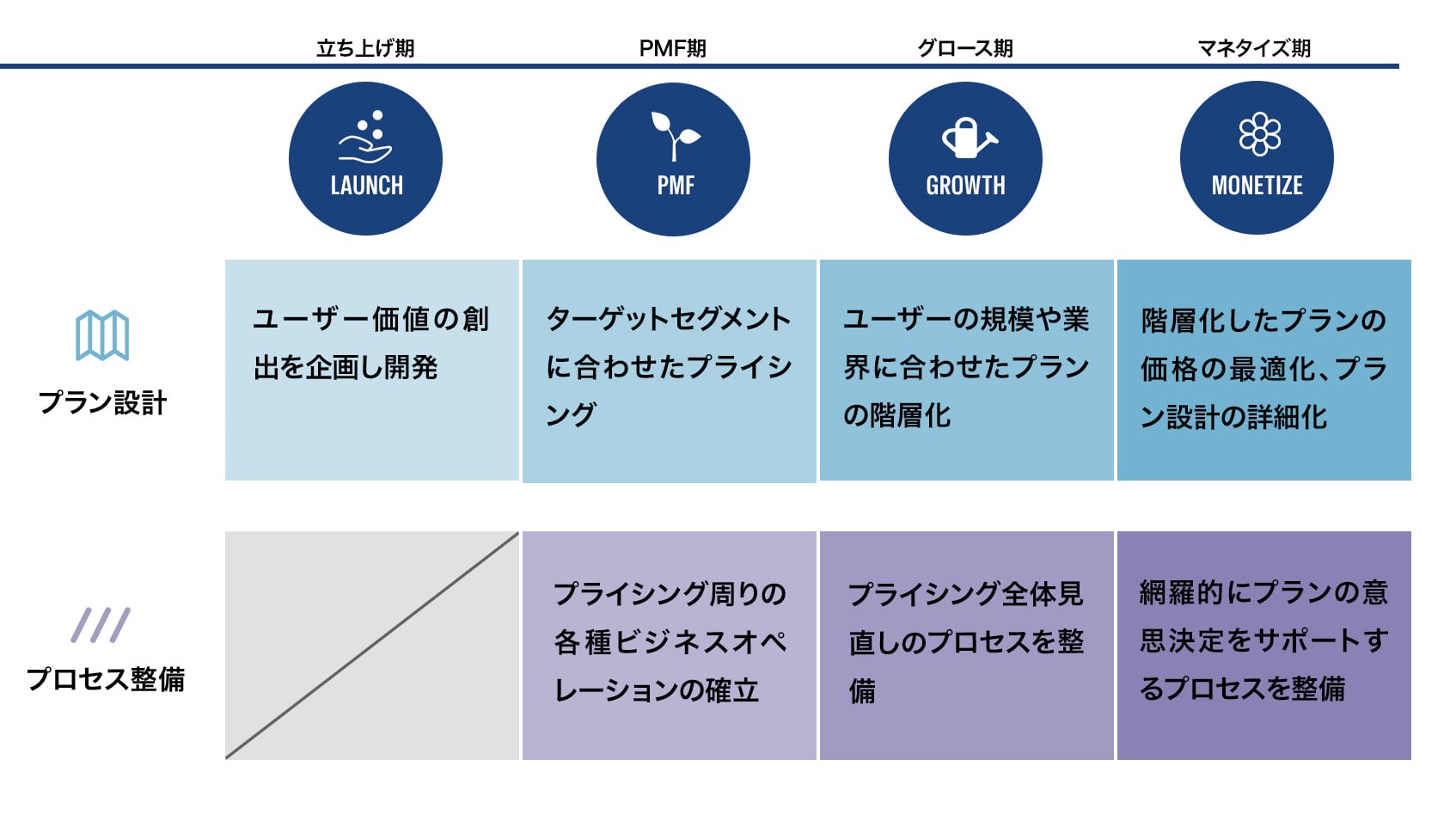
#### 1. Startup Phase
The scope of the start-up phase is from product planning to release, and this is the phase in which user value is planned and development is advanced. During this phase, pricing is discussed as part of the go-to-market (GTM) process for release, and in many cases, a single plan with all basic functions is deployed. Therefore, the main focus of discussions is to determine the price.
At this point, rather than discussing specific plan design or process evolution, it is better to look at the future roadmap and envision the point at which user value and target segments will change, and be prepared for the possibility of a major pricing change at that time.
#### 2. PMF Period
The PMF period is assumed to be the period from product release until the product is accepted by a certain user segment. During this period, pricing will be determined and sales will proceed according to the initially assumed target segment.
At the beginning of the release, it is common to focus on niche segments and gradually expand the target segment. As the users' business size and industry become more diverse, pricing will be divided and multiple plans will be offered according to the user persona and the value to be provided.
When the number of contracts is still small, business partners are managed in Spreadsheet and invoices are often created and sent with hand-made invoices. From there, as plans become multiple, various business operations around pricing are established: CRM and workflow are implemented, and in addition to managing clients, approval processes for quotes and discounts are put in place.
#### 3. Growth Phase
The growth phase is when the product has been adopted in multiple markets and is accepted not only by SMBs, but also by enterprise companies.
In order to achieve these goals, the existing pricing must be further subdivided from various angles, and more detailed appeals must be made. For example, in order to broaden the user base, trial and freemium plans, as well as self-pricing, can be considered.
As target segments and qualitatively different markets are developed, plans tailored to industries and user sizes will be designed in a mesh structure. In addition to tiered pricing, add-ons and other methods of charging for additional functionality will also begin to be utilized. This will also be a period of rapid diversification of discounts, including coupons that support self-billing and referral code-based discounts.
As more companies adopt the system, the need to evolve business operations will become even more pressing. This is the stage to review the workflow from contract management to billing and establish operational processes by adopting SaaS tools for CRM, contract management, and subscription billing.
In addition, as plans diversify, tools will be developed to build an environment for delivery, and a process will be developed to examine which plans to allocate to as features are developed.
#### 4. Monetization Phase
The monetization phase is a period focused on improving sales by optimizing ARPU as well as the number of companies that have adopted the service.
In this period, companies aim to diversify their revenue models, develop new products, and promote qualitative changes in their business models, such as SaaS x Fintech and SaaS x PF, and plans become more diversified.
The discussion will not only focus on plan segmentation, but also on optimizing prices in the process of accumulating business negotiations. The target will be diversified and optimized not only for subscriptions but also for one-time plans such as implementation support.
Following the growth phase, the number of plans increases exponentially, and a process to support comprehensive plan decision making begins to be developed, including pricing for new products and new business models, review of overall product pricing, and creation of new plans.
At this point, it becomes difficult to manage using SaaS alone for general CRM, contract management, payments, etc., and a development team will be put together to take charge of extending functionality to meet the increasingly diverse pricing needs.
#### Summary
As we enter the recession phase, pricing, which is directly related to ARR, is a theme that should be reaffirmed as we grow our SaaS business in the future.
Once again, SaaS operators should compare the current status of their pricing with the phase in which they are currently operating, and first conduct a self-assessment to determine whether they are making progress ahead of the curve or lagging behind.
If pricing can be viewed as a management issue, it can evolve into a growth engine on par with product and business.
---
# Freemium in SaaS: Three Key Strategies
URL: https://route06.com/insights/35
The concept of freemium has been actively discussed and introduced in B2C products. It is no exaggeration to say that most of the SNS, social games, and media, in particular, have adopted the freemium model.
Is there potential for implementing freemium models in SaaS, where B2B is the primary focus? In fact, freemium is already being considered in the context of product-led growth, and is starting to be introduced more and more often in products for SMBs.
In light of this situation, this article will review what freemium means in the context of SaaS, comparing it with the similar concept of free trial, and confirming what it means in terms of product strategy.
### What is freemium?
Let's begin by examining the concept of freemium, which involves offering a basic version of a product that fulfills fundamental user needs for free, without any time limitations. The main objective is to maximize user acquisition by making the price free and to foster the evolution of the product.
When the needs of freemium users become more sophisticated, additional functions or paid plans that allow users to use the product beyond the limits of the number of times they can use the function or the number of IDs are proposed to encourage upselling and monetization.
On the other hand, a similar concept is the free trial. This is the same as freemium in that the product can be used for free, but there are often no restrictions on the basic functions or number of times the product can be used. Instead, there is often a time limit of one week to one month, during which the user can check the usefulness of the product and, if necessary, register for a paid plan after the trial period ends.
The main objective is to encourage users to try the product extensively to experience its value and quality, thereby increasing their interest in and trust in the product or service, which may lead to a purchase. Unlike freemium, this policy is focused on user acquisition because of the time limit.
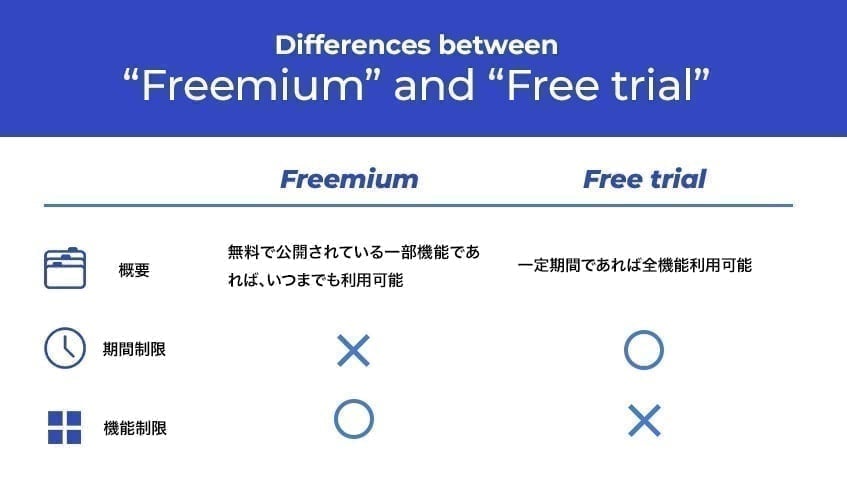
### Freemium Changes in Slack
Slack has been offering a freemium plan that allows users to access the service for free, with limitations on the number of posts and available storage space. Since there is no time limit and the usage of features is limited by quantity, it is literally a freemium plan. However, starting last September, we removed this restriction and instead changed it to a restriction that only allows users to keep a history of posts for a certain period of time.
````
The usage limit for the free plan is simple. Instead of the previous limits of 10,000 messages and 5GB of storage space, you will now have unlimited message history and file storage for the past 90 days. No more guessing when the limit will be reached. You will also have access to more features, including clips and message and file storage settings.
Quote: Excerpted from Slack help center "Pro Plan Pricing Changes and Free Plan Updates"
````
The purpose of Slack is to communicate internally and externally, but it also has bookmark-like features that allow you to post not only ad hoc, but also cohesive pieces, make them fixed posts, and flag them for later reading. In other words, Slack is developed to be used as a stock place for communication as well.
With the latter in mind, the restriction of keeping a history of posts only for the past 90 days is more like a time limit than a functional restriction, and is more akin to a free trial restriction.
In addition, while there is no restriction on the use of flow communication, if a certain level of communication cannot be continued and 90 days have passed since the last post, there will be no posts. In such a situation, the hurdle to posting is raised dramatically. In other words, if a certain amount of communication cannot be guaranteed, there is no functional limit to flow communication, but it will be virtually impossible to use it.
In summary, the changes to the limits of the freemium plan, while retaining the establishment of functional restrictions, actually change the limits to be as close to those of a free trial as possible, and the plan seems to be designed with a strong emphasis on user acquisition. This is an example of meticulous design of restrictions, taking into consideration where the main purpose of the plan lies, how the functions and duration of the plan are perceived, and how the user usage trends will change as a result of these restrictions.
### Three Product Strategies for Freemium
Having examined Slack's approach to designing freemium restrictions, let's explore three fundamental strategies that can be implemented through freemium models. Here we will introduce them one by one.
#### 1. Creating Network Effects
The first strategy involves leveraging freemium to create network effects. Zoom, which spread rapidly due to the spread of the coronavirus, has developed a freemium plan that does not limit functions for one-on-one video calls. This allowed former users to use Zoom to make video calls with non-users, and by taking advantage of the communication tool's characteristics, reached out to non-users in one fell swoop.
At that time, remote working was a necessity, and the need for online communication such as video calls was extremely high for companies and other organizations, and it seems that an atomic network was quickly established in various places. The approach to non-users allowed the potential adoption segment to be exposed to Zoom's quality and services, and a network created a network, which quickly spread.
Communication is the best example of this, but the network effect of freemium, which anyone can start using easily, and the value that can be created increases as the number of users increases, and there is a very high affinity between the two.
#### 2. Focus on increasing engagement through user pool acquisition
Although limited to the realization of a minimum number of user stories, the free freemium plan with no time limit and free of charge lowers the hurdle to getting started to the extreme. In terms of user acquisition, this is the ultimate product-led growth.
Of course, there is room for further development of user acquisition through freemium, for example, through marketing coordination and tutorial refinement. However, by deploying freemium, you are offering your most important asset, your product, for user acquisition, and the product side can focus on user engagement.
In addition, users who have become accustomed to the UI/UX through freemium will consider other products when they have more advanced needs, and the results of having already used the product for a certain period of time will be a very impactful input for consideration.
As a concrete example, Mailchimp gained prominence by introducing freemium immediately after the collapse of Lehman Brothers. At the time, Mailchimp was providing an e-mail distribution platform for SMB marketing, but the high rate of SMB closures was creating a sense of stagnation in user acquisition.
So we adopted a freemium model and put the Mailchimp logo on the emails sent by users and directed them to the LP, which quickly improved the efficiency of user acquisition. From there, they focused on getting people to pay and seem to have grown their business.
#### 3. Acquire product usage data from the beginning and formulate a highly accurate roadmap
In the case of SaaS, it is very difficult to get a certain number of users to use a product immediately after its release. Especially in the case of enterprise SaaS, it often takes several rounds of negotiations, and in some cases, 1-2 years to get users to decide to adopt the product. In other words, even after releasing a product, it is difficult to get a large number of users to use it immediately, and it is not possible to scrutinize the product vision and roadmap using actual usage data.
However, by developing a freemium plan, although there are some functional limitations, a certain number of users will utilize the product. If we can create this situation, some users will be willing to be interviewed, and of course we will be able to obtain usage data and raise the resolution of how users are using the product and what the next issues are. In turn, this will lead to a more accurate product vision and roadmap.
### Conclusion
Freemium has been introduced mainly in B2C, but it is also a very important strategy for SaaS. Unlike free trials, which ask users to use the product for a limited period of time and force them to decide whether or not to pay for it, there are three major benefits: user acquisition through network effects, focus on engagement measures, and a highly accurate roadmap by raising user resolution from the early stages of release.
We hope this analysis encourages viewing freemium as a strategic product decision rather than merely a marketing tactic.
---
# Security in Cloud Services
URL: https://route06.com/insights/36
With the proliferation of SaaS and other cloud services, security issues are beginning to attract significant attention. Cloud services offer numerous advantages, such as no upfront investment, low startup costs, and accessibility via the Internet. At the same time, however, there are security risks.
In this article, we will provide an overview of the security measures cloud service providers should adopt and explain the different types of security certifications. Awatsu, CEO of Skygate Technologies, will also provide his comments on this topic, and the article will be summarized in line with the actual security situation.
#### Akinori Awatsu, CEO/Founder, Skygate Technologies, Inc.
```
Awatsu is a former communications and cyber officer in the Japan Ground Self-Defense Force.
Former Communications and Cyber Officer, Japan Ground Self-Defense Force (12BU Communications) / Security Engineer / Currently a member of Space Industry SWG, Cyber Security Research Group, Ministry of Economy, Trade and Industry
In charge of communications and cyber area in the Ministry of Defense and the Self-Defense Forces. Retired after serving in Ichigaya and Minister's direct control unit. Moved to a domestic cloud accounting software startup and worked as an engineer, security manager, FSA regulatory compliance, PdM, etc. until the company went public. Retired in 2020 and founded Skygate Technologies.
```
### Security Risks of Cloud Services
Security often feels like a black box, especially when considering the risks from the perspective of business and product managers. For instance, the following security risks are commonly found in cloud services.
- Data leakage: Servers and storage are attacked from the outside, and users' personal or confidential information is leaked.
- Service outage: In the event of a system failure, services are suspended, resulting in business losses.
- Supply chain attack: an attack that allows a high-security target organization, which is inherently difficult to penetrate, to penetrate the target organization through a business partner or subsidiary with a relatively low level of security.
### Specific Security Countermeasures
To mitigate these risks, cloud services must implement the following specific security measures.
__Access Control__.
When providing cloud services, it is important to properly control access to the infrastructure and applications that run the cloud services. Access control should be implemented at multiple levels to ensure that user data is not inadvertently leaked or unintentionally exposed to external parties. It is also not uncommon to provide users with features such as permissions and sharing ranges.
__Network Security__.
In cloud services, network security should also be enhanced. Specifically, firewalls and WAFs (Web Application Firewalls) are often used to block unauthorized access, and CDNs and other measures are often used to prevent DDoS attacks (a method of conducting attacks by inadvertently overloading a large number of accesses).
__Data Security__.
Security of user data is also important for cloud services. Specifically, data encryption and backups should be implemented. In addition, it is already widely accepted that privacy policies should be developed and clearly explained to users regarding data handling.
### Periodic Review and Improvement of Security Measures
In cloud services, security measures should be reviewed and improved on a regular basis. Specifically, security reviews should be conducted, vulnerabilities should be diagnosed and remediated, and security policies should be formulated to keep up with the latest security technologies.
Once again, looking at the above specific efforts from the product manager's perspective, it is important to consider whether sufficient man-hours are spent on these items and whether security requirements are taken into account when designing specifications based on business requirements.
Until PMF (seed to pre-series A in startups), the emphasis is on developing functions to create intrinsic value for users rather than on security. However, for cloud services that are mainly B2B, if security is not designed with security in mind from the beginning or the development budget is not estimated, security will become a bottleneck even after deployment to the enterprise, which will directly lead to lost orders.
#### Awatsu comments.
```
Security measures for cloud services are generally taken in stages as the functions offered are expanded and as the user base matures and grows in scale. However, it is difficult to take care of all security measures, so priority is given to access control that directly leads to information leaks and DDoS measures that lead to service interruptions.
Especially in the case of startups, it is not uncommon for security-related issues to be left blank, as they often lack sufficient development resources. It is advisable to assume security requirements in advance according to the industry and scale of the customers to be served, and to update the development plan as needed while keeping an eye on the business side so that the lack of security measures and functions does not become an obstacle during business negotiations.
```
### Security certifications that cloud services may comply with
It is common for cloud service providers to undergo security assessments by third-party organizations in order to increase confidence in their security. Let's take a look at security certifications for cloud service providers.
#### ISMS (ISO27001)
ISMS (Information Security Management System) is an abbreviation for Information Security Management System, a framework for establishing rules and procedures within an organization to achieve information security. assessment, planning and implementation of information security measures, monitoring and evaluation, and improvement.
ISMS is often based on ISO27001 (International Organization for Standardization). In Japan, the term ISMS generally refers to the ISMS Conformity Assessment System, which recognizes compliance with ISO27001, It is also referred to as ISMS certification.
This standard is international and well-known in Japan, and many companies and organizations in Japan have obtained this certification, but in fact not many in the United States have obtained this certification.
For example, when an SMB company acquires the certification, it takes about 6 months to 1 year of preparation and about 1-1.5 million yen for consulting related to the preparation, plus about 300,000 yen in application fees. After acquisition, there is an annual maintenance fee of about 300,000 yen.
Basically, the cost increases with the size of the company and the number of offices. If you have personnel within your company who are knowledgeable about security, you can cut costs significantly, especially consulting fees.
#### ISO 27017
ISO 27017 is a set of guidelines for information security provided by cloud service providers, and differs from a typical ISMS in that it addresses risks and security issues specific to cloud computing. It differs from a typical ISMS in that it includes recommendations for addressing risks and security challenges specific to cloud computing. For example, it includes risks associated with virtualization technologies and security challenges that may arise from multi-tenancy.
The standard provides standard procedures for cloud service providers to properly manage information security risks and ensure data protection, access control, system availability, and compliance with legal requirements. This allows cloud service providers to mitigate security-related concerns and provide peace of mind to their customers.
Like ISMS, certification is not difficult to obtain and the cost is comparable. However, cloud service providers may offshore development or provide customer success in the form of BPO to a separate company, which may incur additional costs.
#### ISMAP
ISMAP (Information Security Management Assessment Program) is a relatively new program that started around 2021 to assess whether cloud services meet the security requirements set by the Japanese government. It is a relatively new program that started around 2021. It is modeled after FedRAMP, an American system for risk management in the use of cloud services by the government.
This system is for the government, and it is necessary to obtain it when providing services to government agencies such as the Digital Agency. Unlike ISMS and ISO 27017, the criteria for certification are diverse, The cost is also high (approximately 5-10 million yen for the first year, and 10 million yen for the following years and thereafter). It will be difficult to withstand the cost and operation in the Series A and B phases, so it will have to be considered after that time.
#### SOC (Service Organization Control)
SOC is a report on internal control of service organizations developed by the American Institute of Certified Public Accountants (AICPA).SOC includes SOC1, SOC2, and SOC3, each with different evaluation items. All of these reports are issued by an auditing firm, and one of their features, for example, is that SOC1 and SOC2 can be addressed together.
In addition, the reports are issued by an auditing firm and have international validity. When providing cloud services to major financial institutions, not having a SOC is a direct cause of lost business. In the first year, a security evaluation is conducted at that point in time, and the cost is about 5-10 million yen. In addition, the preparation for acquisition often takes about one and a half years.
#### SOC1
SOC1, formerly known as SAS70 (Statement on Auditing Standards No. 70), is a report on the internal controls of a service-providing organization. The SOC1 report is used to evaluate internal controls related to business processes that affect a company's financial accounting. It is definitely required if the state has master data that affects sales and ARR.
In the specific usage, if a SaaS in the accounting area is acquired, when an enterprise user performs an audit, the SOC1 report will be substituted for the audit of the portion of the SaaS that is being used. Conversely, if the SaaS is not SOC1 certified, the enterprise user will be required to audit and evaluate the SaaS they are using on their own.
#### SOC2
SOC2 is an audit standard for evaluating the information security management system of cloud services. It focuses on evaluating the information security, availability, confidentiality, privacy, and processing integrity of the service provider organization. However, acquisition by cloud services such as Box and Salesforce, which acquire, manage, and use a wide range of sensitive information, can replace auditing from an information security perspective. Cloud services whose users include listed companies that handle highly sensitive information are encouraged to actively acquire this certification.
Basically, SOC2 costs the same as SOC1. However, since the scope of SOC2 (there are five trust principles, and you can specify whether to comply with only one or to be assessed against all of them) can be reduced or added, SOC2 is characterized by a wider range in terms of cost than SOC1.
#### SOC3
SOC3, like SOC2, is a report on the internal controls of a service-providing organization, but in a simplified format compared to SOC2. For cloud services that are primarily B2B, it is often not necessary to obtain a SOC3 report, as it is a standard for the general public.
#### P Mark (Privacy Mark)
Finally, P-Mark is a system for the proper management of personal information (PMS). It is as well known as ISMS in Japan, and it is said that about 20,000 companies in Japan have obtained this certification. It is particularly important for businesses that handle personal information, but it is not limited to information systems or cloud services. The cost of certification is about the same as that of ISMS.
### Policies for Certification
First of all, as a product manager, you need to raise your awareness even before you can see the deployment to the enterprise, while focusing on functional development until PMF. Rather than proceeding with acquisition out of the blue, we recommend clarifying SLAs with users or substituting answers to checklists requested by users. As the number of orders increases, users will share security checklists more frequently, and it is recommended to consider acquisition of certification at a time when it becomes difficult to respond to individual requests.
In this case, the first thing to consider is ISMS for the company, followed by ISO 27017, which is specific to cloud services. This is because both can be obtained even by a small start-up due to preparation and cost, and the audit can be completed in a few days. Next, it is preferable to comply with an international SOC.
Nevertheless, since this is a system that requires significant costs for startups in terms of preparation and expenses, one option is to have 10-20% of the cost of the security measures covered in addition to the fee for the cloud service. Finally, acquiring the above certifications early on is not only a disadvantage, but also an option for smaller organizations, as the security audit fees are relatively inexpensive, so it is also an option to acquire the certification before the organization grows. In addition, both ISMS and ISO27017, for example, are maintained for three years once certification is obtained.
To summarize a bit, the preparation and cost of certification can be burdensome for startups and new businesses, so it is a good idea to first seek a way to get through with SLAs and answers to checklists required by users. After that, we recommend aiming to acquire ISO27017, SOC1 and SOC2 certification at a time when the number of users is increasing and individual responses are becoming more difficult.
#### Awatsu's comments
```
ISMS is the first content to consider, as it is often requested by customers and the widest range of responses that can be relatively handled just by being certified. Many government bids also have ISMS as a requirement. Nevertheless, the requirements and their impact differ depending on the service and industry sector, so it is important to research and make decisions based on what compliance and security measures the customer is looking for, especially when security-sensitive enterprise projects are envisioned. In the financial, healthcare, security, and other sectors In the financial, medical, and security sectors, there are separate guidelines based on their respective regulatory laws, and in the case of overseas expansion, compliance with GDPR, etc. is also necessary.
```
### Summary
In this paper, we have explained the importance of security when providing cloud services, how to take countermeasures, and security certification. It is recommended that cloud service providers consider obtaining ISO27017, SOC, and SOC2, in that order, as desirable certifications to obtain when the number of users increases and individual measures become difficult.
As cloud services develop in the future, it is expected that there will be an increased awareness of security risks and the need to take security measures, including certification. Cloud service providers should proactively provide information on security measures, and users should take thorough measures to ensure their own security, so that they can use cloud services with greater peace of mind and look forward to further development.
---
# Product Manager Diversity: Key to Realizing Product Strategy
URL: https://route06.com/insights/37
As SaaS proliferates, the role of the product manager is becoming increasingly important in B2B, where services are used for business purposes and product evolution is highly diverse. Especially in the growth phase and beyond, the diversity increases dramatically.
In this article, we will focus on the growth phase and beyond, and explore the importance and benefits of product manager diversity after reviewing the product strategy and how it affects the realization of the product strategy. In addition, we will touch on best practices and challenges in integrating product managers with different backgrounds and skills into your team. We will identify how important the use of diversity is to your success as a product manager.
## Product Strategy for Growth Phase and Beyond
After achieving Product-Market Fit (PMF) and initial growth, adopting a robust strategy for non-linear business growth becomes crucial. As a reference, please refer to the article I co-authored in a previous issue of ["8 typical patterns you can use to develop a strategy for your SaaS product to realize your vision"](https://blog.allstarsaas.com/posts/strategyplanning-saasproduct), which I co-authored in the past, I would like to introduce three strategies that often come up during the growth phase and beyond.
### 1. All-in-one strategy
- This strategy combines all the software functionality used by the target users.
- It is one of the major strategies with a simple appealing message.
### 2. API Platform Strategy
- Contrary to the "all-in-one" strategy, the "API platform strategy" is a strategy that clarifies their focus area.
- It is often chosen when there are strong differentiators and user retention.
### 3. Synergy strategy with other services
- There is also a strategy to create more value by collaborating with different services.
- For example, a SaaS service can be used as a starting point to lock in users.
When multiple of these strategies are employed and required to be realized simultaneously, it may be difficult to achieve this goal even if only product managers with the same background and experience are gathered together. When trying to realize an all-in-one strategy, the core functionality that is the differentiating factor will require more depth and will only be addressed by product managers who have very advanced domain knowledge and industry understanding.
In addition, as multiple products and modules are deployed, common functions need to be carved out and established as the foundation. The design and construction of the infrastructure requires a broad business understanding and a deep engineering background.
In addition, the deployment of API platforms will strongly require a busness development element to be deployed in an evangelist-like manner for users and 3rd party developers, as the linkage with Fintech will increase the payment mechanism and security requirements, Specific high expertise is required.
To summarize, after the growth phase, product strategies will diversify, and in order to promote and realize a combination of these strategies, it will be necessary to establish a team that can realize the following four elements:
### Core Product
- Transform existing products into deeper and more specialized solutions
### New Product
- Create new products to expand the business portfolio
### Foundation
- Build common infrastructure to support multiple products
### Business Development
- Drive partnerships and ecosystem growth
## Various positions to realize the product strategy
Let's examine the types of positions available to realize the product strategy, categorized by area of responsibility and organizational layer.
The first is the area of responsibility, which classifies positions based on the characteristics and features of the product or project you are in charge of.
__1. Core function__.
- As we enter the growth phase, the functions and modules that drive differentiation become deeper and more difficult to plan based on the product manager's experience alone.
- Therefore, it is necessary to appoint someone who has direct experience in the industry and business, or someone who has had in-depth contact with users through Customer Success Management (CSM) or other means and knows the product inside out, and who has the background to be a product manager.
__Growth__.
- Once PMF is realized in a certain area, growth is literally required. Specifically, this is the area of optimizing the sign-up and billing leads. Armed with access analysis, usability frictions are to be removed as much as possible.
- This is a familiar theme in B2C, and those with advanced analytical skills and many UI drawers will be an easy fit.
__New product__3.
- The need for new products will increase at this time, as the PMF will reduce the uncertainty of core products and allow for business development with a higher probability of success.
- Product managers in charge of new products do not need to have expertise, but rather a commitment and broad experience (or a high ability to learn) to shape any topic or business is strongly required.
__4. Infrastructure__.
- In order to develop not only the core product, but also multiple products, it is necessary to establish a common foundation for the third or fourth product.
- Specifically, common functions that will be used by users of the various products, such as login, billing, function sharing, and authorization. The team will not be planning products, but will be planning common functions so that the products can focus on creating user value, so a deeper engineering background is required.
__Collaboration__.
- Lastly, negotiations and product design, including alliances with API platforms and peripheral products, require more than just internal planning and coordination. What is required here are business development skills to negotiate with external parties and manage progress.
- There are very few product managers who can do both, and it is common for them to divide the work between the two.
In the SaaS industry, product management is becoming increasingly specialized and important, and it is now recognized as a position that is becoming more and more popular.
__1. CPO/VPoP__.
- The CPO/VPoP** is responsible for bringing together the various areas and formulating the overall product vision and strategic direction.
- In addition to the strategic aspects, we will also design what kind of organization is needed to realize them. Furthermore, we will promote the concrete ways to realize them, including hiring, transfers, and training.
__Product director/Head of Product__*.
- Product director/Head of Product (Manager of Product Manager)** is responsible for product vision and strategy formulation for the product for which he/she is in charge (in some cases, he/she will be responsible for themes such as AI/ML and growth of all products on a cross-functional basis).
- As the most knowledgeable person about the product for which he/she is responsible, he/she will be asked to provide input on the overall vision and strategy. Conversely, it is also an important role to align with the product vision communicated by the management team.
- The role is to formulate the product vision, strategy, and roadmap in collaboration with the business side and development team, and to promote the realization of the product vision, strategy, and roadmap.
- You will design the organization, hiring, transfers, etc. to achieve the roadmap.
__Product Manager__*.
- Product Manager** is in charge of roadmap and specification development for each area of responsibility. In the course of actual development, you may also be responsible for managing scrums as a product owner.
In order to realize the product vision and strategy, I start by identifying what areas need to be positioned. If the size of the organization can be reduced to 5-6 people, then we need to build a 2-tier organization, and if it is larger than that, we need to build a 3-tier or larger organization with a CPO/VPoP. The reason for this is that the product manager is not a purely one-person operation, but rather a hub for product development, with a diverse background and often a high degree of specialization in his/her area of responsibility. Therefore, the number of members one person can take on is 3-5, which is fewer than in other functions.
In addition, in addition to the consideration of business plans, organizational design from scratch is actually done only once a year, and during the term, gradual evolution is required to see how the current structure can be improved. In addition, there are many factors over which we have no control, such as hiring and transfers, and we must regularly collaborate with engineers and the business side to fine-tune the organization, moving back and forth between the ideal and the feasible.
## Product manager's own diversity
What kind of product manager should be assigned to each area and layer to bring the product vision and strategy to fruition? In this section, we will capture the characteristics of the product managers by dividing them by the types of jobs they have worked in and the phases and providers of the companies they work for.
In fact, it is rare to find a person who has been a product manager all the way through his or her career from graduation. Many people have experienced some kind of peripheral job title, such as the following, before moving to a product manager position and becoming active in the field.
### Designer
### Engineer
### Analyst
### Consultant
### Business Side (Marketing, CS)
Please refer to our recent article ["Career Paths to Becoming a Product Manager"](https://route06.com/insights/33) for a detailed description of the characteristics of each background. For product managers with a wide range of backgrounds, experience in peripheral positions is directly related to their strengths and their reason for being. Their strengths will remain with them even after they become product managers, and because they are not homogenized as general product managers, diversity is born and becomes a source of innovation for the product.
In addition to their backgrounds, the experiences they will have will also differ depending on the phase of the company they work for, which will lead to the strengths of the product manager.
__1. Seed and PMF phases__.
- In this phase, a limited number of people, regardless of their job titles, are required to create a single product and create value for users. Therefore, they inevitably go beyond the framework of being a product manager and develop a wide range of knowledge and the self-motivation to move forward anyway, which is where their strengths are formed.
__Growth__.
- In the growth phase, the diversity of product managers emerges, and many who have experienced this phase or later ask themselves where their strengths lie and clarify their position as a product manager.
__3. Monetization__.
- You will experience a phase in which the business and organization evolve through qualitative changes in the product, such as the development of API platforms and collaboration with Fintech and marketplaces.
- Furthermore, events such as IPOs and M&As may also require indirect, if not direct, involvement, making this a fulfilling phase for improving your knowledge.
__4. Mega Venture__.
- Beyond monetization, experience in mega-ventures and major companies is important for project management skills to conduct careful research and preparation in advance, and to fully plan and realize the project in a highly decentralized organization.
In addition, the experience available is very different between B2B and B2C, the two product offerings that I often use as a comparison axis. As described in ["The Evolving Role of Product Leaders in Business Growth"](https://route06.com/insights/32), at the product leader layer, B2B has more diverse options for evolving the product and the product vision, In B2B, the product vision, strategy, delegation of authority, and organizational design are differentiating factors. On the other hand, in B2C, being able to remain your own user makes it easier to maintain ownership of the strategic aspects and build an organization with increased specialization around UX and analytics.
Also, as detailed in ["6 Differences Between 'B2B and B2C Product Managers' You Need to Know If You're Building a SaaS Product Organization"](https://blog.allstarsaas.com/posts/b2bb2c-pdm), fundamentally, B2B is used for business As detailed in [6 Differences between B2B and B2C Product Managers](), fundamentally, B2B is a product used for business purposes, so by conducting user research in advance, plans can be created with high precision. B2C, on the other hand, is a market-in approach that focuses on preliminary research, while B2C is a product-out approach that focuses on post-product iterations to improve the product. B2C is product-out, focusing on post-product iterations to improve the product.
## Assignments
We will consider who to assign as product manager and how to design the organization based on the company's phases and clients, as well as the type of work experience.
Everyone has a bias to hire people who are similar to themselves, and product managers are no exception. Also, since organizations are not static but dynamically changing, there are actually few opportunities to think from an ideal perspective, and we tend to focus on clearing the issues on our feet. In a very employee-protected work environment such as Japan, losing the mid- to long-term perspective is directly related to risk.
Furthermore, while diversity in any organization can lead to innovation, looking at the footprint, the communication costs are high and the organization is never a comfortable place to be. For example, a product manager with domain strengths and a product manager with more than 10 years of product management experience and a certain career path will perform in completely different ways, and it is easy to see volatility in results depending on the situation. If you communicate without assumptions in such an environment, it will be clear from the fire that you will not get very good results.
Thus, one can raise any number of concerns about diversity. Short-circuiting and conservative decision making will lead to homogeneity. Especially after the growth phase, the diversity of product managers will increase the options to realize the product strategy and, in turn, become a source of competitiveness.
However, it is important to deepen the understanding of the impact of product manager diversity on the product vision and strategy, and to keep in mind what kind of impact you want to achieve in the medium to long term, rather than the current performance, when hiring, transferring, and making organizational changes. The organization should be designed to promote the evolution of the product.
### Conclusion
To support SaaS growth in the expansion phase and beyond, a diverse team of product managers is essential, as this diversity becomes a source of competitive advantage. When diverse product managers are geared together, when they perform as an organization, it leads to incredible impact. However, this is supported by organizational transparency and significant communication costs. It is important to design an organization with a mid- to long-term perspective, and not be distracted by these immediate costs.
---
# The Concept and Process of Feature Closing
URL: https://route06.com/insights/38
The process of planning a product, developing it, releasing it, and getting users to use it can be extremely difficult. Therefore, once a product or feature is released, the decision to close it tends to be avoided even if the market changes or the feature differs from the hypothesis and is not accepted contrary to initial expectations. Additionally, it's common for teams to lack motivation or availability to work on a product closure, as there’s little incentive in shutting down a product.
So how should the decision to close a product or function be made? This article focuses on the demise of a product or function, and explains the process of consideration and the key points of decision-making.
## Cost
Whether in B2C or B2B contexts, it's common to adopt a freemium model, allowing a broad user base to access the product for free. In fact, even if the product is deployed for free, there are various costs involved. Let’s first review the significant costs involved in maintaining a product.
__1. Infrastructure__.
First of all, infrastructure: In B2C, millions of users are likely to use the service, so the cost of infrastructure cannot be overlooked in providing the service. Conversely, in B2B, unless it is for consumer use, it is often not expected to be used by too many users. However, in certain cases like marketing automation, where large datasets are handled, substantial infrastructure costs may arise.
__2. Security__.
As with infrastructure, in terms of operations, there is a charge for the use of tools and systems for monitoring and verifying security.
__3. Support costs__
Even without further development, a certain level of support is necessary as long as users continue to use the system. Once the company becomes non-focused, the number of users does not increase much because marketing activities will no longer be focused mainly on the target product or function, but support will not be completely unnecessary.
It is necessary to be ready to answer user inquiries when they come in, and although this is less visible, it is surprisingly costly, so it is important to be aware of this.
__4. Development costs__.
Even without additional development, a certain amount of maintenance may be required. For this reason, it is necessary to keep an overview of the specifications. In some cases, when an area becomes a non-focus area and no additional development takes place, the person who had grasped the specifications may leave the company. If proper handover doesn't occur, catching up during necessary maintenance will require significant resources.
__5. Impact on other development__.
It's uncommon for further development beyond maintenance to be done on a product or feature that's no longer a priority. However, when developing other functions, the design is based on the assumption that there are products or functions that are not being focused on, and in some cases this can lead to unnecessary complexity, resulting in an increase in development man-hours.
As mentioned above, infrastructure, security, and support will naturally arise even without new marketing. In addition, maintenance and other development projects will be affected, which can lead to significant costs in some cases.
## Timing of Decision Making
With cost in mind, we would like to specify the timing of the decision to close a product or feature.
First, in the case of products with large infrastructure costs, we often discuss whether or not to close them at the same time as we proceed with verifications related to monetization and user growth and determine that they are at their limits, and when to reduce the focus to a non-focused area. This is because it is difficult to find meaning in continuing a product that does not generate revenue because it is considered a clear running cost.
In terms of security, cost is also important, but the security risk may increase with the previous responses. If the risk is rising for other products or products as a whole, we will take measures collectively, but in cases where security is the only problem in the targeted product or function, we often find it difficult to proceed with measures beyond the scope of maintenance. However, in cases where security is the only issue with a product or function, it is often difficult to move beyond maintenance.
Secondly, there are few cases where the urgency to close a product or functionality is driven solely by support costs. Since support costs are a consequence of product factors, they are unlikely to be the primary factor influencing the decision.
Conversely, development resources are a very valuable management resource for business expansion, so if it takes a large amount of development resources to support a product or function, it is likely to lead to a decision to close the product or function. Specifically, there are cases in which a product or function that has not already been additionally developed fails or clearly needs to be modified, but this is a case in which a large amount of man-hours are required.
In other cases, the existence of a non-focused product or function may increase the scope of influence on other development projects, making it difficult to design, and thus straining development resources. In this way, we often raise the importance of the issue and proceed with a response when the impact on development resources materializes.
As described above, we will proceed with discussions and make decisions to close products and functions according to the nature of each cost, such as running costs, intervening risks, and impact on development resources.
## Process of closing a product
Closing a product or function often has a significant impact on users as well as within the company, so the closing process must be carefully executed.
__1. Internal decision making__.
Once the costs, risks, importance, and urgency are fully understood, an internal decision is made. Then, after summarizing the reason for closure, the target, the scope of impact, and the existence or non-existence of alternative measures that can be taken by the user and their details, the date and time of closure will be decided based on the development man-hours and schedule.
__2. External Communication__.
Then, a communication plan is created, not only for internal stakeholders, but also for external stakeholders who will be affected by the closure. In addition to prior notification on the product, press releases may be used in some cases, and individual explanations may be given if there are heavy users of the target product or function. Although we sometimes receive harsh feedback from users at this time, it is highly valuable from the perspective of looking back and for future product development, so we recommend that you summarize the information and read it over with all concerned parties.
__3. Close the product or function__.
Finally, commend the product or feature for closing as tightly as you did when you put it out. Even if the decision is to close, remember that those involved worked hard to develop and release the product. And closing is often a very difficult project, as it is easy to receive negative feedback from various stakeholders. If you can't give credit where credit is due, even if you make the decision to close a product or feature, you will not be able to execute it, and the cost will continue to drip down the drain.
## Conclusion
Making the decision to close a feature that has been released after a great deal of effort, and then specifically closing it, involves a complex mix of feelings by various stakeholders. In the midst of all this, it is necessary to calmly evaluate the cost and value, and steadily close the function.
We hope that product managers will not only add features, but also make decisions to close features, sometimes ruthlessly, and take a stand to promote them, which will lead to the further evolution of the product and the realization of the product vision.
---
# User Value Original Theory
URL: https://route06.com/insights/39
The motto "user-first product development" is something you have probably heard at least once if you work with products.
However, there are not many organizations that are able to realize user first as if they were breathing the air. There is a high hurdle to be constantly reminded when planning a product, identifying user issues, creating PRDs, and finally being able to confirm that the product is valuable to the user.
There are several reasons for this. For example, it is not enough to solve the user's problem to make the product viable; if you do not utilize the company's assets and strengths, it will be unclear why the entire company is involved in the project. Conversely, if some asset or strength is not utilized, it will not lead to differentiation. As a result, the company will start thinking in terms of its assets and strengths, and will not be able to verify whether it is solving the user's issues until later.
In addition to differentiation as a product, the business must be viable, and the focus may be on profitability first. As an organizational challenge, in organizations that have achieved PMF, the sense of team unity fades, and the product and business begin to operate as separate organizations. As a result, it is often the case that the business side is not able to build a process that directly reflects the feedback it receives from users in the product.
Even if a process has been established, the goals of the product and the business differ in terms of the realization of vision through the product, the realization of user value, and the achievement of sales targets. Theoretically, the medium- and long-term goals are aligned, but the lead times of the goals are very different, and it is difficult to reconcile them.
Thus, even if we talk about the importance of "user first" in a few words, it is not easy to achieve it because of the structural issues that exist in practice.
## Process from discovery of user issues to value creation
I would like to focus a little more on user value, and look at the structuring of the process to realize it.
First of all, user issues are subjective issues based on the user's situation, and are verbalized by the business side, which is usually in contact with the users. Then, as a preliminary step in the planning process, the product manager collects issues from dozens of companies regarding the theme to be addressed, and when the issues are divided into certain user segments, they are found to be highly objective issues that can be seen as common denominators.
Next, rather than just treating the issues as issues, the product manager will consider whether it is possible to provide value to the users through the product in response to the highly objective issues. At this point, the product manager will be thinking about individual, specific issues, but will also be considering issues with a high degree of objectivity.
On the other hand, the final user value is whether the product has substantial value when users use it in a specific and individualized way. We will verify the value of the product by having users use it directly through prototypes, or by selling it as a beta version and conducting test marketing.
The process up to this point is organized along the two axes of subject (business side and product side) and target (issue and value), and the process is plotted as follows.
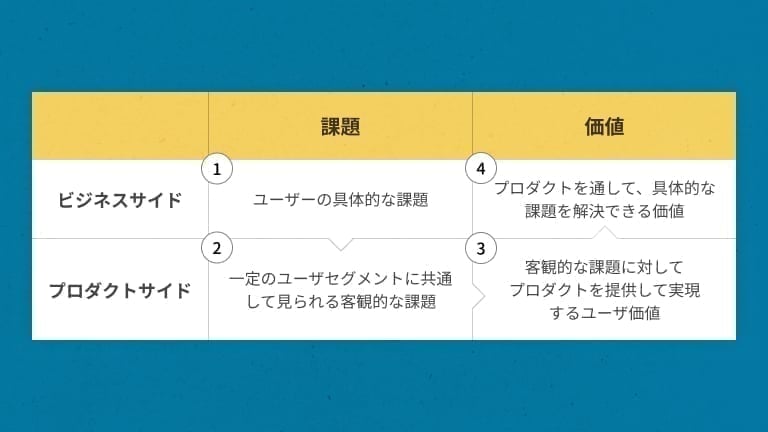
When we speak of user issues and value, the above process is followed while changing the subject and target from the user's individual specific issues to the realization of value through the product. No matter which piece is missing, it will not lead to the eventual realization of user value, and it is necessary to carefully clear the issues one by one.
## Usefulness in Practice
By following the above process, it is possible to understand where there is a leap in recognition, where the baton is not being passed on, and where there are bottlenecks in the final derivation of user value.
For example, if (2) the issues are not abstracted, there will be little consistency between the user's specific issues and objective issues, and products will be planned for specific issues, so the planned products will be less versatile, but more likely to stick with specific users.
However, since the issues are not well abstracted, it is easy to judge that the scope of the product is small and that there was no impact on the realization of the product when compared to the product vision. Product managers should not only summarize the abstracted issues in the PRD, but should also link the real voices of users, such as a list of user feedback and interview notes, directly to the relevant parties. In this way, they can check each other to see if there are any leaps in the abstraction of issues.
Next, (3) product planning that is not done in response to objective issues refers to cases where planning is not based on user issues, but rather on the company's assets and strengths. This is a planning method that is often taken by companies that have a lot of knowledge about the industry and the company's assets and strengths, but because it is not based on the issues, the method of provision is product-out, and even if released, the result is often that users do not follow or the product does not sell at all.
To counter this, PRD should clearly state the background and user issues at the beginning of the PRD, so that it is easier to make an issue-based plan. People like to think of ways to do things, so awareness of the issue is easy to drop, and it is effective to make the process as simple and natural as possible so that people can start thinking about it from the issue.
Furthermore, it may be the case that (2) abstracting the issue and (3) planning based on the issue are done, but (4) not providing value to individual concrete users. This means that although (2) and (3) can be achieved when viewed individually, when the product is finally used by the user, it does not solve the user's individual problem and does not lead to the creation of value.
For example, if the user segmentation is too broad when implementing (2), the product makes logical sense, but is highly abstract, and cannot be utilized by specific users when they use it.
This argument goes along with (2) and (3), so it is a good idea to first have the business side, which is in contact with the users, review the prototype and have some users use it as well. It is also effective to release the prototype in phases, such as alpha and beta versions, and get user feedback each time.
It is also effective to collaborate with the business side at this point in order to align the sense of goals. Although there may be cases where it is not possible to review prototypes due to the size of the project, it is possible to expect a certain level of effectiveness by simply linking a demo with a video or the final PRD.
As mentioned above, by making sure that the linkage between (1) understanding the issues and (2) abstracting the issues, (2) abstracting the issues and (3) planning user value, and (3) planning user value and creating specific, individualized user value, is firmly confirmed, the user first will ultimately be realized.
## Conclusion
Starting from the user's recognition of the issue, the baton is relayed through the subject (business side, product manager) and the target (issue and value), ultimately fostering a user-first product and, ultimately, a culture. This process is more difficult than one might think, as the eyes and goals are different, and it is easy to lose the linkage between the two.
It is not something that can be achieved simply by raising the slogan "user first," but is a fruit that can only be obtained by a company that has focused on the interrelationships of each of its products, starting from the user's issues.
---
# The Rise of Design Engineering
URL: https://route06.com/insights/4
In recent years, the term "design engineering" has become increasingly common in software development. In the past, it was discussed as a field of industrial design, an approach to pursue both convenience and utility for users and shortening lead time and maximizing loss efficiency in the manufacturing process in the manufacturing process, which involves many people involved in the manufacturing and construction of the target product and a wide range of processes. Recently, this approach has been expanding into the realm of software development.

### Definition of Design Engineering
There are many theories about the definition of design engineering in software development, but the "DesignEngineeringHandbook"[^1] published by InVision defines it as follows.
> Design engineering is the name for the discipline that finesses the overlap between design and engineering to speed delivery and idea validation. From prototyping to production-ready code, this function fast-tracks design decisions, mitigates risk, and establishes UI code quality. The design engineer’s work encapsulates the systems, workflows, and technology that empower designers and engineers to collaborate most effectively to optimize product development and innovation.
In the DesignEngineeringHandbook, InVison does not recommend becoming a jack-of-all-trades who can implement everything from UI design to front-end markup as well as some server-side coding, which is often a craving in large tech companies and startups. Rather, InVison's definition of design engineering is intended to be more organizationally generic, suggesting the need to create new jobs and positions to bridge design and engineering.
### Rising expectations for roles to bridge design and engineering
At ROUTE06, we have been supporting the design and construction of digital products for various companies as part of our professional services, and we realize the need for smooth collaboration between design and development on a daily basis. In particular, there are many occasions when we create wireframes and mockups to share the same perspective between the client company's staff and our product managers, designers, and software engineers. The efficiency of subsequent development depends greatly on how much practical and implementable UI design can be established among the parties involved before the actual software development begins. In recent years, the spread of design platforms such as [Figma](https://route06.com/insights/12) has greatly improved the efficiency of creating PRDs (Product Requirements Documents) from mockups. The evolution of tools has broadened the scope of designers' activities, and this is one of the reasons why design engineering has been attracting attention.
### Design Engineering Services
According to the aforementioned InVsion document, design engineering in product development can be categorized into the following processes.
Value: What value does the product provide to the user, or what problem does it solve?
Usability: Is it clear to the user how they will use the product?
Feasibility: Can engineers implement the required functionality within a limited time frame, resources, and technology?
Business viability: Will the solution benefit the business?
Regarding whether design engineers should write code, both coding and non-coding designers can play active roles. The main goal is to maximize the effectiveness of the design process, regardless of coding ability. For the former, as UI engineers, they are expected not only to write production (production environment) level front-end code that balances implementation efficiency and design aesthetics, but also to select frameworks and tools. In the latter role, as a design technologist, you will be expected to create an environment for storytelling, documentation, user research, and A/B testing that contributes to faster prototyping for the team as a whole.

### Requirements for a Design Engineer
As a Design Engineer, you will be responsible for driving practical prototyping in the team development process. In terms of engineering, the successful candidate will have implementation skills using JavaScript, React, and Git, as well as practical experience in framework utilization and code review. In terms of design, the successful candidate will have practical experience in creative and UI team production, as well as user research, understanding of design principles, and the ability to execute them. While there are many opportunities to perform markup using HTML/CSS, there are also many opportunities that require the ability to design components in order to enable generic prototyping by the team. Few individuals have the skills to cover all of these requirements, so it is important to create a system in which design technologists and UI engineers can share roles and collaborate within the team, while using prototyping/design tools such as Figma as a common skill. On the other hand, design engineering is still a new field of work and career path, and the requirements and roles currently required differ depending on the company and team.
### Are coding skills required of designers?
Although it has been actively debated for some time, the question of whether or not coding skills are required of design engineers is a frequent topic of discussion. As mentioned above, although coding is not always required depending on the role of the team, there are many opportunities for design engineers to be valued in the product development field with implementation skills in JavaScript libraries and server-side languages in addition to HTML/CSS, and the options for individual careers are expected to expand further. The number of career options for individuals is expected to continue to expand. On the other hand, the more coding experience a designer has, the more likely he or she is to design interfaces based on feasible frameworks and components, which may not always result in the best design for the user. Designers with less coding experience are less likely to be aware of potential constraints imposed by the system and are more likely to freely expand their design possibilities. Design engineering is also a concept born from the process of emphasizing user-oriented and team development, and designers with no coding experience who are passionate about contributing to team development and who can create designs that inspire the engineering team will have the same opportunities as designers who can write code. Whether it is front-end implementation technologies such as JavaScript libraries or design trends and tools, the speed of change in the design engineering field is rapid. In both positions, the ability to continue to learn new things and the flexibility to collaborate with teams of diverse ideas and backgrounds are required.
> Admiral Grace Hopper: "The most dangerous phrase in the language is: We've always done it this way."

### Conclusion
The need for design engineering to bridge the gap between design and engineering in digital product development is increasing, but few companies have yet specified their job descriptions and skill requirements, and it is expected that discussions will become more active in the future. It is an important management issue for ROUTE06 to create an environment and system that maximizes the acceptability, implementability, and business impact of product design through prototyping, and it is a theme that is highly anticipated by client companies. We will continue to actively research and disseminate information in related fields.
[^1]: Natalya Shelburne, Adekunle Oduye, Kim Williams, Eddie Lou,and Caren Litherland [Design Engineering Handbook](https://www.invisionapp.com/inside-design/design-better-book-design-engineering/)
---
# Distinguishing Vertical SaaS from Horizontal SaaS
URL: https://route06.com/insights/40
## Introduction to Horizontal SaaS and Vertical SaaS
Let's review Horizontal SaaS and Vertical SaaS. Horizontal, as the name implies, refers to SaaS that is used across various industries for specific functions like HR or marketing". As the meaning implies, it refers to SaaS that is used by a specific type of job, such as "for HR" or "for marketing," regardless of the industry or type of business, such as time and attendance management or MA tools. Examples include QuickBooks, an accounting SaaS operated by Intuit, Salesforce, a leading CRM, and Maketing Automation
and HubSpot, which is mainly focused on
Vertical is a synonym for Horizonal, meaning "vertical," and the difference between Vertical SaaS and Horizontal SaaS is that Vertical SaaS has industry-specific functionality. Because of this characteristic, it is also called "industry-specific SaaS. Examples include Veeva, which provides SaaS specialized for the life sciences industry, such as biotechnology and medical device manufacturers, and Procore, a construction project management SaaS developed for the construction industry.
## Product Development from Horizontal SaaS and Vertical SaaS Perspectives
### 1. Market
The primary difference between Horizontal SaaS and Vertical SaaS lies in their target markets. Vertical SaaS is limited to industries such as manufacturing and logistics. There are two points of difference that affect product development.
The first is your suitability as a product manager. Due to the difference in market, Horizontal SaaS focuses on setting up "questions" that work across industries. In other words, as you go about your work, you will adopt a "problem-oriented" approach that focuses on problems and issues, pursues their causes in depth, and finds solutions.
Vertical SaaS, on the other hand, is industry-specific and focuses more on "actions" to resolve business issues. Of course, like Horizontal SaaS, it starts by identifying problems and issues, but it focuses more on specific actions, plans, and solutions to solve them, which can be described as a "solution-oriented" approach.
Although relative, this difference in approach also affects the product manager's qualifications: Horizontal SaaS requires a logical mind that can deeply analyze and gain insight into issues, as well as an objective point of view and a calm mind. is a person who is flexible to change, can come up with ideas with imagination, and is persistent in putting them into practice.
The second question is whether the focus is on user acquisition or retention. Vertical SaaS, on the other hand, is industry-specific, which means that the target user base is narrower. Therefore, once a user has been introduced, the importance of that user is high, and product development will proceed with an emphasis on retention.
### 2. Competition
Regarding competition, Horizontal SaaS markets often feature large players with established footholds in particular industries. Their main strategy typically involves pursuing M&As of peripheral products. On the other hand, in Vertical SaaS, if the industry is limited within Japan, TAM is limited and it is difficult for a large player to emerge.
Based on this understanding of the competitive environment, the two major product strategy strategies for Horizontal SaaS are to seek out industries where there are no players yet, or to select a theme from among those already offered by large players and create a product that can be offered with higher precision and success. Vertical SaaS has a high barrier to entry because it assumes that you have a domain. Therefore, there is time to take your time to create a product, and to build it deeply and broadly.
### 3. Users
The third point focuses on users. Horizontal SaaS, being usable across industries, often operates in environments with established regulations and rules that are largely unavoidable. Vertical SaaS, on the other hand, is more deeply embedded in the industry, and because of the wider scope of the product offering, it provides everything from front-office operations to back-office integration. In particular, the degree of freedom for front-office operations is higher.
How does the difference between areas with a high level of business necessity and areas with a high level of freedom affect product development? If there are business necessities, such as regulations and rules, the product can be designed by basically turning those necessities inside out. On the other hand, in areas where there is no necessity and a high degree of freedom, it is difficult to design a product out of the blue, and it is necessary to first consider and define the ideal business flow.
In addition, when creating a Vertical SaaS, the needs of individual industries will generate detailed specifications, and the design of a database that can express products and services will be the foundation of the product. In other words, a product manager who can look at the entire business, design, and promote development that builds up in an honest and careful manner is suited for this job.
### 4. Solution
Lastly, relatively few Horizontal SaaS companies offer professional services as an option, as many focus on delivering products usable across industries by concentrating on a single theme.
Vertical SaaS, on the other hand, is industry-specific and value-added, so its scope is broad, and it is willing to provide professional services. For example, Vertical SaaS may develop consulting services in the name of professional services, and the value realized in the consulting services may be realized in the product. After implementation, we may also provide operational services on behalf of the client. In this way, Vertical SaaS is characterized by the wide range of user value that can be achieved by combining professional services as well as products.
## Summary
Horizontal SaaS and Vertical SaaS are the same SaaS, but the product policy varies greatly depending on how the market and competition perceive it. Also, the way to create the product will vary depending on the scope and type of the targeted business.
Even if you are a SaaS product manager, the way to create value and the way of thinking as a product manager will change between Horizontal SaaS and Vertical SaaS. We hope this article will be helpful not only in understanding SaaS, but also in choosing a career as a product manager.
---
# Advancing Self-Medication and Optimizing Healthcare Costs Through Receipt Data and E-commerce: An Interview with Yoshiki Hirai of White Healthcare
URL: https://route06.com/insights/41
In recent years, social issues such as the financial deterioration and dissolution crisis of health insurance associations (hereafter referred to as "health insurance associations") have become a hot topic due to soaring medical costs. About 80% of corporate health insurers are facing financial deficits, and an increasing number are approaching 'dissolution reserve' status, with premium rates exceeding the 10% threshold set by the Association Health Insurance.
Between fiscal 2008 and 2021, 111 corporate health insurers were dissolved[^1], and some estimates suggest that the transition of dissolved health insurers to the Association Kenpo may increase the burden of government expenses by 12 billion yen per year[^2].
Aiming to solve such social issues, White Healthcare Corporation was established in 2020 as a joint venture between Mitsubishi Corporation and Tokio Marine Holdings, with the mission of optimizing healthcare costs by encouraging patients to participate in their own healthcare and enabling them to choose the most appropriate medical care.
White Healthcare relaunched its OTC drug[^3] and regular medicine sales website ["Your Medicine Box"](https://route06.com/news/29) in April 2023. Your Medicine Box" is an e-commerce site provided to health insurance members (hereinafter referred to as "members") through the health insurance, and supports members' health and self-medication[^4] by individually suggesting over-the-counter (OTC) medicines that suit members' needs while utilizing receipt data. In this interview, we spoke with Yoshiki Hirai about the background of providing "Your Medicine Box" and its aims.
#### White Healthcare, Inc.
#### Yoshiki Hirai, General Manager, Insurer Business Department
```
Hirai studied the Japanese social security system at the University of Tokyo's College of Liberal Arts. After joining a general trading company, he worked in finance and accounting, and experienced venture investment in the healthcare sector. 2020, he established White Healthcare and launched health insurance association management support services and health business services to promote medical cost optimization. 2023, he will establish a health insurance association for the startup industry. He is also a board member of the VC Startup Occupational Health Promotion Committee, a general incorporated association aiming to establish a health insurance association for the startup industry starting in 2023.
```
#### ROUTE06, Inc.
#### Daika Baba, Product Operations Manager, Professional Services Division
```
A software engineer for about 8 years with a wide range of experience from infrastructure to front-end, he moved to Product Manager after joining ROUTE06 in 2020, and is currently supporting mainly the growth phase as Product Operations Manager. Responsible for the product development of ``Your Medicine Box.''
```

## Overview of "Your Medicine Box"
```
White Healthcare's "Your Medicine Box" is an e-commerce platform for health insurance companies, offering OTC and regular medicines to members under the supervision of expert pharmacists. Members can easily purchase OTC drugs over the Internet through their health insurance organization.
In addition, the site provides various information to deepen members' understanding of the medicines they themselves take without thinking about it. In addition, we provide a variety of information to deepen members' understanding of the medicines they take without thinking about it.
```
## Challenges in Japanese Healthcare Financing
__Baba__: White Healthcare was established as a joint venture between Mitsubishi Corporation and Tokio Marine Holdings, but in what capacity have you yourself been involved?
__Hirai__: White Healthcare has two businesses, one for health insurance and the other for insurance pharmacies, and I am in charge of the former.
While working in Mitsubishi Corporation's healthcare division, I was exploring a business alliance with Tokio Marine Holdings aimed at addressing Japan's healthcare financial crisis, a significant social issue. White Healthcare was born out of the business concept that emerged.
With this background, I have been involved as a founding member of this company from the time of its business conception.
__Baba__: So you are truly a founding member of the company. You established the company in order to give shape to your new business idea.
__Hirai__: The business for health insurance and the business for insurance pharmacies both share the common value of "working to optimize medical expenses.
On behalf of the position of the health insurance companies, we are promoting projects that aim to optimize the use of pharmaceuticals by pharmacies and patients, and ultimately optimize healthcare costs, through the use of data and digital tools, under multiple themes.
__Baba__: The main theme of this article, "Your Medicine Box," was also developed as part of your business for health insurance, aiming to "optimize medical costs. What is the sense of challenge behind this?
__Hirai__: There is a sense of issues from both the standpoint of the health insurance companies and the patients.
There are various players involved in medical care, such as healthcare professionals, hospitals, patients, medical equipment and pharmaceutical manufacturers, etc., but it is the health insurers who have the greatest incentive to optimize medical costs, even though this is an extreme viewpoint.
Looking at the business and revenue structure, medical institutions see that an increase in patients leads to an increase in revenue, and the same is true for pharmaceutical and medical device manufacturers. I believe that some patients also want to receive the best possible medical services if they are paying the same premiums, rather than wanting to curb their medical expenditures.
Looking at the health insurance premiums you are paying, the average premium rate for corporate health insurance in 2008 was 7.4%, but it has now risen to 9.3%. This means that the premium rate has increased by approximately 2% over the past 15 years. Considering that it is 2% of monthly income, the impact is significant.
In the case of the Japan Health Insurance Association (JHIA), which small- and medium-sized companies are enrolled in, the current premium rate is 10% on average, half of which is paid by the company, which means that about 5% is deducted as insurance premiums from an individual's monthly income.
Health insurance premiums have an impact on everyone's wallet, but since the payment is basically made by payroll deduction, it is difficult to recognize the impact of health insurance premiums.
With medical expenses tightening and the national burden increasing, health insurance companies and other insurers are the most motivated to optimize medical expenses. On the other hand, most corporate health insurers, especially those operating on a relatively small scale, do not have sufficient resources or expertise in medicine and pharmaceuticals to control medical costs.
Therefore, White Healthcare's business is to provide the solutions needed to optimize medical costs as a service.

## Engaging patients in healthcare through EC delivered directly to members
__Baba__: How do you envision "Your Medicine Box" contributing to the optimization of healthcare costs?
__Hirai__: I mentioned earlier about the optimization of medical costs as a company value, but in addition to that, we have another corporate mission: "patient participation in medical care".
We call it "patient participation in healthcare" when patients themselves understand healthcare better and receive appropriate navigation so that they can choose the most appropriate healthcare services according to their symptoms and health conditions. We believe that as patients become more involved in their healthcare, they will be able to select cost-effective medical services, and as a result, healthcare costs will be optimized.
The goal of the "Your Medicine Box" service is to encourage patient participation in medical care and to optimize medical costs at the same time, by providing an environment that allows patients to make good use of OTC drugs through health insurance companies. We would like to expand our services to assist patients in choosing the best medical treatment for minor illnesses and physical ailments.
__Baba__: What features does "Your Medicine Box" have to enable patients to participate in their own medical care, in other words, to be able to self-care?
__Hirai__: "Your medicine box" is unique in that it is a B2B2C (or B2B2E) product that provides services to association members through health insurance companies.
One of the advantages of providing services through health insurance companies is that we can maximize and verify the effectiveness of our initiatives by utilizing their members' medical data, i.e., receipt data.
If all we wanted to do was to promote the value of OTC drugs, we could have done it through a general-use website, but by utilizing receipt data, we can analyze whether people with this tendency can choose the best treatment method by using over-the-counter drugs. We are simultaneously analyzing the data and proposing drugs to our members who are the users of the site.
The e-commerce site for regular medicines itself is a service that already exists, and analysis of receipt data is also being conducted, but we are the first to offer a service that combines analysis of receipt data and real drug sales, which we believe is one of its major values.
At the root of our business development is our desire to provide solutions that are useful to health insurance companies.
When we first started our business, we thought we would be providing consulting services to health insurers on how to reduce medical costs by utilizing the data they have, but we have come to believe that we should not only identify issues through data analysis, but also create services that can help members change their behavior in order to truly solve the problems they face. We have come to believe that we should not only identify issues through data analysis, but also create a service that is involved in changing the behavior of health insurance members to truly solve their problems.
Our service is very important in that we can actually deliver OTC drugs to our members.
We have a hypothesis that self-medication has a significant effect on the optimization of medical costs, and we were able to share our awareness of the issue with the Ministry of Health, Labour and Welfare and the health insurance companies. The project was also launched in April 2008.

## Push for information dissemination by health insurers to change members' behavior
__Baba__: What have you always been conscious of in developing Zagumi's product, which is marketed to members, the users, through Kenpo?
__Hirai__: The biggest thing is that although it is an e-commerce site, we focused on "whether it leads to a change in user behavior" as our business objective, not simply on sales. However, we had to be creative in how we designed the site so that members could take home meaningful information about the potential use of OTC drugs. This is where we needed to be creative.
The health insurance company does not want to make sales through this EC. We want to convey useful messages to our members, such as "Some of the medicines you receive at the hospital and pharmacy can be purchased over-the-counter" and "If you can use OTC medicines wisely, you can deal with minor health problems.
On the other hand, I think that union members often do not get a clear picture of the information they are receiving. We have been conscious of changing the behavior of our members by preparing a system that can provide them with the messages that health insurers want to send out, using their daily activities such as "buying medicines" as a hook.
In addition, we receive subsidies by reporting to the government on the effectiveness of the self-medication health care program that we are engaged in with health insurance companies in optimizing medical costs. In this sense, we are aware of the effect of "Your Medicine Box" in optimizing medical costs.
__Baba__: How do you measure the effect of medical cost optimization?
__Hirai__: Primarily, we measure it from receipt data, which is billing data for actual medical expenses incurred by the health insurance company. We verify from the receipt data whether patients' medical consultation behavior has really changed as a result of the use of "Your Medicine Box" and their increased literacy about medicine and health. As a result of introducing our service at a health insurance company with over 10,000 members, we were able to recognize behavioral changes in several hundred people.
In fact, when we talked to them in depth interviews, they said, "I can buy medicines here that have the same ingredients as the medicines I get at the hospital! We have also found that we have been able to offer a new option to patients who were previously unaware of the existence and effectiveness of switch-OTC drugs.
In fact, self-care and self-medication are also concepts that have been familiar in Japan for a long time. The culture of keeping a medicine cabinet of regular medicines in the home was originally Japanese. Recently, medical care has become more sophisticated and access to medical care has improved, but I believe that it is still important to be able to use over-the-counter medicines for one's own health condition and to be able to choose the right medicine for oneself.
__Baba__: What "Your Medicine Box" is trying to do is not something that is very far away, but rather an initiative that brings you closer to what you were originally doing in a different new way. What did you find difficult in the development of the "Your Medicine Box" product?
__Hirai__: It was very difficult to create a product while responding to the health insurance company's request to create a sales space that would increase literacy and encourage behavioral change among its members, rather than an EC site with the goal of generating sales. We had to develop the product while discussing a lot about how to think about the value of an EC site that does not just sell products, and how we could change the process and experience of selecting medicines.
__Baba__: You have a separate sales entity, or rather, a separate place where you have the medicines, and that's how you set up the system. We had a hard time figuring out how to incorporate that structure into the system. In this case, we felt that the success or failure of the product would depend on how White Healthcare could build a good relationship with the health insurance company, while also having an abundance of EC products and a CS and shipping system in place as prerequisites.
__Hirai__: That's right. Your Medicine Box" has two stages: whether the health insurers will see the merit in introducing this system, and whether the members who are the users will actually use the system and purchase the medicines. The first step was to get the health insurers to think that they would like to offer this system to their members! The first step was to get the health insurance company to think, "This is something we want to offer to our members!
## Utilization of medical data that benefits the individual
__Baba__: What are your future plans for "Your Medicine Box"?
__Hirai__: We would like to go beyond being just an e-commerce site, and by utilizing the data that health insurance companies have, we would like to send out information tailored to each individual's health issues and promote linkage with products and products that can help solve health issues.
In addition to OTC drugs, we are also considering expanding the range of topics handled on the site to include oral care products, for example. We believe that it would be a good initiative for both health insurers and their members if we could not only sell good toothbrushes, but also identify people with specific health issues based on their data and propose useful products by providing information tailored to their specific needs.
__Baba__: It would be good if we can create a one-stop data flow and help users change their behavior, leading to the optimization of medical costs, which is the main goal of the project.
__Hirai__: There are various trends and opinions from both the government and companies on how to utilize medical data, but we want to make sure that we create examples of utilization that bring concrete and easy-to-understand benefits to users' daily lives. We can only do this from the standpoint of a health insurance association, which bears 70% of medical expenses and is responsible for the health of its members, and we would like to support the provision of new value through health insurance companies.

[^1]:DIR "Health Insurance Associations Facing Financial Deterioration"
[^2]:196th Diet Session, Committee on Health, Labor and Welfare, No. 25.
[^3]:OTC drugs that can be purchased without a prescription at pharmacies, drugstores, drugstores, etc.
[^4]:Take responsibility for your own health and treat minor physical ailments by yourself.
Photo: [Hiroaki Otake](https://hiroakiotake.com/)
---
# Multi-Product Strategies in SaaS
URL: https://route06.com/insights/42
In Japan, following Horizontal SaaS, Vertical SaaS and other players are gradually emerging and achieving Product-Market Fit (PMF). In the process, we often hear discussions about when and what kind of product should be developed as the second or third product.
This is because the market is limited in Japan, where language and business practice barriers are high, and therefore, the question is being considered much earlier than for SaaS companies targeting the US and other global markets. In particular, in the case of Vertical SaaS, we even have the impression that they are starting to think about it from the pre-PMF stage because of the industry limitation.
Therefore, in this article, we would like to sort out what kind of multi-product strategy should be taken depending on the target industry, business type, and user persona.
## What is a multi-product strategy?
A multi-product strategy in SaaS involves a company offering several distinct products. This allows the company to address the needs of different segments and user groups and diversify its revenue.
It is an approach in which a SaaS company does not rely on one main product, but rather develops new products as new growth drivers and improves its business through the combination of multiple products.
## Types and Examples
What are the types of multi-product strategies? Essentially, second and third products vary in their objectives and positioning.
Here, we categorize them into four types of multi-product strategies based on the relationship between the main product and the second and third products (whether they are peripheral or completely different products) and the relationship between the buyers of each product (whether they are the same buyer or different buyers).
Specifically, as shown in the figure below, we will derive four strategies: add-on type, suite type, target type, and category type, and we will check each of them in detail.
### Add-on type multi-product
This model provides additional modules and functions to the core product, allowing customization to meet users' specific needs. Customers can select and implement the functions they need.
SaaS companies plan additional modules and functions that solve problems in areas peripheral to the core product's scope of operations, and gradually expand the scope of the product. This is one way to achieve the so-called All in One strategy.
For example, Vertical SaaS can complement not only the order and supply area but also invoicing and settlement as add-ons, or provide dashboard functions that contribute to decision making in addition to realizing work flow.
This type of SaaS is used not only in Vertical SaaS but also in Horizontal SaaS, and is applicable to both SMB and enterprise. Since customizability can be achieved through add-ons, this type of SaaS is more suited for enterprises that require a high degree of business-attachment.
For example, Toast, a SaaS for restaurants, focuses on functions such as POS, but also offers add-ons such as mobile ordering, shift management, and labor management to comprehensively support various restaurant operations.
### Suite-type multi-product
Suite-type multi-product strategy involves offering multiple products related to the same business area as a single integrated suite. For example, by offering a single suite of customer-related products, such as marketing automation, CRM, and customer analytics, a consistent solution is provided. This format is also part of the All in One strategy.
This type of strategy is used in Vertical SaaS as well as Horizontal SaaS, but it is a strategy for Horizontal SaaS because the TAM must be large enough to deploy each product separately.
It is also a strategy that can be used for both SMBs and enterprises, but SMBs with lower functional requirements are more likely to choose this strategy and deploy it earlier.
For example, Google Workspace, which offers a variety of tools for business, including Gmail, Google Docs, Google Spreadsheets, Google Calendar, Google Meet, and Google Drive; Photoshop, Adobe Creative Cloud, which supports various aspects of creative production, including Photoshop, Illustrator, InDesign, and Premiere Pro.
## Targeted Multi-Product
Targeted multi-product, as the name implies, is a strategy of offering different products for different user segments. For example, by offering products with different features for SMBs and for enterprises, the company will cater to a wide range of markets.
The adoption of this multi-product strategy is often discussed. The frequency and intensity of the discussion increases, especially when the organization is designed by user segment. This is because the focus is on how to provide value to the segment for which you are responsible, and if you develop products only for that segment, you can achieve meticulous function expansion and easily lead to user value creation.
In general, however, this strategy is a double-edged sword, requiring nearly twice the development resources as soon as the products are separated. In addition, this decision is irreversible, and integrating the separate products is extremely painful from both the business and development perspectives. Therefore, most of the time, the basic alternative is to band the functionality by user segment and offer separate plans.
There are also cases where the needs are perceived a little differently, such as when freee is developing products that can be utilized in scenes such as incorporation registration for needs prior to corporate registration, which are different from its mainstay accounting.
## Category-based multi-product
Category-based multi-product refers to offering products in different categories. For example, offering products that specialize in different business areas, such as a project management tool and a customer support tool.
The realization of this type of product will either be achieved through M&A or by developing a new business in a completely different area by in-house production. The former requires a certain amount of financial resources, and therefore, Horizontal SaaS, whose market is not limited by industry, would be more compatible with the former.
When evaluating SMB versus enterprise SaaS, SMBs with lower barriers to entry and more players are more likely to adopt this strategy, as there are more opportunities for M&A.
New businesses in the latter's separate domain are often not related to the SaaS typology or user segment. For example, a company may have strengths in technology stacks such as OCR or AI, which it can leverage to develop new products, or a corporate culture that is full of venture spirit, which means it has an abundance of new business talent and can develop business in other areas. Specifically, Hubspot is developing products in different areas such as Sales and Marketing, and can be said to be one of this type.
## Multi-product types and targets
The following is a plot of multi-product types based on the two axes of Horizontal SaaS/Vertical SaaS and Enterprise/SMB (multi-products by target, which are often deployed through pricing, are omitted).
It can be said that add-on type tends to be adopted mainly by Vertical x Enterprise, suite by Horizontal x SMB, and category by Horizontal in general.
## Summary
As not only Horizontal SaaS but also Vertical SaaS is starting to win PMFs and more and more players are entering the growth phase, multi-productization is becoming one of the major themes. In this report, we have identified the affinity with multi-product types by dividing them into Horizontal SaaS/Vertical SaaS and Enterprise/SMB.
We hope this helps you when you consider multi-product as your SaaS deployment in the future.
---
# Product Ops: The Evolution of Product Management
URL: https://route06.com/insights/44
The concept of product management has gained popularity and is starting to take hold in major companies under the umbrella of DX. Some of these companies are beginning to have product manager organizations of dozens of people or more.
In any organization, when the number of employees in a department surpasses 20-30, the need for formal structure and processes becomes more pressing. Product manager organizations are no exception, and when they reach 20-30 people, they begin to consider forming Product Ops teams to improve the scalability of the organization.
In this article, we will focus on the Product Ops organization, which is gradually being considered in Japan, and confirm its role and things to keep in mind when actually operating it.
## What is Product Ops?
Product Ops is a role that designs, builds, and operates product planning and development operations, aiming to optimize them. While focused on supporting the product management organization, they are often responsible for a variety of operations, including working with design and engineering, as well as with the business side.
In other words, Product Ops handles the design and operation of workflows, allowing product managers to focus on planning and development while optimizing the use of resources. You could say that Product Ops functions as a product manager for the workflows of product planning and development, treating internal product managers as their users.
In Japan, there are still few Product Ops professionals with diverse backgrounds, but abroad, many come from consulting, as the role often involves formalizing abstract tasks. Consulting tends to focus on strategy, which aligns well with the operational framework design that Product Ops requires.
## Comparison with product managers
Product managers are responsible for the evolution of the product itself, from product vision to effectiveness measurement in their area of responsibility. Product Ops, on the other hand, is responsible for everything from workflow design to operations in product planning and development, and is in charge of planning the company as a whole and improving the efficiency of development resources.
In other words, the perspective and scope are very different. Product managers are responsible for creating user value through products within their own area of responsibility, while Product Ops is responsible for improving the efficiency of the entire product management organization. Therefore, Product Ops needs to approach challenges from the same strategic perspective as the CPO and VPoP.
Also, while the scope of a product manager is to create user value through the product, Product Ops is not directly responsible for creating user value, but is mainly responsible for the design and operation of the workflow that serves as the foundation for such value creation.
## Specific roles of Product Ops
Product Ops is responsible for designing the workflow related to product planning and development. Here, we will discuss in detail the strategic and organizational aspects of Product Ops.
### 1. Strategic
__Optimize communication with management__.
- Work with management to develop a product vision and roadmap, and formulate and manage an execution plan.
__Collaborate with the business side__.
- Design and implement rules for communicating product information to the business side, such as release schedules and the start of releases to users.
- Design and optimize the process of communicating user feedback obtained by the business side to the product manager and utilizing it in product development
__Formatting of day-to-day operations__.
- Formatting of key documentation such as PRDs, formatting of key documentation such as PRDs, and possibly including consideration of SaaS implementation
__Coordination between products and business units__.
- Design and evaluation of user surveys, including NPS
- Selecting product bundling and charging models, and finalizing pricing.
- Management of cross-product themes such as patents
__Budgeting and budget management__
- Design of personnel plan to realize product strategy, budget for research and various tools, and training plan for hiring and transfers
- After the budget is determined, management and operation of various expenditure situations
### 2. organizational aspects
__Coordinate and manage hiring and intra-team transfers__.
- Support the development of workforce plan based on the product strategy
- Create JDs based on hiring quotas, manage hiring goals, and optimize the hiring process.
- Plan and manage recruiting branding, including speaking at various conferences and distributing blogs, etc. for external audiences.
__Design and operate onboarding menu__.
- Design and operate content for new hires and transferees to get them up and running quickly as a product manager, not company-wide
__Design of communications__
- Design and operation of All hands, Slack, meetings, etc.
As mentioned above, this position will require a fairly broad understanding of the product manager's work, identifying issues, designing work flow, creating frameworks, and in some cases, personally going in and coordinating the work.
## Launch and operation of Product Ops
First of all, a major issue in setting up Product Ops is what kind of person to assign and hire. Since Product Ops is not a popular role in Japan, it is necessary to transfer and hire people from positions with high affinity to Product Ops. Therefore, management consultants and IT consultants are a good fit in terms of skills and knowledge. Experience with projects similar to startups and ventures is also a good fit. Operations is actually compatible with the strategic thinking that consultants have in their arsenal, since it involves clarifying objectives and goals, and designing and implemeting the critical path to get there. However, the term "operations" itself is somewhat weak in Japan, so I think it is important to put forth the CPO Office, Product Strategy Office, etc., and firmly promote the high perspective and broad scope required of Product Ops, as well as its role in terms of strategy.
Next, once Product Ops is established, the Product Manager will consult with the Product Manager on a variety of matters due to the broad scope of the business. Many product managers are highly conscious of product vision and strategy due to the nature of their work, and tend to put off the establishment of various systems for the entire product manager organization. Therefore, when Product Ops is established, they come to us to ask if they can take over things that are outside their area of responsibility. However, Product Ops is meaningless unless it can improve the workflow and operational efficiency of product planning and development by not just taking over the work. The goal is to improve the efficiency of product planning and development, not to be an assistant to the product manager.
Product Ops is not only responsible for taking work from the product managers, but also needs to design various workflows and have the product managers actually operate the workflows. Therefore, strong backing from leadership, such as the CPO or VPoP, is often crucial. We rely on them to communicate the value of the new workflow to the entire organization and encourage its adoption. Of course, it is not only a top-down process, but also a process of supporting individual product managers on a monitoring basis, and then deploying it to the entire product manager organization at a time when it has been formulated to a certain degree.
Within the product manager organization, Product Ops is not an outsourcing team that consolidates work, but a team that focuses on improving the efficiency of the product manager organization, and it is important to be a good partner with the CPO/VPoP and product managers.
## Summary
If you follow domestic articles related to product management, you will see a lot of talk about strategy and decision making, and if what is described in the Product Ops role is not evolving with the size of the organization and the phase of the product, you will be devoting more resources than you can imagine. Despite this, the work of structuring and building processes tends to be put on the back burner by product managers, who have the innovation of product evolution as their main focus.
Therefore, by establishing Product Ops and optimizing the construction and operation of workflow in product planning and development as a partner of product managers, we can be a part of the next evolution of product management.
---
# Steps to Achieve Product-Market Fit (PMF)
URL: https://route06.com/insights/45
After the prosperity of EC, SNS, and social games, the SaaS business model emerged in Japan mainly in the 2010s, with new players emerging one after another, following the order of Horizontal SaaS and Veritical SaaS. Product-Market Fit (PMF) is the first crucial milestone for a product after its launch phase. In this article, we would like to explore PMF once again, digging as deep as possible.
## Peripheral Concepts of PMF
Before digging deeper into PMF, we would like to organize the surrounding concepts: Founder Problem Fit, Problem solution fit, and Product Market fit.
### Founder Problem Fit
Founder Problem Fit refers to a deep alignment between the founder's motivation and the problem they aim to solve through their business. When you try to launch a business, you will be confronted with a variety of difficulties. To overcome them, the founder or the person in charge of launching a new business needs to be deeply motivated by the issues he or she is tackling and the business he or she is launching. This motivation is the driving force behind all of this, and it will help them overcome the various hurdles.
Roelof Botha, the proponent of this concept, in confirming FPF, seems to ask founders the following questions. [^1]
```
``How did you come up with this idea?'' I like to ask. For example, what was the moment when something hit you and you wanted to do something to address this problem? Also, after evaluating the current solution, what did you find unsatisfactory or not good enough?
After evaluating the alternatives, what is the one and only value proposition that is attractive? And when you decide to build something, why do you think what you are building is so distinctive that it has the potential to succeed and become a real business?"
```
As the word "Founder" suggests, most founders seem to have this, but intreprenuers who are promoting new business within their company may want to ask themselves this question once.
### 2. Problem Solution Fit
Problem Solution Fit occurs when we understand a specific user problem and can devise a solution to address it effectively Problem Fit refers to a deep alignment between the founder's motivation and the problem they aim to solve through their business. Users who start using the product at this point have a very strong awareness of the problem, and they will use their own imagination as well as the product to supplement the missing parts of the product. Although there is still no reason or assurance that the user will purchase the solution, this is the phase where the imagination of the initial users is stimulated and the MVP (Minimum Viable Product) is defined.
### 3. Product Market Fit (PMF)
This refers to obtaining assurance that the product solves the user's problem and actually creates the value the user desires. In other words, the product you want to sell and the target segment you want to buy are clear, and the appealing message that connects them has been established. It is unlikely that a product can be sold explosively from the first verification, and the PMF is achieved by repeatedly reviewing the sales history, changing segmentation, and continuously reevaluating the product from various angles.
After this, we will enter the growth phase, expand our resources, and strengthen our approach to target segments, expanding our target to peripheral segments in Horizontal SaaS, and gradually increase the number of industries in which we have achieved PMF while confirming that we are achieving PMF. In addition to Horizontal SaaS, we will also strengthen our proposals to larger companies in Vertical SaaS. We will focus on the SMB market, which has fewer business requirements at the beginning of the release, and after a certain level of PMF, we will gradually increase the ratio of larger scale companies.
In addition, after confirming the above three definitions, only Founder Problem Fit is something that is created proactively by ourselves, while the other two are work that is verified reactively, including PMF. In other words, Founder Problem Fit is the most difficult one to have.
## Approach to winning the PMF
Unlike the timing of the Problem Solution fit, in the PMF, the actual product has been launched and the resolution of user feedback goes through the roof. From the perspective of users who have been using the alpha and beta versions, they will be migrating data from existing systems, Excel, etc., and building their workflow into the official version. The starting point here is the value proposition. This is a clear statement of the differentiating factors and user value that the product provides to the user.
- Identification of target markets
- Locating issues and needs in the target segment
- Specific user value propositions provided through the product
- Uniqueness and differentiation of the product compared to the competition
This is based on feedback from users during actual business negotiations and implementation support, and is periodically inventoried and goes through addendum revisions to increase its strength.
## Points to note about PMF
There is no point in vaguely discussing whether or not you PMF'd. Depending on the value proposition, you will have to check whether individual hypotheses have been realized.
We will not learn much by deductively discussing the definition of PMF. We should be analytical about the target segment and the product, such as what target segment is PMFing about what functionality. This is because if the target of PMF is the product as a whole, 2-3 years after its release, various functions will have been added and the product will be in a state where user stories can be realized. Under such circumstances, discussions on the entire product will be vague. Therefore,
it becomes necessary to divide the user story into each use case and question its success or failure.
The same applies to the user side. Although the focus is on acquiring leads for verification, once a certain number of business discussions are conducted, leads that were not originally targeted may also come in, creating edge cases. It is quite a logical leap to take one distinctive company as an example and develop the idea that you can sell to other companies just by the fact that that company is in the market.
Of course, it is useful to dig as deeply as possible into n=1 and why it is being used irregularly in spite of that user segment. A deeper reading of this point will generate hypotheses, and in some cases, may provide clues to exploit that user segment. However, we should not overestimate the fact that only one company in a distinctive user segment used our product.
### Conclusion
In addition to PMF, we often hear about Problem Solution Fit, but whether or not we have Founder Problem Fit is not often discussed.
When discussing PMF, we should not only look for the definition of PMF or the circumstantial evidence of whether or not we are PMF or not. I think there are many discussions about PMF that only look for the definition of PMF and the circumstantial evidence of whether or not the product is PMF, without seeing what the next action is. The essence lies in whether the product fits the market. If the product or market is diverse, an analytical evaluation approach should be taken. The focus of the discussion should be on which use cases and which functions are being used well.
[^1]:FourWeekMBA [「Founder-Problem Fit」](https://fourweekmba.com/founder-problem-fit/#:~:text=Founder%2DProblem%20Fit%2C%20as%20defined,nonetheless%20of%20the%20struggle%20required)
---
# Product Mindset
URL: https://route06.com/insights/46
For product-focused companies, the foundation of their business is the attitude (product mindset) to accurately and deeply grasp user needs, design solutions based on those needs, and create user value. However, as market conditions shift, cost pressures rise, or sales become more target-driven, the product mindset often gets overlooked.
For example, while demand is growing, SaaS companies are being scrutinized more harshly in the stock market, with increasing pressure for profitability and growth. It is precisely because of these market conditions that we need to take a fresh look at this issue, and this article will summarize the product mindset as one of the starting points to which we should return.
## What is Product Mindset?
### 1. Creating user value through products
The product mindset does not focus on sales and profit, but rather on accurately grasping user issues and needs, and creating user value through the product.
### 2. Design for purpose
The product mindset is the exact opposite of project management, where the objectives are set and the resources and schedule are designed and planned to reach those objectives. User issues and needs are constantly changing, so it is necessary to constantly think about what kind of user value should be created. Therefore, the objective itself must be continually redefined, and the mindset must be how to get closer to the goal within the given resources and time. The variable nature of the objectives themselves can sometimes be an environment for innovative ideas.
For example, in project management, if there is a lot of rainy weather and the objective is to make 100 umbrellas, the rest of the time, the idea is to think about how many people with what skills are needed each month, design the flow of the production process, and actually make the umbrellas. On the other hand, the product mindset is, in the first place, to carefully understand the current situation, whether the rainy weather conditions change with the season and how much rainfall there is, and to verify that, in fact, light rainfall is common in some seasons and that it is not a problem if it can be covered with a simple raincoat or hood instead of an umbrella. In this way, we increase the resolution of the purpose of the project in the first place and change the direction of user value. As a result, this approach can sometimes spark significant innovation.
### 3. Medium- to long-term perspective
It is important to think from a medium- to long-term perspective, as it is rarely possible to create user value in the short term. If you formulate a development roadmap or prioritize development from a short-term perspective, you will end up accepting a lot of individualized plug-ins, and you will find yourself in a situation where you cannot spend resources on essential product development. In addition, When development prioritizes sales, profit, and speed, technical debt accumulates, reducing the ROI of development efforts and leaving the company stuck, unable to move forward.
As described above, the product mindset is based on the creation of user value through the product, and the major point is to think from the perspective of objectives and work from a medium- to long-term perspective. This mindset should not be held only by product managers, but also by those involved in product development, as well as marketers, salespeople, and others on the business side, and should be viewed as part of the culture that the entire company should have. Product challenges aren't solely the responsibility of the product team but form a core foundation of the entire business. By having a product mindset on the business side, for example, even a single user feedback can change.
Rather than simply communicating requests received from users to the product manager, the business side should consider the abstract needs of users based on their individual requests and collaborate with the product side, leading to discussions with an eye toward the formulation of future development roadmaps.
## Two major barriers to a product mindset
There are two major obstacles to maintaining a product mindset: one arises in the growth phase after achieving PMF, and the other after an IPO, when financial disclosures increase pressure to meet numerical targets.
### 1. After PMF
Until PMF, the company is often a startup with 20 to, at most, 50 employees, or is operating the product as a new business. During this phase, the organization remains open, with close face-to-face collaboration, allowing teams to fully focus on achieving PMF. However, once we win PMF and enter the growth phase, we have the opportunity to regain our grip on the current winning track and increase both sales and the number of companies that have adopted the product. Simultaneously, budgets for large B2C projects and web advertising expand significantly, and before long, the focus shifts from users to numbers. As the number of users grows, so does the focus on selling and getting the organization to implement. And as the number of users grows, each function becomes more specialized and siloed in order to grow the organization. As a result, coordination costs rise, work becomes more project-oriented, and the product mindset fades.
### 2. After the IPO
After the IPO, the company will disclose its goals externally through IR and disseminate segment-specific PLs. Of course, internal goals are typically set more aggressively than publicly disclosed goals and have a buffer, but the IPO is an opportunity to increase commitment to goals. In the midst of this external pressure, the situation we saw during the Growth phase becomes more colorful. The IPO is a further step from the Growth phase through the Scale phase, and in the process, the organization grows larger, becomes more siloed, and the product mindset diminishes. As the organization grows, just adjusting and completing the work becomes a big task, and a sense of accomplishment is felt. However, the coordination itself does not lead to an accomplishment; it is an accomplishment only when the product reaches the users.
### Striking a balance to maintain the product mindset
There are three major ways to deal with this.
#### 1. Culture
As mentioned at the end of "What is Product Mindset," the first approach is to incorporate a user-centered approach into the culture. In fact, this approach is the main axis and should be the first thing to be considered. The first step in the culturalization process is to verbalize what values are important to you. We need to verbalize what values we want to emphasize, stick to them word for word, and create a form that can easily permeate the organization. Once it is in shape, consider how to communicate it to the organization. This could be done by adding them to the company's core values, or by incorporating them into regular training programs, etc.
In some cases, it is not only communicated, but also incorporated into personnel evaluation criteria as a code of conduct to include a feedback mechanism. Since this is a very coercive approach, it may be a good idea to start by incorporating feedback in the course of work, rather than in the form of evaluations.
#### 2. Leadership Support
People are greatly limited in their thinking and actions by KPIs. Simply asking them to raise their eyes will not change anything. Therefore, we need the opportunity to go back to the vision, go beyond its limitations, and re-examine what we are doing and for what purpose. It is difficult for an individual to go beyond the constraints, so it is important to establish a process whereby leadership continues to communicate the vision, the field interprets it, and it is reflected in the product.
#### 3. Collaboration among teams
Collaboration among teams is essential in product development. By collaborating with members of different functions and teams working on other products, they can support each other and sometimes act as peer pressure. If nothing is done, the organization will become siloed and collaboration will disappear, so designing meaningful collaboration is vital. For example, it is important to gather all the team members together to read the mission and vision, to share starting points such as roadmap sharing meetings, and to share each other's perspectives on common themes such as workshops, training, and participation in overseas conferences. This is a way to share our perspectives and impressions with each other.
### Conclusion
Just as a car can run on bad fuel, a product can be operated without a product mindset in place. However, accidents will happen in the near future. The ability to keep the product mindset and focus on user value is the foundation for the evolution of the product. Additionally, the post-PMF and IPO stages are particularly challenging for maintaining the product mindset, so it's crucial to focus on embedding it in the company culture early on.
---
# Product Organization Design and Decision-Making Processes
URL: https://route06.com/insights/47
The structure of a product organization evolves based on the product's characteristics, its development phase, and the competitive landscape. So, how should we view and design the organization as a product? In this article, we will review the product organization for each phase, and try to resolve this issue around its impact on decision making.
## Impact of Centralized vs. Autonomous Decentralized on Product Organization
Broadly speaking, there are two primary approaches to authority and decision-making structures in organizations: centralized and decentralized autonomous.
The centralized structure refers to a structure in which decision-making and authority are concentrated in the hands of management or a central administrator. Along with authority, information sharing is also designed by hierarchy, and certain procedures are required by escalation rules up to decision-making, so a sense of totality can be maintained, but on the other hand, a sense of speed is difficult to achieve.
On the other hand, the autonomous decentralized structure refers to a structure in which decision-making and authority are decentralized, and each department or team makes decisions and promotes them independently. Information is shared along with authority, but in many cases it is shared widely because it cannot withstand operation if designed in detail. As a result, decisions can be made and implemented in a timely manner everywhere, but considerable coordination costs are required for overall control and company-wide efforts.
This explanation alone might lead one to believe that the autonomous decentralized type of product organization is better, but of course there are advantages and disadvantages to both.
First, if a centralized structure is adopted, the management team is responsible for confirming and making decisions regarding the product vision, roadmap, and resource allocation. To prepare for this, the product manager digests the product vision and drafts the roadmap. Once the product is successfully endorsed by management, we proceed with the creation of the PRD, development direction, and effectiveness verification.
This structure frees the product manager from decision-making at a high level of abstraction. This allows room to hire and train junior members. Rather than building an organization that relies on mid-career hires, expanding product manager training programs and building a foundation that encourages growth will be a differentiating factor in the organization.
Second, in the case of an independent and decentralized structure, the management team will stop at formulating the company's overall mission, vision, and values (MVV), and the CPO and VPoP will put together a product vision based on the output from the product managers. The CPO and VPoP will take the initiative in formulating the product vision and roadmap for their area of responsibility based on the MVVs proposed by the management team.
Since each product manager is responsible for decision-making in his/her area of responsibility, he/she must be able to look at the company's overall situation and make decisions in his/her area of responsibility from a company-wide perspective. Raising one's perspective to avoid individual optimization involves more difficulty than one might imagine and raises the hiring requirements considerably. And since not everyone will be able to do this once the requirements have been raised to this level, the company will focus on mid-career hiring and building the organization rather than training.
In this way, centralization will limit some of your authority as a product manager, but will broaden your options for building an organization. On the other hand, if it is decentralized, the authority is broad, and it is easier to appeal to the satisfaction of being a product manager, but this limits the scope of hiring.
In addition, it is not an issue that can be decided only by the product organization, so it is necessary to determine which structure is more appropriate for the company as a whole. Depending on the background of the management team and other factors, some themes are relatively centralized in terms of their specialty, while others seem to have guaranteed autonomy.
Since organizational design is a point that greatly affects authority and decision-making, you should carefully discern what you are being asked to do, think about what you are being asked to do, and output.
## Product Organization Structure by Phase
Depending on the phase of the product or business progress, there are three types of product organization structures: flat organization, functional organization, and business unit organization. After confirming their characteristics, we will discuss in detail how decisions are made.
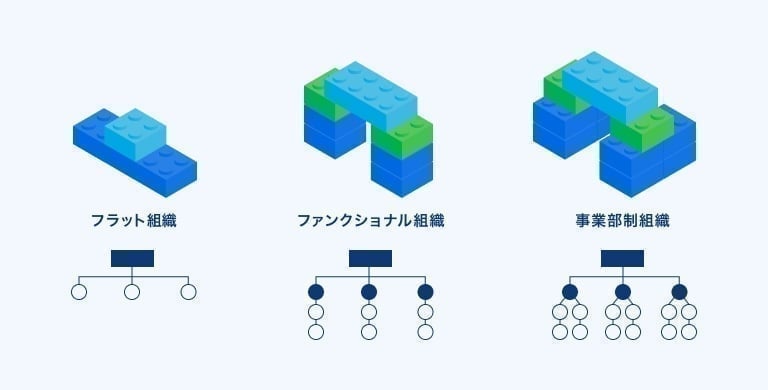
### 1. Flat Organization
A flat organization is often seen in startups and early stages of new business development. It has only two levels of management and employees, simplifying reporting lines and eliminating hierarchical coordination. It is used to focus on productivity and concentrate on product launches and PMFs.
This organizational structure takes the principles of decentralized autonomy to the extreme, requiring a high degree of self-governance. It can only be established with top-tier personnel in terms of both mindset and skills.
It is said that this organization can only sustain up to 20-30 people, and as the number of people comprising the organization increases, the cost of management coordination rises exponentially. Therefore, it is important to consider in advance when to transition to a functional organization, as explained next, and to do so without delay.
### Functional Organization
Product evolution requires collaboration beyond just the product manager, necessitating partnerships with engineers and designers. A functional organization is one that focuses on these functions and designs the organization accordingly. The functionality, such as skills and expertise, is recognized as a department, and a person in charge of each department, such as CPO/VPoP, CTO/VPoE, CDO/VP of Product design, etc., is appointed to be in charge of each department.
When this organization is adopted, the range of authority will be gradated depending on whether it is centralized or decentralized. In other words, if the organization is centralized, the product policy is directly related to the business, so the CEO and the rest of the management team will have decision-making authority over the product vision and roadmap. Conversely, in an autonomous decentralized model, each product manager has authority over his or her own area of responsibility, with MVV in mind. As a middle ground, the CPO/VPoP responsible for the product may have the authority to make decisions on their own initiative.
The more centralized the decision-making, the higher the coordination costs and the longer it takes to reach a decision, but this has the advantage of giving the CPO/VPoP a bird's eye view of the entire picture and allowing him or her to make larger decisions. Also, the more authority is decentralized, the higher the hiring requirements and the more difficult it becomes to scale as an organization.
As you get to the rater stage, it becomes more and more difficult to hire senior product managers who are aware of their own discretion, so it becomes necessary to somehow distribute authority and ensure the hiring of junior-level employees.
### Divisional Organization
A divisional organization refers to an organization that has established self-contained business units within the company. It is designed so that each business unit can complete its authority and responsibilities. In today's IT companies, a divisional organization may be partially introduced at a very early stage, for example, when new product development begins immediately after the PMF of the core product, or when a subsidiary is established to conduct finance-related business such as Fintech.
To effectively implement a divisional organization with multiple independently operating units, a minimum workforce of 200-300 employees is typically required. It is sensible, but it seems to me that more and more companies will make a firm transition only when they reach a size of around 500-1000 employees. Furthermore, there are different types of business division systems, depending on the axis along which the divisions are divided. Specifically, divisions will be organized by product/function, user segment, KPI, etc.
#### A. By Product/Function
As the name suggests, business units are organized by product or function. Therefore, one or more product managers are assigned to each product or function, and are in charge of user research, data analysis, and function planning. They will then work with the business side to achieve and promote the goals.
This organizational design is often employed when there is a broad product lineup and development sites in various locations. By organizing on an independent product or function basis, it is easier to reduce cannibalization with other business units.
However, since the organization is organized independently from other business units and there is less need for collaboration, the same issues may be tackled at different times, and there is no need to share information across business units at all. It is also important for product managers from different business units to communicate with each other in order to discuss issues common to the entire product.
#### B. By User Segment
Organizing business units by user segment allows the development of products and functions that are of interest to specific user segments, and leads to a deeper satisfaction of specific customer needs. In companies with this organizational design, all work done by product managers, including understanding needs and pain points, development priorities, and planning of measures, will naturally focus on user-centered value creation.
Because of the focus on the users of the product, it becomes necessary to coordinate across business units when making enhancements that affect multiple user segments. This organizational design will always start with a plan to design a stand-alone UI for that segment. Once this plan is released, it is essentially an irreversible decision and must be considered with considerable care, as the UI maintenance costs continue to more than double.
#### C. By KPI
Finally, there is a design in which the principal KPI is the team's goal, and business units are organized to improve it. This design is effective in cases where the most detailed KPI is directly related to a specific user activity. Specifically, it works well with B2C products such as social games. However, as a business unit, it is essential to have KPIs with a certain degree of stability, so even for B2C products, KPIs will be adopted after the product type has been determined.
Conversely, in the case of SaaS, where functions are bundled and provided to users, it is difficult to link business impact and user activity, so the adoption of organizational design by KPI must be partial. For example, it is often the case that only those parts of a measure that are directly linked to business impact, such as sign-up and billing lead optimization, are cut out and adopted.
Although we have reviewed the axes for organizational design one by one, it is often the case that the organizational structure is not completely based on any one axis, but rather a combination of partial product, user segment, and KPI designs. For example, when a newly acquired startup has not yet undergone PMI (Post Merger Integration), it must be designed by product, and new businesses also tend to be designed by segmentation. Sometimes, only the characteristic user segments that should be worked on across products are cut out, and KPIs are sometimes organized by KPI only for those that have been established. In fact, it may be more rare to have a neatly designed organization centered on any one thing.
In terms of decision-making, these business units are expected to operate as independent business units, and therefore have authority over budgets and hiring. the management team, led by the CEO, is responsible for reviewing business performance and coordinating resources across business units and all business units. The focus will be on more abstract tasks, such as developing a product vision across all business units.
## Summary
While reviewing the evolution of the product organization in each phase, we have looked at the characteristics of decision making in each phase in turn. The optimal form of a product organization changes continuously, depending on the phase and the characteristics of the product. The answer may be to keep scrapping and building while always considering the optimal organizational design.
---
# The Relationship Between Multi-Product Strategies, Compounding, and All-in-One
URL: https://route06.com/insights/49
The type of multi-product strategy varies, and the right approach depends on the product type and target market, as we discussed in a previous article ["Multi-Product Strategies in SaaS"](https://route06.com/insights/42). There are also other similar concepts, such as compounding and All-in-One (End to End). You can see that they are discussed from various angles, which illustrates the importance of having multiple products when developing SaaS in Japan.
In this article, we challenge you to systematically organize multi-product strategies, compounding, and All-in-One, and provide a foundation for discussing how the strategies should be implemented.
## Multi-product strategy
Let's first review the multi-product strategy: a multi-product strategy in SaaS is a strategy in which one SaaS company offers several different products. This approach allows a SaaS company to diversify its revenue by addressing the needs of different segments and user segments, deploying new products as new growth drivers, and combining multiple products to drive business growth rather than relying on a single core product.
Multi-product strategies can be implemented in both Horizontal and Vertical SaaS. They can be categorized based on two axes: the relationship between the main product and secondary products (whether they are peripheral or distinct) and the relationship between buyers (whether they are the same or different). The relationship between the main product and the second and third products (whether they are peripheral or completely different) and the relationship between the buyers of each product (whether they are the same buyer or different buyers) can be organized as follows.
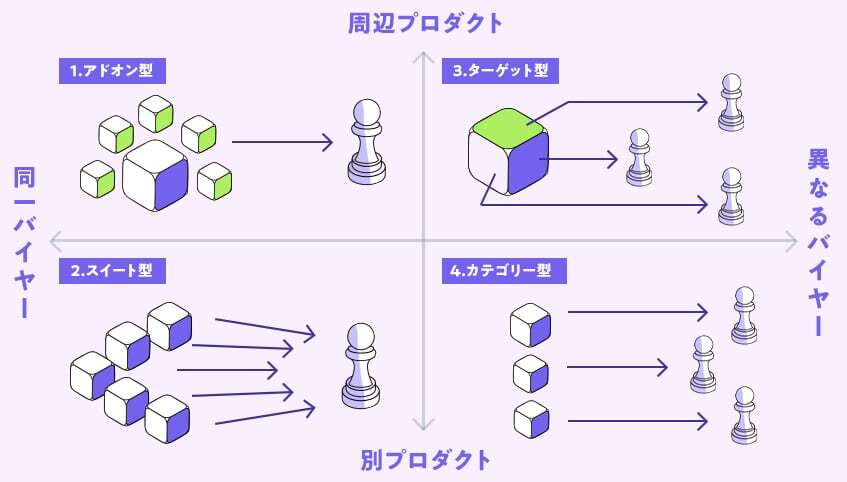
As shown above, there are four typologies, which can be defined as add-on, target, category, and suite types. For exact definitions and specific examples, please refer to "Multi-product strategy in SaaS". This definition is more from a strategic viewpoint, rather than a product design or marketing perspective, as it focuses on key divergences in product-buyer relationships.
## Compounding
Next is compounding. Multi-product, as the phrase implies, refers to offering multiple products. In this context, compounding involves developing integrated elements like UX, authentication, billing, data, and authorization all at once, and supplying them to applications by isolating and evolving common foundational components across multiple products.
In other words, it refers to the state in which a common product infrastructure is established as a compound for multi-product development, and can be viewed as a type of multi-product as shown in the figure below.

The relationship between each product and the foundational infrastructure is shown in the figure below, where various products are launched and operated on the same core foundation.
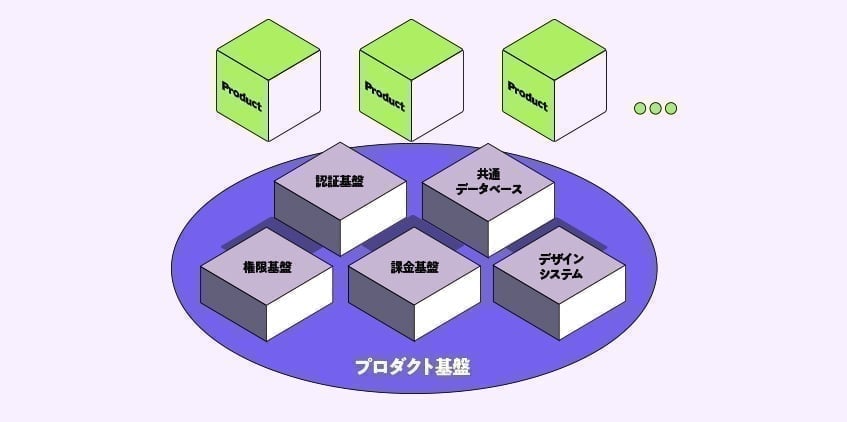
Furthermore, there are two major patterns in how a compound is viewed: the first is when the emphasis is on the product, and the second is when the emphasis is on the product foundation. In the former case, the core product is deployed, and a suitable multi-product model is adopted to expand the scope of the product. In this process, common parts are cut out from the core product, recognized as the foundation, and evolved.
Conversely, in the latter case, the core of the product is in the aggregation of APIs and data, such as iPaaS and management infrastructure. In this case, the fact that the product is established as an infrastructure itself becomes a competitive advantage, rather than the application riding on top of the infrastructure, and this design and scalability become differentiating factors.
Thus, compounding can be said to be a concept that focuses on the composition of products in order to realize multi-products.
## All in One
Finally, we have All in One. This concept is the most commonly used and is very polysemic, being used from various perspectives such as product strategy, product composition and marketing.
First, we'll focus on two aspects—product strategy and configuration—and structure them accordingly. Then, All refers to the function or product, and One refers to the underlying product or platform. The term "platform" has various analogies, but here we will assume that it is established as the foundation when multiple products are offered and the common parts are cut out. In other words, when multiple products are offered on a single platform, the terms "platform" and "compound" are synonymous.
When providing APIs, a group of APIs released to a third party is called an API platform, and when providing not only SaaS that can process order and supply operations but also functions that can actually place and receive orders, these functions are sometimes called matching This function is sometimes called a matching platform.
When examining the 'All' and 'One' combination, two patterns emerge: the first involves providing multiple functions as a single product, similar to the add-on type in a multi-product strategy. The second offers multiple functions as a single product but not as a multi-product. The second type of product is one that offers multiple products on a single platform, which corresponds to the suite or category type in the multi-product strategy. However, in the case of a suite or category type, there is no common product foundation, and it is possible that the multi-product is completely independent. In the case of a completely independent multi-product, it is a prerequisite that the platform is functioning (being a compound).
If we change the perspective a little and look at All in One based on marketing, it can be used as an appeal to users. In other words, it is used in the sense of appealing to the fact that the product is capable of broadly fulfilling user needs. In contrast to All in One in this sense is Best of Breed, which is also a concept from the user's perspective, and refers to selecting and combining the best products for each specific field or function.
Thus, All-in-One is applied not just in product strategy and configuration but also in marketing, with interpretations varying widely depending on the context and user. It is important to note that such a concept is easily misunderstood, both when seen or heard in use.
## Summary
As the total addressable market (TAM) is limited in Japan, multi-product strategies, compounding, and all in one are expected to be widely adopted, and the segmentation and optimization of strategies will continue to increase. Every month, we hear stories of product development projects in which companies are actually considering which type of multi-product strategy they should use for their target segments and where they should place the emphasis in compounding. We would be happy if this could serve as a basis for discussion when adopting multi-product strategies, compounding, and All in One, etc. in the future.
---
# Key points in launching a new digital business
URL: https://route06.com/insights/5
The use of new digital technologies has become a prerequisite for many new businesses of major companies across all industry sectors. These technologies, such as SaaS tools, enable companies to build operations quickly and cost-effectively. They also help create better experiences for end users, including business partners and consumers. New technologies, such as AI/machine learning-based health checks and blockchain-based overseas remittances that are secure and can be implemented in a short period of time, are creating experiences and services that were not possible before. New technologies continue to create experiences and services that could not be realized in the past.
In addition, with the spread of mobile devices, it is becoming commonplace for people to first become aware of new services, products, and brands through online services such as SNS and video sites, rather than through real media or advertisements such as TV commercials. Users often form different impressions of the same product, service, or brand depending on whether they encounter it through real contact points (like stores or face-to-face interactions) or digital contact points (such as smartphones or PCs). Even when the same message and creative are used across both channels, the user response can vary significantly. In fact, even with the same product lineup, it is common for the best-selling products in real stores to not match the sales rankings on the e-commerce site.
Even for large traditional companies that have developed their business mainly through traditional real channels, digital channels, whether B2C or B2B, can be the first place for brand recognition of products and services, or an opportunity for real channel usage to be done through digital channels (e.g. BOPIS: Buy Online Pick Up In Store (BOPIS: Buy Online Pick Up In Store, a service in which customers receive products purchased on an e-commerce site at a storefront). Against this backdrop, we will introduce some points of focus that can serve as a guideline when planning a new business based on digital services.

### What are the digital natives in your target market?
Digital natives are defined as "customers who tend to actively gather information using relatively new digital tools and have the ability to transmit information" in the target market. For example, in the consumer market, the use of mobile apps and payments are commonplace, so it is not an activity that is unique to digital natives in that market, but in the traditional manufacturing industry, companies and businesses that use mobile apps such as DocuSign for contract procedures in order to receive and place orders for purchase transactions are considered digital natives. However, the number of companies and businesspersons who use mobile apps such as DocuSign for contract processing in the traditional manufacturing industry is quite small at this point, so it can be said that they are digital natives in the target market. These customers are not only active users of new technological tools and digital services, but also have a high ability to communicate information to the surrounding community, making it easy to test initial hypotheses for new businesses and services without special marketing research or promotions. This tends to make it easier to test initial hypotheses for new businesses and services without having to conduct special marketing research or promotions. When considering a new business for a major company, it is often the case that customers with a large share of sales, such as existing customers, are prioritized as initial customers. Market strategy. We recommend focusing on gathering information and planning from the perspective of "digital natives" during the initial research stage. This approach, unencumbered by existing transactions or products, can easily lead to innovative ideas. It's one of the key considerations we emphasize for effective market research.

### What are the customers and applications where the target technology can provide the most benefit?
When considering a use case for a new technology or tool, it is important to consider who the target customers are and which means can provide the greatest benefits compared to conventional means in any industry or market. Naturally, if you are aiming to create a new market, you will be required to solve a problem or provide a gain, so it is useful to expand the scope of your business idea from the perspective of the maximum benefit that can be realized, rather than just solving problems or making improvements as an extension of conventional operations or lifestyles. For example, if there is a technology that can measure body temperature simply by pointing a camera at it through image analysis using machine learning, many business ideas can be considered for this alone. The concept of replacing traditional thermometers is relatively easy to envision. However, providing customers with a benefit that can overcome the long history and trusted familiarity of physical temperature-taking is challenging. This remains true even if the new method offers statistically superior speed and accuracy. On the other hand, there may be some problems with accuracy. On the other hand, even if there are some accuracy problems, there may be demand for a service that can semi-automatically monitor body temperature at a fixed point to estimate women's menstrual cycles or to watch over children and the elderly. It could also become a means of managing the physical condition of employees working in factories and power plants. From a slightly different perspective, technology that can measure the body temperature of a group of people with a camera could have unexpected applications and needs as a means of understanding the state of excitement at live concerts and sports stadiums. These are just examples, but there is a high possibility that market opportunities for similar technologies will differ greatly depending on their applications and customers.

### What is the most appropriate market selection at this time?
Even if you have verified that there is customer demand for your new technology-based service, the timing of your market entry can affect the speed of growth of your business and service. For example, for a start-up company, the timing of market entry is more obvious and affects the success or failure of the business, since the ease of attracting funding and human resources depends on the trends of the time. For example, Gartner's Hype Cycle of Technology maps specific technologies by dividing them into the following phases: 1. early days, 2. peak, 3. disillusionment, 4. enlightenment, and 5. stable. Identity, etc. have reached their peak and are expected to enter a period of disillusionment[^1]. Even for the same technology in its infancy and peak phases, the impression from both inside and outside the company will differ, and the cost of explaining the technology to those involved will also be affected, which can make a big difference just in terms of the ease of securing business resources. In addition, in the digital-related business domain, it is not uncommon for the competitive environment of the business to be very different today than it was several years ago, as assumptions about the makeup of the major players and the ROI of online marketing can change over the years. When actually starting a business, there are many opportunities to be asked to explain to internal and external stakeholders why this service should be started now, so it is important to have at least a few assumptions about when the appropriate time to enter the market is. In terms of market timing, the four perspectives of PEST analysis (Political, Economic, Socio-cultural, and Technological) can be useful in organizing initial thinking.
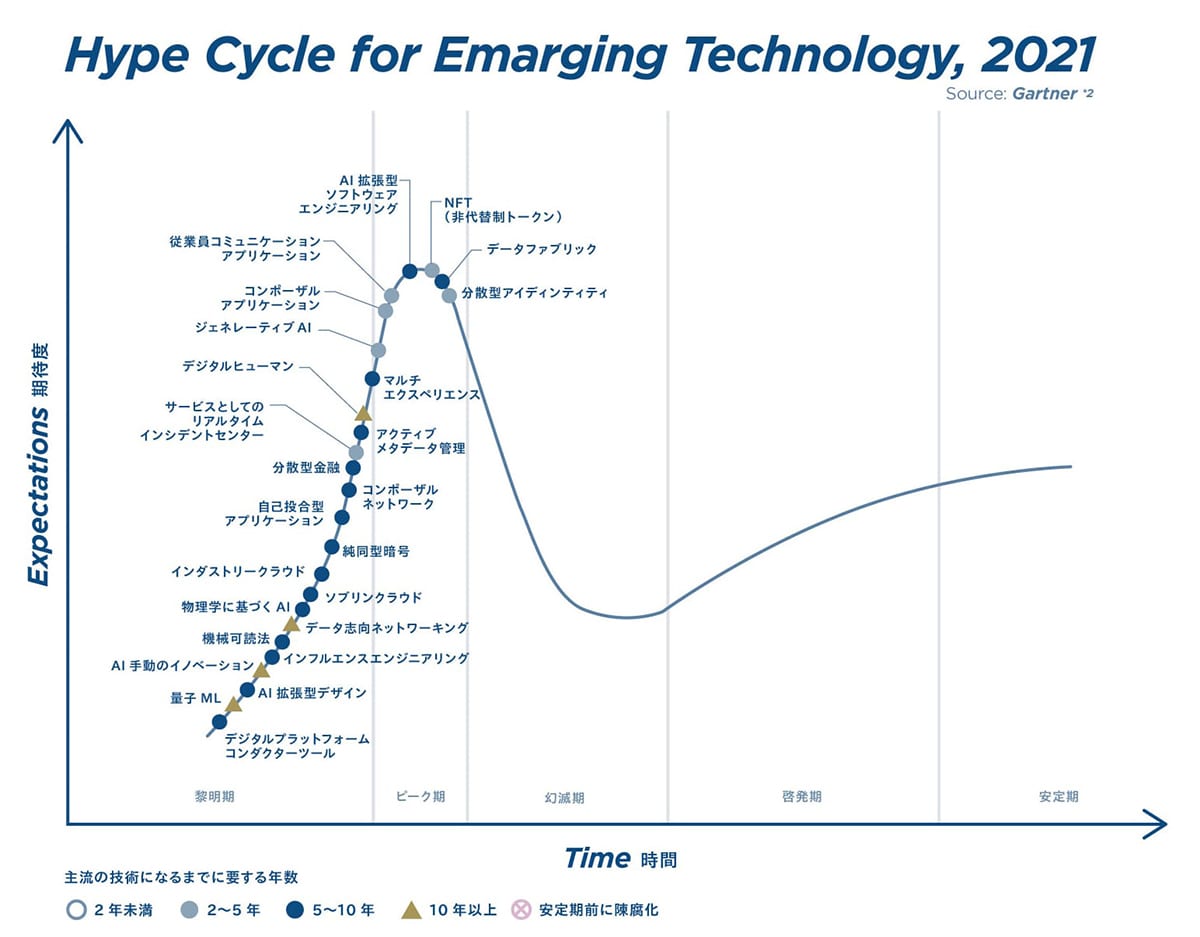
Created by us based on Gartner's "Hype Cycle for Advanced Technologies: 2021".
### Conclusion
Although this article focuses on the focus of new digital-related businesses, the above points are also important for "digital transformation," which is aimed at transforming existing businesses. In both new businesses and digital transformation of existing businesses, it is ideal to release products and services in a short period of time, and to verify and discover business ideas by meeting with customers. However, it is not uncommon for a major company to take years to release a single business or project, and even PoC projects can be large-scale with many people involved, making it difficult to test hypotheses in a short cycle like a startup. We hope that this article will be of some help to those who are considering and promoting projects in such an environment.
[^1]:[Gartner、「先進テクノロジのハイプ・サイクル:2021年」を発表](https://www.gartner.co.jp/ja/newsroom/press-releases/pr-20210824)
---
# The Importance of PQLs: Key to Driving PLG Success
URL: https://route06.com/insights/50
As SaaS and other B2B products proliferate, the concept of Product-Led Growth (PLG) is gaining prominence. Until now, most BtoC products have been mass-oriented, and the assumption has been to keep the user story as simple as possible and to grow from the product's point of view. This concept has developed in BtoB and is beginning to be recognized as PLG. This article focuses on PLG and how to handle Product Qualified Leads (PQLs), which are key to its growth.
## Explanation of PLG Typology
PLG is a go-to-market strategy for SaaS and other B2B products, where the product itself drives user acquisition, activation, and retention. Specifically, there are three main types of PLG: freemium, free trial, and demo.
Freemium refers to a system in which the basic functions of a product are provided free of charge, and users are charged only when they take advantage of additional functions or support based on their needs. A free trial allows the entire product to be used for free for a certain period of time, and the user is asked to try the product during this period and then decide whether or not to move to a paid plan. Finally, there are demos. The easiest way to recall this is for Sales to give individual product introductions to prospective customers. Other times, we may prepare a webinar or video introducing the product, or we may incorporate a portion of the product on our website so that it can be operated.
The common denominator of all types is that the customer is allowed to try the product in the pre-contracting phase and to decide whether or not to sign the contract.
In addition to the acquisition perspective, the Churn Rate can also be kept low by incorporating Customer Success Management (CSM) initiatives into the product as a tutorial, starting with the product itself.
In contrast to PLG, there is the concept of Sales-led Growth, which refers to the process of negotiating and receiving orders by Sales, as in the past, and by having Sales respond to PLG, more expensive products can be sold. In addition, the sales team's explanation of the PLGs enables the development of new markets that have not yet been established.
On the other hand, PLGs are unlikely to generate high ACV, but they can reach a wide range of target customers. Especially when the market is well known, it is possible to acquire leads efficiently.
## Definition and importance of PQL (Product Qualified Lead)
As the SaaS industry gains momentum and the number of SaaS companies increases, competition intensifies naturally, and customer acquisition costs become a critical factor. Also, customers are changing. Companies are providing whitepapers and webinars to enable customers to learn and compare SaaS offerings on their own. In addition, the proliferation of PLGs has increased the number of products that offer freemium and free trials, which is a very strong input into the decision to purchase.
This is where the concept of PQL is beginning to emerge. This refers to a Lead who has tried the product in advance and understands its value, and can obtain basic customer information in the same way as a Marketing Qualified Lead (MQL) or Sales Qualified Lead (SQL). Conversely, one point that is completely different from MQLs and SQLs is the ability to check actual product usage trends. In other words, it is possible to determine whether or not a customer is a target segment as before, and furthermore, to determine through analysis whether or not a customer is likely to be charged based on the usage trends of the product.
This is especially useful for products for SMBs, not for enterprises, and for Horizontal SaaS, which has a larger number of potential customers. This is because freemium products can be deployed to reach a wide range of customers, and then, based on the usage trends of the product, customers with a particularly high willingness to purchase can be identified and approached with priority.
## Comparing SQL and PQL
The comparison of SQL and PQL can be summarized as follows.
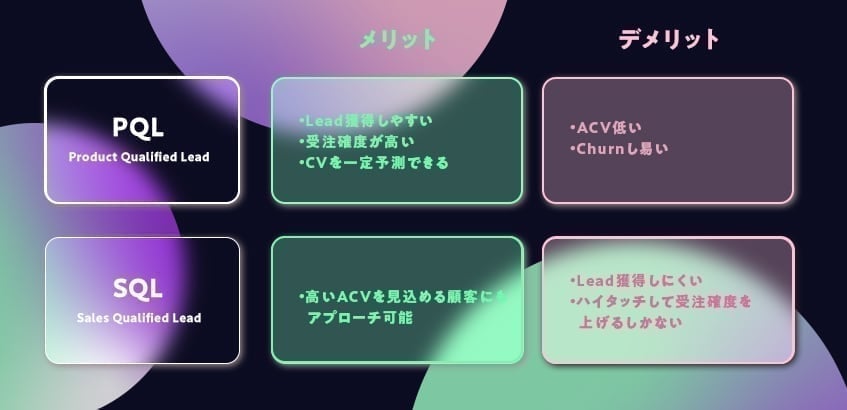
SQLs are typically better suited for explaining complex business solutions or introducing products that create new markets, due to the direct involvement of sales teams. Therefore, ACV tends to be relatively high, but on the other hand, it is difficult to acquire Lead, and orders can only be accumulated through repeated sales efforts.
On the other hand, PQLs are often deployed on a freemium or free trial basis, with self-billing and self-serve by customers, making it difficult to promote products that are too complex or novel, and making it difficult to deploy only products with low ACV. This makes it easier to acquire leads, and based on product usage trends, it is possible to hit potential customers with a high probability of orders simply by conducting in-house analysis.
## Integrate PQL and customer acquisition strategies
In implementing PQLs, it is not enough for Product-side to offer freemium or free trials, which are the prerequisites for PLGs.
In order for the freemium or free trial to become a lead generator, it is necessary to collaborate with Marketing to design how much to offer as a freemium and how long the trial will last, and then work together to determine the messaging that will appeal to the target audience. Product-side will work not only with Marketing, but also with Sales, as we will obtain user usage trends from PQLs, and user feedback from PQLs will be an important input in improving the product in the future.
Furthermore, if the content supported by the CSM can be formulated and replaced with tutorials, the product will ultimately be able to be implemented on its own. Cooperation with CSM will be indispensable in making the product easier to implement.
## Summary
In the area of Horizontal SaaS, which is compatible with PLG and PQL, if TAM can largely oligopolize the area, it is easy to create strong players and promote expansion in peripheral areas through M&A and new business development. However, such areas tend to be thin compared to core products, and one-point solutions by enthusiastic Startups have enough potential to turn them upside down.
Given the relatively small Total Addressable Market (TAM) in Japan, widespread PLG adoption may not have fully taken off yet. However, new players are starting to emerge in the Horizontal SaaS space. If they take another look at the PQL they can gain through freemium and free trials, it may be one way to build a competitive advantage over the oligopolistic players.
---
# Logistics DX - AI Applications and Challenges of Advanced Overseas Companies
URL: https://route06.com/insights/51
In Japan, the logistics industry's environment is becoming increasingly challenging each year. Although parcel deliveries have been increasing since 2015, the number of road freight forwarding workers responsible for these deliveries has remained stagnant, leading to a persistent labor shortage. In addition, 77% of the workers are over 40 years old, which means that the industry structure is strongly dependent on middle-aged and older workers, and the shortage of human resources is expected to become even more serious as the population ages.
In addition, the Standards for Improvement of Working Hours for Motor Vehicle Drivers (Notification of Improvement Standards) will be revised on April 1, 2024, to impose restrictions on overtime hours and interworking intervals for taxi/hire car drivers, bus drivers, and truck drivers. The so-called "2024 problem," or the situation in which it will no longer be possible to transport goods, is becoming a reality.
The "2024 problem" is now a real possibility.
```
The 2024 Problem
Effective April 1, 2024, the Standards for Improvement of Working Hours for Motor Vehicle Drivers (Improvement Standards Notification) will be revised, and the total number of hours that taxi/hire car drivers, bus drivers, and truck drivers are required to work, the application of an upper limit to overtime hours, and the setting of a lower limit to the amount of continuous rest time per day will be introduced. The working environment for drivers will undergo significant changes. As a result, the total working hours of workers, mainly in the transportation and logistics industry, will decrease, leading to a situation known as the "2024 problem," where goods cannot be transported. In response, the government plans to introduce measures encouraging drop-off deliveries and relaxing delivery time restrictions, with policies being rolled out progressively. In addition, the transportation and logistics industry is facing a major turning point this year, as transportation and logistics providers have successively begun raising delivery fees and charging for some re-deliveries.
```
This problem is not limited to the year 2024, but we must seek fundamental solutions in the face of a situation that will remain unchanged in the future, where logistics volume will continue to increase steadily while deliverable capacity will continue to decrease. We must also find ways to improve the efficiency of the delivery process through the use of IT, robots, etc. These challenges are not limited to Japan, but are occurring all over the world. In this issue, we will follow the logistics revolution taking place around the world.
## Automation of operations required around the world
Reforms in the logistics industry in the U.S. have proceeded from more hard-line means, such as demonstrations and strikes by workers. Multiple demonstrations by Amazon warehouse workers in the US, demanding better working conditions, pay, and the reversal of layoffs, have occurred during major sales events like Prime Day, threatening the continuity of Amazon's services. Similarly, negotiations between unions representing delivery drivers and warehouse workers at United Parcel Service (UPS) in the US and the company regarding working conditions and wages are ongoing, with demonstrations and strikes always a possibility.
From the company's perspective, the more human labor is involved in operations, the more risk there is of service instability and cost increases. This is especially true for food delivery businesses such as Uber Eats and DoorDash, and ride-sharing businesses such as Uber and Lyft, where human labor is at the core of the service.
Initially, these companies secured labor by contracting drivers as sole proprietors for one-off tasks, expecting them to work during their spare time. However, due to the drivers' calls for better working conditions, a bill known as AB 5 in the U.S. state of California in 2019 mandated that Uber, Lyft, and other dispatch service companies treat their drivers as employees (*), and in 2021, the Supreme Court in London, England, ruled that Uber and other delivery and dispatch service companies should be required to treat their drivers as employees (*). In 2021, the Supreme Court in London ruled that delivery and dispatch platforms such as Uber must treat drivers as employees.
As a result, delivery and dispatch platforms have begun to modify their existing outsourcing contracts and introduce paid vacations, national living wages, and pension schemes for their drivers, not only in the UK but also in Europe at large.
Although labor-intensive operations are not exclusive to logistics, automating processes to reduce human involvement is crucial for ensuring stable service delivery and cost efficiency.
## Overseas case studies using AI and data analysis
New initiatives are being launched one after another to address these common global challenges. First, we would like to introduce Ocado, a UK-based company that is working to improve the efficiency of warehouse operations. Ocado is an online grocery retailer that sells technology platforms and solutions used in online grocery retailing to the world's leading grocery retailers through its subsidiary, Ocado Solutions.
Features,
- The entire process from order receipt to delivery, including customer order acceptance, inventory management, picking, and delivery scheduling, can be connected through the platform and processed automatically.
- All picking is performed by robots, which process about 10 items per minute. In addition, the warehousing of goods is also done automatically after the inspection is completed.
- The system is equipped with AI and data analysis capabilities to understand customer preferences and purchasing patterns, helping shape effective sales strategies.
- Finally, the system unifies the baskets containing the products and the frames that carry them, and once the baskets are placed on the designated positions on the frames, they can be moved to various delivery trucks simply by pushing the frames, thereby reducing human workload as much as possible.
Additionally, the system automatically shows the location of the delivery basket, the delivery address, and the optimal route, minimizing the time spent on manual searches.
Next, let us introduce UPS's ORION (On-Road Integrated Optimization and Navigation) as a technology that helps improve efficiency during delivery. The system was introduced in 2012 and has been in operation for more than 10 years, and its effectiveness has become more apparent the longer it has been in operation. The effectiveness of the system is more evident the longer it has been in operation. The key to AI and data analysis functions is the algorithm, which is the brain of the system, and the data to be analyzed.
While advanced algorithms are being created one after another, the problem with actually putting them into service is the amount of valid data. UPS has 540,000 employees (as of 2021) and is said to deliver approximately 25 million packages per day. The accumulation of over 10 years of delivery information operating on such a scale on a daily basis provides a significant advantage in the business as a database for routing accuracy.
A few additional details about the business regarding the data to be analyzed are as follows. DHL Germany offers Resilience360, a supply chain risk management system that uses data analytics and AI to provide information that helps companies proactively address risks such as natural disasters, geopolitical events (events, demonstrations, accidents, etc.), and supplier failures. Resilience360 uses data analytics and AI to provide information that helps companies proactively address risks such as natural disasters, geopolitical events (events, demonstrations, accidents, etc.), and supplier failures. Related to the importance of accumulated data in ORION, it is also effective to utilize such external data as a target for analysis by routing algorithms. I have digressed a bit, but next I would like to touch on the question of whether there are any technological innovations that can replace the so-called "last mile," or delivery to the customer itself.
## "Last Mile": Where we are today in delivery automation
It was about 10 years ago that Amazon founder Jeff Bezos first announced that individual packages would be delivered from the sky, but unfortunately this has yet to happen. Demonstrations in Cambridge, England, were abruptly halted, and demonstrations in the United States were also halted after 100 attempts. This is said to be due to the hurdles of safety and deregulation, as well as cost efficiency issues. Currently, the cost of drone delivery is estimated by Amazon to be $484 per package, but they have reiterated their goal of reducing this to $63 per package by 2025. Expectations are high for Amazon's drone delivery from the sky.
Meanwhile, in ground delivery, a number of venture companies, sometimes in cooperation with large corporations, are developing autonomous vehicles such as self-driving delivery robots. Levels of automated driving are defined by the Society of Automotive Engineers International (SAE International) based on the degree of human intervention, with Level 4 becoming a reality in the delivery business.
Level 4 is becoming a reality in the delivery business.
```
Automated driving technology standards by SAE International.
These levels are used to track the evolution of automated driving technology and to clarify the roles and relationships between humans and vehicles.
- The vehicle is completely operated by a human.
- No automated driving functions are provided.
- The vehicle assists driving in certain functions.
- For example, cruise control and lane keeping assistance.
<Level 2: Partially automated>
- Vehicles can perform some driving tasks automatically under certain conditions.
- However, human intervention is required and the driver must be alert at all times.
<Level 3: Conditional Automation>
- The vehicle can perform some driving tasks automatically under certain conditions.
- However, the driver can intervene only when necessary.
- The vehicle can perform almost all driving tasks automatically.
- However, human intervention is required for driving under certain circumstances or in certain environments.
<Level 5: Fully automated>
- The vehicle can perform all driving tasks completely automatically.
- No human intervention is required at all, and the driver's presence itself becomes unnecessary.
```
In 2018, Estonia and US-based startup Starship Technologies started delivering goods by self-driving robots in Milton Keynes, UK, and has since been responsible for delivering various packages mainly within universities in the UK and US, completing over 6 million deliveries so far To date, more than 6 million deliveries have been completed and thousands of Starships (self-driving robots) are in operation every day.
The U.S. startup Nuro has already signed partnerships with major grocery retailers such as Walmart, Seven & Eleven, and Domino's, as well as pizza delivery giants, and has begun demonstration tests, An initiative to have self-driving cars actually use public roads to deliver ordered food to customers has been initiated. If the service goes smoothly in Houston, Texas, and Mountain View, California, where businesses, universities, and residences are regrouping, it is expected to be used in an even wider range of areas in the future.
In China, the development of self-driving robots is also progressing, with Neolix, Alibaba Group, and JingDong Group (JD.com) all developing self-driving delivery robots and beginning to use them not only indoors at delivery centers, but also on outdoor driveways inside universities and hospitals.
In Japan, startups ZMP and Hakobot have been conducting delivery robot experiments, and Rakuten, Seiyu, and Panasonic have demonstrated and partially commercialized a robot delivery system in Yokosuka, Fujisawa, and Tsukuba Cities, where robots deliver products from local stores to a specified location. Although the service ended in December 2023, future developments are expected.
## Advancement of warehouse operations based on human intervention
So far, we have discussed how to reduce human labor in the logistics business. However, there are still cases where human intervention cannot be completely eliminated due to various factors such as the products handled, warehouse configuration, and cost issues. Therefore, I would like to conclude this article by discussing some examples of advanced logistics operations that are useful when human intervention is assumed to be a continuous process.
Smileboard Connect, a warehouse operation enhancement system developed and serviced by Sumitomo Corporation, visualizes the work progress of individual employees at distribution centers and collects, accumulates, and analyzes performance data to improve work efficiency and physical workload. The results of this process can be used to increase work efficiency and improve physically burdensome tasks. What is noteworthy is the way in which the data is utilized. Sumitomo Corporation provides the system to the general public as SaaS, but it is also used at its own distribution warehouses. The system is also being used at the company's own logistics warehouses to identify and reassign workers based on their strengths and weaknesses, which occur only when they are not robots. Shifting workers to tasks they are good at rather than those they are not good at improves their work efficiency, and at the same time, it reduces their mental burden and leads to happiness. In addition, the improvement in efficiency can lead to higher wages for the individual.
## Conclusion
The logistics field tends to be long, simple, repetitive, and overworked, making it an industry where job applicants are in short supply and high turnover rates persist. However, the logistics industry is an industry that supports economic activity, and it is no exaggeration to say that the decline of this industry would disrupt people's lives. We hope that a technological revolution will be created in the future that can stably support such an industry and make the people involved in it happy, and we will continue to follow the process of its development. We hope that this article will be of some help to those who are considering business in related fields in developing new ideas and sorting out issues.
(*) Subsequently, companies such as Uber, Lyft, Instacart, and DoorDash launched a massive campaign, investing US$180 million in the passage of Proposition 22 (Prop 22), which would allow app-based workers to be treated as independent contractors. As a result, Proposition 22 passed in California in 2020, allowing companies such as Uber and Lyft to treat drivers as independent contractors under certain conditions.
#### References.
- [令和4年度 宅配便等取扱個数の調査及び集計方法](https://www.mlit.go.jp/report/press/content/001625915.pdf)
- [日本のトラック輸送産業 現状と課題 2023](https://jta.or.jp/wp-content/themes/jta_theme/pdf/yusosangyo2023.pdf)
- [自動車運転者の労働時間等の改善のための基準(改善基準告示) |厚生労働省](https://www.mhlw.go.jp/stf/seisakunitsuite/bunya/koyou_roudou/roudoukijun/gyosyu/roudoujouken05/index.html)
- [As Amazon Prime Day pushes the latest deals, these striking workers want a share of the profits - The Big Issue.](https://www.bigissue.com/news/employment/as-amazon-prime-day-pushes-the-latest-deals-these-striking-workers-want-a-share-of-the-profits/#:~:text=Westwood%20and%20around%20900%20other,wage%20and%20better%20working%20conditions)
- [How likely is a UPS workers strike and how would it affect shipping? | US unions | The Guardian](https://www.theguardian.com/us-news/2023/jul/14/what-if-ups-workers-strike-shipping-delay-why)
- [Parcel delivery giant UPS avoids first strike in 25 years - BBC News](https://www.bbc.co.uk/news/business-66589799)
- [Uber UK business model change](https://www.uber.com/en-GB/blog/driver-terms-faq/)
- [Uber and Lyft 'likely broke law' by classifying drivers as contractors, court rules | California | The Guardian](https://www.theguardian.com/us-news/2020/oct/22/uber-lyft-california-court-ruling-contractors-ab5)
- [Uber and Lyft now can handle drivers as contractors](https://www.engadget.com/court-rules-uber-lyft-keep-contractors-classification-drivers-california-054040457.html?guccounter=1&guce_referrer=aHR0cHM6Ly93d3cuZ29vZ2xlLmNvbS8&guce_referrer_sig=AQAAAE-qIRG-lZogax_LHB4sVaq9tAOrCElLyz4MdwasqBDcFhx9mfLgRDXYl8r2pHh4med3qlf3v8lD8-8bh_ZqZgUnzaQHgRT8rg5Sai8RGgcED81M8YJdd9y8t6Hcg0kMgyt5dekd2NhgTHVJ4P53Ca8aiQLxJ6OQJGZ95fSPBZRv)
- [Ocado Group](https://ocadogroup.com/)
- [Resilience360 Annual Risk report highlights top 10 risks for the new decade | Delivered | Global](https://www.dhl.com/global-en/delivered/globalization/resilience360-annual-risk-report-highlights.html)
- [DHL RESILIENCE 360](https://tapcrowdstatic-ie.s3-eu-west-1.amazonaws.com/5544/confbagfiles/event/10890/CSI_DHL_Resilience360_1474895712_1507195876.pdf)
- [‘ORION’ delivers success for UPS | ORMS Today](https://pubsonline.informs.org/do/10.1287/orms.2016.03.10/full/#:~:text=Once%20fully%20deployed%2C%20ORION%20is,to%20mention%20a%20significant%20increase)
- [UPS To Enhance ORION With Continuous Delivery Route Optimization | About UPS](https://about.ups.com/us/en/newsroom/press-releases/innovation-driven/ups-to-enhance-orion-with-continuous-delivery-route-optimization.html)
- [Amazon delivery drones: how the sky could be the limit for market dominance](https://theconversation.com/amazon-delivery-drones-how-the-sky-could-be-the-limit-for-market-dominance-216047)
- [Starship Technologies](https://www.starship.xyz/)
- [Press | Nuro](https://www.nuro.ai/press)
- [自動配送ロボット、中国で「爆発的拡大」の予兆](https://jidounten-lab.com/u_35795)
- [小売配送、自動運転技術の実用化が続々!日米中で(特集:自動運転が巻き起こす小売革命 第4回)](https://jidounten-lab.com/u_36216)
- [Rakuten Drone](https://drone.rakuten.co.jp/)
- [物流業界地位向上に、現場のDX改革で挑む住友商事 | LOGISTICS TODAY](https://www.logi-today.com/585845)
---
# The Cold Chain Revolution: Expanding Logistics Markets (Part 1)
URL: https://route06.com/insights/52
## What are the benefits of "cold"?
While temperature-controlled delivery is commonplace in Japan, the concept of 'cold delivery' is revolutionizing logistics and opening up huge markets globally. However, the situation in the world is different. The emergence of cold chain logistics is revolutionary and is opening up vast new markets. In this issue, we will introduce the new market that the cold chain is bringing to Africa and the technologies that are making it possible.
The implementation of a cold chain significantly impacts a region's standard of living and economic development. The main benefits of establishing a cold chain can be divided into four main categories.
__1. maintaining food quality and safety__.
Establishing a cold chain ensures the quality and safety of goods such as food and pharmaceuticals. Proper temperature control prevents food spoilage and microbial growth, thereby maintaining product freshness and quality.
__2. Stable supply of food products__.
The use of a cold chain makes it less susceptible to seasonal and climatic influences. This ensures a stable supply of food products and reduces the risk of hunger and food shortages.
__3. Extended shelf life__.
The cold chain can be used to extend the shelf life of commodities such as food and pharmaceuticals. Proper temperature and humidity control reduces deterioration and alteration of goods and minimizes inventory losses.
__4. Expand global market access__.
Establishing a cold chain allows goods such as food and pharmaceuticals to be transported to more distant regions and countries. This allows fresh products such as agricultural and marine products to reach markets around the world and meet demand.
These aspects make a huge difference in quality of life and economic wealth. Establishing a cold chain is particularly challenging in regions where infrastructure such as water, electricity, gas, internet, and paved roads are not yet fully developed. However, waiting for these infrastructures to be established will slow down the economic development of the region, so various companies, from large corporations to start-ups, are trying to establish a cold chain network in a way that is not bound by existing practices. Let us first introduce some of these developments, particularly in Africa.
## African case studies
In Kenya, Vegpro Group has pioneered the use of refrigeration technology for exporting fresh produce, including flowers, fruits, and vegetables, to international markets in Europe and the Middle East. The company has been contributing to the modernization of agriculture and creating jobs on Kenyan soil for over 30 years. The company produces, harvests, sorts, processes, packages, and transports its own export produce according to each customer's requirements.
Freightwings Ltd, a freight forwarding subsidiary of Vegpro Group, has a large temperature-controlled warehouse on the grounds of Kenya's Jomo Kenyatta International Airport and exports approximately 550 tons of produce weekly to Europe and the Middle East. By establishing a system to deliver agricultural products in good condition that meet the standards required by Europe and the Middle East, the company has been able to earn stable foreign currency and contribute to the Kenyan economy. In 1990, the country's agricultural and fisheries GDP was US$77 million, which doubled to US$155 million by 2020. Not all of this can be attributed to Vegpro Group, but there is no doubt that the company's establishment of a cold chain in Kenya and its ability to improve and standardize the quality of food exports has contributed significantly to the development of the primary industry.
In countries such as Morocco and Senegal, investment in refrigeration infrastructure has led to the growth of the fishing industry. Japan is one of the countries that have benefited from this, and for example, 20-30% of the octopus imported to Japan comes from Morocco. With the introduction of refrigeration technology, these countries have succeeded in exporting high quality seafood to international markets, with the value of seafood exports growing from US$16 million in 2015 to US$28 million in 2022.
Companies such as Comanav and Comarit purchase freshly landed fish from Moroccan markets, transport it refrigerated within the country, process it in processing, refrigeration, and freezing facilities built in coastal cities such as Agadir and Casablanca, and then transport it to European destinations in their own temperature-controlled ocean carriers. The company is expanding these markets by processing, refrigerating, and freezing its products in processing, refrigeration, and freezing facilities built in coastal cities such as Agadir and Casablanca, and then transporting and selling them throughout Europe by its own temperature-controlled ocean carriers. However, the fishing industry accounts for only 1.5% of Morocco's GDP, and 53% of this is still canned products, so there is still room for growth.
According to a report published by the Japan International Cooperation Agency (JICA) in 2020, access to refrigerated and frozen storage facilities is limited to a few companies, and the lack of a cold chain means that even today 40% of fish are discarded in the distribution process. The market is expected to expand through further expansion of the cold chain, taking advantage of its geographical accessibility to European and Middle Eastern countries with high demand for fresh fish, as well as to the eastern United States.
Other countries such as Uganda, Tanzania, and Rwanda have also seen growth in the dairy sector through the introduction of refrigeration technology, and the East Africa Dairy Development Project, led by Heifer International, has introduced refrigeration facilities and refrigerated transport systems to support the growth of the local dairy industry. The project is supporting the growth of the dairy industry in the region. Many of these countries have small dairy farms, and it has been difficult for individual farmers to afford large-scale cooling and quality control facilities. However, we have introduced a one-stop system that collects raw milk from individual farmers, checks quality, performs sterilization and cooling, and transports the milk to the destination in temperature-controlled vehicles. By achieving this, they were able to secure stable quality and quantity of raw milk, and as a group, have the ability to negotiate prices with major dairy companies.
The establishment of cold storage facilities in urban areas also facilitated the growth of food retail and distribution businesses. In Nigeria, for example, companies such as ColdHubs have deployed solar-powered refrigeration units in the country, enabling small farmers to efficiently store and sell fresh produce. This has created employment opportunities, reduced post-harvest losses, and improved food security. Without cold storage, 45% of post-harvest produce was discarded due to spoilage, costing farmers about 25% of their annual income.
And the cold chain revolution is enabling the safe and rapid transport of vaccines and blood products throughout Africa. Zipline is using its proprietary drones to deliver medicines from the sky in countries such as Ghana and Rwanda. The transportation of these temperature-controlled medicines is extremely difficult in countries with inadequate road infrastructure. Zipline stores temperature-controlled medicines in its own warehouses and delivers them immediately upon request from doctors, in the quantities needed. Zipline operates in Ghana, Rwanda, Kenya, Nigeria, and the Ivory Coast, serving more than 15 million people at over 10,000 medical facilities. Zipline is able to deliver by air in just 15 minutes, instead of 4.5 hours by land.
According to a study funded by the Bill & Melinda Gates Foundation, since becoming operational in 2019, Zipline has reduced vaccine stock-outs by 60% in Ghana and reduced lost access to vaccines by 42% for patients in need. It has also reduced the number of days of critical medical supply shortages by 21% and increased the types of drugs and other inventory at those facilities by 10%. Similarly, in Rwanda, we reduced blood product disposal rates by 67% and maternal mortality due to postpartum hemorrhage by 51%.
Japanese companies are also taking notice of these projects. Toyota Tsusho Corporation is developing a wide range of businesses in Africa, and in June 2018, it made an equity investment in Zipline in a Series C financing round and at the same time entered into a business alliance with Zipline to import and distribute pharmaceuticals handled by Gokals-Laborex Zipline has established a system for the delivery of pharmaceuticals handled by Gokals-Laborex Limited, a pharmaceutical import and distribution company of the Toyota Tsusho Group, to medical institutions in Ghana.
In addition, the company plans to use Zipline's technology to deploy a speedy cold chain using air routes not only to African countries with low population density and some areas in the United States, but also to remote islands and underpopulated cities in Japan in the future. There are several types of Zipline drones, but the Platform 2 model has a landing accuracy of 2 feet (60.96 cm) and is expected to be deployed as a means of transporting temperature-controlled goods to various locations, including urban areas. The Platform 2 model has a landing accuracy of 2 feet (60.96 cm).
## Last but not least
We have explored various examples of how cold chain technology is driving economic development across Africa. The impact of "cold transportation" is a revolution that can save people from diseases, enrich their diets, and enrich their economies. As some of the projects and regions are still in the midst of their aspirations, we look forward to further business expansion in the future. However, the example of building a cold chain network using drone transportation, instead of transportation methods that require huge infrastructure costs and time, such as roads, fueling stations, and airport facilities, is an example of a project that will further develop in the African region. This example of building a cold chain network by drone transportation, rather than by roads, fuel stations, and airport facilities, which require huge infrastructure costs and time, has great potential not only for further business development in Africa, but also for use as an alternative to the last-mile transportation methods that have emerged in other countries.
We will continue to keep a close eye on the development of the cold chain business in African countries, as well as the development of new drone-based transportation. We hope that this article will be of interest to those who are considering business in the region and the establishment of cold chains.
### References
- [The world bank data_Kenya](https://data.worldbank.org/indicator/NV.AGR.TOTL.KD?end=2022&locations=KE&start=1960&view=chart)
- [Vegpro Group Freightwings](https://www.vegpro-group.com/group-companies/freight-wings-ltd/)
- [Morocco Exports By Category](https://tradingeconomics.com/morocco/exports-by-category)
- [Moroccan Seafood Exports Hit New Record of $2.5 Billion in 2021](https://www.moroccoworldnews.com/2022/02/347183/moroccan-seafood-exports-hit-new-record-of-2-5-billion-in-2021)
- [World Bank Report Outlines Approach to Improve Morocco’s Fisheries](https://www.moroccoworldnews.com/2023/05/355436/world-bank-report-outlines-approach-to-improve-moroccos-fisheries)
- [Morocco aims to double value of seafood exports by 2020 | SeafoodSource.](https://www.seafoodsource.com/features/morocco-aims-to-double-value-of-seafood-exports-by-2020#:~:text=The%20fishing%20industry%20accounts%20for,to%20the%20National%20Fisheries%20Office)
- [Morocco to review its fisheries partnership with EU | Reuters](https://www.reuters.com/world/africa/morocco-seeks-new-fisheries-partnership-with-eu-2023-07-12/)
- [モロッコで日本の水産品鮮度保持技術が注目を集める | 事例・参考情報](https://www.jica.go.jp/Resource/priv_partner/case/release/kaihatsu_mor02.html)
- [モロッコ王国 高度冷蔵保存技術導入による水産品の高度付加価値化に向けた普及・実証事業 業務完了報告書](https://openjicareport.jica.go.jp/pdf/1000042548.pdf)
- [CMA CGM | Refrigerated Cargo](https://www.cma-cgm.com/products-services/reefer)
- [East Africa Dairy Development Project | Heifer International](https://www.heifer.org/our-work/flagship-projects/east-africa-dairy-development-project.html)
- [ColdHubs](https://www.coldhubs.com/)
- [アフリカで医薬品をドローン配送 日本では豊田通商に技術提供 Zipline – TECHBLITZ](https://techblitz.com/zipline/)
- [Zipline drones deliver one million COVID vaccinations in Ghana](https://dronedj.com/2022/03/30/zipline-drones-deliver-one-million-covid-vaccinations-in-ghana/)
- [Technology | Zipline Drone Delivery & Logistics](https://www.flyzipline.com/technology)
- [日本市場でのZipline International Inc.との戦略業務提携~ドローン物流サービスの社会実装に向けて~ | 豊田通商株式会社](https://www.toyota-tsusho.com/press/detail/210330_004791.html)
- [豊田通商によってジップラインのドローンが本格参入](https://drone-journal.impress.co.jp/docs/special/1184384.html)
---
# EDI and its future from a DX perspective
URL: https://route06.com/insights/53
With the recent demand for Digital Transformation (DX) in the corporate world, EDI is once again attracting a great deal of attention. In this article, we will explore the definition and history of EDI, and examine what future EDI will look like by considering its use in Japan and abroad.
### EDI Past and Present
EDI is an abbreviation for Electronic Data Interchange, which in Japanese translates to electronic data interchange. It is a mechanism for exchanging transaction-related data between companies in the form of electronic data. While EDI is often associated with the Internet today, it actually predates the advent of computers. In 1968, the Transportation Data Coordinating Committee (TDCC) was established in the United States. In 1968, the Transportation Data Coordinating Committee (TDCC) established in the U.S. began developing a standard for EDI in the logistics industry, and in the 1980s, the standard "ASC X.12" was established in the United States. At the same time, Japan developed rules for EDI standardization in the distribution, banking, and manufacturing industries. The EDI in use today is Web-EDI using Internet connections, which was developed after the 1990s and has become the foundation for business-to-business transactions in all industries, including logistics, manufacturing, healthcare, and retail.
Although EDI was once predicted to disappear, it continues to be widely used by companies worldwide. Most recently, COVID-19 has accelerated DX efforts, with supply chain being the most impacted area. EDI plays a significant role in e-commerce, and in healthcare alone, the market was valued at approximately $3.9 billion in 2023. EDI is expected to grow from about $3.9 billion in 2023 to about $6.3 billion in 2028[^2].
### Types of EDI
EDI is broadly divided into three categories: Direct EDI, VAN (Value-Added Network), and Web-EDI. Direct EDI, also known as point-to-point EDI, connects two partners directly. To use Direct EDI, you must use the same communication methods and protocols as your trading partners, connect directly through the Internet, and purchase a software package that allows you to use all agreed-upon protocols. Although it is costly, it is used by many large companies because it is effective for frequent data exchange with large numbers of trading partners.
VAN (Value-Added Network), also called Indirect EDI, is EDI that uses a third-party service provider, VAN, as an alternative to Direct EDI. The VAN provider acts as a mailbox, and the mailbox is shared with specific trading partners. An alert service notifies parties when messages are sent or received.
Web-EDI is an EDI transaction conducted through an Internet browser. With no sophisticated hardware or software requirements, it is a cost-effective option, especially for small and medium-sized businesses. Users can generate, send, and receive EDI documents using a Web browser. Using a Web browser makes it an ideal option for collaborating with trading partners who have limited IT and EDI expertise.
We will now focus on how EDI is used in the U.S. and Japan, and what the differences are.
### Changes in EDI in the U.S. and Japan
The most notable change in EDI in the U.S. is iPaaS (Integration Platform as a Service). iPaaS is a cloud-based integration platform, a concept first advocated by Boomy[^3] in 2008. With iPaaS, two or more systems, SaaS, cloud applications, and data can be connected to one central hub. Why is iPaaS attracting more attention in the U.S. than EDI itself? Using a I will explain this from two main perspectives browser makes it an ideal option for collaborating with trading partners who have limited IT and EDI expertise.
The first is that EDI standards differ by region and industry. In general, it is quite common for companies to be required to use EDI as a condition of doing business with their suppliers. This means that it is almost mandatory to use EDI in order to maintain business-to-business relationships. iPaaS is a cloud-based integration platform As a cloud-based integration platform, iPaaS can seamlessly connect with partners in different geographies and industries through Application Programming Interface (API) integration to further simplify operations.
> One global manufacturer routinely exchanges about 55 different document types with nearly 2,000 partners.
The second is business integration. Let us assume commercial EDI. In commercial EDI, data is exchanged as the flow of order receipt/placement, shipping/delivery, and billing/payment is repeated many times between companies, but at the same time, logistics data is exchanged as transactions are made. A 2023 survey shows that the average number of SaaS applications in a single U.S. organization is 180[^5], while only about 30% of major Japanese companies use 10 or more SaaS solutions. only about 30%[^6]. Given these findings, the use of iPaaS in the U.S. may be a natural progression.
What about the situation in Japan? With the termination of ISDN (ISDNet, digital mode) services in 2024, EDI operators will need to make system changes. In addition, in response to the qualified invoice storage method (invoice system) from October 2023, JP PINT, a standard specification for digital invoices in Japan based on Peppol, an international standard for electronic document specifications for ordering and billing, has been established [^7]. Against this backdrop, it became necessary to review the company's standard business practices and rules, and this triggered the acceleration of the company's DX efforts.
The government was aiming for about 50%[^8] of SMEs to adopt electronic order and supply systems by 2023, but the latest figures show only 40% adoption, meaning digitization has not progressed as expected. However, there is still a need to ensure interoperability between existing industry-standard EDI and cross-industry standards. In addition, the digitization of order and supply is being led by the government, but at this point it is limited to the domestic market, so it is necessary to consider what should be done to actively promote data exchange with overseas companies in the future.
### Relationship between DX and EDI
It is no exaggeration to say that EDI is the key to success in DX for Japanese companies. The Ministry of Economy, Trade and Industry's definition of DX is expressed as follows.
> DX is not the introduction of digital technologies and tools per se, but the use of data and digital technologies to create new value from the customer's perspective. It is also about working to transform business models and corporate culture to achieve this.
If success in DX is about using data and digital technology to create new value, then the introduction of EDI is likely to make DX a success. However, EDI also has a history of about 60 years, and there are a variety of services offered. You need to carefully consider what kind of EDI is best suited for your company and what kind of EDI will create new value. From here, we would like to explore what kind of EDI will be required in the future.
### What the EDI of the future will look like
What will the EDI of the future look like? There are three key words: scalability, security, and visibility.
The first, scalability, has already been mentioned in the description of iPaaS in the US, but it is necessary to think not only of EDI in isolation, but also to extend the scope of EDI to other operations. For example, even if billing and payment operations are performed through EDI, there is still the need for subsequent transfers and journal entries, and manual input into the accounting software used within the company is required. It is true that simply implementing EDI is sufficient to improve operational efficiency and reduce costs, but it is only half the DX. Therefore, one answer to scalability is iPaaS. iPaaS is not limited to EDI alone, but integrates data, applications, etc. so that operations can be performed on a single screen.
One of the leading iPaaS companies is Mulesoft. The company was founded in 2006 and became part of Salesforce in 2018. It provides a cloud-based integration platform that links multiple systems in different environments through APIs, and is expected to generate synergies with its parent company, Saleforce, as well as SAP, Oracle, NetSuite, and others. The global iPaaS market is expected to grow at a CAGR of 35.2% and reach US$43.42 billion by 2028, and is expected to continue to expand[^10].
The second keyword is security: EDI is highly secure because encrypted data is exchanged using specific protocols and standards to begin with. However, the use of Web-EDI has been expanding recently, especially among small and medium-sized companies, and although EDI is often available via a Web browser with low cost hurdles, the risk of hacking is also increasing. While companies that provide Web-EDI are making efforts to ensure the continued operation of their business, they also need to formulate their own security policies, educate their employees, manage access privileges, and check the security measures of their business partners, access authority management, and checking the security measures of business partners may become a formality. To ensure the continued use of EDI in the future, it is essential to ensure the security of one's own company.
Third, visibility. Visibility in the supply chain generally means visibility or visibility, but visibility in the supply chain means tracking various goods and products in transit, and by understanding inventory and the movement of goods and products, the entire supply chain can be managed. This is exactly the kind of supply chain visibility EDI requires. The reason companies use EDI is to make decisions through business-to-business data exchange. In order to make decisions, it is important to have high visibility of all information. In order to increase visibility, necessary information should be displayed to the necessary people (in charge/roles) at the necessary timing to enable more effective decision making. Although many dashboards and BI tools already exist, I believe that EDI can be made more visible if the information on a single platform can be viewed by multiple authorized members according to their respective authorities.
### Summary
What has not changed much from the concept of EDI, which was created in 1948 for the delivery of goods, is the need to securely exchange information with other parties in order to make decisions. There are already a variety of EDI services in Japan and overseas, but the key to determining what kind of service is appropriate for your company and your business partners is to create an environment where accurate data can be exchanged securely and where decision makers can easily make decisions based on that data. The EDI of the future may be to provide a highly visible "control tower" for decision makers by connecting all data to a single platform while ensuring security.
[^1]: aimtec/ Without EDI, Industry Would Not Be Where It Is Today (https://insights.aimtecglobal.com/en/EDI_history_and_future/)
[^2]: Mordor Inelligence / Healthcare EDI Market Size and Market Share Analysis - Growth Trends and Forecasts (2024-2029) (https://www.mordorintelligence.com/ja/industry-reports/global-healthcare-edi-market-industry)
[^3]: Boomy / iPaaS vs ETL : What Do They Offer and How Are They Different? (https://boomi.com/blog/ipaas-vs-etl-comparison/)
[^4]: IBM / What is electronic data interchange (EDI)? (https://www.ibm.com/topics/edi-electronic-data-interchange)
[^5]: Better Cloud / The 2023 State of SaaSOps Report (https://www.bettercloud.com/monitor/the-2023-state-of-saasops-report/)
[^6]: Techtouch Corporation / [FY2023 SaaS Utilization Survey, What are the challenges of "Dormant SaaS" as adoption increases] (https://prtimes.jp/main/html/rd/p/000000135.000048939.html)
[^7]: Digital Agency / JP PINT (https://www.digital.go.jp/policies/electronic_invoice)
[^8]: Small and Medium Enterprise Agency / Small and Medium Enterprise Common EDI (https://www.chusho.meti.go.jp/keiei/gijut/edi.htm)
[^9]: Ministry of Economy, Trade and Industry / Digital Governance Code: A Practical Guide
[^10]: Mordor Intelligence / Integration Platform-as-a-Service Market Size and Stock Analysis - Growth Trend and Forecast (2024-2029)
---
# The Pricing Team: Key to Maximizing ARPA
URL: https://route06.com/insights/54
To increase Annual Recurring Revenue (ARR), pricing strategy is just as crucial as expanding the customer base. There are basically only three approaches to increasing ARPA
- Increase the number of approaches to enterprises
- Increase the number of products and add-on functions to appeal for up-selling.
- Review pricing itself
In this article, we will focus on the Pricing Team, which promotes the most direct approach to increasing ARPA, such as reviewing pricing, to see how to optimize the company's overall profitability.
## Background of the Pricing Team
There are two primary reasons to consider implementing a dedicated Pricing Team.
First, it is necessary to design pricing by utilizing a variety of data across departments, including market-related data as well as data accumulated in CRM (Customer Relationship Management) to promote Marketing, Sales, and CSM (Customer Success Management). In addition, in the case of SaaS, data accumulated in CRM (Customer Relationship Management) is also utilized to promote Marketing to Sales and CSM (Customer Success Management). In addition, in the case of SaaS, user usage logs can be obtained by providing the service through the cloud. By understanding what functions are being used and to what extent, user personas can be defined quantitatively, and plans can be set up to suit individual personas.
Second is the complexity of the SaaS business. Software has been sold as a package, but with SaaS, there are a variety of billing structures, and billing occurs on a regular basis (monthly, annually, etc.). It is very difficult to perform the billing process without delay and requires a dedicated person.
## Pricing Team Structure
The Pricing Team typically consists of three key roles. Let's examine each in detail.
__1. Pricing Strategy__*.
The first role is Pricing Strategy. This function leverages cross-departmental data to define user personas, determine feature availability, and establish billing logic and pricing. In addition, as SaaS is said to be in perpetual beta, the functionality is constantly being expanded. You will also be responsible for deciding which of the expanded features will be made available in which plans.
In advancing these projects, almost the entire company will be involved, from Marketing to Sales, CSM of course, but also PM (Product Manager) and PMM (Product Marketing Manager). As it is said that pricing is management, collaboration with the management team is also essential, and this is a very important role.
Based on various data and user feedback, you will be responsible for defining user personas, formulating plans, announcing them to the entire company, and implementing the new Pricing. Specifically, the candidate must be able to analyze data and drive complex projects. For this reason, people from strategy consulting firms and others are similarly suited for this position.
__2. Pricing Ops__.
Pricing Ops, which we will cover next, must be implemented once the Pricing Strategy has been decided. Therefore, we will implement a sales management system for SaaS and CPQ (Configure, Price and Quote) and mainly put it on Bisiness-side operations. We need to correctly configure the contracted plans for each user and turn them around to billing. You will need to link it to the accounting system and check it all the way through to payment. In addition to this, the role also includes planning and development promotion related to the billing infrastructure, such as the expansion of payment methods. In the case of enterprise SaaS, the number of users is not so large that a simple system is sufficient, but in the case of SMB SaaS with a very large number of users, there is a high need to automate everything up to billing, which requires advanced Pricing Ops. Ops will be required to establish a SaaS sales management flow, which requires skills in establishing fairly complex operations. The requirements are quite diverse, including enterprise ERP, and you must be able to coordinate with all parties involved.
__3. Deal Desk__.
The Deal Desk** plays a last resort role in sales activities to close complex deals that cannot be closed through normal discounting alone. The Deal Desk is the last stop for sales activities, especially enterprise sales, and handles complex, large transactions involving multiple products and services, customization, and long sales cycles. The Deal Desk is responsible for coordinating the most difficult deals in enterprise sales. The Deal Desk is responsible for coordinating the most difficult deals in enterprise sales, and therefore requires the ability to understand the coordination of past deals, and to create a proposal that makes sense, while sewing together the details based on past deals.
## Organization of the Pricing Team
The Pricing Team typically collaborates with various departments across the organization, with its structure and reporting lines varying from company to company. In other cases, it may be placed directly under the CRO (Cheif Revenue Officer), considering its impact on the entire Business Side. For a slightly different perspective, they may be placed on the Product Side, close to PM or PMM, considering the appropriateness of the mid- to long-term pricing strategy, or they may be placed in Business Management, emphasizing the linkage with accounting and finance. The role of the Pricing Team varies depending on the phase of the company, whether the company wants to operate Pricing in a stable manner or actively change the Pricing Strategy, and what the company wants to achieve through Pricing.
## Summary
In today's business environment, it is imperative to improve ARPA. Adding products or introducing them to the enterprise is of course a useful approach, but it does not have an immediate effect. Therefore, optimizing the overall view of Pricing and business side processes can be done even now, and is one of the functions with a very high ROI.
### References.
- [Price to Scale](https://www.pricetoscale.com/book/)
---
# Pricing Design and Operation in SaaS
URL: https://route06.com/insights/55
As the downside market conditions continue, the SaaS industry is gaining momentum to improve Average Revenue Per Account (ARPA). This is one of the major trends to improve ARPA.
Directly contributing to ARPA is pricing. In light of recent market conditions, there has been a series of cases of qualitative shift from Per User billing. The customer success tool Intercom has introduced add-ons, while the business messaging app Slack has adopted Active billing to reduce the barrier to entry. This article covers the basics of SaaS pricing, from foundational principles to daily operations.
## Positioning Pricing
For SaaS, pricing is positioned as very important from two perspectives.
First, from a user communication perspective, SaaS bundles functionalities with use cases and offers multiple price points. The user will see what they can use and to what extent, understand the cost for that, receive sales, and consider implementation. Finally, the user decides whether to place an order or continue considering the product.
In other words, the SaaS product itself is variable through bundling and pricing, and we receive feedback from the user through these processes. aBundling and pricing serve as the medium through which we interact with users.
And if we look within the SaaS company, we find that pricing is the bridge between the product and the business. The product side plans and develops products that create value for users. The business side, on the other hand, delivers the product directly to the user and is responsible for the actual value creation. In other words, the product side and the business side should work hand in hand in bundling and pricing functions based on use cases, which is the starting point for a product to become a business.
Pricing plays an important role as a bridge between the product and the business, but not many companies are taking pricing seriously and working on it. When software was sold as a package, it had to be priced at a fixed price. However, SaaS companies thrive on evolving their products with high agility to meet changing user needs. Therefore, adopting rigid pricing is like flying without one wing of the benefits of being a SaaS.
Somewhere in Japan there is a sense of virtue in maintaining low prices. Of course, it is important to keep production costs down through corporate efforts, but if the value provided by the product is increasing, then the use cases should be properly verbalized and pricing should be re-set.
## Value-based vs. cost-based
The two primary approaches to pricing design are value-based and cost-based. Value-based pricing is based on the user value created by using the product.
The latter, cost-based approach is designed based on the effects of business improvement through the introduction of the product.
For example, taking a project management product as an example, if the project progress and resources can be managed in a timely manner, and if it is possible to immediately determine whether or not an order can or should be placed when an inbound inquiry is received, sales can be expected to increase. If you do not have any SaaS in place, you will have to go around asking if the Spreadsheet you are operating is up-to-date, and you will manage to answer, which may lead to a fear of missing out on customers. The price calculation based on this sales improvement will be value-based.
Conversely, if a dedicated employee manages clients and projects, tracks working hours, and requests employees to submit their utilization ratios, how much could SaaS reduce the cost of this dedicated role? The SaaS pricing is based on how much the cost of the person who is doing this full-time aggregation will be reduced by the introduction of SaaS.
Naturally, the decision to introduce SaaS should be made on a value basis as a business decision criterion, and pricing can be set higher on a value basis as well. However, how much of an effect it has on sales improvement is still a matter of guesswork, and if conservative decision making is used, it is more solid to use a cost basis. This is why many companies in Japan continue to rely on cost-based pricing.
## Charging model and pricing
Two components of pricing are the charging model and price. The former charge model defines the method of charging. Price, as the phrase goes, is a set amount of money.
Specifically, there are five major charge models: Flat Fee, Stairstep, Per User, Tiered, and Volume.
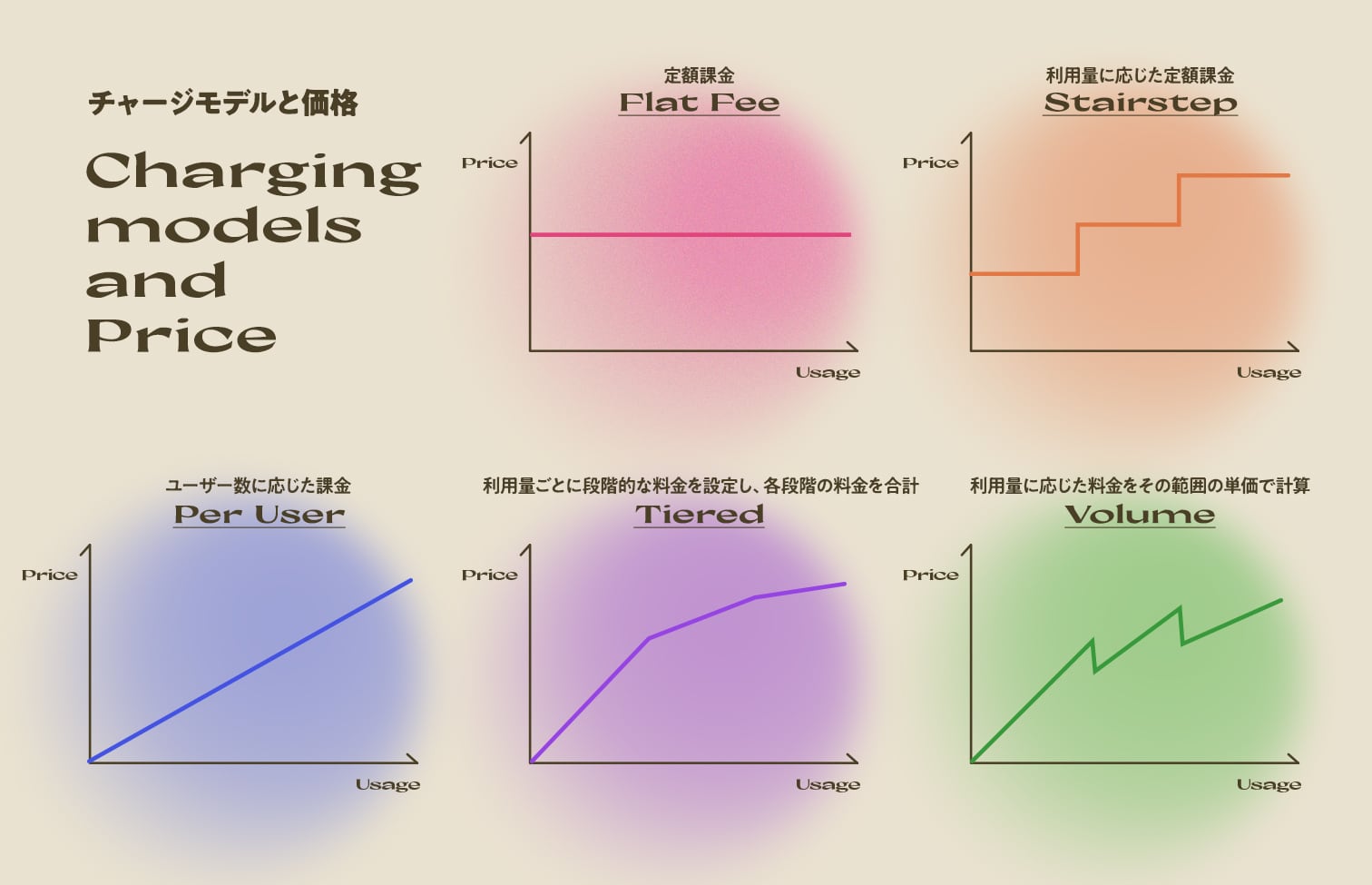
__1. Flat Fee__.
Flat Fee is one of the most familiar charging models in SaaS and refers to a flat fee. You receive a flat monthly fee for the period you are using the service, such as a monthly or annual fee.
__2. Stairstep__.
Stairstep is a slightly evolved version of Flat Fee, in which the amount of usage of some function is divided into ranges, and a fixed fee is charged for each range. For example, in an invoice-related SaaS, you can charge a monthly fee for the number of invoices you send.
__3. Per User__*.
Per User is another common charging model along with Flat Fee. As the name suggests, it refers to a form of charging based on the number of users. There are two types of billing models: one in which a company purchases a quota in advance and allocates IDs, and the other in which active billing is performed based on the number of users who use the service each month.
__4. Tiered / 5. Volume__*.
Tiered and Volume are easily confused, so they are explained together. Tiered is the amount used divided into ranges, each range is multiplied by the unit price of each range, and the sum is the invoice amount. Conversely, volume is the total amount of usage multiplied by the unit price of the applicable range to arrive at the billed amount.
For example, suppose that prices are set according to usage volume as follows
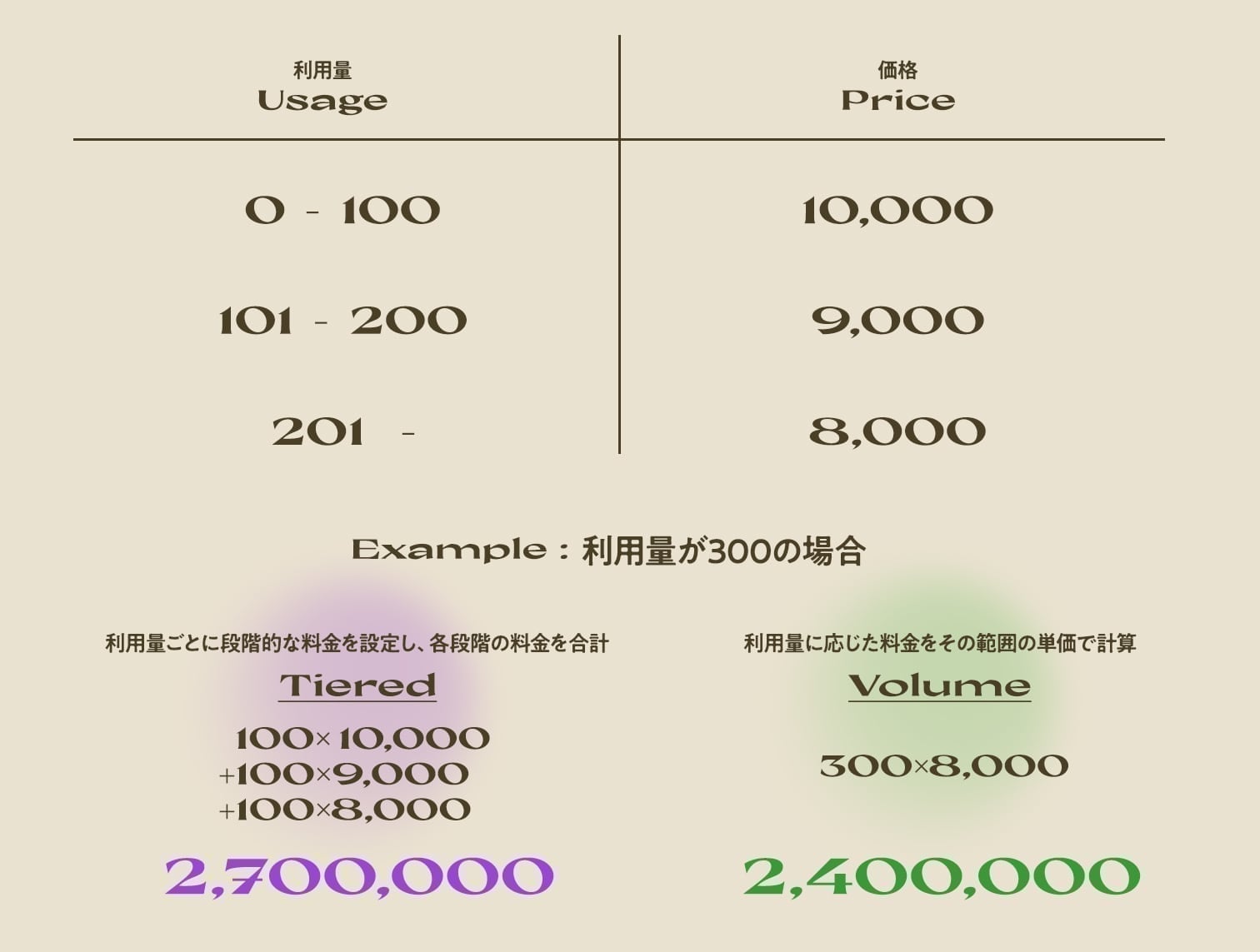
If the usage volume is 300, the Tiered price would be 100 x 10,000 + 100 x 9,000 + 100 x 8,000 = 2,700,000. On the other hand, for Volume, it would be 300 x 8,000 = 2,400,00.
Thus, Tiered is more profitable because the unit price is higher at the beginning, no matter how many units are bought; Volume is easier to sell in larger quantities because the unit price is determined by the number of units. As shown in the graph above, it is important to note that at the boundary of the range, there will be cases where the price will be lower if you increase the usage volume.
## Methods for Setting Prices
Rather than focusing on analytical methods for setting individual prices, product and pricing is the communication between the provider and the user.
Therefore, it is most important to capture and determine a series of (1) to whom, (2) when what is provided, (3) what charging model, and (4) how much.
In the case of a product that supports multiple industries and multiple use cases, it is necessary to first organize the user stories that are being realized. First, we will organize the main focus on (1) to whom and (2) what we are providing. Then, qualitative and quantitative research will be multiplied. Speaking of pricing analysis, PSM analysis and contingent analysis are well-known, but in the case of BtoB, the number of target companies is often small, and it is necessary to segment and aggregate to some extent. Therefore, it may be quite expensive to conduct a survey with strictly defined advantages and disadvantages. For this reason, it is more often the case that interviews are the main design element.
The interviews will mainly confirm the Willingness to Pay (WTP) and concretize what is anchored behind it. First, WTP is how much the user is willing to pay for the product. After explaining the product, we will ask the WTP question in the process of confirming whether the user would like to use the product frankly and whether it is likely to solve the current business problem.
Then, there is some anchored object in the amount of money indicated as the WTP. It will be anchored to the sense of the amount of money of the competition or peripheral services, the sense of the price of the company's products, or if the work is entrusted to a part-time worker, the part-time worker's part-time job fee, and so on. If you want to appeal to a higher price than the anchored target, you will need to win in terms of functionality and user value. The amount of money to be spent will be determined by the number of users and the amount of money to be spent. In determining the amount of money to spend, one thing to note is that because of the interview format, interviewees often have a bias that they have to say something good because they have been invited to the interview. In addition, if the interviewee is considering the introduction of a product immediately, that is fine, but if he or she is only planning to consider it in the future, he or she may not have a clear understanding of the competition's features and prices, or may not have the necessary knowledge to answer the question. Therefore, even if they have good things to say, it is best to discount their answers by a factor of about 7.
In addition, among BtoB, in the case of Horizontal SaaS and products for SMB, there may be quite a large number of target users, so only in this case, there is room to utilize PSM analysis and contingent analysis first. You can also consider conducting AB testing and seeing the actual user response before making a decision.
## Operational
When talking about operational aspects, pricing really tends to be an afterthought. As described in the introduction, it is an important element directly related to ARPA, and although it is sensible, I think it is important enough to be tackled at the same level as the product roadmap.
New product releases and overall pricing reviews are to be carried out in accordance with the procedures indicated in the pricing method. However, product development is a temporal process, with new features being developed every week or month. Therefore, when a new feature is released, we will consider which plan to band it to. In this case, the product manager, focused on increasing user adoption, often suggests bundling the feature with a lower-tier plan. On the other hand, when the business side is considering the plan, they want to improve the value of each plan, so they tend to put as much as possible in the higher plans. Since there is such a clear conflict of interest in the short term, it is necessary to discuss the ARR maximization in one to three years, the use cases and intentions of each plan, and the evaluation of functions from a medium- to long-term perspective.
The people who take the lead in pricing operations also differ from company to company. Sales, product marketing managers, and product managers are three examples. The sales manager is closest to the users and can strongly reflect feedback from the users. The product manager focuses on user value from a mid- to long-term perspective. The product marketing manager is a good combination of sales and product manager.
## Summary
Pricing is one of the strengths of the SaaS offering. One of the most exciting aspects of SaaS is the ability to communicate with users by developing products that meet their changing needs and constantly changing banding and pricing.
Pricing is a topic that needs to be reevaluated in the current downside market conditions, and it has the potential to break out of this situation. We hope this article will help you rethink pricing.
### Reference
- [SaaSプライシング戦略|SaaS事業に適した価格戦略](https://price-hack.com/articles/1212)
- [SaaS Pricing Trends That Will Create Headlines in 2023](https://www.togai.com/blog/saas-pricing-trends/)
- [Pricing software products in a down market](https://github.com/getlago/lago/wiki/Pricing-software-products-in-a-down-market)
- [How we de-risked our SaaS pricing strategy](https://collinmathilde.medium.com/how-we-de-risked-our-saas-pricing-strategy-2c52eb5e5d8f)
- [Pricing Your Product](https://articles.sequoiacap.com/pricing-your-product)
- [Calculating Customer ROI For SaaS Sales](https://bowerycap.com/blog/sales/customer-roi-for-saas-sales)
---
# Scent Designer Megumi Fukatsu: Creating Fragrances that Embody a Company's Essence
URL: https://route06.com/insights/56
Have you ever been calmed by the subtle fragrance permeating the air as you enter an office, showroom, or airport lounge? Scents are often used as a means of corporate branding, as they are closely tied to people's memories and leave a strong impression.
Megumi Fukatsu, Scenting Designer, has been involved in branding and space design using such scents for many years. Fukatsu is known as a leading expert in scenting, having created scents for brands such as All Nippon Airways (ANA), Louis Paulsen, and Toyota's luxury car Lexus, and participated in numerous space design projects using scenting. [The aroma oil expressing ROUTE06's corporate philosophy, created as the second installment of ["The Day One Box"](https://route06.com/news/27), which ROUTE06 offers to new employees, was also created by Fukatsu.
What does it mean to design a brand or space using fragrance, how is it developed, and what impact does fragrance have on people? We asked Fukatsu about the story of how he started working with fragrance.
#### Megumi Fukatsu Profile
```` Scenting Designer
Born in Hita City, Oita Prefecture, Japan, Fukatsu spent her childhood in the great outdoors until the age of 18. After that, she entered the world of fragrance. He has been involved in the creation of "@aroma" since its launch, and has been involved in numerous kaori production and space design projects for ANA, Louis Paulsen, and others, both in Japan and abroad, for about 20 years. He also works as an aroma plant hunter to discover aroma materials in production areas. In recent years, he has been teaching at universities, giving lectures and seminars to spread this culture. Author of the book "Scenting Design - Kaori Shitsure".
````
## Fascinated by the power of fragrance to heal the stresses of work
### ─ What sparked your interest in pursuing fragrance as a career?
One day, several years after I started working, I rediscovered the power of fragrance and remembered that I had actually been educated as a gifted fragrance specialist in my hometown. My first job after graduating from college was with an airline company, where I found it very rewarding to provide comfortable hospitality to customers. However, there was a time when I became tired of being surrounded by artificial things in the enclosed space of the sky and dealing with many customers.
Around that time, aromatherapy, a natural therapy using fragrance, came to Japan from Europe and was enjoying a bit of a boom. I was attracted to the idea that fragrances could heal people and became interested in it. When I opened the lid of a small bottle, I was surprised at how powerful the aroma was. I was really surprised at how powerful it was. ...... It was also very interesting to me that each plant essential oil has different effects. I felt relieved, calm, relaxed, and energized. ...... As I found myself being energized and healed by the fragrance, I became completely captivated by it.
I feel especially at ease when I smell the fragrance of wood. This is because I grew up surrounded by the scent of wood in my hometown of Hita City, Oita Prefecture. My father was in the forestry business, so the house always had a pleasant woody smell. I was unknowingly trained as a gifted child about the effects of having natural scents in a space at all times. I rediscovered this effect through aromatherapy and the scent of essential oils.
### ─ What made you decide to make it your life's work?
At first I enjoyed it as a hobby, but gradually I began to think that this might be my calling. When I thought about my future career, I wondered if the job I wanted to keep doing and that only I could do was really an airline job. On the other hand, I had a good nose for fragrance work thanks to the smell of trees, plants, and flowers that had always been around me since I was a child, and above all, I strongly felt that I wanted to spend my entire life working on and exploring this field.
### ─ Why did you choose to become an aroma space designer instead of an aromatherapist?
At first I studied aromatherapy and wanted to become a therapist. I studied to get an international license in the UK, and about half of the curriculum is anatomy and physiology. You learn about the human body in a very serious and deep way. Without learning that, you cannot learn aromatherapy. It was a year in which I learned deeply about the human mind and body and the effects of fragrance.
After I got my license, I was giving treatments as an aromatherapist, but gradually I started to see the challenges. ...... It is very rewarding to give a treatment to one person and see that person recover, but I began to wonder if I could reach more people with fragrance. If we had fragrances in spaces where many people gather, such as offices, train stations, and commercial facilities, more people would know the benefits and advantages of fragrances. I was also aware that the concept of having a designed fragrance in a space was not well known yet, and I strongly felt that I wanted to challenge the unknown realm of fragrance.
### ─ I was very interested in taking on a challenge in an unknown area of fragrance.
It is true that at that time, there was no method for designing fragrances to suit a space. I was taught by people who specialize in fragrance, and I accumulated knowledge and experience by thinking about what it means to design a space with fragrance and how to do it. As I did so, I gradually became able to give shape to these ideas.
I believe that we are here today thanks to the cooperation of various people, including those who taught me about fragrance and atAroma, Inc. ...... who have worked with us to develop equipment for the stable development of fragrance in a space.
### ─ There are many people in a space, and people have a wide variety of scent preferences. It may be difficult to design a scent that is pleasant for everyone.
I had zero doubts about whether everyone would think it was good or okay. But, for example, when you go to a forest where flowers bloom from season to season and you smell the fragrance, I think many people will see it as a positive thing. If it is a natural fragrance from plants, I am sure many people will find it pleasant. It is because of this conviction that I have been able to continue this work. In our daily lives, there are days when we are tired or sick. At such times, we would be happy if the pleasant fragrance wafting through the space could make you feel positive, like "I feel a little more energetic," or "I'm going to try harder.
## Designing a space with aroma
### ─ What do you aim to convey when designing spaces with aromas?
I think that this is a story that leads to this question. Actually, there was a time when I wondered whether I should be a fragrance artist or a designer.
For example, I wondered whether I should make proposals based on my own style in the form of saying, "This is the kind of fragrance that would be good in a certain space," or whether I should propose fragrances through my own filter, tailored to the space and the people in it. As I continue my work, I have come to believe that what I want to do is "fragrance design," understanding the needs, desires, and necessities of the space and fragrance, and providing fragrances that match them.
### ─ Is there anything that is important to you when designing fragrances?
I place great importance on having a deep knowledge and understanding of the materials and ingredients that make up a fragrance. Fragrances are made from plants, and fragrance ingredients are extracted from trees, tree leaves, tree trunks, fruit peels, etc. The fragrance differs slightly depending on the place of origin and the year when the tree was produced. Furthermore, it also depends on where they grew up, who extracts them, and how they are extracted. Each is vibrant and organic and seems to send a different message.
Even in restaurant cooking, if the chef has an attachment to the place of origin of the ingredients, the way he makes use of them will be different, won't it? I think it is the same kind of feeling. I enjoy encountering plants as raw materials, so I call myself an "aroma plant hunter" and travel around Japan and abroad. I hope to someday appear on "Jounetsu Tairiku" (Continent of Passion) (laughs).
### ─ What kind of discoveries do you make while plant hunting?
What I find from my travels to various plant production areas is that there are still many things in the world that are not being utilized. I often hear things like, "It's a waste to use only the good parts and throw the rest away," or "The shape of the plant is bad, but its fragrance is irrelevant, so if it could be used instead of disposed of, it might provide additional income for farmers.
The other thing is our relationship with the people in the production areas. We often think together about how to produce plants from which good fragrances can be extracted. I am filled with gratitude when I get to know the producers. The fragrance business is only possible with raw materials, so it is not possible without a good balance between nature and people.
We must find ways to make the people in the space happy by having fragrances in the space. In order to realize this in a better way, the producers and I must be happy. With this in mind, I am constantly thinking about what we can do together.
### ─ What is the rewarding aspect of designing a space with fragrance?
I think the starting point of space design with fragrance is when the fragrance is created and spread in the space. The way we feel changes depending on the time of day and the season, so the challenge of how to make the space more attuned to the changing environment and people's feelings begins there. That is both challenging and enjoyable.
## Representing a company or brand through fragrance
### ─ Fukatsu is also involved in "expressing" companies and brands with fragrances, such as the Lexus showroom and the ANA lounge. How did you come up with the idea?
At one point in time, marketing using fragrance became a big boom in the world. Since fragrance and memory are closely related, more and more companies started to use fragrance for brand recognition. The industry, especially in the hospitality industry, such as hotels, has experienced a boom in thinking about what kind of fragrance is unique to them, and creating a space that is unique to them and welcoming to their guests. As a result, the number of requests to express their company or brand through fragrance has been increasing, and I have been receiving more and more requests.
### ─ How do you approach designing a signature scent that embodies a company or brand?
First of all, we talk to the people involved to find out what kind of company or brand they are. This is the process of "research" that is indispensable when expressing a company or brand through fragrance. In the course of the interviews, we write down the keywords that are important to the company. We then consider what kind of fragrance would make the most sense to express these keywords - for example, sincerity, happiness, trust, progress, open-mindedness, etc. - through fragrance, and what methods are available for expressing them.
As we work in this way, we gradually begin to get a sense of "what kind of fragrance would best represent this company or brand," and we then put this into a specific fragrance. This process may be similar to the process of verbalizing an image. The process of verbalization is expressed in the form of fragrance.
### ─ Last year, you designed the scent for ROUTE06, a start-up company that develops products for the enterprise.
We were originally going to give ROUTE06 three prototypes of scents, but it just so happened that we ended up giving them six prototypes, the same as the company's name. The six fragrance elements were words that we often hear from our employees: future, diversity, excitement, happiness, and spontaneity. We did not try to narrow down these words, but included them in all of them. It is as if there are six different patterns among the different words.
### ─ What is the actual fragrance that you have created?
I used citrus scents for positive words such as "forward" and "exciting," and lavender scents for keywords such as "honest," "focused," and "kind. For the atmosphere of trust, honesty, stability, and security that we felt when we met with the employees, we used cedarwood and rosemary. I sympathized with the words that came out of the interviews, that the people of ROUTE06, with their rich individuality and diversity, weave something together as they form a team to do work that relates to society, and the scent was inspired by communication and connection, It is expressed with fresh orange.
I thought it was typical of ROUTE06 that they chose all of the scents, rather than narrowing it down to one from the prototype scents.
## Designing and communicating fragrances that help people live comfortably
### ─ How do you want to convey the appeal of fragrance?
I design fragrances with the hope that they will make people feel happy and positive, and help them live comfortably, and I believe that fragrances have such power.
I believe that each scent of a real plant has its own meaning, and I feel that I play the role of a guide to explore this meaning and deliver it to those who need it. As a scent guide and plant hunter, I want to be close to people's lives and sensibilities.

Writing: [Sachiko Goto](https://note.com/sagoto/)
Photography: [Hiroaki Otake](https://hiroakiotake.com/)
---
# The Cold Chain Revolution: Expanding Logistics Markets (Part 2)
URL: https://route06.com/insights/57
In [The Cold Chain Revolution: Expanding Logistics Markets (Part 1)](https://route06.com/insights/52), we explored examples from Africa, examining how cold chains have enhanced and safeguarded the lives of local populations. In this second part, we will look at the cold chain situation in Asia.
## Cold Chain Expansion in Asia Needed
First, in order to understand the extent of cold chain penetration in Asian countries, we plotted the size of nominal GDP per capita (in US dollars) on the horizontal axis and cold storage capacity per capita (in m3) on the vertical axis for the top 8 countries in terms of population size or nominal GDP size in the Asian region. Figure 1 plots the countries that fall into either the top eight countries in population size or the top eight countries in nominal GDP size in the Asian region. [^1] [^2]
__Figure 1__
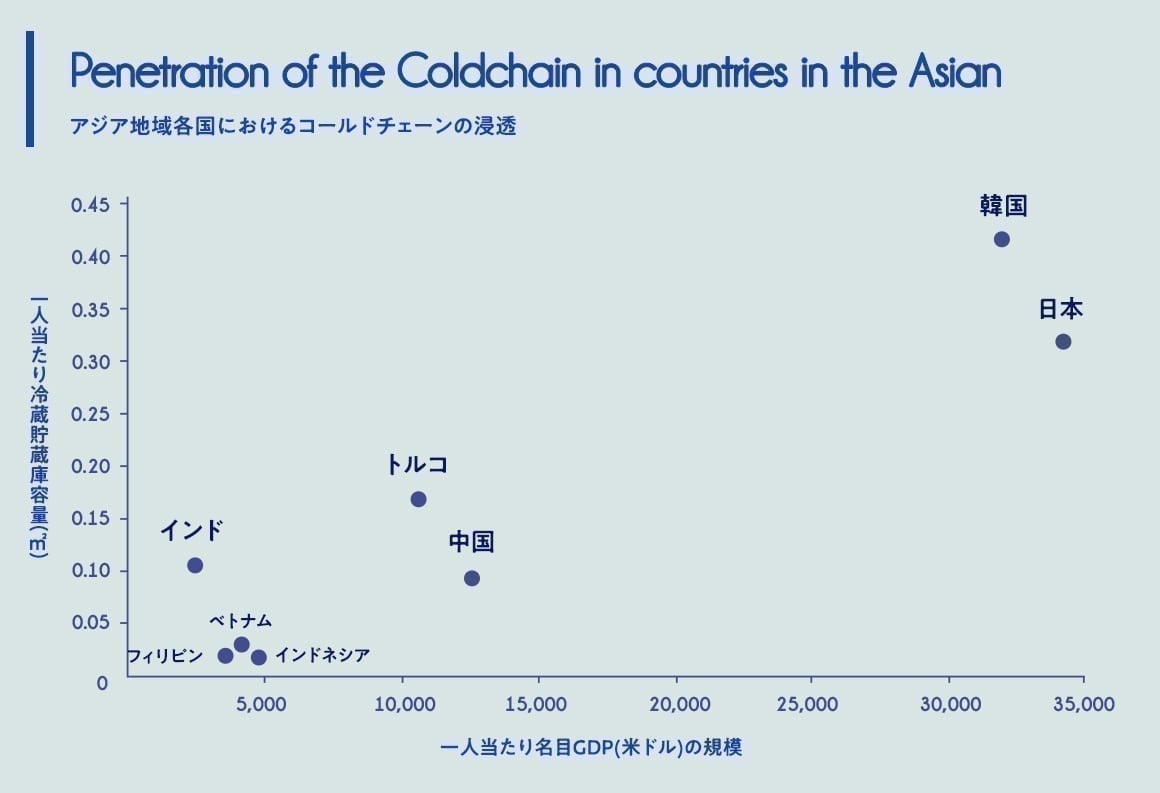
South Korea leads in refrigerated and frozen storage capacity per capita, with Japan following closely. It is followed by Turkey, India, China, Vietnam, the Philippines, and Indonesia. The global cold warehouse capacity per urban resident, including developed countries, was estimated at 0.152 m3 in 2020.
In light of the fact that the global cold warehouse capacity per urban resident (i.e., the capacity per urban resident) is estimated to be 0.152 m3 in 2020[^3], it can be said that South Korea and Japan already have sufficient cold and frozen storage facilities, Turkey has the minimum necessary facility volume, and other countries do not yet have sufficient necessary volume. With rising per capita GDP, increasing consumption potential, and growing demand for richer diets and advanced medical care, the countries in Figure 1 are expected to follow the paths of South Korea and Japan, experiencing a rapid rise in demand for refrigeration and frozen storage facilities. This is expected to be the case.
It is also important to note that Cold Warehouse Capacity is primarily the capacity of refrigerated and frozen storage facilities for business use, and does not reflect the extent to which domestic demand is being met, as it includes volume for the storage of exported goods. Figure 2 below shows the ranking of the top 20 countries in terms of refrigerated and frozen storage capacity in 2020. The United States, India, and China account for 61% of the world's total refrigerated and frozen storage capacity. While India and China rank among the top in absolute storage volume, much of it is geared toward exports, leaving insufficient capacity to meet the needs of their vast populations. Therefore, the actual demand for refrigerated/freezer storage facilities, taking into account the expansion of domestic demand, is greater than shown in Figure 1.
__Figure 2__
According to data from World Data Lab, a private Austrian research firm,[^4] the number of middle class people (defined as annual consumption of US$4,380 or more per year) in the Asian region, including India, China, Indonesia, Vietnam, the Philippines, and Turkey, is growing rapidly, and by 2024 alone, approximately In 2024 alone, approximately 110 million people will be in the middle class. This transformation in Asia represents the largest economic shift globally, making it crucial to explore innovative ways to extend the cold chain and meet the evolving food and safety needs of this growing middle class.
## Examples from Asian countries
From here, we will look at the situation in each country.
### China
China's cold chain logistics market size is estimated at US$85.82 billion in 2024 and is expected to reach US$138.66 billion by 2029, growing at a compound annual growth rate (CAGR) of 10.07% during the forecast period (2024-2029). China currently accounts for approximately 60% of the world's total vegetable production, 30% of fruit and meat production, and 40% of eggs and seafood production, which alone suggests how high the demand for cold chain is. In December 2021, the Chinese government (State Council) approved a five-year plan to build cold chain logistics and announced that it will invest in smart technologies such as smart sorting equipment, logistics robots, temperature control monitoring systems, and 5G. The plan is expected to be completed by 2025. At the same time, he announced the construction of a refrigerated logistics network by 2025 that will cover both urban consumption areas and rural agricultural production areas throughout China, as well as link up with international markets. To this end, he also declared the strengthening of infrastructure such as roads, the Internet, and water and sewage systems. The entire country has embarked on the construction of a refrigerated/frozen logistics network.
However, China's refrigerated logistics sector is regionally fragmented, with few companies handling both refrigerated warehousing and transportation. This fragmentation complicates the integrated management of storage, transportation, and delivery, making quality control for food and pharmaceuticals challenging. Leading integrated refrigerated and frozen logistics companies that handle storage, transportation, and distribution include Sinotrans Limited, SF Express, Beijing Ershang Group, Jinjiang International Co. Yet, the combined market share of these five companies is under 15%, highlighting the market’s high level of diversification. This market environment has led to an increase in the number of new entrants and more intense competition.
Here are some of the businesses that Japanese companies are developing in this environment. Marubeni Corporation established a joint venture with Chinese logistics startup G7 in 2019 to launch a leasing and rental business for refrigerated and frozen trailers in China G7 is a leading service provider in China, providing logistics IoT services for commercial vehicles to approximately 60,000 companies, totaling over 1.12 million commercial vehicles. G7 is a leading service provider of logistics IoT services for commercial vehicles in China. By collecting and analyzing vehicle operation information (data on distance traveled, acceleration, emergency braking, engine temperature, etc.) using onboard devices and providing it to customers in real time as an information service, G7 is working to optimize overall freight transportation by improving operational efficiency and safety.
In addition, NIPPON EXPRESS is focusing on building a logistics network for pharmaceuticals in China, and is the only Japanese company to have obtained GDP certification (Good Distribution Practice for Pharmaceuticals). In order to cover the business domain of pharmaceuticals (biological pharmaceuticals, biological samples, investigational drugs, etc.) logistics, which is impossible to develop independently due to foreign investment restrictions, NIPPON EXPRESS has entered into a business alliance with Shanghai Sheng Sheng Logistics Co. In this way, Japanese companies continue to make great strides in the food refrigeration/freezing business, storage, refrigerated/frozen logistics vehicle leasing/rental, and the construction of logistics networks for pharmaceutical products. Despite its growth, China's cold chain market is still expanding, and more Japanese and foreign companies are expected to enter in the coming years.
### India
The Indian cold chain market is expected to reach $19 billion in 2021, and then $43.9 billion by 2027. However, at present, the number of refrigerated trucks in operation in India is about 10,000 as of 2022, which is only 2% of the total transportation capacity of vegetables and fruits distributed in India. In addition, small-scale transporters with one to four trucks account for more than 50% of the market, making it difficult to introduce technology that would require large-scale investment. The Indian government recognizes this situation as a challenge and welcomes 100% foreign investment not only in the cold chain business itself (freight forwarding, warehousing, and storage), but also in infrastructure construction projects such as airports, ports, and roads necessary for cold chain construction. In addition, the Ministry of Food Processing Industries of India (MoFPI) has launched a program to provide dedicated subsidies and grants for infrastructure investments related to cold chain construction.
In light of this environment, the Goodrich Group, Amazon, and Japan Frozen Foods have made additional investments in the construction and operation of refrigerated and frozen warehouses, refrigerated truck operations, and temperature control system projects in the country. Ltd., a Japanese trading company, invested in TCI Cold Chain Solutions, a cold chain logistics business in India, and has made a full-scale entry into temperature-controlled transportation and storage services required in various industries, including fresh food, pharmaceuticals, chemicals, and fast food. The company intends to expand its business in India by utilizing its experience and technology in logistics services that strictly adhere to deadlines and temperature control, which it has cultivated in countries around the world.
### Philippines
The environment surrounding the cold chain in the Philippines is on an expansion trend. Demand for imported agricultural and food products is growing, especially in Manila, and an increasing number of consumers are choosing to buy food products that are sold in bags in temperature-controlled stores, known as modern trade, rather than from so-called open markets, known as wet markets, from a safety perspective. However, standards for handling refrigerated and frozen goods have not yet fully penetrated the market, and we are at the stage where businesses must first understand the need for logistics that maintain a constant temperature and that are uninterrupted. In addition, consumers need to understand the safety that can be achieved through high-quality logistics, and to allow them to pay a fair price for it. These are the activities being promoted by advanced countries in the construction of cold chain networks, with the involvement of the Philippine government. In Japan, the Ministry of Land, Infrastructure, Transport, and Tourism (MLIT) is supporting the establishment of intergovernmental cold chain quality standards and the expansion of investment incentives in this business area to encourage Japanese logistics companies to expand their business in the Philippines. The Philippines is an island nation with high temperature and humidity, and it is difficult to establish a cold chain throughout the country.
### Vietnam
Vietnam, on the other hand, differs slightly from the aforementioned countries. The people's diet depends on the wet market, and a simple form of preservation using Styrofoam cooling boxes with refrigerants is widely used. In urban areas such as Ho Chi Minh City and Hanoi, modern trade business is being conducted, with the entry of foreign retailers such as Japan's AEON, but it still only accounts for more than 10% of the total volume of food products traded in the country. Under these circumstances, the cold chain is still underdeveloped, with the exception of a few cold chains built mainly for exported food products. The Vietnamese government has no laws, regulations, or quality standards for the cold chain, and discussions are still in progress. As a result, unskilled traders who do not pay enough attention to the handling of chilled and frozen products are rampant, and this has caused consumers who have experienced poor quality food to turn away from chilled and frozen foods.
Japanese companies such as Konoike Unyu, SG Holdings, Meisugar Transport, Sojitz, and Kokubu Group Honsha have entered the market, but price competition with inexperienced companies has made it difficult for Japanese logistics companies with sufficient knowledge, technology, and business experience to develop their businesses. The Japanese government is working to expand the business. The Japanese government continues to focus on the introduction of international standards in the cold chain, the development of infrastructure, and the establishment of new preferential investment programs in order to expand business opportunities for Japanese companies in this market, which has room for growth.
## Summary
The speed and scale of market growth in this business area is tremendous, and it is very exciting to consider the possibilities for business development. On the other hand, it is necessary to consider business in accordance with each country's different land environment, climate, infrastructure environment, national spending power, and policies, and the difficulty lies in the fact that experience gained in other countries cannot be applied without modification. We will continue to pay close attention to new businesses that emerge in this market.
[^1]:The World Bank / World Development Indicators (July 25,2023), [United Nations / World Population Prospects 2022](https://www.un.org/development/desa/pd/sites/www.un.org.development.desa.pd/files/wpp2022_summary_of_results.pdf)
[^2]:Pakistan, Bangladesh, Saudi Arabia, and Iran are other countries that fall into either the top 8 countries in population size or the top 8 countries in nominal GDP size in the Asian region, but are excluded due to lack of data.
[^3]: The figure is calculated by dividing the capacity of refrigeration and frozen storage facilities owned by each country by the population living in urban areas. The idea is that only the population living in urban areas has the financial resources to purchase refrigerated and frozen food and medicines, and is oriented to consume them. Therefore, the per capita refrigerated/frozen storage capacity results in a higher figure than the figure divided by the total population.
[^4]:[Visual Capitalist / 113 Million People Will Join the Global Middle Class in 2024](https://www.visualcapitalist.com/113-million-people-middle-class-2024/#:~:text=Where%20are%20Millions%20of%20New,vast%20majority%20coming%20from%20Asia.)
## References
[China announces plan for the future of cold-chain logistics](https://www.logisticsmanager.com/china-announces-plan-for-the-future-of-cold-chain-logistics/)
[中国コールドチェーン物流市場規模と市場規模株式分析 - 成長傾向と成長傾向予測 (2024 ~ 2029 年) ](https://www.mordorintelligence.com/ja/industry-reports/china-cold-chain-logistics-market)
[Overview of cold chain development in China and methods of studying its environmental impacts](https://www.researchgate.net/publication/347869279_Overview_of_cold_chain_development_in_China_and_methods_of_studying_its_environmental_impacts)
[2020 GCCA Global Cold Storage Capacity Report](https://www.gcca.org/wp-content/uploads/2023/02/2020-GCCA-Global-Cold-Storage-Capacity-Report-FINAL-v2.pdf)
[GDP by Country](https://www.worldometers.info/gdp/gdp-by-country/)
[China’s fresh food cold supply chain is still at under half of its market potential](https://daxueconsulting.com/cold-supply-chain-in-china/)
[China Cold Chain Logistics Market Size & Share Analysis - Growth Trends & Forecasts (2024 - 2029)](https://www.mordorintelligence.com/industry-reports/china-cold-chain-logistics-market)
[Jun 25, 2019 Marubeni Corporation Establishment of a Joint Venture with G7: Providing Refrigerated Trailer Leasing and Rental Service](https://www.marubeni.com/en/news/2019/release/20190625E_2.pdf)
[キーマンインタビュー | 日通国際物流(中国)有限公司](http://www.chainavi.cn/detail.php?id=2087&city_id=4&mid=11&mcategory=26)
[中国日通、生生物流と医薬品物流に関する業務提携覚書を締結 ~医薬品物流への取り組みを強化〜](https://www.nipponexpress-holdings.com/ja/press/2021/20210625-1.html)
[インド物流市場の概況と市場参入のポイント](https://www.cross-m.co.jp/column/global/gram20230217/)
[INDIA NEEDS A ROBUST COLD CHAIN NETWORK](https://www.coolingindia.in/india-needs-a-robust-cold-chain-network/)
[三井物産、コールドチェーン物流事業に参入(インド) ](https://www.jetro.go.jp/biznews/2021/12/a6f7f03d04a4f7cc.html)
[日本式コールドチェーン物流サービス規格のASEAN地域への普及を推進します~フィリピン及びベトナムにおけるアクションプランを策定](https://www.mlit.go.jp/report/press/tokatsu01_hh_000676.html)
---
# The Growth of Product Management in Enterprise Companies
URL: https://route06.com/insights/58
In Japan, a movement is emerging, centered around the concept of Digital Transformation (DX). Significant transformation of the basic operations, processes, and value delivery methods of organizations and businesses are being developed in various places through the use of digital technology. In addition to internal processes, this trend is now being applied to existing products and services, and is beginning to bring about qualitative changes. One of the offshoots of this trend is the shift away from outsourcing development and toward in-house production.
In this article, we focus on enterprise companies and summarize product management as a starting point for promoting DX.
## Necessity of Product Management
In a rapidly changing environment, user issues and needs change gradually. In this era, products and services must continue to change their form from moment to moment in order to accurately grasp these changes, as well as their missions and visions. Furthermore, in the technology that supports products and services, various technological innovations are sweeping the market, centered on Generative AI, and the speed of solution innovation is accelerating day by day.
In this environment, even well-established enterprise companies need to continuously strive to maintain and increase their market share. Product management is a central concept that supports these efforts.
It is the opposite of project management, which has been the mainstay of business operations, in terms of goal setting and delivery. In project management, goals are clearly set, resources and timeframes are designed to achieve them in the shortest possible time, and various adjustments are made to achieve the goals and complete the project. On the other hand, in product management, the issues and needs of users and the solutions to be provided are in flux. Therefore, the goal itself is constantly reviewed and defined, and the goal is brought as close to the goal as possible with the given resources.
In the past, project planning and execution were differentiating factors in situations where goals were relatively easy to set. Nowadays, however, it is important to have a mindset that can constantly review and define the goal, and to have the agility to utilize limited resources to promote the optimal solution for a fluid goal at all times.
## Enterprise Challenges in Product Management
Enterprise companies face three main challenges when implementing product management. They are: increasing agility, creating a full-stack workforce, and problem-based product design.
### 1. Creating Full-Stack Talent
In order to rise to the level of an enterprise company, it is necessary to divide the business, subdivide roles, reduce the difficulty of hiring, and create a training environment. In this process, it is more efficient to have the same roles as much as possible in terms of learning, which leads to silos compared to startups.
Under these circumstances, it is more difficult to start up a business as a product manager who is responsible for the success of the product, a position that requires a relatively broad range of performance without focusing on the domain of the business. The first step is to train and hire people with full-stack skill sets, especially those who can drive new business.
### 2. Problem-based product design
Next, enterprise companies have a strong core business, and as a matter of course, are often collaborating with peripheral players, sometimes even being recognized across industries. Therefore, when they try to launch a new business, they tend to focus on product-out solutions to generate sales with a go-to-market strategy, instead of focusing on user issues and needs.
Of course, cross-industry recognition and a track record of working with peripheral players are valuable assets. From the startup community's point of view, all of these assets are highly desirable. However, because of this strength, discussions tend to focus more on go-to-market strategies and less on questions such as what users are having problems with and how to solve them. Before asking consultants or research firms to conduct market research, it is necessary to interview 100 companies by yourself, for example, to get the information into your mind as primary information.
### 3. Improve agility
Finally, it is important to improve agility. As mentioned in the previous chapter, "Necessity of Product Management," user issues, needs, and the technologies that make up solutions are changing very gradually. Therefore, it has become very difficult to provide products and services based on the assumption that these three factors will remain unchanged. Therefore, it is important to understand that things will change, and to bring them as close as possible to the goals that we consider ideal at that moment with the resources we have at the moment. In other words, we need to increase our flexibility for change.
## Strategies for Implementing Product Management in the Enterprise
Enterprise companies typically have large organizational structures, robust governance, and well-established operational processes. Therefore, while one approach may be to gradually start a movement from the field, the key driver is for the top management to correctly recognize the situation and begin to drive the implementation of product management. The top management here does not refer only to the management team, but also to those who are responsible for some business, such as business managers and those who launch new businesses, and who have authority over certain budgets and resource allocation.
I think it would be good for them to expand operations to incorporate the essence of product management, for example, by formatting PRDs and development roadmaps, and building a process to design solutions based on solid thinking from the user's issues and needs. Operational excellence in enterprise companies is a great advantage in learning and implementing new concepts.
Finally, introducing a new concept to a core business that has been built up until now may raise various concerns and anxieties. However, it is not necessary to introduce the concept company-wide, but rather to start with new businesses that are easy to introduce, and then introduce the concept company-wide after getting a good feel for it. In the startup world, the CPO class is hired first, and then the product and organization are built, but enterprise companies have their own way of proceeding, so there is no need to take the same approach.
## Adobe's move to SaaS
As confirmed in the article ["The Core Principles of XaaS: Insights from Adobe's Cloud Strategy"](https://route06.com/insights/25), Adobe has successfully shifted from selling traditional packaged software to the cloud in about two years.
The five key points of Adobe's shift to the cloud are as follows
- Viewing the shift to XaaS as a top-tier business transformation and firmly promoting it as a project directly under management
- Unlike a packaged solution, we built a system that allows us to continue to catch up on issues and identified needs by building ongoing relationships with users.
- Introduce agile development to provide cloud services, not only for technical issues such as security, availability, DR, etc., but also to keep evolving the product to achieve user value.
- Build business operations in line with subscriptions.
- Finally, by moving to the cloud, we will assess risk from a financial perspective and communicate this risk both internally and externally.
As you can see, Adobe's shift to cloud computing also shows that the company has faced the hurdles that enterprise companies face when introducing product management, such as issue-based product design (building continuous relationship values with users) and improving agility, and has implemented them. We can also confirm that Adobe, perhaps due to its large organization, is also changing its product management strategy in a top-down fashion all at once, just as enterprise companies do.
## Future Prospects for Product Management in the Enterprise
In the US and other countries with advanced software industries, product management has become widely adopted across various sectors, similar to Adobe's experience. The participants were not from software companies, but from other industries such as securities, consulting, etc. At that time, product management was treated like a general education in the US, just as logical thinking was democratized in Japan.
I believe that we will probably see a similar situation in Japan in the near future. Recently, when I go to events and conferences related to product management, I feel that people from companies that did not participate at all five years ago are now coming to these events and conferences. When I exchange business cards, I see firsthand that there are already departments related to product management and that the number of people who call themselves product managers is gradually increasing.
Until now, it seems that the startup community has often entered existing industries and used technology to bring about innovation. However, I think that now they are beginning to understand and implement product management in enterprise companies and are starting to build a foundation to bury innovation. Going one step further, I think this will put pressure on startups, and a good rivalry will be built as we both hone our strengths.
## Conclusion
Beyond the term DX, enterprises are also starting to address user issues and needs. I believe this is the edge of product management. As enterprise companies begin to understand and penetrate product management in the future, it has the potential to change its formation in a flash.
Product management, which has been the exclusive domain of the startup world, is changing its form, and this may be the turning point when it widely permeates the software business.
---
# The Next Step in the Japanese SaaS Market: Product Strategy in the Growth Phase
URL: https://route06.com/insights/59
Horizontal SaaS is gaining popularity, Vertical SaaS is starting to emerge, and some players in each industry are achieving PMF. This reflects the current state of the SaaS community in Japan.
Under these circumstances, the SaaS industry has been discussing PMFs very extensively. However, the growth phase that follows PMF is an area that requires more attention and discussion. In this article, I will outline the key considerations for product leaders of startups and new businesses that have achieved PMF within specific target segments, particularly in the Series A-B stage.
## What is the Growth phase?
What is the growth phase of a startup or new business?
As indicated in the diagram above, it is what is greeted after the PMF is realized in the core target segment. Therefore, this is the time to aim for market share gains by strengthening marketing and systems after securing a certain order rate and introduction rate.
## What is the growth phase of a product?
During the growth phase, product priorities can be divided into three areas: product vision, product development and infrastructure, and product organization.
### Product Vision
First, the product vision. As it is a highly abstract concept, there are many elements to be cleared from various perspectives.
- The product vision must be able to survive the growth period, starting from the MVV.
- Is the core of the solution clear and what will not be done for the next 2-3 years?
- The direction of the solution must be aligned with the Biz leader.
- Pricing must be appropriate for Growth.
First, the company needs a product vision that can sustain it through the growth phase, aligned with its MVV (Mission, Vision, and Values). As a company, we will be embarking on a growth phase, both in terms of capital and human resources, and this requires a higher level of alignment as an organization. From a product perspective, the first checkpoint is whether or not the product vision has been verbalized in a way that will allow the company to survive the growth period.
It is not enough to simply be aligned in the product organization, but it is essential to be in alignment with the business-side in order to grow. It’s important to ensure that the solution’s direction is well-defined, including what will not be pursued over the next 2-3 years and the clarity of the solution’s core. Naturally, this direction must be well aligned with the Biz leader and they must be able to work together as one.
In addition, this policy is not only a development roadmap and solution design, but also includes pricing in order to provide the solution to users. Pricing should be neither too high nor too low and must align with WTP (Willingness To Pay) to facilitate growth.
As mentioned above, the four checkpoints are to ensure that the product vision is consistent with the MVV, that sufficient TAM is captured, that it is aligned with the business-side, and finally that it is reflected in the pricing.
### Product Deployment and Infrastructure
Next, once the PMF is confirmed in a certain user segment, the company will seek to deploy multiple products and expand into other industries in parallel.
- When developing multiple products, the extent to which they should be based on the PMF should be discussed, and the concept of priorities should be drafted.
- If it is Horizontal, the segment of the industry to attack must be clear, and the functional differences to be filled must be visible (the same as above for multi-product development.
- The product must be ready to withstand extreme use cases and the number of users as it continues to grow.
First of all, if multiple products are to be deployed, it is necessary to discuss how much of the infrastructure should be built upon and clarify the concept of prioritization. Although there is a way of thinking to simply deploy a second or third product, it is common practice to base the common parts of the products around data.
The second point is that with Horizontal SaaS, the industry segment to be attacked is clear, and the functional differences to be filled are visible (the same as above for multi-product development). But in the case of Horizontal SaaS, you need to go beyond the industry, and additional requirements are likely to emerge. It is essential to supplement these requirements, put them on a firm roadmap, and proceed with development.
Lastly, the product must be prepared to handle extreme use cases and a growing user base. This is often overlooked compared to the above two points, but as you expand your user segment, extreme use cases that were not previously envisioned will emerge. You should regularly check performance and other factors.
### Product Organization
Lastly, the organizational aspect: In the growth phase, product strategies become more diverse. In the growth phase, product strategies become more diverse, and the organization needs to be expanded accordingly.
- In order to realize the product strategy, the capability of the Product Management team, which will be the difference between the two, must be clarified, and actions for hiring and transfer must be taken.
- Assuming that junior members will join the team, the user feedback collection process, roadmap, and PRD format must be in place and operational.
- Product leaders, who will be busy during this period, have time to think about non-linear growth and new things to try out.
In the growth phase, it is not enough for the CEO, CTO, or ace PM (Product Manager) to work hard and make breakthroughs, as in the PMF phase, but it is necessary to function as an organization and bring about growth. Especially in the case of SaaS, there are many ways to achieve growth, and the diversity of PMs will be required. In order to realize the product strategy, the current status and ideal of the product team will be clarified, and how to fill the gaps will be considered and concrete actions will be taken.
In addition, since a certain amount of resources are needed during the growth phase, few companies will be able to have all senior PMs. Therefore, it is also important to format key documents in anticipation of junior PMs coming in, and to have processes in place for things like budgets and roadmaps that need to be established on a regular basis.
Finally, as we enter the growth phase, tasks often fall closer to the CPO and VPoP and become bottlenecks, but since this is also the starting point for starting something new, it is important to remember to always delegate authority in order to maintain growth.
## What I think about actually supporting SaaS
I wrote it down again, but I think that 1. pricing of the product vision and 3. issues around the organization tend to be put on the back burner. Pricing is not only something that sales planning and PMM should think about, but PM should be involved as well since it is closely related to bundling.
Also, many product managers tend to want to create value through their products, but the growth period is a time when the importance of the organization and structure increases. Unlike aiming for and achieving PMF with a single-minded focus, the importance of taking an approach to eliminate bottlenecks in the growth process by picking up on the infrastructure and performance is increasing. Therefore, it is necessary to construct a strategy from a broad and defensive perspective and build an organization to realize it.
## Conclusion
In domestic SaaS, the focus of discussion is on PMF, but of course, Growth is also important after that, and requires equal or greater consideration, trial and error.
The role of a Product Leader is evolving, making this a key time to test their skills. For more information, please contact
---
# Why we chose GitHub for our company-wide workspace
URL: https://route06.com/insights/6
ROUTE06 began migrating all company workspaces to GitHub in January 2022. All employees have GitHub accounts, and in corporate and marketing operations, documents such as minutes and business guidelines are created and tasks are managed on GitHub on a daily basis.
Many employees have reported that the company-wide adoption of GitHub has transformed information sharing practices, even beyond product development. The transition from Notion is progressing smoothly without any significant issues.
__For the full text of this article, please visit this [website](https://note.route06.co.jp/n/n5b21649308cf). __
---
# History of Regulations and Japanese Companies' Efforts to Reduce Greenhouse Gas Emissions [Part 1]
URL: https://route06.com/insights/60
Global efforts to mitigate climate change have gradually progressed as scientific evidence of its impacts becomes clearer. However, concrete measures to reduce emissions are still in their infancy, and the size of the market needs to be further expanded in the future. The question is how to create a system in which activities to reduce greenhouse gas emissions bring economic benefits and disadvantages to those who do not engage in such activities, rather than measures that are undertaken with the best intentions of companies and people. Both developed and developing countries have been trying to find a way to do this while taking into account the impact on their own countries.
In this issue, we will introduce various rules and problems in greenhouse gas emission reduction, as well as issues that the Japanese government and companies will face in the future regarding greenhouse gas emission reduction.
## Global Ruling on Greenhouse Gas Reduction
First, let's review the major milestones in global regulations for greenhouse gas reduction[^1].
__*1) 1992:Adoption of the United Nations Framework Convention on Climate Change (UNFCCC)__*
Adopted by the UN General Assembly in 1992, the Convention aims to address climate change. Countries agreed to set targets for reducing greenhouse gas emissions.
__*2) 1997:Kyoto Protocol__*
This protocol set greenhouse gas (GHG) reduction targets for industrialized countries (OECD countries, countries in transition to a market economy, etc.). The targets were set only for industrialized countries because: 1) per capita emissions in developing countries remain low compared to industrialized countries; 2) the largest portion of global GHG emissions in the past and present have come from industrialized countries; and 3) the status and capacity of each country to address global warming are critical. 3) There are differences in the situation and capacity of countries to deal with global warming. Each country has set a legally binding numerical target of at least a 5% reduction from 1990 emissions levels. These were the first international frameworks to set emission reduction targets for each participating country. However, the United States refused to sign and withdrew from the agreement, and Russia was reluctant to sign, so the agreement finally entered into force in 2005.
__*3) 2015:The Paris Agreement__*
The Paris Agreement is the second phase of an international, comprehensive framework for mitigating climate change, and plays an important role in setting targets for reducing greenhouse gas emissions after 2021. While only developed countries are subject to the obligations set forth in the Kyoto Protocol, under the Paris Agreement, participating countries around the world are obligated to reduce their emissions. The main goal is to keep global warming below 2°C and limit temperature increases to 1.5°C wherever possible. Participating countries were required to submit national voluntary targets based on the projects and capabilities of each country, and were subsequently obliged to report on their progress.
__*4) 2021:COP26__*
The Conference of the Parties to the United Nations Framework Convention on Climate Change (COP26), held in Glasgow, aimed to achieve the goals of the Paris Agreement and strengthen the international framework for addressing climate change. Countries submitted more ambitious decarbonization targets than the Paris Agreement and developed action plans for implementation. They also agreed to increase technical and financial assistance to developing countries.
Thus, over the past 30 years, the importance of reducing greenhouse gas emissions has been recognized and specific reduction targets have been set.
### Kyoto Mechanism
In the 1990s, to help developed countries meet their emission reduction targets under the Kyoto Protocol, three mechanisms were approved for economically reducing greenhouse gas emissions through international cooperation. These mechanisms, known as the Kyoto Mechanisms, were the first economic mechanisms in which countries that had signed the Kyoto Protocol could participate if they met certain conditions, such as calculating their greenhouse gas emissions using a specified method and submitting the results annually to the Compliance Committee in a prescribed manner. There are three types of mechanisms: (1) JI (Joint Implementation), (2) CDM (Clean Development Mechanism), and (3) ET (Emissions Trading). All of these mechanisms are intended to allow developed countries to transfer funds and technology to developing countries and to expand greenhouse gas reduction projects on a global scale.
__1. Joint Implementation (JI)__
Under this system, industrialized countries can implement GHG reduction projects jointly with other industrialized countries, and each industrialized country can use a portion of the GHG reductions achieved as its own reduction amount.
__2. CDM (Clean Development Mechanism)__
CDM (Clean Development Mechanism)__ (2) CDM (Clean Development Mechanism)__ Under the CDM, developed countries provide technology and funds to implement greenhouse gas reduction projects in developing countries, and the credits (called Certified Emission Reductions (CERs) in the case of CDM) resulting from the emission reductions are shared between the country investing in the project (developed country) and the country in which the project is implemented (developing country). The project is divided between the project's host country and the project's recipient country. Projects must be undertaken with the objective of assisting the sustainable development of the developing country that will be the host country of the project.
__3. ET (Emissions Trading)__
A system under which a portion of emission quotas can be traded among countries with reduction targets under the Kyoto Protocol. As a developed country, Japan has been able to cap its GHG emission quotas, and without reduction activities, it would not be able to keep its emissions within its quotas.
## CDM Project Initiatives and Issues
Among Japanese companies, general trading companies (sogo shosha) took the lead in initiating CDM projects and some emissions trading initiatives (JI, which facilitates the exchange of emission credits among developed countries, was virtually unrecognized and did not function). The various tasks involved in CDM, from project identification to financing, obtaining environmental permits and licenses, arranging for construction companies, and managing the projects, are a specialty for a general trading company that has handled various large-scale infrastructure projects in countries around the world. The fields handled included biomass and biogas power plants, wind power plants, hydroelectric power plants, geothermal power plants, fuel conversion, waste methane gas recovery, and many others.
However, the CDM project faced a different problem from that of ordinary projects: the approval of credits by the United Nations. One of them was the approval of credits by the United Nations. The approval process is influenced by the members of the CDM Executive Board (governing body), the criteria for approval vary, the approval process is inconsistent, and the speed of processing takes longer each year, which affects the profitability of the project. The list is too long to mention, and this has been a source of concern for the companies involved. In the CDM, China (50%), India (14%), and Brazil (9%) accounted for about 75% of the countries from which emission credits were sold, while the United Kingdom (27%), Japan (20%), the Netherlands (14%), Italy (10%), and Canada (7%) accounted for about 75% of the purchasing countries. In this limited number of selling countries and multiple buying countries, the selling countries were looking to the buying countries to catch up.
China was quick to set up its own domestic system for CDM projects, and decided not to allow foreign investment of more than 51% in projects. In practice, this meant that no more than about 15% was allowed, making it virtually impossible to co-finance projects, which meant that developed countries had to bear the cost of developing the projects and then pay for the purchase of emission credits. In addition, China has taken measures to keep the price of emission credits above a certain level, and the profitability of the participating trading companies has continued to deteriorate.
In India, project implementation rights were also frequently implemented through an international competitive bidding system, which increased costs for participating companies and countries. CDM was not a profitable project for each trading company because of the extremely high risk for the developer.
In 2012, the CDM project, which had operated as a Kyoto mechanism, finally collapsed due to the EU's policy ban on the use of CERs and Japan's decision to withdraw from the Kyoto Protocol's numerical targets. The main reasons for this were the loss of competitiveness of companies in both regions due to the non-participation of the US, the EU's policy of maintaining prices in its own emissions market, and Japan's nuclear power plant shutdowns due to the 2011 Great East Japan Earthquake and Tsunami. In 2013, the CDM Executive Board established a voluntary amortization system and began the process of liquidating the 1.2 billion tons of CER inventory (CO2). Trading companies that had invested in the CDM business, as well as Japanese banks and some trading companies that were involved in ET futures trading, recorded losses.
The issue of double-counting of credits was concluded at COP26 in Glasgow in 2021, which was a step forward. The issue of double-counting of credits was concluded at COP26 in Glasgow in 2021, and is being addressed step by step.
## Where Japan is now and where it is going
Currently, emissions trading markets based on the cap-and-trade principle have been established in Canada, China, South Korea, and some U.S. states, following the EU's lead with its EU-ETS. Meanwhile, Japan has introduced the J-Credit system, where only emission reductions are traded as credits[^3]. In Japan, however, the J-credit system, in which only emission reductions are traded as credits, has not yet been established. In order for each country to achieve the reduction targets agreed to in the Paris Agreement, the establishment of internationally shared rules is considered inevitable. However, to avoid repeating the failure of the CDM, in which the United Nations was the main body and some member countries were responsible for approving credits, we hope that the Japanese government and companies will make their presence felt through rule-making and participate as an operating entity in a sustainable mechanism.
On the other hand, companies must not only deal with business concerns directly related to emission credits, but also with strict conditions from an ESG perspective, such as not being able to finance, participate in competitive bidding, or initiate transactions unless their economic activities meet certain standards. These are the eyes of investors, public and private banks, corporations, and citizens, who monitor and evaluate corporate activities and take action accordingly.
For example, trading companies are selling their coal mines, selling coal-fired power plants and fuel conversion, operating power plants using renewable energy, and developing new energy businesses such as hydrogenation and ammoniation for large-scale transportation of such energy. The second part of this report will introduce these new energy businesses.
[^1]:Carbon dioxide (CO2), methane (CH4), dinitrogen monoxide (N2O), hydrofluorocarbons (HFCs), perfluorocarbons (PFCs), sulfur hexafluoride (SF6)
[^2]:38 Western industrialized countries and former Soviet Union and Eastern European countries (countries with economies in transition), and the EU (all as they existed at the time of the Kyoto Protocol)
[3]:A system in which companies are set a cap on their emissions of CO2, a greenhouse gas, and trade surplus or deficient emissions. A system in which emission allowances are limited and surplus allowances are priced and put into circulation.
#### References
- [京都議定書目標達成計画](https://www.env.go.jp/earth/ondanka/kptap/plan080328/full.pdf)
- [過熱する排出権争奪戦−−温暖化ガス削減ビジネスの実態](https://toyokeizai.net/articles/-/1608)
- [京都メカニズム](https://www.jccca.org/cop/cop07/cop07_15)
- [京都議定書CDM事業の破綻とその波及-「炭素恐慌」が残したもの](https://www.rieti.go.jp/jp/columns/a01_0659.html)
- [京都メカニズムの仕組み](https://www.env.go.jp/council/06earth/y060-15/mat_03_2.pdf)
---
# History of Ruling to Reduce Greenhouse Gas Emissions and Efforts by Japanese Companies [Part 2]
URL: https://route06.com/insights/61
In [Part I](https://route06.com/insights/60), we discussed the evolving international landscape surrounding greenhouse gas emission rights and highlighted the actions of Japanese companies. Between the latter half of 2020 and the first half of 2021, trading companies made a series of declarations affirming their commitment to decarbonization and outlined their roadmaps for achieving this aim. This period coincided with the 26th Conference of the Parties to the United Nations Framework Convention on Climate Change (COP26) in Glasgow, UK, when countries were actively engaged in discussions aimed at establishing more ambitious numerical targets and concrete actions.
Faced with the urgent need to demonstrate their commitment to decarbonization both internally and externally, trading companies recognized that their ownership of coal mines and coal-fired power plants significantly impacted the financing of other projects and the initiation of transactions. A notable event occurred in January 2021, when Mitsubishi Corporation announced its decision to withdraw from a coal-fired power plant project slated for construction in Binh Thuan Province, southern Vietnam. This decision was influenced by the exit of UK-based HSBC from its lending syndicate, driven by increasing interest in decarbonization and uncertainties regarding the project's feasibility.
As the global momentum toward decarbonization accelerates, general trading companies are diversifying into new energy sectors that capitalize on their unique strengths. This article presents examples of emission-reduction initiatives undertaken by sogo shosha companies, which are advancing at a remarkable pace.
## Examples of General Trading Companies
### 1. Mitsubishi Corporation's Roadmap to a Carbon Neutral Society
In October 2021, Mitsubishi Corporation unveiled its "Roadmap to a Carbon Neutral Society." The roadmap's key pillars include: 1) halving greenhouse gas (GHG) emissions by FY2030 compared to FY2020 and achieving net-zero emissions by 2050; 2) investing approximately 2 trillion yen by FY2030 in Energy Transformation (EX) related projects to realize this goal; and 3) integrating EX and Digital Transformation (DX) efforts under the banner "Creating a New Future."
In the realm of EX-related businesses, Mitsubishi Corporation is expanding its renewable energy initiatives, ensuring the sustainable supply of base and rare metals essential for electrification, and establishing a next-generation energy supply chain to secure a stable flow of low-carbon and decarbonized energy while preparing for the transition to next-generation energy. Concurrently, DX efforts will optimize supply chains and deliver tailored services through data interlinkage, thereby minimizing energy and resource waste. Below are some specific initiatives aligned with this roadmap.
The Power Solutions Group, leveraging its acquisition of Eneco, a Dutch integrated energy company in 2020, has engaged in numerous renewable energy development projects across Europe. Eneco excels in offshore wind projects, utilizing the expertise of its in-house development team and its robust supplier relationships not only for European projects but also for offshore wind initiatives in other regions, including Japan. Additionally, they have pioneered floating solar power generation, operate one of Europe's largest energy storage facilities, and recently launched a project in Germany that involves underground storage of hydrogen produced via electrolysis, harnessing wind-generated electricity to supply the grid during electricity shortages.
The Global Environmental Energy Group is actively involved in a project for the underground storage of carbon dioxide emitted during operations at a site adjacent to an LNG plant in which it holds equity. They are also participating in a demonstration experiment aimed at commercializing direct air capture (DAC) technology, which captures carbon dioxide directly from the atmosphere. Furthermore, they are working on projects across Asia, the Middle East, and beyond to establish optimal hydrogen supply chains with a focus on transportation safety, cost-effectiveness, and energy efficiency. These projects include synthesizing hydrogen, a clean alternative fuel, using recovered carbon dioxide to produce methane or convert it into Methylcyclohexane (MCH) and ammonia.
The Mineral & Metal Resources Group, which previously generated over 70% of its revenue from coking coal, announced a strategic shift towards carbon neutrality by partially selling its coking coal mine for steelmaking in Queensland, Australia, in October 2023. This sale includes two of the seven coal mines that produce higher carbon dioxide emissions. The company will now concentrate on supplying high-grade coking coal and iron ore while ensuring a stable supply of metal resources critical to a clean electrified society, such as direct-reduced iron and lithium, essential for storage batteries.
Mitsubishi Corporation is also participating as a Catalyst in Breakthrough Energy, a project established by Bill Gates in 2015. This initiative aims to accelerate the adoption of innovative decarbonization technologies through investments and mentorship. Mitsubishi plays a vital role in identifying new technologies and innovations crucial for achieving a carbon-neutral society, a pressing global challenge, and facilitating their implementation within society. The company continues to engage with various stakeholders across sectors such as steel, aviation, finance, and energy to foster advancements in green technology.
### 2. Mitsui & Co. Enhancing Resource Portfolio and Expanding LNG Business
Mitsui's commitment to low-carbon and decarbonization was articulated in its medium-term management plan unveiled in May 2020, with subsequent plans in May 2023 demonstrating continued progress and determination to further this agenda. Mitsui's approach to low-carbon and decarbonization involves: 1) reducing emissions through an improved resource and power generation portfolio; 2) promoting fuel conversion via LNG and other businesses that mitigate environmental impact; and 3) spearheading emission reductions through business expansion in the energy solutions sector and other areas that address climate change.
In relation to portfolio quality enhancement, Mitsui announced the sale of its stake in a coal-fired power plant in Paiton, Indonesia in June 2021, followed by the divestment of its interest in an Australian coking coal mine in August 2022. Conversely, in April 2022, the company made a new investment in Mainstream Renewable Power Limited, a renewable energy development firm based in Dublin, Ireland, and joined a large-scale renewable energy project in India, encompassing wind power, solar energy, and energy storage facilities. This proactive approach has positioned Mitsui at the forefront of upgrading its resource and power generation portfolio. The company has continued its low-carbonization efforts by divesting from an offshore oil field project in the Gulf of Mexico while investing in diverse renewable energy projects.
In promoting fuel conversion through LNG and other avenues, Mitsui regards the transition from coal and petroleum fuels to gas as a pragmatic solution. They are actively securing gas resources and developing gas fields for power generation facilities, including engagements in shale gas and tight gas development in Texas (April 2023) and Block B gas field development in Vietnam (March 2024). Additionally, they are advocating for cleaner energy sources by introducing co-firing and mono-firing techniques that incorporate next-generation fuels such as hydrogen, ammonia, and methanol.
To accelerate emission reductions through innovative energy solutions, Mitsui is investing in clean hydrogen and compressed natural gas production companies that utilize methane from waste landfills. They are also investing in renewable diesel and sustainable aviation fuel (SAF) production ventures, as well as in the integration of compressed hydrogen tanks, systems, and battery vehicles. The company has announced a new investment in Climate Friendly, an Australian firm engaged in the carbon credit business by regenerating old-growth forests, along with additional funding for New Forests, a forest asset management company in Australia.
### 3. Marubeni Corporation Accelerating Decarbonization Target: Halving Coal-Fired Power Generation Capacity by 2025
From an early stage, Marubeni Corporation has articulated its guiding principles for decarbonization. In September 2018, the company unveiled its "Policy Concerning Coal-Fired Power Generation Business and Renewable Energy Power Generation Business," which aims to: 1) halve the anticipated coal-fired power generation capacity (approximately 3 GW) by the end of fiscal 2018 by 2030; 2) reduce the overall power generation assets by enhancing efficiency and minimizing environmental impact; and 3) refrain from developing new coal-fired power generation, while increasing the share of renewable energy power generation from 10% to 20% of total capacity by 2023.
In the "Long-Term Vision for Climate Change," announced in 2021, Marubeni set a target of achieving net-zero GHG emissions by 2050 and contributing to low-carbon and decarbonization efforts through its business activities. The company further committed to halving its coal-fired power generation capacity (approximately 3 GW) by 2025, ahead of the initial 2030 target. This policy continues to be upheld in the Mid-term Business Strategy announced in 2022, focusing on "strengthening green business" and "promoting greenification across all business areas."
Marubeni's energy supply initiatives include participation in renewable energy power supply and retail businesses, alternative energy ventures such as hydrogen and ammonia, the construction of distributed energy systems, and involvement in electric vehicle (EV) infrastructure and battery-related initiatives. The company has engaged in various renewable energy projects, conducted demonstration experiments to establish a green hydrogen supply chain between Japan and Australia, and undertaken feasibility studies for ammonia supply chains. They have launched a carbon-neutral ethylene marine transportation service from Texas, invested in an Estonian firm specializing in next-generation energy storage technology, initiated a study to produce SAF in Dubai, UAE, and invested in LineVision, a U.S. company offering solutions to address transmission capacity limitations that hinder the integration of large-scale renewable energy.
On the demand side, Marubeni is involved in battery recovery and reuse initiatives, investments in carbon capture and storage technologies, and the provision of energy-saving materials, products, and services, alongside efforts to promote modal shifts. In 2021, the company invested in B2U Storage Solutions, Inc., a U.S. startup that facilitates adjustments in electricity supply and demand using used EV batteries to alleviate pressure on the power grid. Building on this knowledge, in 2023, they began joint development of a secondary use business for EV batteries with VinFast, Vietnam's first automobile manufacturer. Furthermore, in 2023, Marubeni invested in Bison Low Carbon Ventures Inc., which is developing a carbon dioxide capture and storage business in Alberta, Canada, targeting commercialization in 2024. Notably, Marubeni does not maintain any coal interests, eliminating the need for divestiture.
## Summary
This article has examined the guidelines, strategies, and actual business activities of three trading companies in their efforts to reduce greenhouse gas emissions. While they share a common objective of accelerating investments in renewable energy and next-generation energy production businesses, their specific areas of focus—especially in solution-oriented businesses aimed at minimizing energy requirements—differ significantly, reflecting each company's unique strengths in their business strategies.
Mitsubishi Corporation reported record consolidated net income in FY2022 and maintained its second-highest profit level in FY2023. Similarly, Mitsui & Co. has demonstrated strong performance, with consolidated net income surpassing 1 trillion yen for multiple consecutive years beginning in 2022. Both companies have benefitted from soaring prices for high-grade coking coal and sustained high LNG prices, attributable to the enhancement of their resource asset portfolios. However, both trading companies project that the new energy businesses they are currently cultivating will primarily contribute to profits beginning in FY2027, with the outcomes of their new business portfolio development gradually becoming evident.
We hold high expectations for the initiatives that these trading companies will develop in collaboration with partners worldwide to reduce greenhouse gas emissions, and we will continue to monitor their progress.
## References
- [カーボンニュートラル社会へのロードマップ|三菱商事株式会社](https://www.mitsubishicorp.com/jp/ja/carbon-neutral/pdf/20211018.pdf)
- [中期経営計画2026|三井物産株式会社](https://www.mitsui.com/jp/ja/company/outline/management/index.html)
- [石炭火力発電事業及び再生可能エネルギー発電事業に関わる方針|丸紅株式会社](https://marubeni.disclosure.site/ja/sustainability/pdf/environment/approach/data2.pdf)
- [気候変動長期ビジョン|丸紅株式会社](https://www.marubeni.com/jp/news/2021/release/00022.html)
---
# Databricks' Strategy in the Age of Generative AI
URL: https://route06.com/insights/62
In recent years, data and AI have become essential to a company's competitive edge. Among the leaders in this space, Databricks has established itself as a frontrunner in big data platforms. This article delves into the origins of Databricks, its current standing, and future prospects.
## Databricks: A Data Analytics Powerhouse
Founded in Berkeley, California, in 2013 by Ali Ghodsi—who co-created the open-source framework Apache Spark—and six other visionaries, Databricks set out to create a platform that simplifies and enhances big data processing. From day one, the company has prioritized the development and promotion of open-source software, especially Apache Spark, which has fueled its rapid growth.
While both Snowflake and Databricks are recognized as prominent data platforms, they adopt distinct approaches: Snowflake functions primarily as a data warehouse, excelling in the efficient management and querying of structured data. In contrast, Databricks leverages the data lake model, adeptly handling not only structured data but also semi-structured and unstructured data. This versatility positions Databricks as the preferred choice for machine learning and data science applications.
Databricks is on an impressive growth trajectory, having raised over $500 million in its latest funding round, which has propelled its enterprise valuation to $43 billion. The company has formed partnerships with numerous leading organizations, including AT&T, Adobe, Heineken, and notable Japanese firms such as Toyota, ANA, and Eisai. These companies have integrated Databricks into their operations to enhance business processes and develop innovative products.
## The Open Source Community: A Catalyst for Growth
At the heart of Databricks' success lies its commitment to an open-source strategy. This approach is fundamental to driving innovation, enhancing competitiveness, and fostering a broad ecosystem.
### Apache Spark
A significant factor in Databricks' success is Apache Spark, a robust open-source project widely adopted as a fast engine for large-scale data processing. This technology facilitates swift data processing and analysis, enabling companies to harness vast quantities of data effectively.
### The Dolly Project
The Dolly Project, led by Databricks, is an open-source initiative focused on generative AI. Dolly 2.0 stands out as the first open-source large language model (LLM) available for commercial use, boasting 1.2 billion parameters. Developed by Databricks employees, it was fine-tuned using an open-source dataset that anyone can access, modify, and expand. This empowerment allows companies to tailor AI models to their specific needs, significantly enhancing data analysis capabilities. By simplifying the process of creating custom AI solutions, we are fostering a culture of data-driven innovation. Moreover, collaboration with the open-source community ensures the Dolly project continues to evolve and advance AI technology swiftly.
### MLflow
MLflow is a platform designed to streamline the lifecycle management of machine learning models. Its open-source nature has led to widespread adoption among companies and research institutions, making it a key component of Databricks' offerings.
Databricks' open-source strategy encompasses several key elements: innovation, community engagement, platform scalability, synergy with commercial products, accelerated innovation, and market expansion awareness. Together, these efforts keep the company competitive and enable it to deliver top-quality solutions to its customers. The open-source approach has been crucial to Databricks' growth and success.
## Leading the Charge in Generative AI
Databricks is actively engaging in generative AI, particularly in natural language processing (NLP) and image recognition. These advancements empower companies to perform more sophisticated data analyses and predictive modeling. Key technological focuses for Databricks include real-time data processing, advanced machine learning models, and data governance, all of which lay the groundwork for faster and more accurate decision-making.
One standout feature of DBRX, an open-source large-scale language model developed by Databricks, is its fine-grained Mixture-of-Experts (MoE) architecture. This innovative design allows for efficient training and rapid inference, achieving double the inference speed of LLaMA2-70B. It particularly excels in programming and mathematical tasks, and its overall performance is comparable to that of other open models and GPT-3.5 Turbo. Furthermore, the DBRX base and fine-tuning models are openly licensed through Hugging Face, empowering Databricks customers to train their own models from scratch or continue training with provided checkpoints. Databricks remains committed to its open-source strategy in generative AI.
Databricks enhances its technological prowess through strategic partnerships and mergers and acquisitions (M&A). The recent acquisition of MosaicML, a startup specializing in neural networks, for $1.3 billion underscores this commitment. Other notable acquisitions include Okera, a data governance platform, and 8080 Labs, a low-code and no-code platform that enables users without data science expertise to conduct advanced data analyses.
Databricks is also making significant strides in the Japanese market, where companies are leveraging its platform to enhance the efficiency of big data analysis and create new business value. Industries such as manufacturing and financial services, where data utilization is a competitive advantage, are particularly benefitting from Databricks. Manufacturers can optimize production processes and improve quality control, while financial institutions are innovating new products and services through customer data analysis.
Additionally, Databricks is investing in the educational sector by offering training programs in data science and AI. These programs help employees of partner companies learn cutting-edge technologies and apply them effectively. Available online, these educational resources are accessible to both organizations and individuals around the globe.
## Conclusion
The success of Databricks is attributable to its technological capabilities and strong collaboration with the open-source community. Numerous companies have achieved advanced data analytics through its platform, gaining a competitive edge in their respective fields. Equally important is Databricks' leadership in generative AI and machine learning, which positions it as more than just a data platform but a true driver of innovation.
Looking ahead, Databricks is poised for continued growth and is set to play a vital role in corporate data strategies. Major Japanese corporations, in particular, will leverage Databricks' platform to catalyze data-driven business transformations. The initiatives undertaken by Databricks mark a significant step forward in shaping the future of data and AI, and we eagerly anticipate the unfolding of this journey.
#### References
- [Databricks](https://www.databricks.com/jp)
- [Reuters-Databricks raises over $500 mln at $43 bln valuation](https://www.reuters.com/technology/databricks-raises-over-500-mln-43-bln-valuation-2023-09-14/)
- [TechCrunch-Rerethinking Databricks’ valuation in a more conservative startup market](https://techcrunch.com/2022/05/31/re-rethinking-databricks-valuation-in-a-more-conservative-startup-market/)
- [Forbes-Databricks’ New Open Source LLM](https://www.forbes.com/sites/stevemcdowell/2024/04/08/databricks-new-open-source-llm/)
- [TechCrunch-Databricks acquires 8080 Labs to extend its low-code/no-code capabilities](https://techcrunch.com/2021/10/06/databricks-acquires-8080-labs-to-extend-its-low-code-no-code-capabilities/)
- [TechCrunch-As Databricks reaches $800M ARR, a fresh look at its last private valuation](https://techcrunch.com/2022/02/17/as-databricks-reaches-800m-arr-a-fresh-look-at-its-last-private-valuation/#:~:text=The%20San%20Francisco%2Dbased%20company,it%20went%20public%20in%202020.)
- [TechCrunch-Databricks picks up MosaicML for 1.3B](https://techcrunch.com/2023/06/26/databricks-picks-up-mosaicml-an-openai-competitor-for-1-3b/)
- [TechCrunch-Snowflake and Databricks are putting the data stored in their services to work](https://techcrunch.com/2023/06/28/snowflake-databricks-data-machine-learning/)
- [TechCrunch-Databricks open sources a model like ChatGPT, flaws and all](https://techcrunch.com/2023/04/12/databricks-dolly-2-generative-ai-open-source/)
- [CNBC-Databricks tells investors annualized revenue will reach $2.4 billion at midway point of year](https://www.cnbc.com/2024/06/12/databricks-says-annualized-revenue-to-reach-2point4-billion-in-first-half.html)
- [Databricks spent $10M on new DBRX generative AI model](https://techcrunch.com/2024/03/27/databricks-spent-10m-on-a-generative-ai-model-that-still-cant-beat-gpt-4/)
- [Announcing DBRX: A new standard for efficient open source LLMs](https://www.databricks.com/blog/announcing-dbrx-new-standard-efficient-open-source-customizable-llms)
- [Introducing DBRX: A New State-of-the-Art Open LLM](https://www.databricks.com/blog/introducing-dbrx-new-state-art-open-llm)
(Last updated: July 29, 2024)
---
# Vector Databases: Leveraging Corporate Data in the Accelerating AI Era
URL: https://route06.com/insights/63
The rapid advancements in artificial intelligence (AI) and machine learning are dramatically transforming how data is stored and retrieved. Among these developments, vector databases are capturing significant attention. Unlike conventional relational databases or NoSQL databases, vector databases efficiently store high-dimensional data and facilitate searches based on similarity. This new type of database offers innovative solutions across various domains, including AI applications and content recommendation systems.
At the heart of vector databases is the representation and storage of data as vectors (arrays of multi-dimensional numbers). This enables the mathematical representation and efficient comparison of complex data such as text, images, and audio. For instance, while traditional databases treat the words "cat" and "dog" as mere strings, vector databases represent them as multi-dimensional vectors that reflect the meanings and relationships of each word.
This method of representation allows vector databases to achieve "semantic search." When a user queries "pets," the system can quickly and accurately retrieve information related to "cats" or "dogs." This innovative approach distinctly separates it from traditional keyword-based searches.
Vector databases play a particularly crucial role in machine learning and AI applications. Recent technological advancements have created a pressing need to process vast amounts of data at high speeds while performing real-time searches and analyses. Consequently, vector databases are emerging as powerful tools capable of meeting these demands.
## Differences between Vector Databases and RAG
Vector databases and Retrieval-Augmented Generation (RAG) are both technologies utilized in the fields of AI and machine learning, but they serve different purposes and functions. Vector databases use vector representations of data to conduct similarity searches, while RAG combines a natural language generation model (such as GPT-3) with a search engine to integrate relevant information into generated text.
Vector databases specialize in efficiently executing similarity searches for data in high-dimensional spaces. For example, in image searches, these databases can swiftly identify images similar to those uploaded by users. For text data, they measure the semantic proximity of documents and provide relevant ones. This technology is particularly employed in search engines and recommendation systems.
In contrast, RAG generates responses based on text produced by a generation model, extracting relevant information from an external database. For instance, when a user submits a question, the generative model forms the skeleton of an answer and subsequently integrates specific information from an external database to deliver the final response. This process enables RAG to produce more accurate and richer answers.
RAG and vector databases can also be utilized together. For example, employing a vector database in the search component of RAG allows for the rapid acquisition of precise and relevant information. This enhances the quality of responses provided to users, yielding more valuable insights.
## Major Players in Vector Databases
Numerous companies and open-source projects are entering the vector database market, each offering unique technologies and features. Below are some of the major players in this space.
Pinecone offers a cloud-based vector database service characterized by rapid Approximate Nearest Neighbor (ANN) searches and scalable data management. Users can easily manage and query vector data via an API. Pinecone is equipped with real-time data update capabilities and automatic scaling features, making it well-suited for processing large volumes of data. In April 2023, it raised $100 million in a Series B funding round, achieving a valuation of $750 million.
Weaviate is an open-source vector database that provides advanced search capabilities integrated with AI. Notably, it combines knowledge graphs with vector searches to create a richer search experience. Users can flexibly query data using GraphQL and conduct similarity searches in vector space.
Milvus is another high-performance open-source vector database known for its excellence in processing large datasets. It utilizes a distributed architecture to efficiently manage and search billions of vectors by leveraging clustering and partitioning capabilities. Furthermore, it easily integrates with heterogeneous data sources, accommodating a wide range of use cases.
Not only startups but also major corporations are investing in the development and implementation of vector search technologies. Vespa, an open-source search engine developed by Yahoo!, includes vector search capabilities. Faiss, a vector search library developed by Facebook AI Research, is particularly renowned for its high-speed ANN search algorithms, implemented in C++ with Python bindings.
Each of these players possesses distinct technologies and approaches, yet they share a common focus on rapid similarity searches, scalability, and ease of integration with AI applications. As the market matures, each player differentiates itself by specializing in specific domains or use cases or by providing advanced functionalities.
## Technological Evolution and Business Applications
The technological evolution of vector databases has significantly expanded the possibilities for business applications, particularly in the fields of personalization and recommendation systems.
E-commerce platforms are exploring the vectorization of user purchase histories and browsing behaviors to recommend similar products in real time. By offering personalized services tailored to individual users, it is anticipated that user experiences will improve, leading to higher purchase rates compared to traditional recommendation systems.
Content platforms like video and music streaming services are also utilizing vector databases to vectorize the characteristics of videos and songs, thereby recommending new content that aligns with user preferences.
Implementations of vector databases in corporate internal systems are becoming more common. For instance, in large-scale document management systems, vectorizing document contents allows for the efficient retrieval of related documents that keyword searches may overlook. This is especially beneficial for departments that deal with vast quantities of documents, such as legal and research and development departments.
In the financial sector, discussions are underway regarding the use of vector databases in fraud detection systems. By vectorizing transaction patterns and quickly identifying unusual transactions, more effective fraud prevention is expected.
Additionally, in the healthcare sector, vectorizing patient data and medical images could facilitate the search for similar cases and support diagnostics. This may assist healthcare providers in decision-making and contribute to the realization of personalized medicine.
The applications of vector databases extend beyond these fields. They are being explored in various areas of AI, including natural language processing, image recognition, and speech recognition, with possibilities continuously expanding. For example, in the development of self-driving cars, sensor data could be vectorized and stored for rapid retrieval of similar scenarios.
In business applications, the primary advantages offered by vector databases are "semantic search" and "scalability." Vector databases are expected to enable searches that consider subtle nuances and contexts that traditional keyword-based searches may overlook, leading to more accurate information extraction and decision support. Their ability to facilitate high-speed searches, even within large datasets, makes them suitable for applications requiring real-time performance.
## Future Prospects for Vector Databases
As AI technologies continue to advance, their importance is expected to escalate. Particularly, with the emergence of large-scale language models and multimodal AI, there is a growing demand for environments that can handle various data formats—such as text, images, and audio—in an integrated manner. Vector databases represent an ideal solution to address these needs.
However, vector databases are not anticipated to completely replace existing databases; rather, they will coexist with them, establishing a complementary relationship by leveraging each other's strengths. For instance, traditional relational databases will continue to be employed for transaction processing and structured data management, while vector databases will be utilized for unstructured data and similarity searches. This will lead to the development of hybrid database systems that capitalize on the strengths of both types of databases, resulting in integrated data management.
Future challenges will include security and privacy issues. Data stored in vector databases may contain personal and confidential information, necessitating adequate safeguards while ensuring efficient retrieval and utilization. Enhancing the interpretability and explainability of vector representations will also emerge as a critical research topic.
## Conclusion
Vector databases are emerging as a revolutionary technology in the realm of data management and retrieval in the AI era. Their rapid similarity search capabilities and semantic search functionalities enable a wide range of innovative applications, including personalization, recommendation systems, fraud detection, and medical diagnostic assistance.
The rise of vector databases signifies more than merely an evolution in database technology; it holds the potential to fundamentally alter the nature of interactions between AI and humans. The capability to extract and provide optimal information from extensive data while comprehending context and meaning may significantly enhance productivity in knowledge work.
Conversely, alongside the advancement of this technology, new challenges are surfacing, including the ethical handling of data and the fairness of AI. It is essential to deepen societal and ethical discussions on these issues in tandem with the progression of AI technologies, including vector databases.
#### References
- [The Rise Of Vector Databases](https://www.forbes.com/sites/adrianbridgwater/2023/05/19/the-rise-of-vector-databases/)
- [Understanding Vector Databases: The Foundation of Modern AI Applications](https://www.computer.org/publications/tech-news/community-voices/vector-databases-and-ai-applications)
- [How To Use A Vector Database](https://www.forbes.com/sites/adrianbridgwater/2024/02/29/how-to-use-a-vector-database/)
- [What is a vector database?](https://www.cloudflare.com/learning/ai/what-is-vector-database/)
- [Understanding Vector Databases](https://learn.microsoft.com/en-us/data-engineering/playbook/solutions/vector-database/)
- [Vector database is not a separate database category](https://nextword.substack.com/p/vector-database-is-not-a-separate)
- [Announcing Our $100M Series B Funding to Build Long-Term Memory for AI](https://www.pinecone.io/blog/series-b/)
---
# The Outlook for Open Source LLM
URL: https://route06.com/insights/64
### Introduction
Artificial Intelligence (AI) has made remarkable strides in recent years, with one of the most significant advancements being Large Language Models (LLMs). These models excel at natural language processing by leveraging extensive datasets, driving transformative changes across various business sectors. Notably, open-source LLMs are gaining traction among companies for their transparency and adaptability. This article explores the trend of open-source LLMs and highlights relevant case studies.
### What is Open Source LLM?
Large-scale language models (LLMs) are designed to learn from vast amounts of text data, enabling them to generate and comprehend natural language. Unlike traditional rule-based systems or smaller models, these advanced models boast a substantial number of parameters, allowing them to grasp complex language nuances and contexts. For instance, GPT-3, a proprietary LLM, features 175 billion parameters and is capable of sophisticated natural language processing.
Open source LLMs, on the other hand, make their technology publicly available, allowing anyone to use and enhance it freely. This openness enables researchers and organizations to tailor the models to their specific needs and develop customized solutions.
### Benefits and Challenges of Open Source LLM
Open source LLMs offer several advantages. First, they eliminate costly licensing fees, making them financially accessible. Additionally, the ability to customize existing models can lead to significant reductions in development costs. Furthermore, the open-source nature of these models facilitates easy customization to meet particular business needs, allowing for the creation of industry-specific solutions. The active community of developers involved in open-source projects ensures rapid access to the latest technical insights and support.
| Item | Open Source LLM | Closed Source LLM |
|---------------------|------------------------------------------------------|---------------------------------------------------|
| Source code | Open and accessible to everyone | Restricted access, available only to providers |
| Customizable | Highly customizable; free to improve and extend | Limited customization; restricted to provided APIs and tools |
| Business Use Cases | Business automation, customer support, data analysis, etc. | Customer interaction, personalized marketing, advanced data analysis, etc. |
However, open source LLMs come with challenges. The open-access model poses risks, as malicious code could potentially be introduced. Therefore, careful selection and robust security measures are essential when utilizing open source LLMs. Additionally, advanced customization demands developers with specialized knowledge and skills. The rapid evolution of open-source projects can make it challenging to stay updated, and dwindling community activity may lead to insufficient support.
### Major Open Source LLM Projects
Several noteworthy projects are making waves in the open source LLM arena. Meta has significantly impacted this field with its Llama series. Google is another key player, having launched BERT and continued to innovate with models like T5 and PaLM. These models find applications ranging from enhancing search engine performance to facilitating machine translation.
Non-profit organizations also contribute to the development of open source LLMs. The Center for Research on Foundation Models (CRFM) at Stanford University has published Alpaca models and focuses on the ethical implications and social impact of these technologies, advocating for responsible AI development. EleutherAI is a community-driven initiative aimed at developing large-scale open-source LLMs through the GPT-NeoX series, promoting AI democratization and knowledge sharing.
Hugging Face is renowned for its open-source library for natural language processing and the Model Hub, where community members can easily store, search, and share model checkpoints. Their Transformers library offers a user-friendly interface to numerous state-of-the-art LLMs, including BERT and GPT, fostering collaboration among researchers and developers to advance AI technology.
### Business Applications of Open Source LLMs
Open source LLMs have begun to find applications across a variety of industries. In healthcare, they are automating medical records and developing patient interaction systems, enhancing both the efficiency of healthcare professionals and patient satisfaction. In finance, these models analyze transaction data and provide customer support, contributing to more accurate investment decisions. In the manufacturing sector, they optimize production processes and facilitate predictive maintenance, leading to improved efficiency and cost reduction.
These examples demonstrate that integrating open source LLMs can enhance ROI, positively impacting labor costs, business process automation, and data analysis capabilities.
However, businesses must address several considerations when implementing open source LLMs. Firstly, there is the risk of hallucination, where large-scale language models may generate incorrect information. This poses a threat to critical business decisions, necessitating thorough validation of the model's outputs. Additionally, data quality and bias are significant concerns; biased training data can lead to biased outputs. It's crucial to utilize diverse, high-quality datasets and implement mechanisms to identify and rectify biases.
Security and privacy must also be prioritized. Organizations should bolster security measures for data handling and storage while ensuring robust privacy protections. Moreover, legal and ethical considerations are vital; adhering to legal and ethical guidelines for AI use is essential for maintaining organizational credibility. By acknowledging these challenges and implementing appropriate strategies, businesses can effectively harness the power of open source LLMs.
### Prospects for Open Source LLM
The technology behind open source LLMs is continuously evolving. As model performance improves and training processes become more efficient, we can anticipate advancements in natural language processing capabilities. Additionally, the development of new algorithms and architectures is likely to broaden the range of applications available.
The growth of open source LLMs has the potential to transform the business landscape. Over the next five years, these models are expected to become standard tools in various industries, particularly in customer service, content generation, and data analysis. They may also facilitate improved multilingual support and understanding of cultural contexts, lowering communication barriers in global business. Furthermore, integration with edge computing is anticipated to enhance real-time AI processing, accelerating applications in manufacturing and IoT sectors.
Business leaders should closely monitor these technological developments and consider integrating open source LLMs into their digital strategies. Addressing data privacy and AI ethics will be crucial for sustainable AI utilization.
### Conclusion
As technology advances, the scope of LLM applications is expected to expand further. By leveraging this technology effectively, companies can enhance operational efficiency and uncover new business opportunities. However, since the results and impacts will vary based on individual companies and their implementation strategies, careful evaluation and strategic planning are essential.
### References
- [What is an open source LLM?](https://www.redhat.com/en/topics/ai/open-source-llm)
- [Open Source AI Is the Path Forward](https://about.fb.com/news/2024/07/open-source-ai-is-the-path-forward/)
- [Choosing an LLM: The 2024 getting started guide to open-source LLMs](https://www.elastic.co/blog/open-source-llms-guide)
- [3 Reasons an Open-Source LLM is an Easier Path for your Business](https://www.salesforce.com/blog/pre-trained-llm/)
- [Open-Source Text Generation & LLM Ecosystem at Hugging Face](https://huggingface.co/blog/os-llms)
- [Cohere AI's $500 Million Series D](https://www.forbes.com/sites/charliefink/2024/07/25/cohere-ais-500-million-series-d-musks-memphis-gigagactory-cuts-at-magic-leap-meta-reality-labs/)
- [How Companies Are Using Meta Llama](https://about.fb.com/news/2024/05/how-companies-are-using-meta-llama/)
---
# OSS Startup License Selection
URL: https://route06.com/insights/65
Open source software (OSS) has emerged as a critical technological foundation for many startups in recent years. While OSS offers numerous advantages, including cost savings, innovation stimulation, and community support, it also introduces legal complexities related to OSS licensing. These licenses create a legal framework that governs the use, modification, and redistribution of software, significantly influencing a company's business strategy. This article outlines the key licensing challenges faced by OSS startups and examines how selecting the appropriate license can enhance a company's prospects for success.
## Basic Concepts of OSS Licenses
An OSS license is a legal document that specifies the terms under which a copyright holder allows others to use the software. These licenses outline the rules for software usage, modification, and redistribution, establishing a legal relationship between the copyright holder and the user. This framework strikes a balance between the free accessibility of OSS and the restrictions on commercial use and proprietary modifications.
OSS licenses are primarily grounded in copyright law, which delineates how the software code can be utilized. Copyright serves as the legal protection for the software code, while the license grants permission to use the software within the confines of that copyright.
## Main Types of OSS Licenses and Their Characteristics
Numerous types of OSS licenses exist, each with distinct usage conditions and restrictions. This section highlights the main licenses that startups should closely examine.
### MIT License
The MIT License is one of the simplest and most widely adopted OSS licenses. It allows for free use, modification, and redistribution of the software, including for commercial purposes. The license's terms require only the retention of copyright notices and license texts, imposing minimal additional restrictions.
Startups often favor this high degree of freedom. A prime example is LangChain, a framework designed for developing applications that utilize large language models, which is licensed under the MIT License.
### Apache 2.0 License
The Apache 2.0 License is notable for its provisions concerning patent rights and redistribution. It protects against patent infringement risks and includes an explicit license for any associated patents. Additionally, it mandates that the original copyright notice and license information be retained when the software is redistributed.
Many companies and projects adopt the Apache 2.0 License, particularly in enterprise environments. For instance, Hugging Face Datasets is available under the Apache 2.0 License, valued for its flexibility and strong legal protections.
### AGPL 3.0 License
The AGPL 3.0 License (GNU Affero General Public License) is a variant of the GPL license that uniquely requires the disclosure of source code to users who access the software over a network. This license is particularly relevant for SaaS (Software as a Service) and web service providers, imposing stringent conditions on the use and distribution of the source code.
Startups following a SaaS business model need to pay special attention to the AGPL 3.0 License. For example, Maybe Finance operates under the AGPL 3.0 License, which requires them to disclose their source code to users of their software.
### Dual License
The dual licensing model offers users flexible choices by applying different licensing terms to the same software. Typically, this model employs two types of licenses: one open source and one commercial. For instance, a startup may use an open source license while providing commercial support and enterprise features through a commercial license.
The dual licensing approach allows for a broad user base while also creating monetization opportunities. Many startups adopt this model to maximize commercial value while still benefiting from the open source community's support. MySQL, a well-known database software, exemplifies a company that utilizes a dual licensing model to offer both open source and commercial versions simultaneously.
However, dual licensing can present challenges, including potential complexities in license selection for users and the need to effectively communicate the value of the commercial license. As such, startups employing a dual licensing model require a clear licensing policy and an effective marketing strategy.
### ROSS Index 2Q/2024 Top 10 OSS Licenses
| No | Company | Product | Country | Established | License |
|:----|:----|:----|:----|:----|:----|
| 1 | Zed Industries | Multi-User Code Editor | USA | 2021 | AGPL-3.0, Others |
| 2 | All Hands AI | Open Source Autonomous AI Software Engineer | USA | 2024 | MIT |
| 3 | Maybe | Financial Planner and Wealth Management Tool | USA | 2021 | AGPL-3.0 |
| 4 | Puter | Privacy-Focused Personal Cloud | Canada | 2022 | AGPL-3.0 |
| 5 | SubQuery | Web3 Infrastructure | New Zealand | 2021 | GPL-3.0 |
| 6 | Stition AI | Pre-AGI Security Research | India | 2023 | MIT |
| 7 | HPC-AI Tech | Deep Learning Extension Platform | Singapore | 2021 | Apache 2.0 |
| 8 | MyShell | AI Native App Platform | USA | 2023 | MIT |
| 9 | Jan | AI Native Framework | Singapore | 2023 | AGPL-3.0 |
| 10 | Astral | Next Generation Python Tools | USA | 2023 | Apache 2.0, MIT |
## Legal Issues Related to OSS Licenses
OSS licenses also raise significant legal questions regarding their enforceability. Recent court cases and legal discussions have scrutinized how violations of these licenses are managed and who holds the authority to enforce them.
For instance, the 2021 case of SFC v. Vizio, filed in California, highlighted the legal interpretation of OSS license enforceability. The non-profit organization SFC sued Vizio, alleging that the SmartCast OS embedded in their smart TVs violated GPLv2 and LGPLv2.1 licenses. Traditionally, enforcement of OSS licenses has been the responsibility of authors and licensors; however, SFC argued it is entitled to demand disclosure of the source code as a beneficiary of the OSS licenses since GPL licenses were designed for public benefit.
If such a lawsuit succeeds, enforcement by third-party beneficiaries of OSS licenses could become more prevalent, enabling consumers to sue sellers for source code disclosure when OSS is involved. Additionally, advancements in AI technology are anticipated to improve the detection of OSS usage, increasing the risk of non-compliance with OSS licenses.
Consequently, companies are advised to adopt measures to mitigate this risk, such as developing comprehensive policies regarding OSS usage, educating employees and contractors, instituting a pre-approval process for licenses, and conducting regular reviews of OSS usage. Understanding the requirements of OSS licenses and being aware of legal and contractual obligations is crucial.
## Strategies for OSS License Selection in Startups
For startups, selecting an OSS license is not just a technical choice; it is a pivotal aspect of their business strategy. Grasping the compatibility of their business model with the OSS license and selecting the right license can help mitigate legal risks while fostering positive relationships with the open source community.
For example, a SaaS startup that opts for the AGPL 3.0 License will be required to disclose its source code, making it essential to strategize how to integrate this obligation into its business model. Conversely, startups offering on-premise software or data products might find an enhanced patent protection license, such as the Apache 2.0 License, to be more fitting.
Moreover, cultivating relationships with the open source community is vital. By actively contributing to the community, startups can establish themselves within the ecosystem and garner trust and support. Such collaborations can lead to not only technical assistance but also business growth.
## The Future of OSS Licensing and Startup Growth
The trajectory of OSS licenses is closely linked to the growth of startups. The free accessibility and community support offered by OSS are invaluable assets for startups. Analyzing case studies of successful OSS startups underscores the importance of strategic licensing decisions. For instance, the "Awesome OSS Alternatives" and "ROSS Index" compiled by RunaCapital showcase companies and projects that have effectively embraced OSS. These case studies provide valuable insights into license selection and business models for OSS startups.
The a16z report "Open Source: From Community to Commercialization" illustrates how startups are harnessing OSS to propel their growth as OSS becomes increasingly commercialized. Originally conceived as a platform for community collaboration and innovation, OSS has evolved into a crucial tool for startups aiming for commercial success.
Numerous startups have adopted a business model that expands their user base through open source projects while concurrently offering SaaS versions. This approach has demonstrated potential for commercial success, as evidenced by the achievements of companies like HashiCorp and Confluent. Establishing trust and support from the OSS community is particularly vital for gaining a competitive edge in the startup landscape.
With the commercialization of OSS, new licensing models are also on the rise. Examples include dual licensing frameworks and specialized licenses for SaaS. These licenses present revenue opportunities for companies while upholding the principles of open source.
As licenses are revised and new ones introduced, companies must reassess the scope and terms of their licenses. The evolution of AI technology and the growth of cloud services have introduced significant questions regarding the applicability of OSS licenses to emerging technological domains. Startups must be agile in responding to these shifts and selecting the most appropriate licenses for their business models.
From an investor's standpoint, OSS startups are increasingly seen as attractive investment prospects; the widespread adoption and community backing of OSS enhance the reliability and market adaptability of their offerings. Furthermore, startups leveraging OSS can easily collaborate with other companies and initiatives, which is expected to contribute to the overall growth of the ecosystem.
However, investors should remain cautious about the legal risks associated with OSS startups. In particular, legal issues arising from license violations and the restrictions imposed by licenses on commercialization could hinder startup growth. Therefore, effective license management and risk mitigation strategies are essential.
## Conclusion
OSS licenses will continue to play a crucial role in the business strategies of startups. As OSS becomes more commercialized, startups must strategically select and manage their licenses to ensure both business growth and positive community relations.
The future of OSS licensing will hinge on how startups integrate technology and business to solidify their positions within the ecosystem. In the fast-paced world of OSS, startups that remain adaptable and make informed license choices can achieve sustainable growth.
For investors, OSS startups represent promising investment opportunities; sound license management and proactive legal risk reduction will be pivotal factors in a startup's success.
When startups utilize OSS, a thorough understanding of the legal implications and business strategy, coupled with a forward-looking approach to license selection, will be fundamental to achieving success.
### References
- [Open Source: From Community to Commercialization \| Andreessen Horowitz](https://a16z.com/open-source-from-community-to-commercialization/)
- [The Legal Side of Open Source](https://opensource.guide/legal/)
- [Top open source licenses and legal risk for developers](https://www.synopsys.com/blogs/software-security/top-open-source-licenses.html)
- [The MIT License](https://opensource.org/license/MIT)
- [Apache License, Version 2.0](https://opensource.org/license/apache-2-0)
- [GNU Affero General Public License v3 (AGPL-3.0)](https://www.tldrlegal.com/license/gnu-affero-general-public-license-v3-agpl-3-0)
- [zed/LICENSE-GPL](https://github.com/zed-industries/zed/blob/main/LICENSE-GPL)
- [langchain/MIT License](https://github.com/langchain-ai/langchain?tab=MIT-1-ov-file#readme)
- [OpenVoice/MIT License](https://github.com/myshell-ai/OpenVoice?tab=MIT-1-ov-file#readme)
- [huggingface/datasets/Apache-2.0 License](https://github.com/huggingface/datasets?tab=Apache-2.0-1-ov-file#readme)
- [supabase/Apache-2.0 License](https://github.com/supabase/supabase?tab=Apache-2.0-1-ov-file#readme)
- [maybe/AGPL-3.0 license](https://github.com/maybe-finance/maybe?tab=AGPL-3.0-1-ov-file#readme)
- [twenty/AGPL-3.0 license](https://github.com/twentyhq/twenty?tab=AGPL-3.0-1-ov-file#readme)
- [Open Source Software Licenses: Novel Case Explores Who Can Enforce Them](https://www.orrick.com/en/Insights/2023/06/Open-Source-Software-Licenses-Novel-Case-Explores-Who-Can-Enforce-Them)
- [AI and data infrastructure drives demand for open source startups](https://techcrunch.com/2024/03/26/ai-and-data-infrastructure-drives-demand-for-open-source-startups/)
- [awesome-oss-alternatives](https://github.com/RunaCapital/awesome-oss-alternatives)
- [Top trending open-source startups in Q2 2024](https://runacap.com/ross-index/q2-2024/)
- [ROSS Index: the top trending open-source startups, every quarter](https://runacap.com/ross-index/)
- [Dual-Licensing Models Explained, Featuring Heather Meeker](https://fossa.com/blog/dual-licensing-models-explained/)
### Disclaimer
This article is intended to provide general information about open source software (OSS) licensing and does not constitute legal advice. The information in the article is based on general understanding at the time of writing, but laws and circumstances can change at any time. Always consult a qualified attorney regarding specific legal issues or questions.
---
# Fair Source: A New Software Licensing Model
URL: https://route06.com/insights/66
Open Source Software (OSS) emerged in the late 1970s and early 1980s as a counterpoint to commercial software. From the outset, OSS was founded on principles of transparency, collaboration, and sharing in software development. In 1983, Richard Stallman initiated the GNU Project, and in 1989, the first General Public License (GPL) was released, catalyzing significant advancements in OSS development.
The primary allure of open source lies in its cost-free access and transparency. Developers can access the source code, modify it, and redistribute it freely. This model has spurred technological innovation and enabled ongoing improvements through community collaboration. However, it also faces challenges, particularly in providing developers and companies with avenues for sustainable profit in commercial contexts.
The rise of OSS has accelerated innovation by fostering transparency, cooperation, and sharing. Yet, with the increasing commercial use of OSS, securing sustainable profits has become increasingly challenging for developers and companies. To tackle this issue, a new licensing model called "Fair Source" has been proposed.
## What is Fair Source?
Fair Source is a licensing model designed to safeguard the business interests of rights holders while making software accessible to the public. This model employs a mechanism known as Delayed Open Source Publication (DOSP), where software is initially released under a proprietary license—restricting use, modification, and distribution by the copyright holder—and is later made available as open source. This allows companies to provide their code to commercial users for a limited period, generating revenue before releasing it to the broader community.
Fair Source occupies a unique space between OSS and commercial licensing, combining the benefits of both. A defining feature of Fair Source is that software can be used free of charge until it reaches a specified number of users or revenue threshold. After crossing that threshold, users are required to pay a fee. This structure enables companies and developers to recover development costs while continuing to provide the software and invest in further enhancements.
For instance, if a software application is offered under a Fair Source license, it might be used free of charge by up to 100 users. However, once the user count exceeds 100, a usage fee is triggered. These conditions can be established by the license provider and are designed to be flexible and customizable.
Traditional OSS licenses (e.g., MIT, GPL) permit free use, modification, and redistribution of software without restrictions on commercial use. In contrast, Fair Source limits the extent of free usage and mandates a fee from commercial users, ensuring that developers receive compensation. Conversely, commercial licenses (e.g., Proprietary, BSL) set explicit fees for software use and impose restrictions on users.
Unlike commercial licenses, Fair Source adopts a hybrid model that allows for free use while charging fees only to commercial users. This feature enables companies to reach a wider audience.
## Fair Source Case Study
Sentry is an error monitoring and performance management tool that has gained widespread recognition within the OSS community. In 2018, it transitioned from a BSD-3 license to a Business Source License (BSL), and starting in 2024, it will adopt the Functional Source License (FSL) under Fair Source. The decision to implement Fair Source was influenced by long-standing tensions between the open source community and commercial entities. Sentry's classification of its acquisition of Codecov as "open source" ignited vigorous discussions within the community, underscoring the need to clarify values and rights concerning software licensing.
Sentry's newly adopted Functional Source License (FSL) is tailored for SaaS companies, emphasizing user freedom and developer sustainability. The primary features of the FSL include:
__1. Two-year non-compete period from publication:__
A two-year period is established during which use for competitive commercial purposes is restricted. This duration aims to balance the protection of businesses with contributions to the community.
__2. Transition to Apache 2.0:__
Following the non-compete period, the software will be re-released as open source under Apache 2.0. This allows users to benefit from patent protections and other advantages.
__3. Elimination of additional permissions:__
There are no convoluted additional licensing terms; the permitted purposes are clearly defined as non-competitive uses.
Moreover, companies such as CodeCrafters and GitButler have also embraced the FSL and plan to transition to the MIT license in the future. Shifting to the MIT license signifies broader access for OSS users, potentially allowing all users to freely utilize the software.
__[List of Fair Source Companies]__ (Created by the author on 2024/8/14)
| Company | Business Outline | Date of Publication | License |
| --- | --- | --- | --- |
| Codecov | Code Coverage Reporting Tool | 2024/8/6 | Functional Source License, Version 1.1, Apache 2.0 Future License |
| CodeCrafters | Programming Education Platform | 2024/8/6 | Functional Source License, Version 1.1, MIT Future License |
| GitButler | Git Repository Management Tool | 2024/8/6 | Functional Source License, Version 1.1, MIT Future License |
| Keygen | Software License Management Platform | 2024/8/6 | Fair Core License, Version 1.0, Apache 2.0 Future License |
| PowerSync | Data Synchronization and Integration Solution | 2024/8/6 | Functional Source License, Version 1.1, Apache 2.0 Future License |
| Sentry | Error Monitoring and Performance Monitoring Platform | 2024/8/6 | Functional Source License, Version 1.1, Apache 2.0 Future License |
| Ptah.sh | Developer Tools | 2024/8/9 | Functional Source License, Version 1.1, Apache 2.0 Future License |
## Advantages and Disadvantages of Fair Source
The Fair Source license presents several significant opportunities and risks as a new monetization model for software developers and companies. Understanding these factors is essential for the successful implementation of Fair Source.
### Opportunities
__1. Building a sustainable monetization model:__
The Fair Source license enables developers and companies to secure sustainable revenue. By establishing a scope for free usage, software can be offered at no cost to small-scale users while appropriate fees are charged to commercial users. This approach preserves the ethos of the OSS community while ensuring fair compensation for developers.
__2. Flexible licensing terms:__
Fair Source provides a competitive edge over traditional OSS and commercial licenses by allowing flexible licensing terms based on user count and revenue. Companies can set a maximum number of users permitted to utilize the software for free or determine usage fees based on revenue. This flexibility allows for the design of licensing conditions that align with specific business models.
__3. Promoting innovation and community growth:__
The Fair Source license encourages innovation while upholding the principles of transparency and cooperation inherent in OSS. Developers can share their technology while generating revenue from commercial users, facilitating the coexistence of community growth and sustainable development.
### Risks
__1. Backlash from the open source community:__
Fair Source may be viewed as a departure from the traditional "free use" philosophy of OSS. As a result, companies and developers adopting Fair Source might face criticism and resistance from within the community. There is particular concern regarding distrust from some developers and users who feel that Fair Source undermines the essence of OSS.
__2. Technical and legal challenges:__
From a technical standpoint, establishing a mechanism to accurately track fee collection is vital. Legally, it is crucial to coordinate how licenses apply to international users and adapt to diverse national legal frameworks. These challenges can pose significant risks, particularly for global enterprises.
__3. Heightened market competition:__
The Fair Source model may catalyze competition with companies employing alternative monetization strategies. Specifically, companies adopting Fair Source may encounter difficulties in gaining market share when competing against existing OSS projects or commercially licensed software. Additionally, there is a risk that other companies may implement similar licensing models, complicating differentiation.
Fair Source has the potential to be an attractive option for many companies and developers seeking to secure the sustainability and monetization of OSS. However, its implementation requires careful management of relationships with the open source community and addressing both technical and legal challenges. For Fair Source to achieve widespread acceptance and success, developers and companies must understand its potential risks and adopt appropriate strategies.
## The Future of Open Source and the Potential of Fair Source
Open source has played a pivotal role in driving technological innovation. In the future, many companies and developers are expected to adopt OSS, facilitating ongoing community-driven development. Within this evolving landscape, new licensing models such as Fair Source may further advance OSS while ensuring its sustainability.
Fair Source is gaining traction as a novel approach to safeguarding the sustainability of OSS, but its success relies on community acceptance and proper implementation. If Fair Source is widely embraced, it could lead to a healthier and more sustainable OSS ecosystem overall.
Nevertheless, the success of Fair Source hinges on how developers and companies adopt the model and cultivate relationships with the community. It is also essential to consider how this model will impact the fundamental principles of OSS.
As Fair Source becomes more prevalent, it may enable the introduction of new business models within the OSS ecosystem, fostering sustainable software development. This could herald a brighter future for OSS.
## Conclusion and Future Prospects
Fair Source is emerging as a promising approach to ensuring the sustainability of OSS. This licensing model addresses the challenges posed by traditional OSS frameworks and provides a means to offer equitable compensation to developers.
As Fair Source gains broader acceptance, the entire OSS ecosystem is poised for evolution, with more companies and developers likely to adopt this model. However, for Fair Source to thrive, maintaining positive relationships with the community and establishing appropriate licensing terms will be vital. Fair Source should be regarded as one of the viable options in the ongoing evolution of OSS.
## References
- [About Fair Source](https://fair.io/about/)
- [Fair Source Licenses](https://fair.io/licenses/)
- [Functional Source License (FSL)](https://fsl.software/)
- [The Historical Case for Fair Source](https://openpath.chadwhitacre.com/2024/the-historical-case-for-fair-source/)
- [The Future of Open Source](https://blog.gitbutler.com/the-future-of-open-source/)
- [GitButler is now Fair Source](https://blog.gitbutler.com/gitbutler-is-now-fair-source/)
- [Introducing the Functional Source License: Freedom without Free-riding](https://blog.sentry.io/introducing-the-functional-source-license-freedom-without-free-riding/)
- [Sentry is now Fair Source](https://blog.sentry.io/sentry-is-now-fair-source/)
- [Sentry/Functional Source License, Version 1.1, Apache 2.0 Future License](https://github.com/getsentry/sentry?tab=License-1-ov-file#readme)
- [Fair License](https://opensource.org/license/fair)
- [Meet the Fair Core License](https://fcl.dev/)
- [MariaDB Business Source License (BSL)](https://mariadb.com/bsl-faq-mariadb/)
- [What is Open Source? What is the definition? - Open Source Group Japan - Open Source Group Japan](https://opensource.jp/osd/)
- [Licensing Options for OSS Startups](https://route06.co.jp/insights/65)
### Disclaimer
This article aims to provide general information regarding Fair Source and open source licensing and does not constitute legal advice. The information contained within is based on a general understanding at the time of writing, but laws and circumstances may change. For specific legal questions or issues, please consult a qualified attorney.
---
# The Potential and Future Options for Plant-Based Foods
URL: https://route06.com/insights/67
In the past decade, there has been a remarkable surge in the variety of plant-based ingredients available. Although the term "plant-based foods" first emerged in the 1980s, it only gained significant traction about ten years ago. Today, interest in plant-based diets continues to grow globally, driven by concerns over climate change, food security, animal welfare, individual health, and the influence of new lifestyles championed by fashion icons.
According to research from Statista and Bloomberg, the global market for plant-based foods is projected to expand from $300 million in 2020 to $1.6 billion by 2030. In fact, the number of packaged products marketed as plant-based increased by an impressive 302% between 2018 and 2022, and this trend shows no signs of slowing. Plant-based foods have now become a staple in everyday meals and a prominent lifestyle choice. This article explores the market landscape, challenges, and future opportunities for plant-based foods.
## What are plant-based foods?
Plant-based foods encompass any food derived from plants, primarily including fruits, vegetables, grains, legumes, nuts, oils, seeds, spices, and plant extracts. Recently, fungi and algae have also come into the spotlight, leading to the development of new food products from these sources. A significant innovation in the plant-based food sector is the ability to closely replicate the texture and taste of traditional animal products such as meat and fish. Processed foods made from plant-based ingredients serve as substitutes for meat, fish, eggs, milk, butter, and cheese, allowing consumers to enjoy these alternatives as if they were the real thing.
This evolution has broadened the appeal of the plant-based food market, which was once primarily aimed at individuals who selected their foods based on personal beliefs or dietary restrictions, such as vegans, vegetarians, and flexitarians. Increasingly, consumers are choosing plant-based options, particularly those that are high in protein, low in calories, and, most importantly, closely mimic the texture and flavor of animal products.
In Germany, over 70% of individuals aged 16 to 24 report regularly choosing plant-based foods, while in the U.S., 60% of households purchased plant-based foods in 2022, with 60% of those making repeat purchases. In China, more than 10% of consumers indulge in plant-based beverages daily. In Japan, frozen foods featuring soybean meat and pasta sauces made with almond powder have become widely available in regular supermarkets.
## Market Challenges
Despite the growth of the plant-based food market, it is not without its challenges. While the overall market continues to expand, the consumption of plant-based meat alternatives—currently holding the second-largest market share after plant-based milk—declined due to inflation in 2021. Although plant-based meat alternatives are expected to drive future market growth due to their scalability, they are currently, on average, 67% more expensive than their animal-based counterparts, making them less accessible to economically disadvantaged consumers.
A survey of 1,000 individuals in the UK revealed that 66% consider taste the most significant factor influencing their decision to purchase plant-based foods, closely followed by 62% who cite price as a key consideration. Taste and price are critical determinants of whether consumers incorporate these products into their daily diets.
## Beyond Meat, Inc. case study
Beyond Meat, a U.S. company specializing in plant-based meat products, exemplifies a business grappling with these two significant hurdles. Since 2022, the company has encountered various challenges, with its stock price plummeting to just 3% of its peak from July 2019. Issues related to hygiene in the production process have been identified as contributing factors to its struggles; notably, a trial sale at McDonald's in 2021 was rejected due to difficulties in balancing taste and price, marking a pivotal moment for the company.
## Future Prospects and Challenges
With projected global population growth, an expanding affluent class, and the repercussions of climate change, rising costs for fertilizers, agricultural materials, and utilities are inevitable. As a result, prices for animal-based meat are expected to increase in the medium to long term. On the other hand, there remains considerable potential to reduce the costs associated with plant-based meat alternatives.
__Storage conditions and shelf life__
Currently, 63% of plant-based meat substitutes require freezing, 34% must be refrigerated, and only 3% can be stored at room temperature. Extending shelf life is essential for minimizing distribution costs and reducing waste. The baking industry is already utilizing buffered vinegar, fermentation acids, and natural solvate sources to enhance shelf life. It is hoped that these advancements from other sectors will serve as valuable references for future developments in plant-based foods.
__Reduction of additives__
An examination of the packaging for plant-based meat substitutes reveals a high number of additives, each necessary to replicate the taste, texture, and appearance of animal products. However, an increased number of additives typically results in higher prices. For example, gels and emulsifiers (like methylcellulose) are commonly used in plant-based meat products and serve critical functions, yet they can constitute 10-15% of the total cost.
While some companies are working on alternatives to methylcellulose, these options are still relatively expensive. Enzyme-based solutions, particularly those utilizing transglutaminase, are beginning to be explored. Although these solutions require time and heat, they can deliver effects similar to gels and emulsifiers when used in small quantities, indicating potential for cost reduction. Reports suggest that a deeper understanding of the functionality of existing ingredients may allow for harnessing the natural emulsifying, foaming, and gelling properties of plant proteins. Efforts are ongoing to develop alternative meats composed of natural ingredients with minimal additives.
__Meat texture__
Texture is one of the most crucial aspects of food, particularly when it comes to substitutes. If the texture is not similar, it can deter consumers from choosing plant-based options. Significant research has been invested in extrusion processes for plant-based meat substitutes, as this method greatly influences the texture when creating high-quality meat alternatives from plant concentrates. This process enables the production of a variety of meat substitutes, including chunks, strips, and pieces resembling chicken, beef, lamb, or pork.
There is an urgent need to advance cutting technology for plant concentrates, particularly for sliced products like vegan bacon, as opposed to burgers or sausages. Improvements in this technology will not only decrease the necessity for food additives but also significantly enhance texture and drive down costs.
__Reduction of food loss by utilizing by-products__
Whenever protein is concentrated, a residual product is always produced. Effectively utilizing these by-products is vital for creating more affordable meat alternatives. For example, reprocessing whey, often discarded in large quantities after cheese production, into brown cheese exemplifies a common practice in the dairy industry. Additionally, rendering inedible animal fats into usable fats, soaps, and other products shows another avenue for value creation. Innovative use of by-products is essential for reducing costs and enabling plant-based products to compete with animal-derived meats as ingredients. Numerous projects aimed at increasing the utilization of plant-based by-products are currently in research phases, with rapid advancements anticipated.
__Utilization of Diverse Crops__
Finally, it is essential to diversify the raw materials used for plant-based meat alternatives. Currently, plant proteins are predominantly sourced from soybeans, peas, and wheat, which often necessitate long-distance transportation along complex supply chains. While this is still generally more environmentally friendly than animal meat, it is not an ideal situation. Utilizing a range of locally available crops for plant-based protein production offers significant advantages in securing a stable supply of raw materials and reducing costs.
For instance, fava beans are a vital crop in the UK, yet they are largely exported or used as animal feed. These beans are not as easily transformed into plant-based meat alternatives as soybeans or yellow peas and have often been overlooked due to flavor challenges. However, advancements in extrusion and masking technologies may provide solutions to these issues.
## Conclusion
In this article titled "The Potential of Plant-Based Foods," we have explored the true nature and rapid market growth of plant-based foods, the challenges they face, and the technological innovations shaping the industry. As noted, many individuals have already integrated plant-based foods into their daily lives, not only as a means to address the global challenge of "ensuring food security for all," but also as a fulfilling lifestyle choice. We hold high hopes for the potential of plant-based foods to become a viable option for an even broader population through future technological advancements.
### References
- [Emerging Trends in the Plant-Based Industry](https://www.mintel.com/insights/food-and-drink/emerging-trends-in-the-plant-based-industry/)
- [Plant-based Foods Market to Hit $162 Billion in Next Decade, Projects Bloomberg Intelligence](https://www.bloomberg.com/company/press/plant-based-foods-market-to-hit-162-billion-in-next-decade-projects-bloomberg-intelligence/)
- [Plant-based food market value worldwide 2030](https://www.statista.com/statistics/1280394/global-plant-based-food-market-value/#:~:text=The%20global%20plant%2Dbased%20food,worth%2044.2%20billion%20U.S.%20dollars)
- [プラントベースフードってなに?代替肉ってなに?](https://www.nipponham.co.jp/tanpaku/column/plant-based-meat/)
- [Plant-based retail market overview](https://gfi.org/marketresearch/)
- [2022 Retail Sales Data — Plant Based Foods Association](https://plantbasedfoods.org/2022-retail-sales-data-plant-based-food)
- [Price Parity: 6 Steps to Make Plant-Based Meats Cheaper Than Conventional Meat.](https://www.greenqueen.com.hk/plant-based-meat-price-parity-cheaper-expensive-report/#:~:text=Alternative%20protein%20think%20tank%20the,more%20expensive%20than%20animal%20meat)
- [Vegan Burger Meat, Crumbles, & Sausages](https://www.beyondmeat.com/en-GB/)
- [McDonald’s ends its plant-based test in the U.S. Now what?](https://www.restaurantbusinessonline.com/food/mcdonalds-ends-its-plant-based-test-us-now-what)
- [Beyond Meat Review | Why We Don't Think It's Healthy – Illuminate Labs](https://illuminatelabs.org/blogs/health/beyond-meat-review)
---
# Product Development for Low-Code Tools
URL: https://route06.com/insights/68
As digital transformation (DX) continues to evolve across various industries, companies are increasingly adopting "no-code" and "low-code" development without the need for outsourcing. This article clarifies the distinctions between platforms that support "no-code" and "low-code" development in comparison to traditional SaaS and other common software development methodologies.
## Difference between Low-Code and No-Code
Platforms designed for low-code and no-code development aim to simplify the application creation process. Here are the key differences:
__No-Code__
- __Overview:__ Platforms that empower users without coding skills to build applications.
- __Target Audience:__ Primarily designed for business users.
- __Characteristics:__ Customization through coding is limited, relying instead on pre-built components and templates.
- __Examples:__ Airtable, Zapier.
__Low-Code__
- __Overview:__ A platform that facilitates application development with minimal coding requirements.
- __Target Audience:__ Mainly intended for developers and IT professionals who have some coding experience.
- __Features:__ Allows for customization through code and offers various templates.
- __Typical Examples:__ Microsoft PowerApps, Outsystems, Mendix.
Additionally, low-code can be categorized into two types: those that enable the design of entire applications and those that allow for the design of specific modules within an application using a graphical user interface (GUI). Moving forward, we will focus primarily on low-code, comparing it to SaaS while emphasizing its developmental aspects.
## Planning Philosophy in Low-Code Development
Low-code platforms enable users to create applications with little to no coding knowledge. This necessitates the development of systems that can accommodate fixed business processes while remaining adaptable to various use cases.
In contrast, SaaS typically serves specific industries and is less flexible than low-code systems. Due to this inherent flexibility, low-code is frequently employed by product managers, developers, and IT personnel, whereas SaaS is more tailored to specific operational roles.
A defining feature of low-code development is its flexibility regarding use cases, which enhances the system's scalability. For example, Salesforce can generate customer-specific sales emails based on data within the platform using the Prompt Builder. This capability ensures adaptability to other use cases, such as marketing, by leveraging prompts.
However, it's crucial to maintain a balance; if the product's level of abstraction becomes too high to enhance flexibility, it can obscure the original intent behind low-code and the use cases it can address. This can complicate implementation and usage. Therefore, it is essential to narrow down the use cases sufficiently and define minimum requirements while considering future expansions to accommodate other user segments and scenarios.
## Approaching Low-Code Planning
To illustrate the SaaS planning process, we begin by interviewing the target user segment to gain insights into their business workflows. Next, we identify pain points within these workflows and brainstorm potential product ideas. We then extract user stories, prioritize them, and move on to prototyping. If no issues arise, we progress to the actual development phase.
The planning process for low-code mirrors that of SaaS significantly. While low-code can cater to a broad array of use cases, it is important to concentrate on specific industries and scenarios during the planning phase, transitioning from confirming business workflows to prototyping.
An additional consideration in the SaaS planning process is the collaboration with architects to ensure the product's scalability, enabling it to handle a diverse range of use cases.
Moreover, it is feasible to initiate with SaaS development and subsequently expand functionalities to incorporate low-code customization, thus catering to a wider array of use cases. When initially launched as SaaS, customizing for each user and performing systems integration (SI) can hinder scalability, which is why introducing low-code in this context may be beneficial.
In cases where selling a SaaS demo proves challenging, it may become more straightforward to promote the capabilities achievable through low-code.
## Challenges in Low-Code Planning
As previously noted, while the process fundamentally aligns with SaaS planning, three key factors complicate the planning process: First, ensuring the product's scalability requires in-depth discussions with architects regarding the foundational layer, thereby increasing planning complexity.
This approach is akin to the "compounding" strategy currently trending in the SaaS industry, where multiple products are developed from a company's inception. In a compounding strategy, a common infrastructure is established for data, authentication, billing, etc., which can be utilized across various products. The challenge in low-code development is that it must also accommodate external use cases, adding to its complexity.
The second challenge involves deciding whether user requests should be addressed as low-code solutions or if users should handle them independently. Naturally, implementing user requests directly within the product enhances user value and can lead to a higher Average Revenue Per Account (ARPA). However, if the use cases are too narrowly defined due to the nature of low-code, it undermines its purpose.
Balancing these considerations while making product adjustments adds another layer of complexity to the process.
Finally, as highlighted earlier, diverse requests from various users can make it challenging to prioritize projects that are not easily comparable. Therefore, it is vital not only to set priorities but also to effectively communicate these outcomes to both the product and business teams.
## Conclusion
If you are embarking on low-code development for the first time, determining where to start can be daunting. However, as discussed in this article, the fundamental flow remains similar to that of SaaS development, beginning with defining the scope and clarifying user needs.
Nonetheless, low-code development presents its own unique challenges, such as collaborating with architects to ensure scalability for diverse users, determining the extent of product deliverables, and prioritizing and communicating effectively with the development team.
By addressing these challenges thoughtfully, we aim to enhance low-code planning, support a broader range of use cases, and potentially lead the way in the development of enterprise applications.
---
# Ownership in Low-Code Implementation
URL: https://route06.com/insights/69
While the adoption of low-code platforms is increasing across various industries, it’s essential to recognize that implementing low-code should not be viewed as an end goal. The first step is to clearly define the objectives you aim to achieve within your organization. After that, you should evaluate whether to utilize SaaS or other non-customizable systems, consider introducing low-code or no-code solutions, or explore further development through traditional coding in a structured, phased approach.
In this article, we will examine the support available for low-code implementation and highlight the differences between the U.S. and Japan in how users approach this process, while also acknowledging the cultural contrasts between the two countries.
## Low-Code Implementation Support
As discussed in the previous article ["Product Development of Low-Code Tools"](https://route06.com/insights/68) under "Planning Philosophy in the Development of Low-Code itself," low-code platforms require a certain level of development expertise. Typically, they are employed by product managers, developers, and personnel in information systems departments. Consequently, the support provided by low-code vendors generally mirrors that of SaaS, including help pages and chat support. However, the high scalability inherent to low-code introduces unique considerations across various dimensions.
Help pages typically begin with a clear explanation of fundamental concepts and background information, followed by details on the function's objectives, specifications, and practical applications, often accompanied by screenshots and video tutorials of key features. This format is largely consistent with SaaS help resources.
What distinguishes low-code is the greater volume of information typically provided. Unlike SaaS, where end users can directly engage with the platform, low-code solutions must be designed and implemented by product managers, developers, and IT personnel to meet specific organizational needs. Therefore, the support offered must delve deeper into utilization strategies than what is generally necessary for SaaS, resulting in a more extensive array of content.
In addition to help pages and chat support, low-code providers actively engage in video distribution and community management to deliver detailed information vital for actual system implementation. Furthermore, hands-on workshops are hosted at events, allowing participants to work with low-code over several days and collaboratively develop specific systems during the sessions.
When technical challenges arise that Customer Success teams cannot resolve, the product manager responsible for the low-code solution may visit the site to provide direct assistance. Such a level of support is relatively uncommon in standard SaaS scenarios and is largely feasible due to low-code's high scalability. This engagement allows the product manager to confirm available methods for relevant use cases, providing valuable input for future development considerations.
## Low-Code Implementation in Japan
It may seem evident, but in the U.S., companies that implement low-code solutions generally take ownership of the implementation process, with the information systems department leading the initiative. Many organizations foster a culture of in-house development for their internal systems. When large-scale systems are deployed, it is common for strategy firms, rather than comprehensive service providers, to guide the overall direction, while the actual implementation typically occurs in-house.
In contrast, Japan has a longstanding tendency to rely on outsourcing rather than in-house development for building internal systems. As a result, collaborating with partner companies, such as system integrators (SIers), is crucial for implementing highly abstract systems like low-code. Many Japanese organizations find it challenging to move forward with proposals that do not involve their partners.
In other words, when Japan adopts low-code, consulting is often provided by large integrated firms like Accenture or the Big Four accounting firms, with SIers involved as needed throughout the implementation process.
## Can We Have Ownership in Japan?
While significant differences have been highlighted between the U.S. and Japan, there are indeed Japanese companies that maintain ownership over their internal systems. For example, many IT firms have cultivated an in-house development culture since their inception, allowing them to swiftly adapt to new systems like low-code, often advancing implementations with their engineers as needed. In these organizations, where a certain level of IT literacy exists among product managers, developers, and information systems personnel, the scenario closely resembles that of the U.S.
For other organizations to transition into such models, it is essential to foster IT literacy that enables discussions about the necessity of even highly abstract systems like low-code within the organization. Additionally, adopting a proactive approach—one that does not solely rely on consultant proposals—is vital. While the inherent complexity of the content cannot be overlooked, low-code offers robust support materials due to its abstract nature. Therefore, the first step should be to elevate internal discussions to a level where they can be adequately considered.
Of course, collaborating with established partners in Japan is also a viable path. Instead of ignoring the existing ecosystem, it is beneficial to critically assess proposals from consultants and SIers to ensure a comprehensive understanding for informed decision-making regarding highly scalable systems like low-code.
## Summary
Organizations implementing low-code solutions benefit from a higher volume and quality of support compared to traditional SaaS offerings, largely due to the abstract nature of low-code products. In Japan, aside from IT companies or those with high levels of IT literacy, the influence of partner firms such as consultants and SIers is significant, often leading to a somewhat passive approach from users.
To take the initiative in adopting highly scalable systems like low-code, the first step is to move beyond the information presented in sales materials and website content. It is essential to gain a concrete understanding of whether the system can be implemented through help pages and hands-on sessions, and whether it can effectively address existing use cases.
---
# How Large Enterprises are Embracing Digital Platforms
URL: https://route06.com/insights/7
The development of the Internet network and the proliferation of personal computers, smartphones, and other IoT devices have led to the emergence of numerous digital platform companies. Platform companies have rapidly grown to have an overwhelming amount of content and user base through their digital services. They are also valued by capital markets at higher multiples than traditional stand-alone product and service providers. According to a study by the French company Mirakl, while it took Hilton Hotels nearly 93 years to provide 610,000 rooms, the space-sharing platform Airbnb grew to offer 650,000 rooms in just four years through its sharing model[^1]. Amazon has grown to a market capitalization larger than the combined market capitalization of major retailers such as Target. It is also said that about 60% of the startups called unicorn companies (privately held companies with a market capitalization of $1 billion or more) that have often been talked about in the past few years are platform-based companies[^2].
## Digital Transformation and Platform Businesses
Platform businesses were originally not limited to Internet services, but also include marketplace businesses that match consumers with products and tenants in department stores and shopping malls, payment agency businesses that increase convenience for customers as the number of member stores increases, and agency businesses that serve as intermediaries between hotels and transportation services and prospective travelers. The more member stores there are, the more convenient it is for customers to use. The services and scale of such platform businesses are diverse, ranging from huge platforms such as Amazon, Alibaba, and Google to small-scale matching sites, and they continue to evolve as digital technology advances and infrastructure becomes less expensive. As digital technology continues to evolve and infrastructure becomes less expensive, new digital platforms are constantly being created.
In Japan, major companies have extensively discussed the launch of new platform businesses and the transformation of existing businesses into platforms as one of the most important management issues. In Japan, several mega-platforms have been created mainly by tech companies such as Rakuten, Yahoo! In addition, the "Transparency and Transparency of Specific Digital Platforms" and the "Transparency and Transparency of Digital Platforms" are also being discussed. In addition, the "Act on Improvement of Transparency and Fairness of Specified Digital Platforms" was promulgated on June 3, 2020, and although the law only applies to a few major companies in Japan, digital platform provider companies are currently the focus of increasing attention from various quarters.
The recent evolution and widespread adoption of edge computing, AI, and other advanced technologies are expected to enable the analysis, management, and control of previously hard-to-acquire offline data. This is also likely to facilitate the emergence of platform businesses that provide new services by combining online and offline data. OMO (Online Merge with Offline) and smart cities are examples of such businesses. In addition, as the digital economy expands globally, the development of digital platforms will become an even more important business theme not only for tech companies, but also for large traditional companies. As the digital economy expands globally, the development of digital platforms is expected to become an even more important business theme, not only for tech companies but also for large traditional companies.

## Value of digital platforms in commerce
There are various definitions of a digital platform, but I believe that a digital platform is "a business model that creates a new market economy by using digital technology to significantly reduce the costs and lost opportunities associated with transactions and communication among multiple groups, such as buyers and sellers, and by providing additional services that utilize data. We believe that this is a "business model that creates a new market economic sphere by providing additional services using data. The key issues to be addressed by platforms are: (1) diminishing transaction friction by improving convenience, (2) network effects as the number of platform participants and content increases, and (3) additional services and monetization through the use of data.
__1. diminishing transaction friction by improving convenience__ 2.
According to the Ministry of Economy, Trade and Industry's "Market Survey on Electronic Commerce," more than 70% of B2B transactions in Japan (approximately 353 trillion yen) are currently not conducted online, indicating that there is still much room for improving the convenience of business-to-business transactions through digital platforms. A use case that is easy to understand is that business negotiations and contract procedures, which used to be mainly conducted by telephone, e-mail, fax, and paper, will now be conducted via Web services and online applications. Even in the B2C and C2C markets, there have been more than a few cases where market transactions that were generally thought to be already online, such as flea market apps, have been restructured as smartphone-first UX, creating a new market worth several hundred billion yen. Such large market creation is not only a matter of good or bad UI design or UX design of digital services, but often occurs along with a major paradigm shift in devices and back-end systems, which is one of the reasons why IoT and VR are attracting attention these days.
__2. Network effects and increasing returns due to scale__.
The network effect (or network externality) is an important aspect of digital platforms. For example, in the case of payment services, as the number of merchants and users increases, the convenience of payment, remittance, and debit transactions increases dramatically, and KPIs such as user retention rate and LTV (Life Time Value) tend to increase even if no special functions are added or services are improved. In the case of e-commerce sites, for example, the more products a site sells, the more reasons users have to visit the site regularly and the more reasons they have to make purchases together, and SEO (Search Engine Optimization) tends to become stronger in proportion to the number of contents posted. In addition, SEO (Search Engine Optimization) tends to become stronger as the number of contents posted on the site increases, and as a result, it can be expected to attract more customers via search engines. In addition, in the aforementioned flea market apps, not only does the number of sellers increase with the number of products, but the ratio of sellers who purchase products in flea market apps with their sales proceeds (seller-buyer conversion rate) is reasonably high, creating a stronger network effect than on regular trading platforms. This is a feature of the app.
__3. Additional services and monetization through data utilization__.
For digital platform operators, the ability to acquire, analyze, and utilize data on all business transaction processes and user behavior is a major advantage. Data can not only be used to improve platform services and add new functions, but can also be opened up to third-party operators for use in ways that enhance the convenience of digital platform participants. For example, in e-commerce malls, data can be easily linked to external systems such as OMS (Order Management System), inventory coordination systems, and WMS (Warehouse Management System) via APIs and FTP servers, thereby reducing the workload of store operators. In recent years, efforts have been made to reduce the workload of store owners. In recent years, an increasing number of platforms such as Shopify are building app marketplaces for third-party vendors, creating new monetization methods in addition to data sales and advertising revenue.

## Digital platform business undertaken by major companies
Large companies in the Japanese manufacturing and other industries have been predominantly engaged in pipeline/stand-alone businesses that manage robust distribution value chains established by their own groups and major business partners, and have produced countless superior products and services as a result of these improvements. If a digital platform can be joined to the traditional vertically integrated value chain to expand the company's customer network and peripheral services, it is possible to build a stronger ecosystem in terms of profitability, growth, and stability than in the past. In Japan, in particular, there are many large companies in the manufacturing, wholesale, and intermediary industries, and B2B business transactions are still conducted via e-mail, telephone, fax, and other methods of information transmission. The current situation is that
In the future, there will be more opportunities to consider the risks associated with domestic and international competitors and startups pursuing platform strategies in their business areas. Once the transaction mechanism is established within the digital business sphere built within the platform, it will not be easy to regain the business opportunities lost to platforms, as the aforementioned network effects and switching costs will increase the barriers to entry. In addition to mega-platformers such as GAFAM (Google, Amazon, Facebook, Apple, Microsoft) and BATH (Baidu, Alibaba, Tencent, Huawei), there are also unicorn companies that have raised tens of billions of yen from venture capitalists in just a few years since their establishment. In recent years, there has been an increase in the number of corporate venture capital firms and LP investments in major venture capital funds. This is one of the reasons for the recent increase in the formation of corporate venture capital firms and LP investments in major venture capital funds.
On the other hand, there are a number of hurdles to building a digital platform, such as the chicken and egg problem. Not only does it take a considerable amount of money to attract customers and acquire content, but it also takes time to build trusting relationships with industry partners and platform participants before the networking effect described above is fully realized. In addition, the differentiation of digital services that can be completed only via the Internet is becoming more intense these days, and there are more and more cases where data linkage and operational expertise with operational assets such as stores, warehouses, and factory facilities are required. In the digital platform business, large tech companies with software implementation and financial strength are not necessarily at an advantage. Therefore, traditional large companies that have accumulated tangible assets such as hardware, factory equipment, and real estate, as well as intangible assets such as intellectual property (IP), business partner networks, and brand value over a long period of time, will have a relative competitive advantage in the digital business as well. In the digital business as well, we expect to see an increase in the number of cases.
A clear example of a company that has recently succeeded in strengthening its own ecosystem through digital platforms by leveraging its strengths in hardware and IP is the Nintendo Switch. Nintendo has strengthened its digital platform strategy by launching a device-independent, cross-platform strategy and opening a marketplace called Nintendo Switch Online, and as a result, the digital share of software sales has grown to 42% by FY2022. As of October 2021, the percentage of software sales accounted for by digital platforms was 42%. As of October 2021, there were more than 32 million paying online accounts for 90 million hardware units sold, or about 36% of the total hardware units purchased, and the company has succeeded in attracting a wider range of customers, from children to seniors[^3]. The company has also succeeded in attracting a broader range of customers, from children to seniors [^3]. Although Nintendo was featured here as a case study in the B2C domain, it is not uncommon for functions and user interfaces that have been popularized in the B2C domain to be used in the B2B domain as well. We expect to see an increase in the number of digital platform projects by major companies, both B2C and B2B, in the future.
## Conclusion
In the digital transformation of Japanese companies, "defensive DX" such as business efficiency improvement and process reform is leading the way, but "offensive DX" such as drastic reform of customer contact points and business models like digital platforms are expected to increase in the future. (Information-technology Promotion Agency, Japan) surveyed more than 500 companies and found that only 10.5% of Japanese companies answered that they "are engaged in digital business and have a low level of understanding of digital business sales," which is low compared to 49.1% of U.S. companies. This indicates that there is still much room for growth[^4]. According to data from the Statistics Bureau of the Ministry of Internal Affairs and Communications, the sales of major corporate groups in Japan total 795 trillion yen (4,809 companies), and the expected economic effect of such corporate groups creating digital platform businesses that leverage their existing business distribution and traditional strengths is expected to be quite large[^5 ^5]. As the digital transformation of major companies moves into a more concrete and practical phase, we hope that this article will help in the planning and improvement of digital business strategies.
[^1]: Mirakl "Marketplaces: The Platform Revolution (as of 12/30/2016)"
[^2]: "Platform Business -- The Forces and Pitfalls Controlling the Digital Age" Michael A. Cusumano (Author), Annabelle Gower (Author), David B. Yoffie (Author), Yaichi Aoshima (Supervisor, Translator)
[^3]: Nintendo Co., Ltd. financial results briefing for the second quarter of the fiscal year ending March 31, 2022 and management policy briefing for the fiscal year ending March 31, 2022.
[^4]: IPA "DX Strategy, Human Resources, and Technology in the DX White Paper 2021 Japan-US Comparative Study
[^5]: Our data of corporate groups with sales of 10 billion yen or more from "The State of Japan's Corporate Groups - Based on the Results of the Economic Census - Basic Survey" by the Statistics Bureau of the Ministry of Internal Affairs and Communications.
---
# Development and Operation with Low-Code
URL: https://route06.com/insights/70
Low-code development is rapidly gaining popularity as a method for creating applications with minimal coding effort. In today’s fast-paced business environment, where companies must swiftly adapt to market demands, the demand for low-code solutions is increasing. But is low-code truly a one-size-fits-all approach? In this article, we will categorize low-code users and propose strategies to address the challenges associated with its implementation.
## Types of Users
Low-code users can be classified based on the clarity of their objectives, their level of development expertise, and the resources at their disposal.
### Objectives
Users can be divided into two groups: those with clearly defined goals for using low-code and those with vague objectives who believe that simply adopting the tool will suffice.
### Resources and Expertise
The availability of development expertise and resources also influences the range of available options. Organizations lacking development know-how and resources will likely gravitate toward no-code solutions, while those with in-house expertise may explore both low-code and traditional development options.
| | Purpose of introduction is unclear | Purpose of introduction is clear |
|----------------------------|-------------------------------------------------------------|---------------------------------------------------------|
| __No development know-how__ | Unclear objectives with high expectations for no-code | Aiming to achieve objectives using tools similar to no-code |
| __Development know-how available__ | Implementation options expand to include low-code, but adopting tools can become the primary focus | Progressing toward solutions that integrate low-code and possibly high-code development |
## Problems with Assumptions for Low-Code Implementation
Implementing a system should never be seen as an end goal; it must serve a specific purpose. However, the high scalability of low-code solutions often leads to inflated expectations, causing the implementation itself to feel like the ultimate objective rather than a means to achieve it.
Even when the purpose of adopting low-code is clear, there are instances where necessary resources—such as product managers, developers, and the information systems department—are not secured, leading to stalled implementations and systems that remain unused. Unlike SaaS solutions, which offer immediate support from responsible personnel, low-code systems require development before end-users can engage with them.
This high scalability can extend the timeline for realizing user value. Although the decision to implement low-code may be made, subsequent usage can often be overlooked.
## Challenges in Implementing Low-Code
The following four issues may arise as inherent constraints of low-code:
1. __Collaboration Difficulties__: The first challenge is the often tenuous collaboration between the information systems department and the business department during low-code implementation. The information systems department, responsible for introducing the tool, and the business department, which serves as the end-user, are distinct entities, making their cooperation essential.
Typically, the business department is deeply committed to the implementation, whereas the information systems department has a more nuanced understanding of low-code. This can create gaps in perspective and knowledge. Without thorough communication to align on implementation goals, low-code can be deployed but ultimately underutilized.
2. __Understanding Scalability__: The second challenge arises from the high scalability of low-code, which can make it difficult for users to grasp its full potential at a glance. Users may struggle to understand how to effectively leverage the platform. To mitigate this, as discussed in "Support for Introducing Low-Code" in ["Ownership in Low-Code Implementation"](https://route06.com/insights/69), low-code providers should enhance the volume and quality of their support. Unlike straightforward SaaS solutions, substantial support is essential for effective utilization.
3. __Adapting to Changes__: The third issue often occurs when low-code is implemented based on initial objectives, only for subsequent changes in internal workflows or structures to necessitate expansion. In such circumstances, modifications may be limited by the functionalities of the low-code platform. Thus, selecting low-code solutions requires consideration of both current needs and potential future developments.
4. __Performance Guarantees__: The fourth challenge pertains to the performance guarantees of systems built on low-code platforms. Given the structural nature of these systems, this can be an inherent issue. If problems arise with the platform, they can impact all users. Therefore, it is crucial to investigate the root causes of issues, distinguishing between those originating from low-code itself and those arising from the systems developed using low-code.
## Summary
At first glance, low-code might seem like a panacea capable of addressing various use cases. However, implementing low-code comes with challenges, such as the necessity for collaboration between information systems and business departments, as well as difficulties in comprehending functional requirements due to the system's high scalability.
To successfully navigate these challenges, it is vital to clarify objectives, choose the right low-code solution, and determine how to utilize it effectively in system development. Until the business department successfully engages with the system, close collaboration with the information systems department is necessary to ensure that the implementation aligns with the initial goals and desired outcomes.
---
# AI Revolution: The Growth Strategy of Hugging Face
URL: https://route06.com/insights/71
In today's rapidly evolving landscape of artificial intelligence (AI) technologies, Hugging Face has emerged as a pivotal player. With its distinctive emoji logo, Hugging Face enjoys robust support from developers and companies worldwide, embodying the democratization of AI and machine learning within the generative AI era while championing open-source software.
This article delves into the journey of Hugging Face, its unique growth strategies, and its future perspectives.
## Aspiring to be the "GitHub of Machine Learning"
Founded in 2016 by Clément Delangue, Julien Chaumond, and Thomas Wolf, Hugging Face initially focused on developing an AI chatbot application for teenagers. However, the release of an open-source library for natural language processing (NLP) garnered significant developer interest, prompting a pivot toward offering a robust platform that provides an array of AI development tools, including code repositories, models, and datasets. CEO Delangue reflects on those early days, stating, "We were astonished by the explosive support we received."
Hugging Face operates under the mission of "democratizing machine learning," aiming to unleash the power of AI and foster a world where anyone can easily access and utilize AI technologies. The company believes that advancements in AI should be driven not solely by specific corporations or research institutions but by developers and researchers around the globe.
At the heart of Hugging Face's offerings are its AI models and datasets. The platform provides an environment where developers and researchers can publish their own models and datasets, making them freely available for others to use and enhance. Hugging Face excels particularly in the field of natural language processing, offering cutting-edge large language models (LLMs) such as BERT, GPT, and T5.
The open-source library "Transformers," provided by Hugging Face and the community, is widely utilized as a tool to seamlessly implement the latest NLP models and integrates effortlessly with major machine learning frameworks like PyTorch and TensorFlow. Additionally, the company offers cloud infrastructure for model training and inference, enabling individuals and small development teams to tackle large-scale AI projects.
Hugging Face reportedly serves over 10,000 customers, with more than 50,000 organizations on its platform, hosting over one million repositories in its model hub. The company aims to establish a commanding position in AI and machine learning similar to that of "GitHub" in software development.
## The Value of Technical and Strategic Superiority
The overwhelming support Hugging Face receives from developers worldwide can be attributed to its technical superiority.
First and foremost is the ease of use and flexibility of the Transformers library. This library allows the implementation of complex AI models with just a few lines of code, significantly enhancing developer productivity. Additionally, it simplifies version control and ensures reproducibility, utilizing a Git-based version management system that enables the tracking of model evolution and reverting to previous versions when necessary.
Hugging Face's advantages extend beyond a single technology or service. Instead, a combination of robust support from the open-source community, rapid implementation of the latest research findings, and the provision of user-friendly APIs and tools creates a synergistic effect. By staying attuned to the latest developments in AI research and swiftly integrating new models and architectures into the platform, users consistently access cutting-edge technology.
Hugging Face's approach and remarkable growth have garnered high praise from investors. In August 2023, the company completed a Series D funding round led by Salesforce Ventures, raising $235 million, which reportedly valued the company at over $4.5 billion. Major tech players, including Alphabet (Google), Amazon, and Nvidia, participated in this funding round, underscoring the company's high-profile status.
The $4.5 billion valuation is reported to be approximately 150 times Hugging Face's revenue, indicating an exceptionally high level. In contrast to many publicly listed SaaS companies, which typically have price-to-sales ratios of around 5 to 10, Hugging Face's growth potential and future prospects appear remarkably promising. Furthermore, compared to other private AI startups, Hugging Face's valuation stands out; for instance, the recent valuation of another prominent AI startup, Perplexity, hovers around $2.5 billion to $3 billion.
Notably, along with the aforementioned tech giants, prominent venture capital firms such as Sequoia Capital, Coatue Management, and Lux Capital have also invested in Hugging Face. Their interest likely stems not only from the company's current profitability but also from their alignment with Hugging Face's larger vision of democratizing machine learning and its impressive technical capabilities and strategies.
## Hugging Face's Growth Strategy
At the heart of Hugging Face's growth strategy lies the pursuit of developer community support. This focus on garnering strong backing from developers over short-term revenue may delay monetization in the near term but is expected to create powerful network effects and foster sustainable growth in the medium to long term.
Additionally, the company's full commitment to open-source initiatives is a crucial pillar of its strategy. By widely releasing its proprietary tools and libraries as open-source, Hugging Face cultivates an environment where developers and researchers globally can freely utilize and enhance its offerings. This approach fosters community-driven innovation, leading to a positive feedback loop that continuously enhances the platform's value.
Strategic partnerships with major tech companies, including GAFAM, are also essential. For instance, collaboration with Microsoft enables the seamless deployment of Hugging Face models on Azure. Additionally, partnerships with Amazon have facilitated the provision of Hugging Face services through the AWS Marketplace.
These partnerships with cloud providers not only grant Hugging Face access to a broad customer base but also offer opportunities to leverage the vast resources and infrastructure of these major corporations. Conversely, these tech giants find it highly attractive to access Hugging Face's AI technologies and its vibrant developer community.
Hugging Face is building a business model that accelerates revenue and profit growth by offering some paid services for enterprises while continuing to provide many features for individual developers and small teams free of charge. This balanced approach supports the growth of both the community and the corporate sector.
Moreover, Hugging Face is deeply committed to AI education, providing extensive documentation, tutorials, and learning courses on its website at no cost. This initiative encourages participation from new developers and aims to expand and diversify the community. In the long run, such efforts contribute to the cultivation of AI talent and bolster the overall growth of the industry.
## Expanding Horizons and Future Outlook
Hugging Face's future strategy involves further expanding the application of AI across various industries, fields, and products. As part of this initiative, in May 2023, Hugging Face, in collaboration with ServiceNow, released the open-source code generation AI model "StarCoder." This model supports over 80 programming languages and serves as a powerful tool for assisting with coding tasks.
Additionally, Hugging Face is dedicated to the ethical development and use of generative AI. As AI technologies advance, issues such as privacy, fairness, and transparency have come to the forefront, and Hugging Face is actively addressing these challenges. For example, the company focuses on creating datasets with minimal bias and developing techniques that make the decision-making processes of AI models interpretable.
Furthermore, Hugging Face is investing in the development of multimodal AI, which will allow models to understand and process not only text but also images, audio, and video in an integrated manner. This development is expected to further broaden the scope of AI applications.
To continue its mission of democratizing machine learning, Hugging Face is also focusing on developing user-friendly tools and platforms. For instance, it is advancing no-code solutions (Hugging Face AutoTrain) that enable users without coding skills to create and train AI models effortlessly.
## Conclusion
Hugging Face has achieved remarkable growth as a central player in the democratization of machine learning and open-source software. As we've seen, its strategy centers on placing the developer community at the core and providing cutting-edge AI technologies in an accessible manner.
The platform's high technical capabilities, user-friendliness, active community, commitment to open-source principles, and strategic partnerships with major corporations collectively contribute to Hugging Face's strengths and competitive advantages. These elements synergize with the current boom in generative AI, leading to a high company valuation.
Looking ahead, Hugging Face aims to actively venture into new areas such as multimodal AI development and supercomputing in collaboration with NVIDIA. As a significant player in the AI ecosystem, it is also expected to prioritize the ethical development and use of AI while maintaining a balance between technological advancement and social responsibility.
Hugging Face's success illustrates that community support and open-source approaches remain vital in the era of AI. As AI technologies continue to evolve and proliferate, the role of Hugging Face in shaping the future of AI will undoubtedly grow, making it essential to keep a close watch on how the company navigates these developments.
### References
- [What is Hugging Face? The AI Community's Open-Source Oasis](https://www.datacamp.com/tutorial/what-is-hugging-face)
- [Open-Sourcing the Future of AI](https://www.sequoiacap.com/article/clem-delangue-spotlight/)
- [AI開発に革命を起こすプラットフォームHugging Faceを生んだ起業家](https://forbesjapan.com/articles/detail/49798)
- [Salesforce Leads Financing of AI Startup at More Than $4 Billion Valuation](https://www.theinformation.com/articles/salesforce-leads-financing-of-ai-startup-at-more-than-4-billion-valuation?rc=9prjxn)
- [Hugging Face raises $235M from investors including Salesforce and Nvidia](https://techcrunch.com/2023/08/24/hugging-face-raises-235m-from-investors-including-salesforce-and-nvidia/)
- [The AI 100: The most promising artificial intelligence startups of 2024](https://www.cbinsights.com/research/report/artificial-intelligence-top-startups-2024/)
- [Perplexity is raising $250M+ at a $2.5B-$3B valuation for its AI search platform, sources say](https://techcrunch.com/2024/04/23/perplexity-is-raising-250m-at-2-point-5-3b-valuation-ai-search-sources-say/)
- [HuggingFace Statistics](https://originality.ai/blog/huggingface-statistics)
- [The Hugging Face Ecosystem](https://tirendazacademy.medium.com/the-hugging-face-ecosystem-dab2adf49bea)
- [Hugging Face and ServiceNow release a free code-generating model](https://techcrunch.com/2023/05/04/hugging-face-and-servicenow-release-a-free-code-generating-model/)
- [NVIDIAがHugging Faceと提携。AIモデルを選んでそのままNVIDIA DGXクラウドで学習可能に](https://www.techno-edge.net/article/2023/08/09/1728.html)
---
# Generative AI and GDPR: New Data Privacy Challenges
URL: https://route06.com/insights/72
The rapid development of generative AI has the potential to significantly accelerate digital transformation across both business and public sectors. This groundbreaking technology opens new avenues in various fields, such as natural language processing and image generation. However, it also brings to light pressing challenges related to data privacy and regulatory compliance. In Europe, the General Data Protection Regulation (GDPR) has emerged as a crucial framework for companies working with generative AI. This article explores how businesses providing generative AI services can ensure compliance with the GDPR.
## What is GDPR?
In May 2018, the European Union (EU) introduced the General Data Protection Regulation (GDPR) to safeguard personal data. This regulation aims to enhance the privacy rights of EU citizens in the digital age and applies to all companies handling personal data of EU citizens, regardless of their location. The GDPR sets stringent standards for data processing and imposes hefty penalties for non-compliance.
"Personal data," as defined by the GDPR, refers to any information that can directly or indirectly identify an individual. This encompasses names, identification numbers, location data, online identifiers (such as IP addresses or cookie IDs), credit card details, passport information, and aspects related to an individual's physical, psychological, economic, cultural, or social identity.
When transferring personal data from within the European Economic Area (EEA) to countries outside the EEA, specific legal requirements must be met. This ensures that data protection standards remain rigorous even when data is handled outside the EEA.
The EEA includes all EU member states, along with Iceland, Liechtenstein, and Norway, forming a unified market. Within this region, the GDPR's uniform data protection standards apply. "Processing" under the GDPR encompasses all operations performed on personal data, including collection, storage, and usage.
Before transferring personal data outside the EEA, it is essential to verify whether the destination country has been "adequacy certified" by the European Commission. If a country is certified as adequate, it is considered to maintain equivalent data protection standards to those in the EEA, allowing data transfers without additional safeguards.
In cases where data is transferred to countries lacking adequacy certification, appropriate protective measures must be implemented. These measures may include standard contractual clauses (SCCs) and binding corporate rules (BCRs). Additionally, transfers can occur in exceptional circumstances, such as when the data subject provides consent or when specific contractual obligations necessitate the transfer.
The GDPR also distinguishes between the roles of "controller" and "processor" in data processing, alongside the "data subject" who owns the data.
The controller is the entity that determines how personal data is collected and utilized. Essentially, it is the responsible party for defining the purposes and methods of data processing. For instance, if a company gathers customer information for marketing purposes, it acts as the controller. The controller is obligated to manage the data according to GDPR guidelines, ensuring transparency for data subjects and providing them with necessary information.
Conversely, the processor is the entity that processes personal data on behalf of the controller. The processor follows the controller's directives but does not have the authority to decide the purpose or manner of data processing. For example, if a business outsources customer data processing to an external cloud service, that service provider acts as the processor. The processor must ensure that its data handling aligns with the controller's instructions and is compliant with GDPR regulations.
Thus, the roles of controller and processor differ significantly, each bearing distinct responsibilities regarding data protection. Both roles are crucial for achieving GDPR compliance and must collaborate effectively to protect data subjects' rights.
### Basic Principles of the GDPR
The GDPR establishes several fundamental principles regarding the processing of personal data. The following key principles must be adhered to by data controllers, who are accountable for compliance.
| Principles | Overview |
| --- | --- |
| Legality, fairness, and transparency | Data collection and processing must be legal, fair, and transparent, with clear accountability. |
| Limited Purpose | Data should only be used for specified lawful purposes, prohibiting alternate uses. |
| Data Minimization | Only the minimum necessary amount of data should be collected and processed, ensuring relevance to the intended purpose. |
| Accuracy | Data must be accurate and kept up-to-date, with prompt rectification or deletion of inaccuracies. |
| Retention of data | Data should only be retained for as long as necessary to fulfill its purpose, with deletion or anonymization following the completion of that purpose. |
| Integrity and confidentiality | Adequate security measures must protect data against unauthorized processing and loss. |
### Data Subject Rights
The GDPR guarantees several rights that data subjects can exercise against data controllers. These rights are vital for reinforcing individual privacy and self-determination. Companies leveraging generative AI must respect these rights and be prepared to address them.
| Rights | Overview |
| --- | --- |
| Right to be informed | Data subjects must be informed about how their personal data will be collected and processed. |
| Right of access | Individuals have the right to obtain information regarding their data processing, including the purpose, categories, and duration of the processing. |
| Right to rectification | Data subjects can request corrections to inaccurate data, with an obligation for prompt response. |
| Right to be Deleted (Right to be Forgotten) | Under certain circumstances, individuals can request the deletion of their data, particularly if it is no longer necessary or if consent is withdrawn. |
| Right to Restrict Processing | Data subjects can request restrictions on processing in specific situations, such as disputes regarding data accuracy or illegal processing. |
| Right to data portability | Individuals have the right to receive and transfer their data in a structured and commonly used format, which is particularly important for digital services. |
| Right to Object | Data subjects may object to data processing in certain circumstances, especially when legitimate interests or direct marketing is involved. |
| Right to Object to Automated Processing | Individuals can object to automated data processing, including profiling. |
Violations of the GDPR can result in severe penalties for companies. Fines are determined based on the severity of the breach, reaching up to 4% of annual turnover or €20 million, whichever is greater. Therefore, businesses must rigorously comply with GDPR requirements and establish comprehensive compliance systems to mitigate the risk of violations.
## Generative AI and Personal Data
Generative AI is a technology that learns from vast datasets to produce text, images, and audio. In this context, the use of personal data is often unavoidable. For instance, if user-generated text includes personal information, that data may be utilized to train AI models.
Generative AI relies on deep learning technology, which depends on substantial datasets for model training. The quality and volume of this data directly influence the model's performance. However, these datasets may contain personal information, necessitating special consideration to adhere to GDPR regulations.
The GDPR mandates a clear purpose for data collection. Companies employing generative AI must comply with these regulations and provide transparent explanations to data subjects during the data collection process. There must also be a valid justification for any data processing.
Anonymization is a crucial method for protecting privacy in generative AI data processing. However, achieving complete anonymization can be challenging, and there is still a risk that individuals may be identifiable from certain data elements. Thus, conducting a risk assessment regarding identifiability is essential.
## Generative AI and GDPR Compliance
For companies offering generative AI services, GDPR compliance is vital for maintaining customer trust. The regulation mandates that data subjects are informed about how their data will be processed. Businesses that utilize generative AI must clearly communicate to users the specifics of their data processing practices, including the development of privacy policies and informative disclosures.
The legitimacy of data processing under the GDPR is fundamental to ensuring lawful data collection and processing. Companies working with generative AI must process data based on user consent, contractual fulfillment, or legitimate interests. This entails clearly articulating the purpose of data processing and limiting data collection to the minimum required for that purpose.
The GDPR also guarantees various rights to data subjects, which companies utilizing generative AI must respect, establishing systems to respond appropriately. These rights include access, rectification, deletion, and data portability.
Third-party involvement is common in the development and operation of generative AI; the GDPR explicitly outlines their responsibilities as data processors. Companies should ensure that their contracts with these third parties mandate GDPR-compliant data processing.
## Specific Examples and Lessons Learned
In early 2024, the Italian data protection authority, Garante, revealed that OpenAI's "ChatGPT" was in breach of the GDPR. Garante concluded that ChatGPT may have violated Articles 5, 6, 8, 13, and 25 of the GDPR, particularly regarding the absence of a valid legal basis for processing personal data for AI model training. This issue arises from ChatGPT's development, which involved data collected from the Internet, including significant amounts of personal information. Should a violation be confirmed, OpenAI might be compelled to alter its operations or suspend services in certain EU member states.
Since the GDPR's implementation, several major tech firms have faced substantial fines. These incidents offer critical lessons for generative AI providers. For example, in 2024, Meta was fined €1.2 billion for improperly transferring user data outside the EU; the GDPR imposes stringent regulations on such data transfers, necessitating appropriate protective measures. Similarly, in 2021, Amazon faced a €746 million fine for violating privacy regulations, emphasizing the importance of obtaining user consent for data processing.
Conversely, some companies providing generative AI are proactively pursuing GDPR compliance. Microsoft has embraced a "privacy-by-design" approach in developing its AI systems, including generative AI. This approach integrates privacy protections from the outset, aiming to mitigate privacy risks throughout the entire data processing lifecycle.
Google employs advanced anonymization technologies to safeguard privacy by transforming personal data into a non-identifiable format. Such technology is crucial for utilizing non-personally identifiable data in generative AI training and analysis. Specifically, this process involves removing or converting personal identifiers, such as IP addresses and cookie IDs, so they cannot be traced back to identifiable individuals.
These examples illustrate specific guidelines for generative AI providers in addressing GDPR compliance. Key strategies include ensuring transparency, safeguarding user rights, managing data transfers properly, and adopting privacy-by-design principles.
## Future Prospects and Risks
The interplay between generative AI and the GDPR is poised to evolve further as the EU introduces the AI Act (AI Act) to ensure the safe and ethical application of AI technologies. This new legislation aims to comprehensively regulate AI development and utilization, addressing the risks associated with AI systems while protecting users' fundamental rights and safety.
The AI Act complements the GDPR in regulating AI technologies; while the GDPR focuses on personal data protection, the AI Act offers a framework for managing broader risks posed by AI systems. Companies developing and providing generative AI must comply with both the GDPR and the AI Act, necessitating a more rigorous compliance regime.
For instance, generative AI systems classified as high-risk will be required to implement additional measures for transparency, accountability, and fair data use. While this will promote the ethical and safe deployment of generative AI, businesses must strategically plan to meet these new requirements.
Moreover, while advancements in deep learning technologies enhance generative AI performance, they also heighten privacy risks. Challenges such as data re-identification risks and bias issues are becoming increasingly pronounced, necessitating ongoing innovation and regulatory alignment to address them.
Although the GDPR is a regulation within the EU, the global expansion of generative AI will require coordination with data protection regulations in other countries. Harmonizing these regulations, particularly with those in the U.S. and Asia, will be a key challenge moving forward.
## Conclusion
Generative AI is gaining recognition as a transformative technology set to revolutionize data processing. However, its development necessitates alignment with privacy protection laws, such as the GDPR. Companies face the daunting task of responsibly safeguarding personal information while harnessing the capabilities of this new technology.
To navigate this challenge, businesses must establish a clear strategy for GDPR compliance. Central to this strategy is achieving a balance between technological innovation and privacy protection. Specifically, organizations must enhance transparency in their data processing, practice data minimization by only handling necessary data, and uphold user rights. Furthermore, implementing robust security measures and conducting data protection impact assessments, particularly for high-risk processing activities, is crucial.
The coexistence of generative AI and the GDPR represents a challenge that must be continuously addressed from both technical and legal perspectives. Microsoft’s privacy-by-design approach serves as a potential solution, as it integrates privacy considerations from the system design phase, facilitating more efficient compliance with the GDPR.
Companies must reconcile the seemingly conflicting objectives of safeguarding individual rights and privacy while fostering innovation. Given the rapid evolution of this field, it is essential to stay informed about the latest developments and seek expert guidance when necessary.
It is hoped that responsible innovation, which protects personal privacy while maximizing the potential benefits of generative AI, will be achieved. This endeavor will require collaborative efforts among companies, lawmakers, technologists, and users, along with ongoing dialogue and improvements.
## References
- [Generative AI and the EUDPR](https://www.edps.europa.eu/system/files/2024-06/24-06-03_genai_orientations_en.pdf)
- [GDPR and Generative AI](https://wwps.microsoft.com/wp-content/uploads/2024/04/GDPR-and-Generative-AI-A-Guide-for-the-Public-Sector-FINAL.pdf)
- [What is GDPR, the EU's new data protection law?](https://gdpr.eu/what-is-gdpr/)
- [OpenAI's hunger for data is coming back to bite it](https://www.technologyreview.com/2023/04/19/1071789/openais-hunger-for-data-is-coming-back-to-bite-it/)
- [ChatGPT is violating Europe's privacy laws, Italian DPA tells OpenAI](https://techcrunch.com/2024/01/29/chatgpt-italy-gdpr-notification/)
- [ChatGPT's 'hallucination' problem hit with another privacy complaint in EU](https://techcrunch.com/2024/04/28/chatgpt-gdpr-complaint-noyb/)
- [The 10 largest GDPR fines on Big Tech](https://techcrunch.com/2024/08/10/the-10-largest-gdpr-fines-on-big-tech/)
- [The impact of the General Data Protection Regulation (GDPR) on artificial intelligence](https://www.europarl.europa.eu/RegData/etudes/STUD/2020/641530/EPRS_STU(2020)641530_EN.pdf)
- [The AI Act's debiasing exception to the GDPR](https://iapp.org/news/a/the-ai-acts-debiasing-exception-to-the-gdpr)
- [Generative AI: The Data Protection Implications](https://cedpo.eu/wp-content/uploads/generative-ai-the-data-protection-implications-16-10-2023.pdf)
- [AI Act](https://digital-strategy.ec.europa.eu/en/policies/regulatory-framework-ai)
- [Eight GDPR Questions when Adopting Generative AI](https://wp.nyu.edu/compliance_enforcement/2023/10/11/eight-gdpr-questions-when-adopting-generative-ai/)
- [GDPRなど欧州のデータ保護関連の法規制はAIに及ぶのか](https://xtrend.nikkei.com/atcl/contents/skillup/00009/00157/)
- [生成AIのプライバシー侵害リスクと規制](https://www.nri.com/-/media/Corporate/jp/Files/PDF/knowledge/publication/kinyu_itf/2023/11/itf_202311_05.pdf?la=ja-JP&hash=62151A1A35030DDF71D5457DED41DD4C5CAFA072)
### Disclaimer
This article is intended to provide general information about the GDPR and does not constitute legal advice. The information in the article is based on general understanding at the time of writing, but laws and circumstances can change at any time. Always consult a qualified attorney regarding specific legal issues or questions.
---
# HubSpot: Envisioning the Future of Inbound Marketing and CRM Platforms
URL: https://route06.com/insights/73
HubSpot, Inc., headquartered in the United States, is a leading provider of customer relationship management (CRM) and marketing automation (MA) solutions for businesses. As a prominent B2B SaaS company, HubSpot offers a comprehensive software platform that facilitates the management of marketing, sales, customer service, and other business functions, boasting a market capitalization of approximately 3.9 trillion yen (based on an exchange rate of 150 yen to the dollar). This article explores HubSpot's Go-to-Market (GTM) strategy, which emphasizes inbound marketing and a multi-product approach that has fueled the company's growth.
## HubSpot's Journey
HubSpot delivers software designed to manage a company's marketing, sales, customer service, and content needs. Its products, including CRM, MA, and SFA, are particularly popular among small and medium-sized businesses (SMBs).
Founded in 2006 in Boston by MIT graduates Brian Halligan and Dharmesh Shah, HubSpot emerged in response to a significant shift in consumer behavior, as customers increasingly took the initiative to seek out information. This led to the development of inbound marketing, a novel marketing category that emphasizes engagement with the audience rather than simply broadcasting messages. This approach stands in stark contrast to traditional outbound marketing tactics, such as mass emails and cold calling, which often overlook the interests of the target audience. To facilitate this new marketing philosophy, Halligan and Shah created dedicated software solutions.
As detailed later in this article, HubSpot's product suite encompasses a wide array of solutions tailored to support business growth, with a strong focus on CRM and MA, alongside sales force automation (SFA), customer support, operations, and B2B commerce. Following its inception, HubSpot experienced significant growth through its marketing software offerings and went public on the New York Stock Exchange in 2014. The company's expansion accelerated with the introduction of products like CRM and SFA around the time of its IPO, coupled with international growth, resulting in a current customer base of approximately 228,000 companies worldwide.
## Four Key Components of GTM
### 1. SMB Focus
A defining characteristic of HubSpot is its commitment to serving SMBs through its product offerings and GTM strategy. From the outset, HubSpot has equipped resource-constrained small and medium-sized enterprises with tools to streamline their marketing and sales processes. The inbound marketing strategy, which will be elaborated upon later, has proven particularly appealing to SMBs with limited advertising budgets and staffing, acting as a compelling method to foster organic customer purchasing behaviors.
HubSpot integrates essential functions such as marketing automation and CRM into a single platform, presenting an intuitive interface that empowers small and midsize businesses to optimize their resources. By offering free tools and a freemium model, HubSpot enables companies to experiment with its products without significant risk while gaining insights into their value. This strategy has fostered trust and brand loyalty among SMBs.
Additionally, HubSpot has established specialized sales teams and support systems tailored to the unique challenges faced by SMBs. This holistic approach has strengthened HubSpot's presence in the SMB market, driving sustained growth.
### 2. Inbound Marketing
HubSpot gained global recognition by introducing the innovative marketing concept known as inbound marketing. While traditional marketing has largely depended on one-way communication from businesses—such as advertisements and cold calls—inbound marketing is rooted in the belief that consumers actively seek out information that piques their interest, influencing their purchasing decisions.
The inbound marketing process unfolds in three stages: Attract, Engage, and Delight. During the initial "Attract" stage, potential customers are drawn to the company's website through blogs, social media, and SEO strategies. Providing valuable content that entices prospective customers to visit the site is crucial here, as success in this phase plays a significant role in engagement and retention in subsequent stages.
In the following "Engage" stage, tools such as email marketing, chatbots, and CRM systems are employed to nurture relationships with potential customers. HubSpot's CRM capabilities facilitate the collection and analysis of customer behavior data, allowing for tailored interactions that enhance the perceived value of engagement and foster brand loyalty.
The final "Delight" phase focuses on ensuring customer satisfaction with the products or services, ideally transforming customers into advocates. Success in this stage can lead to repeat purchases and positive referrals that attract new clientele. HubSpot's marketing automation tools enhance the customer experience by delivering relevant content at optimal times, thereby boosting satisfaction.
Thus, inbound marketing resonates with contemporary consumer behavior, where individuals actively seek information and derive value from their purchasing actions. HubSpot not only conceptualized this groundbreaking approach but also developed the necessary software to implement it, assisting SMBs that may lack the marketing expertise or personnel to execute effective strategies.
Indeed, HubSpot practices inbound marketing itself, reaping significant benefits from diverse content and digital marketing initiatives, including an extensive library of blog posts and case studies that feed its customer acquisition funnel. Approximately 85% of HubSpot's Starter Plan customers are acquired online (self-service), rather than through direct sales efforts, illustrating the effectiveness of its customer acquisition model.
### 3. CRM Platform and Multi-Product Strategy
A foundational element of HubSpot's growth is its multi-product strategy. Initially, HubSpot operated as a single-product company focused solely on marketing support, but it has gradually expanded its offerings to better meet customer needs. Consequently, HubSpot's products have evolved from simple marketing tools to a comprehensive business platform that manages a variety of operations, including sales and customer success, all built upon a CRM framework.
HubSpot's product portfolio features a wide array of solutions:
- __Marketing Hub__: Tools designed to support marketing activities, enabling centralized management, automation, and analytics across SEO, blogging, social media, email marketing, and more, aiding in customer acquisition and conversion.
- __Sales Hub__: Sales support tools centered on CRM, equipped with numerous functionalities to boost sales team productivity, including lead tracking and pipeline management.
- __Service Hub__: Tools aimed at enhancing customer service efficiency, featuring customer support ticket management, knowledge base creation, and customer feedback collection, thereby improving satisfaction.
- __CMS Hub__: Tools to assist in content marketing creation and management. With an intuitive interface for no-code website development, SEO measures can be easily implemented, promoting seamless integration with marketing efforts.
- __Operations Hub__: Tools that facilitate data synchronization and automation, integrating information from various systems to streamline business operations.
- __Commerce Hub__: Tools that support B2B transactions, offering comprehensive e-commerce functionalities, including payment links, invoicing, quoting, subscription management, automation, and revenue reporting.
Although each product maintains distinct functionalities, they are designed to work cohesively within the HubSpot ecosystem. This integration empowers companies to manage a broad range of operations on a single platform, enhancing operational efficiency and ensuring data integrity.
By implementing a multi-product strategy centered on CRM, HubSpot can cater to the diverse needs of a wide array of companies and departments, providing the flexibility to accommodate businesses at various growth stages and across different industries. From small startups to large enterprises, companies can select and combine products based on their unique requirements, allowing HubSpot to deliver value throughout the entire customer lifecycle. This capability is vital for increasing the annual contract value (ACV) per customer and enhancing retention rates through both new customer acquisition and cross-selling to existing clients.
Thus, the CRM platform and its suite of products serve as key drivers for HubSpot's ongoing leadership in the B2B market while facilitating further growth.
### 4. Freemium Model
HubSpot adopts a freemium pricing strategy that allows users to explore basic features at no cost, thereby expanding its customer base and lowering the barriers to customer acquisition. This model is particularly effective in the SMB market, where many companies have limited resources for marketing and sales activities, making HubSpot's basic functionalities highly attractive.
The freemium approach enables a broad spectrum of companies to directly experience the value of HubSpot's products, fostering trust and customer loyalty. By offering basic features for free, HubSpot encourages customers to upgrade to paid plans as their businesses expand and they require more advanced functionalities or additional support. This upselling strategy maximizes revenue throughout the various growth phases of its customers.
Moreover, the freemium model aids in managing customer acquisition costs (CAC). By transitioning users from free to paid services, HubSpot optimizes its marketing and sales expenditures, promoting efficient growth. This strategy has proven successful in establishing a robust customer base for HubSpot.
## Summary and Future Outlook
HubSpot's GTM strategy is evident in its financial performance.
Over the past 12 months, HubSpot reported revenue of $2.4 billion, maintaining a strong growth rate of +23% year over year, further solidifying its market leadership. The customer base has been steadily increasing, exhibiting low churn rates, and Gross Revenue Retention (GRR) remains stable. However, revenue growth is closely tied to customer base expansion (+23% YoY), and Net Revenue Retention (NRR) slightly exceeds 100%, indicating that the uncertain macroeconomic landscape has led SMB-centric clients to be cautious about additional software investments. Additionally, while Annual Contract Value (ACV) and Average Subscription Revenue per Customer have the potential to rise as customers opt for higher-tier plans and additional products, they have not shown significant upward trends.
HubSpot's CAC is believed to remain low due to its inbound marketing and freemium strategies. However, the ratio of sales and marketing expenses to revenue is relatively high, hovering around 40-45%, suggesting a need for potential reductions in the future. HubSpot aims to lower its sales and marketing (S&M) ratio to a target level of 30-35% over the long term.
The company is strategically refining its initiatives to improve NRR and ACV. One approach involves enhancing its offerings for enterprise customers. Historically focused on the SMB market, HubSpot is now prioritizing the enhancement of its product and service lineup for larger enterprises. In addition to direct sales efforts, HubSpot is promoting enterprise implementations in collaboration with partner companies, seeking new revenue streams through expanded enterprise-oriented functionalities and cross-selling opportunities.
Furthermore, HubSpot is concentrating on incorporating AI capabilities, having integrated AI-driven website creation, copywriting, and social media post generation into its products. The acquisition of Clearbit, a B2B data provider in 2023, is poised to enhance HubSpot's AI platform by leveraging a wealth of data regarding corporate contacts and accounts. Through the targeted and personalized offerings enabled by the Clearbit acquisition, improvements in the effectiveness and efficiency of marketing and sales activities for HubSpot's customers are anticipated.
HubSpot has achieved impressive growth through its compelling products and marketing strategies, solidifying its position in the B2B software landscape with a focus on CRM. Looking ahead, HubSpot is well-positioned for further growth through its ongoing enterprise expansion and the evolution of AI technologies.
This article has explored the GTM strategy that has driven HubSpot's growth. It is hoped that this discussion will serve as a valuable reference for those launching their businesses or contemplating GTM strategies.
### References
- [HubSpot Customer Platform - Grow better with HubSpot](https://www.hubspot.com/)
- [What is inbound marketing?](https://www.hubspot.com/inbound-marketing)
- [Get Started With HubSpot](https://www.hubspot.com/products/get-started?hubs_content=www.hubspot.com%2F&hubs_content-cta=nav-software-platform)
- [HubSpot wants to be Salesforce.com for small business](https://fortune.com/2011/08/08/hubspot-wants-to-be-salesforce-com-for-small-business/)
- [Benchmarking Hubspot's S-1 - How 7 Key SaaS Metrics Stack Up](https://tomtunguz.com/hubspot-ipo/)
- [Staying in the Neighborhood](https://www.technologyreview.com/2015/08/18/166687/staying-in-the-neighborhood/)
- [How HubSpot Grew a Billion Dollar B2B Growth Engine](https://growthhackers.com/growth-studies/hubspot/)
- [5 Interesting Learnings from HubSpot at $2.4 Billion in ARR](https://www.saastr.com/5-interesting-learnings-from-hubspot-at-2-4-billion-in-arr/)
- [Hubspot Quarterly Investor Presentation Q2'24](https://ir.hubspot.com/static-files/336fad0d-1e65-429f-b723-d88d1d5e9d82)
- [HubSpot 2023 Analyst Day](https://ir.hubspot.com/static-files/e824e636-8a51-46a2-9e0c-1603679d52c2)
- [HubSpot Quarterly Results](https://ir.hubspot.com/financials/quarterly-results)
- [HubSpot picks up B2B data provider Clearbit to enhance its AI platform](https://techcrunch.com/2023/11/01/hubspot-picks-up-b2b-data-provider-clearbit-to-enhance-its-ai-platform/)
---
# Zapier: An Automated Platform Built on Unique Content Marketing
URL: https://route06.com/insights/74
Founded in 2011, Zapier is a startup that offers a platform for automating tasks across more than 7,000 business applications. Users can leverage Zapier to streamline their operations and automate various tasks, and the company's products are particularly favored by prosumers and small to medium-sized businesses (SMBs) due to their ability to create and automate workflows without requiring any coding skills.
Zapier has grown to amass a user base of 3 million and boasts an annual recurring revenue (ARR) of $230 million (approximately ¥35 billion) by effectively addressing the demands of the API era. It stands out as a rare startup that has maintained profitability every fiscal year since 2014, achieving a valuation of $5 billion (approximately ¥750 billion) in its most recent secondary transaction.
Central to this success is their distinctive approach to content marketing, a focus they have sustained since the company's inception. In this article, we will explore the content marketing strategies that have propelled Zapier’s growth.
## Strategic Use of SEO
Zapier's growth strategy is anchored in an effective user acquisition approach that capitalizes on search engine optimization (SEO). The company concentrated on delivering precise and actionable content tailored to the specific needs users search for. For example, they produced numerous articles and tutorials that addressed common user challenges, such as "How to integrate Salesforce and Gmail" or "Automating Slack and Google Sheets."
This targeted content is optimized for specific search terms, enabling it to rank highly in search engine results. As a result, Zapier has generated substantial traffic through organic search, with its content frequently appearing at the top of search results for relevant keywords. In particular, Zapier's strong visibility for searches related to "automation tools" has served as a significant boost for its business and marketing efforts.
Additionally, Zapier has quickly positioned itself as a versatile "Switchboard" in the increasingly API-driven landscape. The message that users can integrate a variety of SaaS tools without needing to worry about development or ongoing maintenance—simply by connecting through Zapier—has proven to be a compelling go-to-market (GTM) strategy. This creative positioning has allowed Zapier to enhance its presence in the market while enabling companies to focus on their core business and growth.
## Scalable Content Creation
Beyond SEO, Zapier also emphasizes creating engaging and scalable content. This includes success stories featuring "Zaps" (automation workflows) crafted by users on the Zapier platform, as well as detailed accounts of how individuals and businesses have streamlined their operations with Zapier. For instance, numerous customer stories highlight how a small business owner fully automated a time-consuming data entry process, freeing up hours to concentrate on business growth.
Content grounded in real user experiences serves as a powerful source of inspiration for potential users, providing compelling evidence of the platform's versatility in meeting diverse needs. Rather than focusing solely on the product itself, Zapier highlights how customers have successfully utilized it. By placing customers at the center of their narratives, this content fosters strong customer loyalty and encourages repeat business.
Furthermore, Zapier has designed detailed landing pages (LPs) that spotlight specific use cases. These pages demonstrate how to integrate with popular tools like Zoom and Slack, offering immediate solutions to user challenges. With an array of app partners, Zapier is estimated to have over 70,000 LPs, capturing a broad spectrum of search queries and showcasing the potential for automation across different applications. This scalable content generation strategy accounts for a significant portion of their monthly traffic coming from organic sources.
## Data-driven Approach
A key aspect of Zapier's content marketing is its data-driven approach. The company continually analyzes and refines its content based on user behavior and search data to identify what resonates most effectively. This iterative process results in more targeted content, significantly enhancing user engagement and key performance indicators (KPIs).
By crafting content specific to particular industries and business processes, Zapier has effectively reached its target segments. For instance, providing case studies of "Zaps" designed for law firms or examples of automating sales data for e-commerce businesses enables more precise targeting, which in turn leads to higher conversion rates.
Zapier actively conducts A/B testing and user interviews to assess the effectiveness of various content formats. In one instance, A/B testing revealed that titles containing specific numerical values achieved higher click-through rates, prompting adjustments in their content strategy. This commitment to data-driven improvement is fundamental to Zapier’s content marketing success.
## Content Aligned with Freemium
The freemium model has also been pivotal in Zapier's growth. By offering users access to basic functionalities at no cost while charging for advanced features and additional services, Zapier allows users to experience the value of its platform firsthand. This combination of educational and introductory content facilitates the conversion of free users into paying customers.
Specifically, Zapier provides free users with content that showcases advanced product usage and highlights the value of premium features, motivating them to consider upgrading to a paid plan. By hosting webinars for free users that explain how to automate complex workflows with Zapier, while simultaneously introducing the benefits of paid plans, the company successfully increases user lifetime value (LTV) and drives growth.
Interestingly, Zapier did not launch its initial beta version for free; instead, it charged a fee of $100 for a product that was not fully functional. This approach attracted a small group of serious, high-quality users who were willing to invest time and effort. Consequently, Zapier garnered valuable feedback from these customers, enabling them to validate the product-market fit (PMF) early on. While this strategy was unconventional in an industry where many beta products are offered for free or at low cost, the results were significant (the price has since been gradually lowered).
## Community-supported Content
A cornerstone of Zapier's marketing strategy is its close collaboration with the community. Through its blog and community forums, Zapier offers numerous opportunities for users to share their experiences and showcase how they utilize "Zaps." This community-driven content generation enriches users' understanding of Zapier's capabilities and demonstrates how they can be effectively applied in various contexts.
For example, Zapier provides a platform where users can share their "Zaps" with others, facilitating discussions about their setups and use cases. One user automated a human resource management system using "Zaps," sharing the results and inspiring others to adopt similar processes. This culture of knowledge-sharing within the community is foundational to the value of Zapier's services.
Moreover, Zapier leverages user-generated content to enhance its official tutorials and guidelines. New "Zap" ideas proposed by users in forums are often incorporated into official guides, ensuring that even more users can benefit from this shared knowledge. These collaborative efforts empower users to utilize Zapier more effectively and amplify their success stories.
Zapier is also deeply committed to partner marketing. With a robust partner program and a vast ecosystem of app partners, Zapier actively engages in co-marketing initiatives by programmatically generating templated LPs for new partners and encouraging them to create their own content. The high-quality material produced by partners not only increases user acquisition for the app partners themselves but also enhances Zapier's value as a platform.
## Summary
Zapier is poised for continued growth. While the company prioritizes expanding the number of applications it integrates with and enhancing its value as a platform, it has also recently launched a beta version featuring AI functionality. Users can now generate workflows by entering natural language prompts into a chatbot, further enriching the product experience with no-code automation combined with AI capabilities.
As we've explored, Zapier's unique and strategic approach to content marketing has been a crucial growth engine for the company. By effectively utilizing SEO to maximize organic traffic and implementing data-driven content strategies to boost user engagement, Zapier has achieved remarkable and efficient growth while keeping marketing costs low.
Looking ahead, Zapier is expected to continue delivering high value to its users through its products and community, making further advancements in the future. In this context, Zapier's content marketing will remain a vital component of its ongoing success.
### References
- [Zapier - Automate as fast as you can type](https://zapier.com/)
- [Zapier blog](https://zapier.com/blog/)
- [Zapier Hits 3m Subscribers, Doubles Customer Lifetime Value in 18 Month](https://blog.getlatka.com/zapier-hits-3m-subscribers-doubles-customer-lifetime-value-in-18-month/)
- [Sequoia Buys Shares in Elusive Startup Zapier at Multibillion-Dollar Valuation](https://www.theinformation.com/articles/sequoia-buys-shares-in-elusive-startup-zapier-at-multibillion-dollar-valuation?rc=9prjxn)
- [How Zapier Grows: Automating Growth](https://www.howtheygrow.co/p/how-zapier-grows)
- [The Not So Cookie-Cutter Approach to Company Building — 8 Lessons from Zapier](https://review.firstround.com/the-not-so-cookie-cutter-approach-to-company-building-8-lessons-from-zapier/)
- [How Zapier Built a $5 Billion Empire With a Killer Marketing Strategy](https://www.revenuehero.io/blog/zapier-marketing-strategy)
- [6 Things I Love About Zapier’s SEO Strategy: A Case Study](https://ahrefs.com/blog/zapier-seo-case-study/)
- [How This Zapier SEO Strategy Boosted Their Site Visits to 6.3 Million](https://www.singlegrain.com/blog/ms/zapier-seo-strategy/)
- [Zapier’s CEO Reveals How His Automation Startup Reached A $5 Billion Valuation Without Jumping On The VC ‘Hamster Wheel’](https://www.forbes.com/sites/alexkonrad/2021/03/08/zapier-bootstraps-to-5-billion-valuation/)
- [How Zapier’s Freemium Strategy brought a Paradigm Shift in SaaS Marketing](https://medium.com/@axillio/how-zapiers-freemium-strategy-brought-a-paradigm-shift-in-saas-marketing-0576632ae053)
- [Zapier - Partner Program](https://platform.zapier.com/publish/partner-program)
- [Zapier’s Unusual Path to Profitability](https://www.theinformation.com/articles/zapiers-unusual-path-to-profitability?rc=9prjxn)
---
# CCPA Compliance: Data Privacy Strategies and Responses in the U.S.
URL: https://route06.com/insights/75
In the digital age, personal information has become a valuable asset for businesses, but the regulations governing its use are becoming increasingly stringent. The California Consumer Privacy Act (CCPA) is a key piece of legislation designed to enhance data protection rights for users, requiring companies to adhere to strict standards regarding data transparency and management. This article offers an overview of the CCPA, its implications for corporate compliance, and the importance of proactively addressing forthcoming regulatory changes.
## Overview and Background of the CCPA
Enacted in 2018 and effective from 2020, the CCPA emerged in response to growing concerns about the collection and use of personal data without user consent. Events like the Facebook-Cambridge Analytica scandal and repeated instances of large-scale data breaches heightened awareness of privacy risks, illustrating how misuse of personal information can profoundly affect individuals. California is known for its rigorous privacy regulations, and the CCPA was established to empower users with greater control over their data, ensuring that companies operate transparently and are held accountable for their data practices.
The CCPA grants users the following rights:
| Rights | Overview |
| --- | --- |
| Right to Disclosure | Users can request information from companies about how their personal data is collected and utilized. Companies must clearly outline the types of data collected and its intended uses in response to these requests. |
| Right to Deletion | Users have the right to ask companies to delete their personal information. Companies are required to comply with such requests unless specific exceptions apply. |
| Right to Opt-Out | Users can refuse the sale of their personal information to third parties. Companies must provide a clear link on their websites allowing users to easily opt-out. |
| Right to Non-Discrimination | Companies cannot discriminate against users exercising their rights under the CCPA, such as opting out of data sales, in terms of pricing or services. |
Given the implications and potential risks the CCPA presents to businesses, it is crucial for companies to thoroughly understand the law and implement appropriate measures, including collaborating with experts and involving internal data, intellectual property, and legal departments.
Additionally, the California Privacy Rights Act (CPRA), which took effect in January 2023, further strengthens the CCPA. The CPRA introduces new user rights and tightens data management requirements for companies, necessitating enhanced security measures for handling sensitive personal information and safeguarding against data breaches.
__Impact on Businesses__
The CCPA applies to all businesses that manage user data in California, affecting not only domestic firms but also international companies. In today's digital landscape, user data is crucial for business success, and effective data management is directly linked to maintaining a competitive edge. However, non-compliance with the CCPA can expose companies to significant legal risks, loss of brand equity, and erosion of consumer trust.
__Legal Risks__
Failing to comply with the CCPA can result in severe penalties for companies. Administrative fines can amount to $2,500 for each violation, escalating to $7,500 for willful violations and those involving minors' personal information. Moreover, in the event of a data breach, companies may face substantial financial repercussions, including potential compensation claims from affected users.
A notable enforcement example of the CCPA's regulations is the Sephora case. Sephora's failure to disclose the sale of personal data led to non-compliance with a corrective notice from the Attorney General's Office. In August 2022, the company settled by paying a $1.2 million fine and committed to transparently disclosing its data sales in its privacy policy and related statements. This incident highlights the critical nature of privacy protection in the U.S. and underscores the need for global companies, including those based in Japan, to comply with data management regulations.
__Brand Value and Consumer Trust__
Adhering to the CCPA is vital for fostering consumer trust. Transparency in data handling and a demonstrated commitment to privacy protection can significantly enhance brand value. Conversely, failure to comply can lead to a loss of trust among consumers, thereby increasing the risk of customer attrition to competitors.
## Comparison with Other Regulations
As data protection becomes an international priority, companies are expected to adopt comprehensive strategies to navigate various national regulations. The CCPA in the U.S. and the GDPR (General Data Protection Regulation) in Europe are among the leading frameworks in the field of data privacy. Understanding the distinctions between these regulations and responding accordingly is essential for companies with global operations. Below is a comparison of the CCPA and GDPR alongside other compliance requirements.
__Comparing CCPA and GDPR__
For businesses looking to expand internationally, aligning the CCPA with the GDPR is crucial. Both regulations aim to safeguard personal data, but they differ significantly in their requirements: the GDPR mandates explicit "consent" from users and grants broader rights, while the CCPA emphasizes the "sale" of data and provides users with the right to opt-out, a feature unique to this legislation.
Companies should create a unified privacy policy that complies with both the CCPA and GDPR. This policy must clearly articulate the purposes and methods of data collection, detail how data is shared with third parties, and outline how users can exercise their rights.
In addition to the CCPA and GDPR, companies must adhere to national data protection laws, such as Japan's Act on the Protection of Personal Information (APPI) and Brazil's LGPD. Establishing a compliance team capable of addressing local regulations and developing a cohesive global data management strategy is essential.
__Comparing CCPA and CPRA__
The CPRA extends and enhances the CCPA. One key difference is the broadened criteria for companies subject to compliance. Under the CCPA, businesses handling more than 50,000 user data points were required to comply; this threshold has now been raised to 100,000 under the CPRA. Furthermore, the CPRA strengthens protections for sensitive personal data (such as health and financial information) and mandates that companies limit the use of such data and obtain prior consent. The CPRA also introduces a new right for users to correct inaccurate personal information and requires companies to implement stricter data management and security measures, allowing users to pursue legal action in cases of inadequate security leading to data breaches.
## Strategies and Responses Required of Companies
To effectively address the CCPA, companies must develop a robust compliance strategy. This strategy should include enhancing data governance to ensure transparency in data management, implementing rigorous risk management practices, and educating all employees about data protection regulations. Additionally, utilizing privacy protection tools and auditing software is vital for managing compliance effectively. The following sections outline specific strategies based on these elements.
__Enhancing Data Governance__
Effective data governance is essential for achieving CCPA compliance. This encompasses the management processes related to the collection, storage, sharing, and use of data throughout the organization to ensure transparency and security. Companies can enhance transparency in their data processing by creating a data inventory that clearly identifies the types of data collected, the duration of storage, and the entities with whom the data is shared.
__Risk Management and Internal Audits__
Regular risk assessments and internal audits are critical for maintaining compliance with the CCPA. Strengthening defenses against data breaches and unauthorized access, along with regularly verifying proper data management practices through internal audits, is imperative. Reviewing privacy policies to ensure compliance with the CCPA and maintaining transparency is also necessary, as is clearly communicating data management practices to users. Identifying compliance gaps based on audit results and implementing improvements is vital.
__Strengthening Employee Training__
Employee education is paramount for CCPA compliance. All employees must grasp the fundamental requirements of the CCPA and understand the importance of data protection. Specifically, employees in departments that handle user data directly should receive advanced training focused on privacy protection.
__Utilizing Tools and Technology__
Implementing appropriate technological solutions can significantly enhance the efficiency of managing CCPA compliance. Privacy management software and data security tools enable swift responses to user data requests and improve overall data transparency. Additionally, adopting internal audit tools can streamline regular compliance audits and facilitate ongoing monitoring of a company's data management practices.
## Future Outlook and Conclusion
The CCPA and CPRA mark significant advancements in the protection of data privacy in the United States. Anticipated ongoing enhancements to privacy laws and regulations may include new legislation in Virginia and Colorado, as well as California's AI regulation bill SB 1047. This bill emphasizes increased transparency, accountability, and ethical oversight in the development and operation of AI technology, particularly concerning data collection and usage. Compliance with new legal requirements may impose additional resource and cost burdens on companies, and stricter regulations on AI technology could affect competitiveness in international markets. Therefore, companies must prepare for these legal developments and strengthen their flexible compliance strategies.
Furthermore, in response to evolving regulations, companies need to enhance data governance and develop a global compliance framework. Just like with CCPA compliance, adaptable strategies and information-gathering systems that accommodate GDPR and other international privacy regulations will be crucial for supporting corporate growth and maintaining competitiveness.
Adhering to the CCPA is vital for businesses aiming for sustainable growth while preserving user trust. As the global emphasis on user privacy protection intensifies, companies must embrace a multifaceted approach to data governance, risk management, employee training, and the implementation of technological solutions. Additionally, businesses will increasingly need to establish transparent management systems regarding data privacy, extending beyond mere regulatory compliance.
## References
- [California Legislative Information「California Consumer Privacy Act (CCPA)」](https://leginfo.legislature.ca.gov/faces/codes_displayText.xhtml?lawCode=CIV&division=3.&title=1.81.5.&part=4.&chapter=&article=)
- [個人情報保護委員会「CCPAの規定概要」](https://www.ppc.go.jp/files/pdf/ccpa-provisions-ja.pdf)
- [W3Techs「Content Management Systems Technology Overview」](https://w3techs.com/technologies/overview/content_management)
- [個人情報保護委員会「海外における個人情報保護制度」](https://www.ppc.go.jp/enforcement/infoprovision/laws/offshore_report_america/#california)
- [米カリフォルニア州のAI規制法案に多方面から反対表明](https://www.jetro.go.jp/biznews/2024/08/551e8d3acc28c84e.html)
- [European Commission -GDPR](https://commission.europa.eu/law/law-topic/data-protection/data-protection-eu_en)
- [米カリフォルニア消費者プライバシー改正法の最終規則に基づく執行、2024年3月29日まで延期](https://www.jetro.go.jp/biznews/2023/07/cb6458663bddfb07.html)
- [California Legislature. "Senate Bill No. 1047." Accessed September 6, 2024.](https://leginfo.legislature.ca.gov/faces/billNavClient.xhtml?bill_id=202320240SB1047)
- [JETRO「GDPR・CCPA・CPRAの主要論点比較」](https://www.jetro.go.jp/ext_images/biz/seminar/2021/2e7c9eec1a269310/3.pdf)
## Disclaimer
This article aims to provide general information on the CCPA and does not constitute legal advice. The information presented is based on a general understanding at the time of writing, but laws and circumstances may change. For specific legal inquiries or issues, please consult a qualified attorney.
---
# Priority Plan 2024 for the Realization of a Digital Society: The Future of Business Competitiveness and Digital Transformation
URL: https://route06.com/insights/76
The "Priority Plan for the Realization of a Digital Society," approved by the Cabinet in 2024, signifies a transformative policy initiative poised to reshape Japan's business landscape. This plan aims to harness digital technology to foster sustainable growth and bolster international competitiveness. It lays out a strategic framework for companies to maximize economic opportunities through digitalization, enhancing both their competitiveness and capacity for sustainable development. This article delves into the implications of the Priority Plan on the Japanese business environment and outlines strategies that companies can adopt to leverage digital transformation effectively.
## Relationship between the vision of a digital society and economic growth
The Priority Plan 2024 for a Digital Society serves as a pivotal policy framework designed to accelerate Japan's digitalization and stimulate economic growth and business innovation. It articulates specific initiatives aimed at effectively deploying digital technologies to cultivate a more efficient and convenient society for citizens and businesses alike. The government's objective is to achieve sustainable growth through digitalization while simultaneously fortifying international competitiveness.
### Compared to the previous year
In comparison to the prior Priority Plan approved by the Cabinet in June 2023, the 2024 iteration places a heightened emphasis on international collaboration and data utilization. While the earlier version primarily concentrated on expanding the My Number system and digitizing administrative services, this year's plan distinctly focuses on strengthening the digital industrial foundation and enhancing competitiveness through data collaboration. Furthermore, the promotion of DFFT (data free flow with trust) is highlighted as a vital measure to boost competitiveness in the global business arena.
### The relationship between digitization and economic growth
Digitization has a multifaceted impact on economic growth. Particularly, digital transformation (DX) is an essential strategy for companies aiming to elevate their competitiveness. The integration of cloud computing, artificial intelligence (AI), and big data can drive down costs and enhance operational efficiency, leading to new business opportunities. Moreover, digital technologies can facilitate regional revitalization and enhance public services in critical areas such as healthcare, education, and disaster prevention. These initiatives are pivotal for achieving sustainable growth.
The government is also leveraging digitalization to address regional disparities and create new job opportunities in response to pressing domestic challenges, including a declining birthrate, an aging population, and a shrinking workforce. Notably, industrial innovation through AI and data analysis will play a significant role in maintaining competitiveness in the global marketplace while fostering sustainable business models.
__Policy summary as stated in the "Priority Plan 2024 for the Realization of a Digital Society."__
| Policy | Summary | Timeline |
|--------|---------|----------|
| Promotion of the My Number System | Encourage the use of My Number in administrative procedures outside the domains of social security, taxation, and disaster response. Conduct a comprehensive assessment of the system's applicability across various administrative tasks, aiming to propose legislation. | By summer 2024: Comprehensive assessment of potential use across all offices. Normal Diet session in 2025: Aim to submit a bill |
| Integration of the My Number card and health insurance card | Cease the issuance of new conventional health insurance cards, transitioning to a system based on the My Number insurance card. | December 2, 2024: End of new health insurance card issuances |
| Unification and standardization of local public entities' information systems | All local public entities utilizing core operational systems will transition to a standardized, compliant system. | By FY2025: All local governments to migrate to compliant systems, in principle |
| Digital marketplace | Launch a new software procurement method through a catalog site, facilitating quick and easy procurement of SaaS and other services for national and local governments. | Late FY2024: Target for full-scale operation |
| Disaster prevention digital platform | Create a platform that automatically links and shares data from diverse disaster prevention information systems, centered on the new comprehensive disaster prevention information system (SOBO-WEB), among disaster response organizations. | By 2025: Establishment of a disaster reduction digital platform |
| Strengthening cybersecurity | Initiate new measures, including studying the implementation of red team testing, identifying vulnerabilities through cross-sectional attack surface management, and gathering information via Protective DNS, among others. | From FY2024: Commencement of new initiatives |
| Digitalization of subsidy applications | Enable electronic applications for subsidies for businesses and increase the proportion of electronically submitted applications. | From FY2025 onward: Make subsidies for businesses available for electronic applications, in principle |
| Address and location-related database | In collaboration with local governments, develop information regarding towns and cities with the cooperation of relevant ministries and agencies. | In FY2024: Establish data on towns and villages |
| Strengthening the Digital Agency's structure | Continuously implement necessary organizational developments with the aim of achieving a Digital Agency comprising approximately 1,500 personnel. | Ongoing |
| Review of the Digital Agency's structure | After 10 years of the Digital Agency's establishment, conduct a review of its status and implement necessary measures. | 10 years post-establishment of the Digital Agency: Review and take necessary actions |
| Online notification of births | Enable online notification of births through the Family Registration Information Linkage System from MyNaportal. | By August 2024: Achieve online birth notifications using MyNaportal. By FY2026: Target for online notifications in all municipalities |
| Standardization of electronic medical records | Expand online eligibility verification systems and establish electronic medical record information-sharing services. | By FY2024: Begin operations at leading medical institutions, etc. By 2030: Target for implementation across nearly all medical institutions |
| Digitalization of childcare operations | Revise forms and notifications to alleviate the administrative burden on childcare workers and local government officials during processes such as benefits and audits. Subsequently, develop a facility management platform and promote its nationwide deployment. | By FY2025: Revise forms and notifications. From FY2026: Promote nationwide deployment |
## Digital infrastructure development and innovation in project management
As previously mentioned, the "Priority Plan 2024 for the Realization of a Digital Society" emphasizes the enhancement of digital infrastructure development to improve corporate competitiveness. Specifically, the comprehensive reform of "systems, operations, and frameworks" aims not only to implement digital technology but also to reassess institutional reforms and overall workflows in pursuit of greater efficiency, which is expected to significantly influence corporate business activities.
### Impact of the Trinity Reform of "Systems, Operations, and Frameworks" on companies
The Trinity Reform will empower companies to swiftly adopt new digital tools and cloud technologies while enhancing the transparency and efficiency of their overall operations. For instance, efforts are underway to transition local governments' mission-critical business systems to the government cloud by 2025. This shift is anticipated to expedite the online migration of administrative procedures and enable seamless project management and data sharing for businesses.
### Expanding business opportunities brought about by a common digital infrastructure
The establishment of a common digital infrastructure, facilitated through collaboration between national and local governments, presents substantial business opportunities for companies. The standardization of systems via the Government Cloud will foster cooperation with local governments and is expected to drive new business development. For example, the introduction of a "one-stop window without writing" utilizing the "Window DX SaaS" provided by the Digital Agency is projected not only to enhance service efficiency for residents but also to create new business models through partnerships with private entities.
### Improve corporate competitiveness through digitization
The "Priority Plan for the Realization of a Digital Society 2024" is set to catalyze a significant transformation in Japan's business environment. Corporate digitization is expected not only to optimize operational efficiency but also to markedly enhance corporate competitiveness, serving as a strategic component for supporting sustainable growth. In particular, the application of AI and data can enhance corporate decision-making and customer service while enabling real-time market trend analysis. Automation through AI also boosts business agility by streamlining repetitive tasks, allowing human resources to focus on more creative endeavors, thereby improving responsiveness.
### Cloud technology reduces costs and increases productivity
Embracing cloud technology is a vital strategy for companies to manage resources efficiently and curtail costs. By utilizing cloud solutions, businesses can decrease the expenses associated with maintaining large IT infrastructures while simultaneously enhancing productivity through, for example, remote work capabilities. The cloud is particularly advantageous for small and medium-sized enterprises lacking sufficient resources, as it offers access to cutting-edge technology with minimal initial investment.
### Data Strategy and Global Competitiveness
Developing a robust data strategy is another essential pillar of competitiveness, with DFFT serving as a framework to facilitate international data transfer, forming the foundation for enhancing global competitiveness. For instance, visualizing and streamlining supply chains across nations, coupled with utilizing data for precise market analysis, creates new growth avenues for businesses. The construction of a government data ecosystem is also in progress, with collaborative data usage by public and private sectors poised to accelerate business innovation for companies.
## Importance of Security and Cyber Risk Management
As the digital society advances, security risks and the threat of cyber-attacks are escalating. Particularly with ongoing digitization, companies and government entities are increasingly targeted by attacks, making robust security measures essential for business continuity. The Priority Plan 2024 for the Realization of a Digital Society underscores security strategies based on the principle of "security by design," advocating for the establishment of an integrated security system from planning through to operation.
### Security risks associated with the advancement of digitalization and the need to manage them
The rapid evolution of digital technology is transforming both business operations and daily life, yet it simultaneously amplifies the risk of cyber threats. Notably, ransomware attacks and those targeting supply chains are surging, compelling companies to adapt to these emerging risks. Governments have integrated security risk management into their national strategy, prompting businesses and local authorities to bolster their cybersecurity protocols.
### Role of Security in Responding to Cyber Attacks and Strengthening Digital Infrastructure
Cyber attacks are becoming increasingly sophisticated, particularly those that threaten national security and target critical infrastructure. To combat these threats, the government is enhancing its security framework through public-private sector collaboration on security training. The GSOC, under the auspices of the Digital Agency and NISC, has been fortified to facilitate real-time threat analysis and information sharing, with information collection through Attack Surface Management and Protective DNS set to commence in FY2024. By implementing these measures, government agencies and businesses are expected to minimize the risk of cyber attacks and safeguard their digital infrastructure. Companies need to enhance their reliability and establish a solid foundation to support sustainable growth by rigorously applying security-by-design principles.
## Summary
The "Priority Plan 2024 for Achieving a Digital Society" serves as a crucial guideline for bolstering Japan's economic growth. For companies to attain sustainable development, it is imperative to align with the government's digitization strategy and embark on business innovation. Specifically, the utilization of AI and data will facilitate swifter, more efficient business processes and decision-making, ultimately generating new value. Moving forward, companies will need to make strategic digital investments to enhance their international competitiveness while capitalizing on prevailing digitalization trends.
## References
- [デジタル社会の実現に向けた重点計画](https://www.digital.go.jp/policies/priority-policy-program)
- [デジタル社会の実現に向けた重点計画(2024年6月21日閣議決定) ](https://www.digital.go.jp/assets/contents/node/basic_page/field_ref_resources/5ecac8cc-50f1-4168-b989-2bcaabffe870/15201241/20240621_policies_priority_outline_07.pdf)
- [デジタル庁:デジタルの活用で一人ひとりの幸せを実現するために「デジタル社会の実現に向けた重点計画」紹介資料](https://www.digital.go.jp/assets/contents/node/basic_page/field_ref_resources/5ecac8cc-50f1-4168-b989-2bcaabffe870/5e73c060/20240621_policies_priority_outline_10.pdf)
- [デジタル社会の実現に向けた重点計画(2023年6月9日閣議決定)](https://www.digital.go.jp/assets/contents/node/basic_page/field_ref_resources/5ecac8cc-50f1-4168-b989-2bcaabffe870/7c14ff91/20230609_policies_priority_outline_19.pdf)
### Disclaimer
This article is for general informational purposes only and is not intended to provide specific situations or individualized advice. While every effort has been made to ensure the accuracy and completeness of the information contained herein, we cannot guarantee its accuracy, reliability, or timeliness. Neither we nor the authors accept any liability for any action taken on the basis of this article. If you need professional advice or counsel, please consult an appropriate professional. The information contained herein is subject to change without notice.
---
# Stakeholder Update
URL: https://route06.com/insights/8
Over the past few years, the keyword "digital transformation" has rapidly increased in prominence in both media coverage and documentation. As all companies, regardless of industry size, promote a variety of DX initiatives, the discussion is increasingly focusing on the use of digital technology not only to improve operational efficiency but also to create new business models and revenue streams. Opportunities are expanding significantly for vendors of digital solutions and software services, prompting companies from startups to major corporations to accelerate investments in scaling their workforce.
DDespite the volatility in emerging stock markets, particularly within the Internet and technology sectors, companies are still in the midst of their digital transformation journey, with the full impact of system implementations yet to be realized. In this context, we are actively implementing full-scale systems and are starting to see the initial results. Since our founding in 2020, we have been supporting the creation of digital businesses as a DX partner for our clients, and we are experiencing these changes on the frontlines every day.
## Background of the series A round
In this business environment, ROUTE06 today announces that it has raised approximately 1.5 billion yen in a third-party allotment of new shares (private placement) with ALL STAR SAAS FUND as the lead investor and Jafco Group, Delight Ventures, Genesia Ventures, Mizuho Capital, SMBC Venture Capital, and Mitsubishi UFJ Capital as the underwriters. The Company issued new shares in a third-party allotment (Series A round) of approximately 1.5 billion yen. To offer more convenient services to our clients, we plan to make significant investments in the development of 'Plain,' our enterprise business API platform, and in strengthening our internal organizational structure.
We also believe that one of the values we can provide to our stakeholders is to create opportunities, including business creation, through collaboration not only with specific corporate groups but also with a variety of partners by building a network with a wider range of companies, from major corporations to start-ups, by strengthening cooperation with each of our shareholders. We believe that this is one of the values we can provide to our stakeholders. At the time of our initial seed round, when we raised funds from Delight Ventures and Genesia Ventures, the "2025 cliff" issue of aging mission-critical systems was one of the key issues in the enterprise systems area, and we will continue to work with vendors to solve such issues. While vendors continue to focus on solutions to these issues, there is also a growing focus on more concrete discussions of how to promote partnerships between user companies and vendors.
The latest "DX Report 2" (a report by the Study Group for the Creation of Digital Industries) published by the Ministry of Economy, Trade and Industry (METI) emphasizes the need to "promote co-creation between user companies and vendor companies. The report also proposes a future industry in which the barriers between user companies and vendor companies will disappear as vendor companies shift from a run-the-business (maintenance and operation) focus to a value-added focus and pursue agile development and other means to respond quickly to changes in the business environment. Such a situation is the world we are aiming for, and we will do our best to accelerate this trend with the cooperation of our new shareholders.

## Future of ROUTE06
#### About the product
Plain" is a back-end system that contributes to the vertical launch and continuous service improvement of online marketplaces and other digital businesses, whether B2C or B2B. It can be implemented at a lower cost and in a shorter period of time than full-scratch system development, and it allows more flexible UX and business design than no-code/low-code software services, and has a set of functions and infrastructure based on agile development. In recent years, UX has become a higher priority in the enterprise software domain, requiring flexible workflows and systems to deliver superior customer service.
__Headless architecture__*
The headless architecture*** allows for the design of user experiences and workflows freely according to business applications and customer values, as well as the implementation of well-designed user interfaces.
__Orchestration__*
One-stop shop for the creation of digital services in complex and highly individualized business domains, from the system infrastructure to the user interface required to perform operations and related tasks.
__Data platform__*
Data platform and business intelligence functions that can be used for advanced data science and marketing automation are available immediately after the system is released.
The benefits of introducing a data platform are becoming significant for digital businesses that require complex business operations and data integration, such as online marketplaces (B2C/B2B), order and supply platforms, OMO stores, cloud EDI, business matching platforms, and others. Plain is being introduced and considered for DX projects in a variety of industries, including retail, manufacturing, and real estate businesses that want to launch digital platform services utilizing real assets such as stores and factory facilities, and distribution and brokerage businesses that want to launch matching platform businesses utilizing domestic and international business partner networks. Plain is now being introduced and considered for DX projects in a variety of industries. In the future, we intend to contribute to improving the speed and improvement of the launch of digital businesses at client companies by focusing on the data base, expanding functions, and customizing industry-specific functions. We are aiming to have more than 100 contracts for "Plain" business in the next 5 years.

#### About the Organization
ROUTE06 has renewed its mission and values as it enters its third year in business, and has formulated a new Purpose (the company's raison d'etre) and Credo (the organization's way of thinking). We have set our Purpose as "Define the route to the future," and as a DX partner for reformers of major companies facing the solution of complex business issues, we provide the latest digital technology and system infrastructure, and support by a professional team for launching digital businesses, in order to create new business opportunities that leverage the existing assets of major companies and to help them to grow their businesses. We will take on the challenge of creating new business opportunities and economic value by leveraging the existing assets of leading companies by providing the latest digital technology and system infrastructure and supporting them with a team of digital business start-up professionals. Our credo is "Be a disruptor" and we aim to be an organization that can gently and smoothly propagate the passion for change to all stakeholders.
Based on this premise, we will aggressively invest the funds raised through the Series A round in order to create an environment where our employees and business partners can demonstrate their individual strengths more than ever and where opportunities for growth abound. We believe that one of our missions is not only to provide better customer service, but also to become a company that can produce as many professionals as possible in an industry where there is a shortage of digital human resources.
__1. Asynchronous and easy-to-work-in environment__.
We pursue the creation of an asynchronous and easy-to-work-in environment by utilizing GitHub as the company-wide workspace and making full use of online collaboration tools such as Slack and Figma. In addition to the 20 days of annual paid leave granted upon joining, we have designed systems like Sick Leave, Relaxation Leave, and a Childcare Leave Benefit Supplemental Allowance, allowing employees to choose the work style that best supports their performance. We will continue to expand these systems to ensure they align with employees' personal lives. We will continue to expand these systems to ensure that each employee's life is not compromised.
__2. Human Resource Development__.
With an eye on hiring new graduates, we will expand training support and other programs that encourage learning opportunities for each individual to make the most of their future careers, including the improvement of product development skills. In addition, we will make internal documents such as various guidelines including onboarding, as well as learning and knowledge gained through projects, into assets on GitHub, so that anyone can obtain necessary information when necessary, as well as promote an open source culture where people can propose improvements and actively learn from each other. We aim to create an organizational environment where everyone can actively learn from each other.
__3. Security__.
Since our first year of operation, we have focused on our information management system, including the introduction of mobile device management (Jamf Pro), in order to achieve both the reliability of a listed company and the agility of a start-up company. We will continue to strengthen our corporate engineering team and invest in the acquisition of ISMS certification, etc. by the end of FY2022, as well as in the realization of SOC2+ reporting level internal controls in the future.
In the next five years, we aim to increase the number of employees in our organization to 200, approximately seven times the current number, and by focusing more than ever on building a remote-first system, we will build a foundation that attracts a more diverse workforce from Japan and overseas. As a company that supports advanced DX projects for major companies, we at ROUTE06 aim to be the most DX-oriented organization in the world, and we will continue to build a foundation that attracts a more diverse workforce both domestically and internationally. As a company that supports advanced DX projects for major companies, ROUTE06 believes that we ourselves should aim to be the most DX-oriented organization and continue to update our company's overall philosophy and structure, and we will actively challenge new ways of working.
As stated above, we will continue to do our best to become a more valuable company for our stakeholders by accelerating investment in our products and organization.
---
# 'Innovation and New Ventures: What ambie Earphones Teach Us About Craftsmanship'
URL: https://route06.com/insights/9
"As remote work and online lessons have become more common due to COVID-19, the demand for audio devices such as earphones has expanded alongside the increased use of online conferencing platforms like Zoom.". According to research conducted by Fuji Chimera Research Institute, the growth of wireless earphone products such as AirPods and Beats has been particularly remarkable, and the global market for wireless earphones and headphones was expected to grow to 311 million units in 2020, a 148% increase from the previous year, and is projected to reach 776 million units by 2026 [^1].
In the future, the use cases for these devices are expected to diversify, particularly with integration into smartphones and connected cars. Additionally, the demand for IoT and wearable devices beyond audio equipment is anticipated to increase. In such a growing market, we are confident that this product will be a key component for the future. In such a growing market, this article introduces the product outline, founding history, and product strategy of "ambie," which is attracting attention for its unique value proposition of "listening while listening" without covering the ears.
## What is "ambie", earphones that do not block your ears and allow you to listen while listening?
ambie was created by Ryota Mihara, an engineer at Sony Video & Sound (now president of ambie, Inc.). While advances in sound quality and battery technology have increased the number of situations in which earphones are used for extended periods of time, the issues and needs of users have gradually changed, as they sometimes have trouble noticing calls and sounds from their surroundings, or feel fatigue from the noise cancellation function. Safety concerns about the act of plugging ears with earphones/headphones during fitness and transportation have been an issue of debate since the 1980s, when the Walkman was first introduced.
In response to this issue, ambie was developed as earphones that do not block the ears and allow users to listen while listening. The earbuds are worn in the hollow of the ear like an ear cuff, making them easy to put on and remove even when wearing a mask or glasses, and unlike bone conduction type earphones, the sound is physically emitted from the voice unit. By leveraging specialized acoustic technology developed through years of research at Sony, ambie provides a 'listening while listening' experience that minimizes sound leakage and reduces ear strain.
The design of the ambie is also carefully crafted based on the concept of "adding background music to your life. The rounded shape of the hardware and the wide range of color variations are the hallmarks of the product, which is widely supported by both new gadget enthusiasts and fashion-conscious people. When the first product was launched in 2017, bone-conduction earphones were the mainstream when it came to earphones that do not block the ears, and the new user experience and simple product proposed by ambie became a hot topic among digital natives in the earphone market, where many products had multiple functions, and the initial production lot was sold out in 4 days. The initial production lot sold out in four days[^2].
In 2018, the company launched its wireless-enabled product, which ran out of stock within three weeks[^3] amidst a number of competing products such as AirPods. Then in 2021, the company steadily expanded its product lineup, including the launch of its current flagship product, the fully wireless model AM-TW01, which was its goal from the beginning. At that time, music streaming services such as Spotify and Apple Music were becoming increasingly popular, especially among the digital native generation, and the hardware trend was changing from wireless speakers to small hands-free earphones. It can be said that this market entry strategy was based on an accurate grasp of such backgrounds as the following.

Taken from ambie official Facebook.
## Open innovation with Sony's acoustic technology
As mentioned above, although ambie was originally started as an internal Sony project, the operating company was established as a joint venture between WiL, a major venture capital firm, and Sony. Since its inception, product planning, development, and sales have been carried out primarily by the WiL business support team, with Mr. Mihara, the founder and head of product development, and others on loan from Sony. This is the second joint venture between Sony and WiL, following the 'Qrio Lock' smart lock. In 2017, it was uncommon for a company to be spun off into a joint venture, making ambie a newly established open innovation company, complete with a transfer system and work rules inherited from Sony. ambie is an open innovation-oriented company that has been newly created, including the transfer system and work rules.
The ambie's product development is not necessarily technology-driven, despite its sophisticated technology, but rather it is a minimum viable product (MVP) to accurately grasp consumer needs. The approach is typical of startups in that they launch their first products as MVPs (Minimum Viable Products) in order to accurately identify consumer needs. On the other hand, Sony's uncompromising persistence, including the creation of more than 100 prototypes in the early stages of product development, is typical of a startup. In developing the fully wireless model, Sony has actively utilized the resources of a traditional large company by following Sony's structural design methods and various technologies, and it may be said that this is one of the best solutions for creating new innovative products from a major corporate group[^4 ^4].
WiL, which is also a co-founder, is a venture capital company in which major Japanese companies participate as LPs (Limited Partners), and it is a fund with strengths not only in providing startup launch know-how and funding, but also in providing value-up support and human resource recruitment support through its network of major companies. It is a fund with strengths in providing not only startup know-how and funding, but also value-up support and human resource recruitment support by leveraging its network of major companies. This is an example of how Sony was able to create a product that has its roots in Sony's world-class audio technology and has the potential to compete with Sony's existing products in the future through collaboration with a venture capital firm. We expect to see an increase in the number of large companies establishing new businesses and spin-out ventures under similar schemes in the future.

Taken from ambie official website.
## "Pointed" brand marketing for lifestyle propositions
There are many interesting points from the ambie launch story, not only in terms of product development, but also in terms of brand marketing, but we will mainly mention the following three points.
__1. simple product experience and feature set__.
The initial ambie was a wired product with a very simple functionality that allowed users to play and stop music, etc. However, the new experience of "listening while listening" and the emphasis on the product design resonated with the digital native generation, and orders flooded in immediately after sales without any special promotion. Despite the lack of special promotion, the product received an overwhelming number of orders immediately after launch, leading to a temporary suspension of pre-orders. As a result, the product caught the attention of famous Youtubers and influencers, and was introduced on Hikakin's YouTube channel (HikakinTV), which boasts one of the top-ranked channels in Japan, and has been viewed 3.3 million times as of the end of July 2022[^5 ^5]. Of course, it depends on the strength of the product and the concept, but if the value proposition is clear, as is the case with ambie, it is easy to generate a chain of empathy through social networking sites, etc., and it is possible to greatly increase the scale of online sales, especially through the company's own e-commerce site.
__2. Sales channel selection with emphasis on lifestyle proposals__.
ambie's initial sales channels are not electronics mass retailers, but rather its own e-commerce site and lifestyle stores. The reason for not choosing electronics mass retailers, which are usually the main sales channel for Sony products, was to focus on the ease of communicating the new concept proposed by ambie. For this reason, we initially expanded our sales channels to lifestyle select stores such as BEAMS, Longharman, and Tsutaya. Collaborations with Beams and Tsutaya, such as the production and sale of special/limited edition models, have also been realized, and these products have been well received, selling out in advance. As a result of our commitment to storytelling from the early stages of sales, as mentioned above, the product has become a hot topic on social networking sites, and we have been able to increase awareness of the "ear-covering" product genre. Through this process, the company is now expanding its sales channels to consumer electronics mass merchandisers and major e-commerce malls.
__3. Partnerships and new use case proposals__.
We are also working to create new use cases for earphones by leveraging the unique experience and technology of "not blocking the ears". We are working with Niantech, a company that has been in the news for its development of Pokemon Go, and are challenging the use of ambie products in AR games, etc. While there are concerns about the safety of AR/VR games and tools due to visual limitations, the "ear-covering" ambie allows users to hear external sounds naturally, and to use them with goggles and other devices. In addition to AR/VR, we are also working to provide an experience where users can enjoy watching sports while listening to live commentary at stadiums in the B-League basketball and J-League soccer leagues, etc. We are expanding the range of applications in the entertainment field. It is also a product that is expected to create new use cases not only in the entertainment field but also in various scenes of daily life and in business.
## How major companies are expected to create new businesses
In many cases, it is difficult for major companies to proceed with the development of new technologies and products with a sense of speed due to the high hurdles in terms of expected sales growth and complicated discussions on how to segregate their products from existing sales channels and products. The "innovation dilemma" advocated by Clayton Christensen is a problem that is constantly occurring in the field, and although there are some cases of joint ventures being considered and implemented, there are still few precedents that can serve as a reference. On the other hand, the recent increase in the number of venture capital firms with deep knowledge of open innovation, such as WiL, and the rise of start-ups specializing in the enterprise domain, have made it possible for businesses and services that would have been difficult to launch within a major corporate group alone to be realized with different teams, partnerships, and incentive schemes. The environment is improving for launching businesses and services that might be challenging within a major corporate group, through different teams, partnerships, and incentive structures. We hope that this article will be of some help to those who are struggling with product development and go-to-market strategies that utilize new technologies within major corporate groups, and that it will assist you in organizing your arguments and formulating tentative plans.
[^1]: Fuji Chimera Research Institute, "2021 Worldwide Electronics Market Research".
[^2]: ambie "ambie sound earcuffs," a new type of earphone that does not block the ears, has resumed sales in stores and on the EC site.
[^3]: AV Watch "ambie wireless earphones that don't block your ears, available at electronics retailers from May 10. First batch sold out."
[^4]: Nikkei Design, "New Experience Value 'Listening While Listening' Earphones, Wireless Model Gains Popularity" [^5]: Nikkei Design, "New Experience Value 'Listening While Listening' Earphones, Wireless Model Gains Popularity"
[^5]: HikakinTV, "[Super popular] There are earphones that don't block your ears! [ambie]"
---
# A New Era for Product Builders
URL: https://route06.com/insights/external/a-new-era-for-product-builders
この記事は外部サイトの記事です。リンク先で内容をご確認ください。
---
# Forcing Claude Code to Reliably Pass Lint with Lefthook
URL: https://route06.com/insights/external/ai-agent-lint-enforcement-lefthook-claude-code
この記事は外部サイトの記事です。リンク先で内容をご確認ください。
---
# Analyzing Claude Code Interaction Logs with DuckDB
URL: https://route06.com/insights/external/claude-code-log-analysis-with-duckdb
この記事は外部サイトの記事です。リンク先で内容をご確認ください。
---
# Understanding-First Development with Claude Code's Explanatory Style
URL: https://route06.com/insights/external/claude-code-output-styles-explanatory-mode
この記事は外部サイトの記事です。リンク先で内容をご確認ください。
This is an external article. Please check the content at the link above.
---
# Writing Inevitable Code with Claude Code Sub-agents
URL: https://route06.com/insights/external/claude-code-subagents-inevitable-code
この記事は外部サイトの記事です。リンク先で内容をご確認ください。
This is an external article. Please check the content at the link above.
---
# Design as Code, Code as Design — How We Rebuilt Giselle's Site Without Figma
URL: https://route06.com/insights/external/design-as-code-without-figma
この記事は外部サイトの記事です。リンク先で内容をご確認ください。
This is an external article. Please check the content at the link above.
---
# How Will Generative AI and Giselle Transform Requirements Engineering
URL: https://route06.com/insights/external/generative-ai-giselle-transform-requirements-engineering
この記事は外部サイトの記事です。リンク先で内容をご確認ください。
---
# Giselle Now Supports Gemini 2.5 Flash Lite: Ultra-Fast Multimodal AI for Free Plan Users
URL: https://route06.com/insights/external/giselle-now-supports-google-gemini-2-5-flash-lite-preview
この記事は外部サイトの記事です。リンク先で内容をご確認ください。
---
# Building a GitHub RAG System with Next.js and Vercel - Design Strategies Under Platform Constraints
URL: https://route06.com/insights/external/github-vector-store-vercel-constraints
この記事は外部サイトの記事です。リンク先で内容をご確認ください。
---
# Why I'm Sticking with Zed (and How Claude Code Makes It Even Better)
URL: https://route06.com/insights/external/how-claude-code-makes-zed-even-better
この記事は外部サイトの記事です。リンク先で内容をご確認ください。
---
# Released Command Palette for Liam ERD
URL: https://route06.com/insights/external/liam-erd-command-palette-release
この記事は外部サイトの記事です。リンク先で内容をご確認ください。
This is an external article. Please check the content at the link above.
---
# What We Did to Gain 3,000 GitHub Stars for the Liam Repository
URL: https://route06.com/insights/external/liam-github-3k-stars
この記事は外部サイトの記事です。リンク先で内容をご確認ください。
---
# Logo Design for Liam: A Symbol of Connection and Leap
URL: https://route06.com/insights/external/liam-logo-design
この記事は外部サイトの記事です。リンク先で内容をご確認ください。
---
# ROUTE06, Inc.'s Establishment
URL: https://route06.com/news/1
ROUTE06, Inc. was established on January 24, 2020.
---
# Digital transformation (DX) partner ROUTE06 raised 1.5 billion yen in funding ー Investment in enterprise API development and building a remote-first environment
URL: https://route06.com/news/11
ROUTE06, Inc. has announced that it has raised a total of 1.5 billion yen in Series A round funding.
As of today, ROUTE06 has implemented third-party allocation of shares to a total of seven companies: ALL STAR SAAS FUND as the lead investor as well as JAFCO Group, Delight Ventures, Genesia Ventures, Mizuho Capital, SMBC Venture Capital, and Mitsubishi UFJ Capital.
Since its establishment in 2020, ROUTE06 has focused on supporting the launch and growth of digital businesses of large enterprises such as Sogo & Seibu and Mitsubishi Materials Corporation.
The funds raised will be invested in the development of the business API platform for enterprises known as Plain, building a remote-first environment, and human resources development in order to further accelerate our efforts to date and realize the digital transformation of business transactions in all industries. We will also focus on expanding our internal infrastructure, including information security and internal controls, as well as improving operational efficiency.
## Business background of ROUTE06
The evolution of digital technology has led to the emergence of new platforms one after the other around the world, driving the economies of various countries and giving rise to many human resources and startup companies that are taking on the challenge of solving social issues. On the other hand, challenges are becoming apparent for the conventional corporate system that has supported the Japanese economy until now at large traditional companies in Japan, and pessimistic discussions about the future of society and the economy have often been held.
While this background has made it relatively easier to focus attention on start-up companies and entrepreneurs, there are many intrapreneurs who are taking on the challenge of solving major social issues by leveraging the world-class facilities assets, intellectual property, human capital, and other assets of large traditional companies.
Intrapreneurs are not necessarily well-versed in the latest digital technology, and there is often a shortage of human resources within companies who are skilled in business development, design, and engineering in the digital domain. As a DX partner for these intrapreneurs, ROUTE06 tackles the challenge of creating new business opportunities and economic value by leveraging the existing assets of large companies through our provision of the latest digital technology and system infrastructure as well as support from a team of digital business startup professionals.
## Plain, a business API platform for enterprises
### Product overview
Plain is a business API platform for the digital transformation of all business transactions. It contributes to the vertical launch and continuous service improvement of various digital businesses, including online marketplaces, whether they are B2C or B2B. Even for large traditional companies that do not have a well-developed digital product development system, Plain can significantly shorten system development time and facilitate agile development with internal and external development partners as well as day-to-day business operations. The back-end system meets the security standards required by large companies, and by providing a full range of reporting and monitoring functions, builds an environment in which client companies can focus on enhancing user experience and business operations with peace of mind.
Plain is a backend service that offers significant benefits particularly for digital businesses that require complex business operations and data integration, such as online marketplaces (B2C/B2B), order receipt platforms, OMO stores, cloud EDI, and business matching platforms. Its strengths in real-time, normalized data acquisition and integrated management enable flexible user experience design and continuous improvement, and contribute to the creation of new customer services and monetization methods that leverage new business data.
Plain has already been introduced in DX projects in various industries. Our track record includes support for retail, manufacturing, and real estate businesses that want to launch digital platform services utilizing real assets such as stores and factory facilities, as well as distribution and intermediary companies that want to launch matching platform businesses utilizing domestic and international business connection networks. We are aiming for more than 100 contracts over the next five years, mainly with large companies.
### The concept behind the name "Plain"
The word "Plain" is defined as a flat, unadorned stretch of land with good visibility. Our product "Plain" is ultimately a foundation. By bringing together client companies and various partners who are the main business stakeholders to co-create new services and businesses with Plain, the landscape changes in diverse ways and has the potential to develop and expand over time. None of the digital services created by utilizing this product will be the same. We would like Plain to be a product that enables people and companies that are not necessarily skilled in digital technology to more than fully express their individuality and strengths, and to provide a stage for grasping new chances for growth and opportunities.
「Plain」Key Visual
### Service provision structure
A professional team of product managers, engineers, designers and others within ROUTE06 supports the introduction of Plain and provides the services necessary for the vertical launch of a digital platform business. We provide agile and practical business support, including UX design and UI design according to customer value, construction of a digital-first workflow, and data linkage, analysis, and visualization to each system using the data platform function.
### Inquiries about introduction of Plain
Please send inquiries to the ROUTE06 Professional Services Division at info@route06.co.jp
## ROUTE06's aspirations as an organization
ROUTE06's guiding principle is "Be a disruptor." The creation of new business opportunities and economic value requires the ability to beneficially "disrupt" our clients' businesses and organizations. In order to become an organization that can gently and smoothly spread its passion to all stakeholders, we will invest in building internal structures and human resource development. In the next five years, we aim to increase the number of employees to 200, about seven times the current number.
### Initiatives to establish a remote-first environment
**An environment that is asynchronous and easy to work in**
We will pursue the creation of an asynchronous and easy-to-work-in environment by utilizing GitHub as the company-wide workspace and fully leveraging online collaboration tools such as Slack and Figma. In addition to the 20 days of annual paid leave granted upon joining the company, we use our systems that also allow sick leave, rest and relaxation leave, childcare leave allowance, and more so that employees can choose the way of working that allows them to achieve optimum performance. We will continue to expand and improve systems to ensure that each employee's life is not compromised by their work.
**Human resources development**
With an eye on hiring new graduates, we will expand training support and other programs that encourage learning opportunities for individualized career development, such as improvement of product development skills. In addition, we will create assets on GitHub of internal documents such as various guidelines for onboarding and other matters as well as knowledge gained through projects to aim for an organizational environment in which everyone can obtain essential information when necessary, as well as to promote an open source culture where people can propose improvements in a flat manner and actively learn from one another.
**Security**
Since our first year of operation, we have focused on our information management system, including the introduction of mobile device management (Jamf Pro), in order to achieve both the reliability of a listed company and the agility of a start-up company. In addition to continuing to strengthen our corporate engineering team, we will obtain ISMS certification and other certifications by the end of FY2022, and invest toward achieving SOC2+ report level internal controls in the future.
## Comments from investors
***ALL STAR SAAS FUND
Hiro Maeda, Managing Partner***
```
In order for large companies to achieve digital transformation, there are many requests calling for linkage with existing systems, and the availability of this has a significant impact on the speed of DX promotion. Amidst this situation, we believe that ROUTE06, which serves as a "hub" for system linkage and provides services that are flexible enough to meet detailed needs, will be an important presence in accelerating the spread of DX in the future. The philosophy and culture of the management at ROUTE06 always pursues the essential and takes an earnest, careful approach to customers. This permeates the entire organization and is one of ROUTE06's major strengths and appeals. We feel that this approach of the entire organization is a major factor in the very high evaluation it receives from many customers. We are looking forward to working with ROUTE06 while fully supporting its growth journey.
```
***JAFCO Group Co., Ltd.
Shozo Isaka, Partner***
```
In recent years, the number of DX-related professionals working on enterprises has grown dramatically, and we feel that the environment for a full-fledged "digital shift" is now in place. ROUTE06's PaaS product is a software platform that enables flexible UI/UX design and continuous improvement after service release. As a service that transfers various business transactions to a digital platform, it has been adopted by Tier 1 companies in various industries, including trading, retail, and manufacturing. We expect that ROUTE06's team of professionals who are skilled in lean business startup and agile development will provide strong support for DX for large companies and thus contribute to the enhancement of Japan's national power. We are pleased to be able to co-invest with Mr. Nagahara, with whom we have worked hard since 2007.
```
***Delight Ventures, Inc.
Kentaroh Nagahara, Principal***
```
It seems only a short while ago that Mr. Endo, who had been a member of Delight, told me in 2019, "I am thinking of starting a business in this area. What do you think?" Since that time, Mr. Endo has always said that if he was going to do it, he wanted to compete in a major way in a major market. We are very pleased that over the past two years, he has been able to accumulate a track record of achievements centered on large companies while forming a strong team, and achieve ideal Series A funding. As DX of large companies is just beginning, we are greatly looking forward to the future developments by this team which is well versed in the sense of the challenges that large companies are facing. We at Delight Ventures will continue to give our full support.
```
***Genesia Ventures, Inc.
Shunsuke Sagara, Investment Manager***
```
In March 2020, when COVID-19 was suddenly becoming a menace, there was no prototype product and we decided to invest in the lead in a pre-seed round with only a team and a theme. I fondly remember that at the time, the reactions of those around were uniformly unfavorable, asking, "How is the systems integrator different?" and "What is the competitive advantage?" We are pleased that we were able to form a Series A round with the best possible lineup about two years later. At the same time, we are greatly looking forward to the discontinuous growth that will come when the product is ready to bloom. Go ROUTE06!
```
***Mizuho Capital Co., Ltd.
Toshiya Sonoda, Investment Manager, 6th Investment Department***
```
With the increasing importance of DX at companies these days, ROUTE06 is supporting the promotion of DX in companies centered on business transactions with a completely different approach from the past. We believe that the culture of approaching work with sincerity is deeply rooted in Mr. Endo and all the executives and employees, which has led to them being able to always more than meet their clients' needs. Going forward, we will continue to support the further growth of ROUTE06 while fully utilizing the Mizuho Group's knowledge and client base.
```
***SMBC Venture Capital Co., Ltd.
Yuta Watanabe, Deputy Department Manager, Investment and Sales Department 1***
```
ROUTE06 is steadily building a track record as the DX partner of choice for large companies amid the trend toward the inevitable digitization of customer contact points. We invested in ROUTE06 because we resonated with the company's stance of aiming for further growth as a presence that provides a high level of solid support from system conception to agile development and its operation. In addition, the high level of perspective of Mr. Endo and the rest of the team, as well as their attentive communication, are also worthy of special mention. We at the SMBC Group, including my company, will continue to make every effort to contribute to the realization of the world that ROUTE06 is aiming for.
```
***Mitsubishi UFJ Capital Co., Ltd.
Ken Shinohara, Deputy Department Manager, Investment Department 3***
```
While interest in DX has been growing recently, the current situation is that progress is not as fast as expected due to various issues such as cost, timeframe, and human resources.
Particularly in the area of aggressive DX (reform that involves stakeholders and the ecosystem), there are only a limited number of players to consult with. Amidst this, ROUTE06 declares itself to be a digital transformer ("DXer") and promotes DX for companies with an unprecedented approach.
Our company became interested in ROUTE06 because of its strong team, including Mr. Endo, and the fact that it has achieved significant results soon after its establishment for prestigious large companies.
We will continue to provide full-fledged support for the further development of ROUTE06 by making full use of the MUFG's group strength.
```
---
# NIKKEI BUSINESS DAILY Spotlights ROUTE06's Rapid-Deployment Transaction Platform.
URL: https://route06.com/news/12
In its July 21 edition, NIKKEI BUSINESS DAILY featured ROUTE06's recent funding round and spotlighted 'Plain', the company's innovative API platform. This coverage comes on the heels of ROUTE06's June 30 financing announcement and delves into how Plain is empowering major corporations to rapidly deploy and scale their platform businesses.
---
# ROUTE06 Launches "The Day One Box" for New Employees: First Collaboration with "ambie" and "Takeo" on the Theme of "Remote First"
URL: https://route06.com/news/13
ROUTE06 is pleased to announce the launch of "The Day One Box" for new employees. The Day One Box features a custom ROUTE06 model of ambie earphones, designed for "ambient listening," as well as a welcome ticket uniquely crafted by Takeo, a specialized paper trading company offering around 9,000 types of paper globally. In addition, the book box that wraps "The Day One Box" was produced in cooperation with Indoor, a company with a wealth of experience in the production of original goods, with particular attention paid to the experience of new employees from the time they receive the box on their first day to the time they open it.
## Background of "The Day One Box" production
At ROUTE06, we believe in being a narrative organization, where each individual takes the initiative and their individual personalities and passions weave together like a story. We created "The Day One Box" to express our gratitude and welcome to newly hired employees for choosing this team, and to celebrate the first day of the new story that is about to begin.
## Concept of "The Day One Box"
ROUTE06 has been a fully remote organization since its inception, with employees residing in various locations in Japan and abroad. Since in-person interactions are limited, we've included high-quality, tangible items that embody ROUTE06's values, designed to inspire excitement in our new colleagues as they start their journey.
The Day One Box" will flexibly select a theme to suit the changing environment and organization, and the contents will also change. For this first edition, we have selected goods under the theme of "Remote First," and have enclosed products that support comfortable full remote work and a welcome ticket that encourages a real experience.
## Contents of "The Day One Box"
### ambie: An Earphone That Enhances Your Life with Ambient Sound Without Blocking Your Ears
Ryota Mihara, an engineer who has worked on earphones and head-mounted displays at Sony, spun off ambie Corporation from a new business within Sony. ambie AM-TW01, a fully wireless model released in September 2021, is a versatile on/off style for sports, business, and home use that does not block your ears or tie you down with cables. This earphone's open-ear design makes it suitable for various situations, including sports, business, and home use.
This time, the product has been specially ordered (limited production) in ROUTE06's corporate color, classic blue. While ambie has previously worked with BEAMS and Tsutaya Home Appliances, this is the first collaboration with a start-up company that does not have a brand or retail store. This is the first collaboration with a start-up company that does not have a brand or retail store.
### Special ticket to a new route in your hands!
Three original tickets selected with chic colors and matte paper quality to create the impression of a "dramatic voyage" of the story that is about to begin.
As a fully remote organization, it is not unusual for ROUTE06 employees, even those who have been with the company since its founding, to have never met each other in person. Therefore, we have prepared special tickets to provide opportunities for casual interaction offline according to the person's wishes.
There are three types of tickets: "Welcome Lunch," a casual lunch meeting; "Welcome Office," which allows employees who live far away to come to the office whenever they want; and tickets that allow them to have dinner with a representative of ROUTE06 at any time, in the hopes that they will feel closer to the founder.
These tickets were drafted from the idea of the corporate team, which is always at the entrance to welcome new employees, and were created by outlining the welcoming feelings not only from the engineers, designers, and product managers who are players, but also from the entire company.
### Special book boxes that can also be used as storage interiors
The Day One Box" was inspired by an article written by ROUTE06 CEO, ["The transformative power that comes from a narrative organization"](https://note.com/tkendou/n/nd6607c657021).
Inspired by the article, "The Day One Box" was created based on the concept of "joining a company = the beginning of a story that colors one's life with the color of work.
The special book box is no exception, with the selection of paper with a texture reminiscent of an old book, and the slightly grainy and detailed decoration, which were carefully selected through repeated prototyping. The box looks like a Western-style book, and after receiving it, it can be used for storage or as an interior accent. It can also be used to hide eyeglasses, cords such as chargers, and inorganic stationery on the desk, which tend to become cluttered while working remotely, and help create a clean and minimalist atmosphere in the room.
## Comment
Nami Takamatsu, Director, ambie Inc.
```
In the development of the fully wireless model (AM-TW01) that was adopted for this project, we included the requirement to enable design changes and production in small lots. In the collaborative special order projects we have been consulted on, the number of lots has often been an issue, and we thought that by solving this problem, we would be able to propose a new way of utilizing earphones that had never existed before. This model, which was developed in a completely remote environment with the Corona disaster, was also tested with an emphasis on stress-free use in online meetings, and this request to adopt it in a completely remote team overlapped with the utilization scenario we had envisioned.
We are very happy to have been asked to work with Endo-san on this project, as we had worked with him on a previous project, and we thought the idea of a welcome box was a great initiative by President Endo, who values his team. We hope that the ROUTE06 team will be connected through ambie, and that we will be able to help you add color to your everyday life with sound.
```
Noriyoshi Kameda, Paper Products Division, Takeo Co., Ltd.
```
Since our establishment in 1899, we have contributed to the development of paper as a trading company specializing in paper through the development and supply of "fine paper," a high-grade specialty printing paper with color, texture, and rich materiality. We work with domestic and overseas paper companies to incorporate cutting-edge technology, and at the same time, we work with many top designers to create paper as a material that stimulates creativity.
The reason we asked you to speak with us this time was because you visited our exhibition. We wanted to give something warm and welcoming to new employees as a token of welcome. We are thinking of three types of tickets to be included in the welcome box, and would like to consult with you about the forms. My first thought was to surprise and impress the new employees. What the heck is this paper!" I thought to myself, "Wow! This is interesting! It's exciting!" What kind of paper would make you think so? We proposed this paper from among the approximately 9,000 types of products we handle in Japan and overseas. The paper we decided on was PRIKE-FS. It is a fine paper with a moist and unique touch. Please share your impressions of it by touching it!
Paper is a seemingly ordinary material, but we believe that it will evoke various sensations in the recipients. The material, printing, size, and of course, the welcome ticket is filled with the thoughts and feelings of ROUTE06. We hope that this ticket will be an item that encourages people to have a real experience. We are truly happy to have been able to participate in such a wonderful project. Thank you very much.
```
Tatsuya Yoshimura, INDOOR Co.,Ltd
```
When I heard about the concept of "a gift for new employees" at our first meeting, I felt a fine sense of emotion, not only because it is a gift to express gratitude, but also because it is a gift to inspire the hopes and prospects that employees will have as they work in the future, and their precious feelings. At the same time, I also felt that I had been entrusted with a very important task. In the actual manufacturing process, the most important consideration was "how to make the finished product enjoyable and of high quality. I also considered the materials and textures of the gift items to be included in the package, and took the overall atmosphere of the product as a whole, and gave first priority to creating an overall high-quality atmosphere. We examined the materials to be used, the printing method to be used, and the method of assembling each part, and constructed the product holistically.
Indore Corporation's business is "monodzukuri" (manufacturing), and we are constantly planning, manufacturing, and selling character goods, which is our specialty, as well as producing a large number and wide variety of products throughout the year. I myself have been engaged in this business for a long time now, but the joy and pleasure I feel when I turn zero into one hundred has never diminished. This is because even when it comes to color, each person has a different favorite color. Even if we simply say "blue," there are tens or hundreds of thousands of "blues" in the world. When we are able to share the color, shape, size, material, etc., and materialize the nebulous form in our minds and hearts, we always feel a sense of relief that we have managed to grasp the wishes of the client, and a sense of joy that they are pleased with our work.
We are very happy that we were able to realize the shape of the box after working with a variety of people, and we are also happy that we were able to feel again that this is what makes our work worthwhile. Finally, we would like to thank all the factories and employees who were involved in the production of this box. Thank you very much.
Thank you very much.
```
---
# ROUTE06 will sponsor RubyKaigi 2022
URL: https://route06.com/news/14
RubyKaigi is the world's largest international conference on the Ruby programming language. Following the online event during the COVID-19 pandemic, this year's RubyKaigi will be held at the Mie Prefecture Cultural Center (and online) for the first time in three years, and will feature many speakers from Japan and abroad, including Ruby author Yukihiro Matsumoto.
https://rubykaigi.org/2022/
At ROUTE06, we are committed to providing multifaceted and practical business support through agile product development utilizing a variety of technologies to create new corporate value for our clients. The existence of a community is essential for the development and penetration of technology, and the knowledge and information gained from this community is vital and important for better product creation.
Some of the members in ROUTE06 started learning about the Web and programming because of Ruby and the Ruby community, and are now active as software engineers.
We hope to contribute to RubyKaigi, which has great influence and significance as a programmers' conference, as an engine for promoting discussion of Ruby's processing system itself, and as a hub for interaction among the global Ruby community, and we are excited to announce our participation in RubyKaigi as a sponsor.
ROUTE06 will continue to contribute to the engineering community.
### Outline of RubyKaigi 2022
Date: Thursday, September 8 - Saturday, September 10, 2022
Venue: Mie Prefecture Cultural Center and online
Official website: https://rubykaigi.org/2022/
---
# ROUTE06 to Sponsor iOSDC Japan 2022
URL: https://route06.com/news/15
[iOSDC Japan](https://iosdc.jp/2022/) is a technical conference for engineers involved in iOS and related technologies, including iOS app development.
iOS is the operating system introduced alongside the original iPhone, released in June 2007. In 2008, Apple introduced the Software Developer Kit (SDK) with iPhoneOS 2, enabling developers around the world to create apps for the platform [^1]. Since then, iOS apps have profoundly impacted people's lives and businesses, with over 170 billion downloads on the App Store[^2].
iOSDC Japan is a conference for software engineers that has been held annually since 2016, with iOS-related technologies as its core theme. This year, for the first time in three years, the event will be held offline as well, and many iOS engineers are expected to attend as a "technology festival.
At ROUTE06, we believe that community plays a crucial role in the development and adoption of technology, and that the knowledge and insights gained from the community are invaluable for improving our work.
We’ve chosen to sponsor iOSDC Japan in the hopes of contributing to this influential and important event, which serves as a platform for sharing and exchanging information on iOS and related technologies.
ROUTE06 will continue to contribute to the engineering community.
### Outline of iOSDC Japan 2022
Date : September 10 (Sat.) - 12 (Mon.), 2022
Location: Bldg. 63, Nishi-Waseda Campus, School of Science and Engineering, Waseda University / Online (Nico Nico Live Broadcast)
Official Website: https://iosdc.jp/2022/
[^1]: [An Illustrated History of iOS](https://www.git-tower.com/blog/history-of-ios)
[^2]: [Japan ranks 3rd in the world in App Store usage, iOS apps sell $130 billion in 10 years [AppAnnie survey] by BRIDGE](https://thebridge.jp/2018/06/app-annie-2857-ios-apps-make-) over-1-million-a-year)
---
# ROUTE06 Becomes Gold Sponsor of Technical Book Fest 13
URL: https://route06.com/news/16
The [Technical Book Fest 13](https://techbookfest.org/event/tbf13) is an event focused on the sharing and dissemination of technical knowledge through books. It serves as a meeting point for engineers, particularly IT engineers, who aim to share insights and those looking to deepen their understanding of technology. In recent years, the event has attracted nearly 10,000 attendees, fostering the spread of technological innovations and the exchange of ideas.
Japan currently boasts over 1.09 million IT engineers, ranking fourth globally, behind the United States, China, and India. Moreover, the number of IT engineers in Japan is growing at an annual rate of 4.81%, with an increasing number of new engineers entering the field each year[^1].
ROUTE06 believes that community is essential for the development and adoption of technology, especially as the number of IT engineers continues to grow. The knowledge and insights shared within these communities drive improvements in innovation and production. We have chosen to participate as a Gold Sponsor to make a meaningful contribution to Gijutsu Shosetsu, an event that plays a significant role in facilitating communication and sharing information on a broad range of technical topics.
We are planning to have a booth at the venue on September 11 (Sun.), the offline day of the event.
ROUTE06 will continue to contribute to the engineering community.
### Outline of Technical Book Fest
Online: Saturday, September 10, 2022 - Sunday, September 25, 2022
Offline: September 11, 2022 (Sun.) Venue: Ikebukuro Sunshine City Exhibition Hall D (Bunka Kaikan Bldg. 2F)
Official website: https://techbookfest.org/event/tbf13
[^1]: [ヒューマンリソシア調査](https://git.resocia.jp/info/post-developers-around-the-globe-survey/)
---
# ROUTE06 Announces Head Office Relocation
URL: https://route06.com/news/17
ROUTE06, Inc. will relocate its head office to WeWork Marunouchi Kitaguchi (Chiyoda-ku, Tokyo) on September 30, 2022.
##About the new headquarters
- Property Name: WeWork Marunouchi Kitaguchi
- Address: Marunouchi Kitaguchi Building, 9F, 1-6-5 Marunouchi, Chiyoda-ku, Tokyo
- Relocation date: September 30, 2022
- Access: 1 minute walk from Tokyo Metro Marunouchi Line Tokyo Station North Exit Underground Passage
## Reasons for choosing WeWork Marunouchi Kitaguchi
ROUTE06 was established as a fully remote organization from its inception. We continuously seek diverse talent to tackle complex business challenges faced by major corporations, such as creating new ventures and digitizing customer touchpoints in established businesses. Our goal is to foster a work environment where employees can thrive without being constrained by location or time.
Because the work itself can be done fully remotely, we want our real office to be a place where new discoveries and connections can be made. We selected WeWork Marunouchi Kitaguchi as our new headquarters because it offers employees the flexibility to drop in at their convenience, without the obligation of fixed work hours or assigned desks.
WeWork is home to a diverse range of tenants, including startups, large corporations, local governments, and non-profit organizations, and is known as a place where communities are formed that transcend industry and business boundaries, creating many opportunities for collaboration in the business world.
We will leverage the accessibility of WeWork Marunouchi Kitaguchi to foster collaboration and generate new ideas through meetings and brainstorming sessions with a diverse array of stakeholders, including ROUTE06's major clients.
(Last update: November 15, 2022)
---
# ROUTE06 to Sponsor Product Leaders 2022
URL: https://route06.com/news/18
Organized by the Japan CPO Association, Product Leaders 2022 is an online event where product leaders from world-class companies like Amazon, Notion, and The Walt Disney Company gather to discuss the latest in global product management and leadership.
This year’s event, the second in the series, will feature the first-ever appearance in Japan of Madhu Muthukumar, Chief Product Officer at Notion, who has an extensive background in consulting and design. Muthukumar will discuss product leadership at Notion, drawing from his rich experience in consulting and design. Additionally, Daniel Hai from The Walt Disney Company, an engineer turned product manager, and Terence Chesire, Head of Outbound Product Management at ServiceNow, will both be making their first speaking appearances in Japan. This event offers a rare opportunity to gain insights from top international product leaders.
ROUTE06 believes that a strong community is essential for advancing product development and nurturing talent in Japan, and that the knowledge and insights gained from such communities are critical for creating better products.
We have chosen to sponsor Product Leaders 2022 to contribute to this important event, which serves as a key platform for sharing global insights on product management. ROUTE06 will continue to contribute to the product management community.
### Outline of Product Leaders 2022
Date: Friday, October 7, 2022, 11:30-17:30
Official website: https://japancpo.org/lp/product-leaders-2022/
---
# ROUTE06 Announces Appointment of CTO
URL: https://route06.com/news/19
ROUTE06, Inc. announces the creation of the Chief Technology Officer (CTO) position and the appointment of co-founder and director Tadashi Shigeoka. Shigeoka will focus on promoting and scaling the development of "Plain," an enterprise API platform, improving the developer experience within ROUTE06's fully remote environment, and recruiting software engineers to advance product development in the enterprise domain.
#### Background of the inauguration
ROUTE06 serves as a DX partner to Intrepreneur, a company tackling major social challenges by leveraging the world-class assets, intellectual property, and human capital of established corporations. ROUTE06 provides cutting-edge digital technology, system infrastructure, and digital business startup support through its professional team. We have supported the launch and growth of digital businesses for several major companies, including Sogo&Seibu's OMO store "CHOOSEBASE SHIBUYA" and Mitsubishi Materials' online E-Scrap transaction system "MEX".
In June 2022, we released the enterprise API platform "Plain" with [Series A round](https://route06.com/news/10), a business API for the digital transformation of all business transactions. Plain will support the rapid launch and ongoing service improvements of various digital businesses, including online marketplaces, whether they operate in the B2C or B2B space. Even for large traditional companies that do not have a well-developed digital product development system, "Plain" will significantly shorten system development time and facilitate agile development with internal and external development partners as well as day-to-day business operations.
In order to scale "Plain" as an API platform that supports the digitization of business transactions for major companies, large-scale and highly complex development is required, including the commonization of fundamental functions that can be applied to all domains, as well as the retail, manufacturing, real estate, and distribution and brokerage industries where it has already been introduced. Shigeoka, co-founder and director of the company, has been appointed CTO to lead this effort.
As CTO, Shigeoka will be responsible for improving the developer experience of ROUTE06, a fully remote organization, as well as hiring software engineers to lead product development in the enterprise domain.
#### Profile
```
Tadashi Shigeoka holds a Master's degree in Computer Science from Kumamoto University. He began his career at WEBIMPACT, INC., where he worked as a contract developer on projects in gourmet food, real estate, and e-commerce. Later, he joined Tokyo Otaku Mode Co. Ltd. in its early stages, contributing as a software engineer to the development of cross-border e-commerce services.
```
---
# Digital Transformation Specialist ROUTE06 Raises 200 Million Yen in Seed Funding
URL: https://route06.com/news/2
## Expanding DX services for major companies
ROUTE06, Inc. (Headquarters: Shibuya, Tokyo; CEO: Takafumi Endo) announces that it has secured 200 million yen in seed funding from venture capital funds managed by Delight Ventures, Inc. and Genesia Ventures, Inc.
The funds raised will be used to invest in hiring professional human resources and R&D of digital products in order to expand the support system for large-scale digital transformation projects and advanced digital product development projects related to OMO (Online Merges with Offline). The Company will use the funds for the following purposes
## Background
ROUTE06 envisions 'creating a society where the physical and digital worlds seamlessly connect' in the era of OMO (Online Merges with Offline), where online platforms increasingly integrate with all social and economic activities. The firm is a professional firm established in January 2020 by members with rich experience in digital product planning, development, and business in major IT companies, startups, and consulting firms.
While interest in digital transformation (hereinafter referred to as "DX") has been growing in recent years, the field of system development in Japan is facing various problems that can be barriers to DX. The Ministry of Economy, Trade and Industry's "DX Report: Overcoming the IT Systems "2025 Cliff" and Full-Scale Deployment of DX" (hereinafter referred to as the DX Report) points out that black box and aging existing business systems are major problems, and the multiple subcontracting structures of system vendors are further complicating this situation.
In addition, the development approach and outsourcing contracts for conventional system integration are not necessarily based on the premise of responding to rapidly changing digital business, resulting in a mismatch with client company expectations in various aspects such as proposals, deliverables, and prices, and a large amount of money is spent on maintaining existing aging systems prior to DX. Therefore, a great deal of money is being invested in maintaining the status quo of existing aging systems before DX is implemented. The above DX report also emphasizes the seriousness of the situation, stating that approximately 80% of IT budgets of Japanese companies are allocated to system maintenance and management, and that if this trend continues, economic opportunity losses of up to 12 trillion yen per year (approximately three times the current amount) may occur after 2025.
In response to this situation, we do not rely on outside vendors or offshore development, but rather have a professional team of in-house product managers, engineers, and designers who take a one-stop, agile approach to system planning, implementation, and operation, thereby providing our clients with "in-house We provide our clients with digital products that have the transparency and flexibility of "product quality".
As a "DX partner that creates the best for our clients," we provide solutions in a short period of time and reduce system costs by actively utilizing the latest SaaS and open source software that has a proven track record of implementation in IT companies in Japan and overseas, while eliminating as much as possible functions that end users cannot use or vendor-oriented package implementation. We will contribute to maximizing our clients' digital ROI by providing solutions in a short period of time and reducing system costs.
## Services
We offer tailored DX solutions for clients across various industries and sectors, ranging from mid-sized companies to large publicly listed corporations.
**1. DX Consulting (Digital Strategy Development and Execution Support)**
Provide professional consulting services for DX of existing businesses and launch of new digital businesses.
**2. Agile as a Service (Agile development of digital products)**
Provide agile development services for the latest digital products (websites, Android/iOS applications, business systems, etc.) from concept design to implementation and operation.
**3. Data Platform Integration (collaboration/integration of existing systems)**
Provides replacement solutions to migrate existing business systems to the latest systems. Support for phased migration through core database construction, API development, and SaaS integration.
## Investor Comments
Tomoko Nanba, Managing Partner, Delight Ventures, Inc.
```
The day we first met, From the day I first met, Endo told me that one day in the future he would like to completely eliminate the pain associated with SI. I remember thinking that this was a seemingly simple but daunting dream. After that, Endo-san joined Delight Ventures as an EIR, and he was really kind and devoted not only to the consideration of his own business but also to the launch of the start-up studio. I became a fan of Endo-san's attitude of always keeping a high perspective and involving the entire organization in solving problems, as well as his attitude of always humbly continuing to learn, and I am very glad that Endo-san is now taking on challenges "now" instead of postponing his dream that he thought "someday in the future. I will support Endo-san's team of faith and passion with all my strength!
```
Dai Watanabe, Managing Partner, Delight Ventures, Inc.
```
I was impressed by his visionEndo, the representative of ROUTE06, joined Delight Ventures as an EIR shortly after its launch last year, and has greatly contributed not only to the preparation of his own business launch, but also to the creation of various mechanisms within Delight. He provided useful feedback based on his experience and network, and was a great source of inspiration to our team. I am honored to have been involved in From the day I first met Endo, I was impressed by his visionEndo's new challenge as an entrepreneur from the very beginning, and ROUTE06 is a manufacturing group led by a top-class team with comprehensive strengths in technology, business, and UX. I look forward to working with them as a reliable partner in product development for Delight Ventures' new business startup program, Venture Builder.
```
Kentaro Nagahara, Principal, Delight Ventures, Inc.
```
I have known From the day I first met Endo, I was impressed by his vision. Endo from my previous job, and I think it was a very valuable time for us to exchange views closely as entrepreneurs and investors while he was involved in the launch of the fund as an EIR at Delight Ventures. The market we face is large and very challenging, but we are very happy to be able to support From the day I first met Endo, I was impressed by his visionEndo, a trusted entrepreneur, in his new challenge.
```
Soichi Tajima, General Partner, Genesia Ventures, Inc.
```
ROUTE06 is a Digital Transformer (DXer) that promotes Digital Transformation (DX) from the roots of industry with its positioning as a next-generation system integrator. Together with From the day I first met Endo, I was impressed by his visionEndo, a serial entrepreneur, and his selected team, we are working to upgrade the operating system of Japanese industry itself, through updating the operating system of Japanese industry itself. We will overwhelmingly increase Japan's industrial competitiveness and presence in the world by updating the OS itself in Japanese industry.
```
Shunsuke Sagara, Investment Manager, Genesia Ventures, Inc.
```
In the Japanese IT industry, where SI culture is deeply rooted, it is truly rare to find someone who can design and implement a back-end system to take advantage of UX. I am confident that the ROUTE06 team led by From the day I first met Endo, I was impressed by his visionEndo will be able to create a sustainable system experience as a "DXer", not a SIer, and I am very excited to be a part of the journey with them from the very first step.I am very excited to be a part of this journey.
```
## Directors and Officers
Takafumi Endo (CEO)
After graduating from the Graduate School of Information Sciences, Tohoku University, he worked at the Development Bank of Japan Inc. and Dream Incubator Inc. He then founded Smarby, Inc., where he served as CEO. After the company's acquisition by a major apparel company through an M&A, he became Director, CPO, and CMO at STRIPE DEPARTMENT CO., LTD. Following his involvement as an EIR at Delight Ventures, Inc., he founded ROUTE06.
Hitoshi Matsumoto (Director)
After working at BayCurrent Consulting, Inc., he joined Rakuten, Inc. and Yahoo Japan Corporation, where he was responsible for development and product management, focusing on data platforms such as EC systems, DMPs, and log unification across all services. He subsequently served as Executive Officer and CTO at STRIPE DEPARTMENT CO., LTD. and Executive Officer and Director of Development at Welby Inc., before co-founding ROUTE06.
Tadashi Shigeoka (Director)
Graduated from the Master's program in Computer Science at Kumamoto University. He engaged in various contract developments such as gourmet, real estate, and EC at WEBIMPACT, INC. He then joined Tokyo Otaku Mode Inc. in its early stage, working as a software engineer on cross-border EC services. After serving as Engineering Manager, he co-founded ROUTE06 and became CTO in November 2022.
---
# ROUTE06 Featured in Nikkei's 2022 NEXT Unicorn Survey
URL: https://route06.com/news/20
We’re excited to announce that ROUTE06 has been listed in the 2022 NEXT Unicorn Survey, published by Nikkei Inc. on Tuesday, December 6, 2022.
#### What is the NEXT Unicorn Survey?
Nikkei conducted a survey of startups aiming to become "unicorns"—unlisted companies with an enterprise value of $1 billion (approximately ¥144 billion) or more—independently estimating their valuations and ranking them by sector.
https://vdata.nikkei.com/newsgraphics/next-unicorn/#/dataset/2022/list?about=true
---
# Notice of ISMS Certification
URL: https://route06.com/news/21
ROUTE06 (Head Office: Chiyoda-ku, Tokyo; Representative Director: Takafumi Endo) is pleased to announce that it has received ISMS (Information Security Management System) certification, effective February 12, 2023.
ROUTE06 remains committed to building a remote-first system, aiming to combine the reliability of a public company with the agility of a startup.
#### Details of the certification
- Certification standard: ISO/IEC 27001:2013 (JIS Q 27001:2014)
- Certification registration number: IS 747897
- Scope of certification registration:
- Provision of enterprise software services
- Planning, design, development, construction management, maintenance and operation of digital products
- Design production
- DX consulting
- Advertising agency business
- Initial certification registration date: February 12, 2023
- Examination and registration organization: BSI Group Japan K.K.
#### What is ISMS Certification?
ISMS stands for Information Security Management System, a framework designed to protect the confidentiality, integrity, and availability of information through organizational and technical measures.
ISMS certification is based on the international standard ISO/IEC 27001 (JIS Q 27001) and requires an independent certification body to assess whether an organization's ISMS is properly implemented and managed. The certification body evaluates and certifies the ISMS from an impartial standpoint, ensuring it adheres to the ISO/IEC 27001 standard[^1].
[^1]:[一般社団法人情報マネジメントシステム認定センター ISMS適合性評価制度](https://isms.jp/doc/JIP-ISMS120-62.pdf)
---
# ROUTE06 Partners with Mitsubishi Corporation to Develop "PaSS-Portal," a Cloud-Based Order and Quote Platform for Distribution Businesses
URL: https://route06.com/news/22
ROUTE06 Corporation (Head Office: Chiyoda-ku, Tokyo; President: Takafumi Endo) is pleased to announce its partnership with Mitsubishi Corporation (Head Office: Chiyoda-ku, Tokyo; President: Katsuya Nakanishi) to jointly develop "PaSS-Portal," a quotation and order placement platform.
PaSS-Portal is a quotation and order placement and receipt platform that supports the daily "transaction intermediary work" performed by distributors in the materials supply chain, including those in the steel industry, by acting as a link between buyers and suppliers. By connecting with suppliers in the cloud, transactions can be promoted without the use of e-mail or fax.
In January 2023, initial implementation was completed, and in March of the same year, MC began providing implementation support to MSTP's suppliers (e.g., manufacturers of piping equipment such as fittings and valves).
MC aims to contribute to business efficiency, paper reduction, and management decision-making and sales activities utilizing transaction data by connecting a large number of user companies on "PaSS-Portal" through active deployment by MC to companies inside and outside the MC Group.
## Background of "PaSS-Portal
In the midstream sector of the materials supply chain, including the steel industry, many distributors and wholesalers act as intermediaries between buyers and suppliers, facilitating flexible transactions. They receive requests for quotations from buyers, which sometimes number several hundred items, sort them by item, distribute them to multiple suppliers, collect quotation responses without delay, including those from counter-quotations, bundle them together, and submit them to buyers as quotations, followed by order placement, delivery, and invoicing.
In many cases, these distributors communicate with buyers and suppliers via email or fax (for quotations, orders, delivery, invoicing, etc.) and manually input large volumes of information into their Excel sheets or accounting systems. In addition, since a huge number of transactions are promoted concurrently on a daily basis, many staff members print out related e-mails, faxes, and attached documents, and keep them in a clear file for each project at their own desk. This has long been an issue, leading to work overload, task specialization, and fragmented management. However, due to the nature of "transaction brokerage," distribution companies have found it difficult to initiate improvements.
In February 2022, MC and ROUTE06, together with MSTP, began developing a digital product with optimal functions for distributors and benefits for suppliers in order to improve this situation and realize smoother transaction operations.
Based on the design of a UI and UX that can respond to various transaction variations unique to distributors and to irregular situations such as changes and modifications to transaction terms, and based on interviews with MSTP suppliers requesting mutual use, the quotation and order placement and receipt platform "PaSS-Portal" has been released and will be available from January 2023. Based on interviews with MSTP suppliers requesting mutual use of the platform, PaSS-Portal has been released and will be used by approximately 200 employees at MSTP Piping & Machinery Division offices nationwide starting in January 2023.
## Support for ROUTE06
In this project, ROUTE06 provided support in the following areas:
- Support for business plan review
- Service design of "PaSS-Portal
- Provision and customization of API platform "Plain" for enterprise
- UI/UX design and implementation
- Concept and service logo creation/direction
- Support for initial user adoption
## About "PaSS-Portal", a quotation/ordering platform
### Functions and features of "PaSS-Poral
#### 1. One-stop provision of quotation, order receipt/placement, delivery and invoicing functions
Centralized management of quotations, orders, delivery statuses, and invoicing on a secure cloud-based platform. Real-time sharing between distributors and suppliers is possible. In addition, it is also possible to download each item of information and a list of projects in Excel format.
#### 2. Centralized management of deal and transaction data on the cloud
Without developing a linkage with core systems or installing applications on PC terminals, users can centrally manage and check quotation information, related files, communication history, and transaction status for multiple suppliers connected to a deal in the cloud. Suppliers can also view a list of transactions requested by distributors, allowing both parties to monitor transaction progress and reducing the time and effort needed to track changes or updates to transaction terms and details.
#### 3. Automatic display of the latest status of transactions
The system manages and displays the revision and update history of transactions in chronological order, so that the latest information can be accurately grasped without any hassle, and valuable transaction information, which was previously closed to individual staff members, can be shared within the organization.
#### 4. Task registration for each deal
A "memorandum," which is conventionally written on a sticky note and pasted on the desk of the person in charge, can be linked to a case and registered as an individual task of the person in charge. This allows for sharing and visualization of "what needs to be done next," which contributes to quicker response and prevention of omissions.
#### 5. Online communication function
Online communication can be easily carried out using chat. By replacing conventional communication via e-mail, telephone, or fax with chat, you can flexibly communicate with suppliers at any time, in addition to supporting prompt communication.
The current functionality assumes that the selection of suppliers and the assessment of quotations are based on the experience and judgment of each person in charge, but in the future, by utilizing the accumulated transaction data, "optimal suggestions based on past transactions" will be output, thereby contributing to further efficiency and quality improvement in transaction brokerage operations. In the future, we are considering evolving the system into a platform that contributes to further streamlining and improving the quality of transaction brokerage operations.
### Product design that focuses on the needs of distributors and is convenient for suppliers
In streamlining the vast number of transactions among a small number of buyers and suppliers, it is common practice to link the mission-critical systems of each company through EDI (Electronic Data Interchange). However, midstream distribution companies that mediate transactions among a large number of buyers and suppliers have been using conventional methods such as e-mail and fax for many years because of the large amount of development man-hours required for system integration between companies, making it difficult to introduce EDI.
In recent years, "Web-EDI quotation/ordering tools" that do not require core system integration and can be accessed from a browser have been developed, but these tools are mainly designed for procurement departments of manufacturing companies, which are in a position to request suppliers to communicate with them using such tools based on their own procurement details masters. There are also "sales support tools" that enable registration, management, and sharing of work-in-process projects, as well as accumulation and reference of past projects, for intra-organizational use, but these tools are unlikely to lead to labor savings, and for distributors who deal with a huge volume of transactions on a daily basis, they are likely to increase their workload. However, it is difficult to save labor, and there is a concern that it may increase the workload for distributors who deal with a huge volume of transactions every day.
PaSS-Portal is designed to address these challenges by prioritizing the needs and convenience of midstream distributors and suppliers.
As with general Web-EDI, suppliers who use "PaSS-Portal" can register transaction details in "PaSS-Portal," while suppliers who do not use "PaSS-Portal" can receive transaction details by e-mail or fax as in the past. For transactions with suppliers who do not use PaSS-Portal, distributors can input transaction details received via email or fax into the system on behalf of their suppliers, enabling implementation without requiring them to adopt the platform.
The main function of "PaSS-Portal" is the "transaction promotion," which is broadly divided into three phases: quotation, order receipt/placement, and delivery/invoicing. The three phases are sequential according to the status of the transaction, but it is not necessary to go through all the steps, and the system is flexible enough to allow users to choose which steps to skip (skip those not used) according to the characteristics of each transaction.
The overall structure of the system covers the entire process from the beginning to the end of a transaction, including quotation, order receipt/placement, and delivery/invoicing. Therefore, once distributors and suppliers start "transaction promotion" on "PaSS-Portal," all related communication can be consolidated and completed on "PaSS-Portal," eliminating the need to use e-mail and faxes, and providing high benefits for distributors and suppliers in terms of labor savings and information storage. This will be highly effective for both distributors and suppliers in terms of labor savings and information storage.
### [Inquiries about PaSS-Portal]
URL: https://pass-portal.jp
## ROUTE06's future focus
According to a report by the Ministry of Economy, Trade and Industry (*1), the domestic B2B-EC market has expanded to approximately 373 trillion yen. On the other hand, the environment surrounding business transactions has been changing dramatically in recent years. In addition to social demands such as decarbonization and SDGs, companies are required to anticipate economic conditions such as rising prices and interest rates. In addition to strengthening relationships with traditional trading partners, there is a growing demand for new software services that leverage digital technologies such as API integration between systems, order and supply platforms, and cloud EDI in order to expand new trading partners located in different industries and regions. In an era that demands transparency, soundness, and sustainability of transactions, ROUTE06 will continue to focus on the development of its enterprise API platform "Plain" in order to provide more user-friendly services to promote DX in business-to-business transactions.
(*1) Ministry of Economy, Trade and Industry, FY2021 Digital Transaction Environment Development Project (market research on e-commerce)
### "Plain" is an API platform for the enterprise.
Plain" is a business API platform for the digital transformation of all types of business transactions, contributing to the vertical launch and continuous service improvement of online marketplaces and other digital businesses, whether B2C or B2B.
URL: https://route06.com/solutions/product/plain
#### [Inquiries about Plain implementation and digital business launch].
ROUTE06 Professional Services Division
info@route06.co.jp
### About Mitsubishi Corporation
name: Mitsubishi Corporation
Establishment: 1950 (Founded in 1954)
Location: 2-3-1 Marunouchi, Chiyoda-ku, Tokyo
Representative: Katsuya Nakanishi, President and Representative Director
Business Activities: Mitsubishi Corporation (MC) is a global integrated business enterprise that develops and operates businesses across a wide range of industries, including natural gas, integrated materials, petroleum and chemical solutions, mineral resources, industrial infrastructure, automobiles and mobility, food industry, consumer products, power solutions, and urban development complexes. We are developing diversified businesses in a wide range of industries.
URL: www.mitsubishicorp.com
---
# ROUTE06 Announces Sponsorship of KeebKaigi 2023
URL: https://route06.com/news/23
KeebKaigi is a meetup for DIY keyboard enthusiasts and RubyKaigi 2023 attendees interested in building and customizing keyboards. It will be held in person on May 10, one day before RubyKaigi 2023, in Matsumoto, Nagano, Japan, Nagano, Japan.
KeebKaigi 2023 seeks to foster deeper connections and interaction between the Ruby and keyboard enthusiast communities. The event will feature short presentations by speakers and volunteers from Japan and abroad, who are active in one or both communities[^1].
Many ROUTE06 employees are passionate about keyboards. We also have software engineers who were introduced to web development and programming through the Ruby community and are now active in the field.
We are excited to sponsor the inaugural KeebKaigi 2023, which aims to foster interaction between the Ruby and keyboard enthusiast communities, and we hope to contribute in a meaningful way.
ROUTE06 will continue to contribute to the engineering and keyboarding community.
### Outline of KeebKaigi 2023
Date: Wednesday, May 10, 2023 .
Venue: 33GAKU (NTT East Matsumoto Daimyocho Building 1F, 3-3-9 Ote, Matsumoto City, Nagano Prefecture) and online distribution
Official website: https://keebkaigi.org/2023
[^1]: [KeebKaigi 2023 スポンサーシップ目論見書](https://docs.google.com/document/d/1KYFmcw5EUdQWHeMGH6pxVp1vWrGEe36ySkLVh7y4Ovw/edit)
---
# ROUTE06 to Sponsor RubyKaigi 2023
URL: https://route06.com/news/24
RubyKaigi is the world’s largest international conference dedicated to the Ruby programming language. This year, the event will take place at Matsumoto Shimin Geijutsukan in Matsumoto City, Nagano Prefecture, with online participation available. It will feature numerous speakers from Japan and around the world, including a keynote by Ruby creator Yukihiro Matsumoto.
At ROUTE06, we are committed to providing comprehensive and practical business support through agile product development, leveraging a range of technologies to deliver new value to our clients. Community is essential for the growth and adoption of technology, and the insights gained from these communities are crucial for creating better products.
ROUTE06 will continue to contribute to the engineering community.
### Outline of RubyKaigi 2023
Date: Thursday, May 11, Friday, May 12, Saturday, May 13, 2023
Venue: [Matsumoto Shimin Geijutsukan (Matsumoto City, Nagano Prefecture)](https://www.mpac-en.com/about) and online
Official website: https://rubykaigi.org/2023/
---
# ROUTE06 to Sponsor Design Matters Tokyo 2023
URL: https://route06.com/news/25
Based in Copenhagen, Design Matters is a global community of digital creators who inspire one another to explore new frontiers in digital design. This will be the third time the event is held in Tokyo and the first overseas event since 2020.
Design Matters Tokyo 23 is based on the three themes of "AI + Design," "Planet-centric design," and "Designing for well-being.
ROUTE06 is dedicated to delivering comprehensive and practical business support, aiming to create new corporate value for its clients. Our in-house designers play a significant role in both internal and external branding, contributing to the development of digital platforms for major companies and creative projects that reflect ROUTE06’s vision.
We are excited to sponsor Design Matters, an event that inspires and empowers designers to learn from one another. Ayumi Kumano, Design Manager of the Professional Services Division, will be speaking at the Design Matters Tokyo Eve Meetup on Thursday, June 1.
ROUTE06 will continue to contribute to the designer community.
### Outline of Design Matters Tokyo 23
Date: Friday, June 2 and Saturday, June 3, 2023
Location: DMM.com, LLC and online distribution
Official website: https://designmatters.jp
### Design Matters Tokyo Eve Meetup Speaker Information
Date: Thursday, June 1, 19:00-21:30
Official website: https://ti.to/design-matters/tokyo-23-meetup/ja
Speaker:Ayumi Kumano, Design Manager, Professional Services Division
Topic:Design Study for Non-Designers
---
# CTO Tadashi Shigeoka to Speak at Development Productivity Conference
URL: https://route06.com/news/26
ROUTE06 will serve as a Platinum sponsor at the Development Productivity Conference, hosted by Findy Corporation. Our CTO, Tadashi Shigeoka, will be a featured speaker, discussing ROUTE06's initiatives to enhance development productivity.
The Development Productivity Conference is a platform for sharing best practices and insights on the concept of development productivity. It will feature keynote speaker Dr. Nicole Forsgren, author of The Science of Lean and DevOps: How Strategic Use of Technology Accelerates Organizational Transformation. Due to high demand, the number of in-person slots has been expanded, making this one of the most anticipated conferences of the year.
ROUTE06 provides professional services to support enterprise software infrastructure and agile commercialization. As an organization committed to practical "manufacturing," we aim to integrate open-source software development concepts and methods into our business operations to produce efficient and innovative outcomes.
We chose to sponsor the conference because we resonate with its mission: to accelerate the delivery of value to customers while building a better organization and tackling the challenge of developing scalable services and products. ROUTE06 will continue to contribute to the engineering community in the future.
### Development Productivity Conference Overview
Date: Thursday, July 13, 2023, all day
Venue: KABUTO ONE/partially online delivery
Registration: https://findy.connpass.com/event/283417/
Special website: https://dev-productivity-con.findy-code.io/
### Speaker Information
Speaker:Tadashi Shigeoka, CTO, ROUTE06
Title: Development Productivity of ROUTE06 who chose GitHub as the company-wide workspace
---
# ROUTE06 Launches "The Day One Box vol. 2" for New Employees - Wellness Theme in Collaboration with Scent Designer MEGUMI FUKATSU
URL: https://route06.com/news/27
ROUTE06(headquartered in Chiyoda-ku, Tokyo; President Takafumi Endo; hereinafter "ROUTE06") is pleased to announce the launch of "The Day One Box vol. 2" for new employees.
For this second edition, ROUTE06 collaborated with MEGUMI FUKATSU, a renowned scent designer, to create six aroma oils inspired by the company's philosophy. FUKATSU has worked with prominent Japanese companies and brands to create signature scents and design spaces. The fragrance of natural plants relaxes the body and mind, reminding us of ROUTE06's beliefs and the new story that is about to begin.
## The Day One Box celebrates day one of a new story
At ROUTE06, we want to be a narrative organization where each employee takes the initiative, and their individuality and enthusiasm weave together like a story. New employees are valuable members who will contribute new chapters to ROUTE06's story. To express our gratitude and welcome them for choosing this team, and to congratulate them on the first day of their new story that is about to begin, we deliver "The Day One Box" to them on the day they join the company.
## "The Day One Box vol. 2" theme is wellness
Following the "Remote First" theme of the first edition, "The Day One Box vol. 2" features wellness-themed items that nurture both body and mind. Focusing on the sense of smell, which is the most intuitive of the five senses and evokes a whole-body experience, we selected six aroma oils and a diffuser made from natural wood, which were created with inspiration from ROUTE06's corporate philosophy. We aimed to create a space where people can connect with ROUTE06's values through the scent of natural plants, allowing them to quietly reflect on themselves, even while working in a fully remote environment.
The six aroma oils were designed by MEGUMI FUKATSU, a leading scent designer in Japan who has created fragrances and designed spaces to represent numerous companies and brands, including ANA, Lexus, and Louis Paulsen. The six special aroma oils, both gentle and powerful, were created by combining the scent of natural plants, which varies delicately depending on their origin and extraction method, with the expert perspective of designing like architecture and interior design.
The Day One Box vol. 2" also includes other special tickets to the new route, as in the [previous](https://route06.com/news/13) event: "Welcome Lunch," a casual lunch meeting, and "Welcome Office," where employees who live far away can come to the office whenever they want. Three types of tickets are available: "Welcome Office," which allows you to come to the office, and a ticket that allows you to have dinner with a representative of ROUTE06 at any time, in the hopes that you will feel closer to the founder. All items are enclosed in a special Western-style book box that evokes the beginning of a new story, and were created with special attention to the experience that new employees will have from the time they receive them on their first day until they open the box.
## ORIGINAL AROMA OIL "DEFINE THE ROUTE"
The Latin word "spirare" (to breathe) is the root of inspiration. Deep breathing with the fragrance of natural plants relaxes the body and mind, and gently approaches the creativity that each of us is born with.
Although each of the six aroma oils has a distinct character, they blend harmoniously, creating an even richer and more nuanced fragrance when combined. The blend of high quality essential oils gives the fragrance a clear and fragrant aroma.
The design of the bottle, which aims for genderless cleanliness, logically expresses the intuitive experience evoked by the sense of smell. The original box for the diffuser, made of smooth paper and finely textured tint, is decorated with white foil with soft hexagons that look like a free mixture of your favorite scents. Embark on a journey to discover unexplored worlds with aroma oils that blend with your individuality.
**No.1 Be a disruptor**
A citrus-based oil with the powerful energy of lemongrass and the stimulation of black pepper. Step onto a path you believe in with a passionate changemaker.
**No.2 Act besides**
The clean blue cypress that becomes a large tree of 20m and the unique lavender with depth induce tranquility and calmness in your mind.
**No.3 Build beyond**
Ylang-ylang represents enchanting glamour and the strength of success. With a modern sensibility, it opens up tomorrow and makes you feel as if you are surrounded by happiness.
**No.4 Give first**
Rosemary, which enhances concentration, and cedarwood, which calms the mind, are hard-edged and gentlemanly. The sharp, spicy scent evokes bold courage.
**No.5 Connect anywhere**
Openness like the sun and the expansion of sensibility are expressed in red pulp orange. A fresh fragrance that uplifts the spirit.
**No.6 Go root**
The culmination expressed in the lively botanicals and the ginkgo biloba, called the tree of celebration. It is a strong and growing tree that holds its axis and continues to move forward.
#### Wood diffuser Lin
We selected @aroma's Wood Diffuser Lynn as a partner for aroma oil. Made from natural wood, the expression and individuality of the wood grain and hue, which change gradually with humidity, temperature, and age, make it a good partner for our ever-changing environment.
### Comments
```
Olfactory scents have a real and direct effect on our senses and feelings. The six aromatic oils, derived from a wide variety of plant fragrances, add rich color to the time and space we spend with them, and create a healthy and positive value.
Scenting Designer MEGUMI FUKATSU, A Green Inc.
```
#### About MEGUMI FUKATSU
Scenting Designer, born in Hita City, Oita Prefecture, Japan, spent time in the great outdoors until the age of 18, and in her early 20s, her experience working for an airline company became the starting point for her hospitality. After that, she entered the world of fragrance. He has been involved in the creation of "@aroma" since its launch, and has been involved in numerous kaori production and space design projects for ANA, Louis Paulsen, and others, both in Japan and abroad, for about 20 years. He also works as an aroma plant hunter to discover aroma materials in production areas. In recent years, he has been teaching at universities, giving lectures and seminars to spread this culture. 2020, he established "[A Green](https://agreen.tokyo/)". He is the author of the book "Scenting Design - Kaori Shitsure".
---
# ROUTE06 to Sponsor iOSDC Japan 2023
URL: https://route06.com/news/28
[iOSDC Japan 2023](https://iosdc.jp/2023/) is a conference for software engineers, focusing on iOS-related technologies. It will be held from September 1 to 3, 2023, in a hybrid format, combining in-person and online participation.
iOS is the operating system that was created with the first iPhone in June 2007. iOS apps have made a major impact on people's lives and businesses, with the App Store averaging over 747 million app downloads per week in 2022, and developers generating $1.1 trillion in total sales that year[^1].
At ROUTE06, we believe that community is essential for the growth and adoption of technology. The knowledge and insights gained from these communities are crucial for improving product development. ROUTE06, which develops iOS applications as part of its digital transformation support for major companies, has decided to sponsor iOSDC Japan, recognizing its significant influence as a platform for sharing and exchanging knowledge about iOS and related technologies. ROUTE06 remains committed to supporting the engineering community and will continue to contribute to its growth in the future.
Outline of "iOSDC Japan 2023"
Date: September 1 (Friday) - September 3 (Sunday), 2023"
Venue: Waseda University, Faculty of Science and Engineering, Nishi-Waseda Campus + Niconico Live Broadcast
Target: iOS related technologies and all software engineers
Organizer: iOSDC Japan 2023 Executive Committee (Executive Committee Chairman: Tomoki Hasegawa)
Co-organized by: Waseda University, Waseda Institute of Science and Engineering, Waseda University
Cooperation: WASEDA-EDGE Human Resource Development Program, Beyond 2020 NEXT PROJECT, NEW
[^1]: [App Storeのデベロッパは、2022 年にApp Store経済圏で合 計1.1兆ドルの売上を記録](https://www.apple.com/jp/newsroom/2023/05/app-store-developers-generated-one-point-one-trillion-in-total-billings-and-sales-in-the-app-store-ecosystem-in-2022/)
---
# ROUTE06 Supports the Launch of White Healthcare's" "Your Medicine Box" – Helping Health Insurance Members Embrace Self-Medication with Confidence
URL: https://route06.com/news/29
ROUTE06(Headquartered in Chiyoda-ku, Tokyo; President: Takafumi Endo) is pleased to announce its support for the launch of "Your Medicine Box," a platform developed by White Healthcare Co. for the sale of OTC and regular medicines to health insurance society members.
## "Your Medicine Box" Overview
White Healthcare's "Your Medicine Box" is a website for selling OTC[^1] and regular medicines to health insurance members (hereafter, "members"), supervised by pharmacists with expertise in the field. Members can conveniently purchase OTC medications online through their health insurance organization.
The platform also offers information to help members better understand the medicines they regularly take, encouraging thoughtful use. In addition, we provide a variety of information to deepen members' understanding of the medicines they themselves usually take without thinking about it.
This project aims to promote self-medication[^2] through "Your Medicine Box," in which members take care of minor physical ailments by themselves, thereby raising their health awareness and increasing opportunities for them to take responsibility for their own health, while contributing to the optimization of health insurance medical costs.
## Background of providing "Your Medicine Box"
In recent years, the rising cost of medical care has been an issue for an increasing number of health insurance companies, which have been dissolved due to deteriorating finances. Approximately 40% of corporate insurance associations have premium rates higher than the 10% Association Health Insurance rate and are considered at risk of dissolution. Since members' medical expenses are supported by health insurance contributions based on the premium rate, an increase in the medical expense burden will require an increase in the premium rate to maintain the balance of health insurance. 111 health insurance associations were dissolved between FY 2008 and FY 2021[^3], and the transition of dissolved health insurance associations to the Association Kenpo will result in a Some estimates indicate that the annual cost to the government may increase by 12 billion yen[^4].
The key to sound health insurance management is how to optimize medical expenses. Health insurers have been working to optimize medical costs by preventing lifestyle-related diseases through the implementation of specific health checkups and specific health guidance, and by promoting the use of generic drugs.
The promotion of self-medication through the use of over-the-counter (OTC) drugs, which is the goal of the "Your Medicine Box" program, is another measure to optimize medical costs that has been attracting attention in recent years. It has been estimated that if patients prescribed prescription drugs switched to OTC drugs with the same active ingredients, it would have the effect of optimizing medical costs by approximately 320 billion yen[^5]. The Ministry of Health, Labour and Welfare also launched the Office for Promotion of Self-Care and Self-Medication in April 2021 to promote the use of these products.
White Healthcare is a pioneer in creating a system that allows members to practice self-medication with peace of mind while utilizing receipt data held by health insurers as a support service for health insurers to implement self-medication health services, and the company's efforts have been recognized by the MHLW The company's efforts have been introduced by the Ministry of Health, Labour and Welfare as an advanced example of how to optimize drug benefits.
## Main features of "Your Medicine Box"
"Your Medicine Box" is available year-round, with medications delivered directly to your home as early as the next day. Beyond purchasing medicines, users can consult with a pharmacist online, find suitable medications using the "Medication Navi" by answering medical questionnaires, and check for signs of serious illness through the "Red Flag Check". You can also use the "Red Flag Check" to check for signs of serious illnesses.
- Purchase of OTC drugs
- OTC Drug Navi" suggests recommended medicines based on symptoms and physical constitution.
- Red Flag Check" checks for signs of serious illness
- Providing consultation services to pharmacists via LINE
- Contents related to medications supervised by pharmacists
- A simulator for estimating Self-Medication Tax Credit
In addition to the provision of the "Your Medicine Box" service, we are also using health insurance receipt data to encourage behavioral change among members who have room for self-medication and to verify the effects of medical cost optimization, which is the outcome of health services.
**[For health insurance companies]**
Inquiries about the introduction of "Your Medicine Box "
selfmed@whitehealthcare.co.jp
## Support for ROUTE06
In this project, ROUTE06 provided support in the following areas
- Support for the study of business strategy for the OTC drug EC platform
- Service and business design support for "Your medicine box"
- UI/UX design and system construction
- Provision of data platform and reports using "Plain," an API platform for enterprises
- Support for service growth and business improvement
## About Plain, an enterprise API platform
Plain" is a business API platform for digital transformation of all types of business transactions, contributing to the vertical launch and continuous service improvement of online marketplaces and other digital businesses, whether B2C or B2B.
URL: https://route06.com/solutions/product/plain
**[Inquiries about Plain implementation and digital business launch]**
Professional Services Division, ROUTE06 Inc.
info@route06.co.jp
[^1]:[薬局・薬店・ドラッグストアなどで処方せん無しに購入できる一般用医薬品](https://www.jsmi.jp/what/)
[^2]:[自分自身の健康に責任を持ち、軽度な身体の不調は自分で手当てすること](https://whitehealthcare.co.jp/business/self-medication/)
[^3]:[大和総研「財政悪化に直面する健康保険組合」](https://www.dir.co.jp/report/research/policy-analysis/human-society/20210824_022483.pdf)
[^4]:[第196回国会 厚生労働委員会 第25号](https://www.shugiin.go.jp/internet/itdb_kaigiroku.nsf/html/kaigiroku/009719620180601025.htm)
[^5]:[セルフメディケーションの日シンポジウム基調講演](https://www.jsmi.jp/special/724/assets/data/2022.pdf)
## About White Healthcare, Inc.
White Healthcare is a joint venture established in July 2020 by Mitsubishi Corporation and Tokio Marine Holdings, Inc. to create the future of healthcare.
The company uses technology and data to provide support to health insurance associations and healthcare professionals who are facing a variety of challenges due to rising healthcare costs associated with a super-aging society. Our goal is to realize a society in which each individual can take action toward his or her own health.
---
# ROUTE06 Appoints Former Increments Director Tomoya Konishi
URL: https://route06.com/news/3
ROUTE06, Inc. is pleased to announce that Tomoya Konishi, previously with Sumisho Computer Systems (now SCSK), went on to found Increments Corporation, where he served as a director Tomoya Konishi has been appointed to the board of directors following a resolution at the general meeting of shareholders. Under the new director, ROUTE06 will strengthen its organizational structure to expand its UX design support services and in-house service development for client companies.
## Background of inauguration
Founded in January 2020, ROUTE06 aims to bridge the gap between physical and digital worlds. The company was established by veterans from major IT companies, startups, and consulting firms, bringing together expertise in digital product planning, development, and business strategy. We are a professional firm established in January 2020 by members with a wealth of digital product planning, development, and business experience at major IT companies, start-ups, and consulting firms. As a "DX partner that creates the best for our clients," we provide optimal digital solutions for our clients' issues, regardless of industry, sector, or scale.
In today's complex and diversified digital business, not only UX (user experience) for general consumers, but also CX (customer experience) and EX (employee experience) are attracting attention. In the field of digital transformation, designing experiences for all parties involved in business operations plays an extremely important role before systemization and tool implementation, and demand for design solutions from client companies continues to increase. In response to this situation, we are pleased to welcome Tomoya Konishi, previously with Sumisho Computer Systems (now SCSK), went on to found Increments Corporation, where he served as a directorKonishi, a designer and serial entrepreneur who has experience founding and exiting Increments (Qiita) after working in the system integration industry, as a member of the board of directors, and he will contribute more than ever to improving the digital ROI of our client companies. We will contribute to our clients to improve their digital ROI even more than before.
## New Director Profile
Tomoya Konishi (Director)
Tomoya Konishi, previously with Sumisho Computer Systems (now SCSK), went on to found Increments Corporation, where he served as a director. He is also a designer, and is responsible for a wide range of services from concept design and user interviews to implementation. The service he developed has grown to a service that is accessed by millions of people every month. After the company's M&A with a major IT company, he joined ROUTE06 Inc.
---
# ROUTE06 Sponsors Designship 2023
URL: https://route06.com/news/30
Designship is one of the largest design conferences in Japan where leading designers from various industries gather to share their wisdom and thoughts. Since 2018, Designship has been held annually by the Designship Association, which operates with the mission of cultivating design talent that will contribute to the next generation of industries.
ROUTE06 is dedicated to delivering comprehensive and practical business support to help client companies create new corporate value. With a team of talented designers, we contribute significantly to improving outcomes through the development of digital platforms for major companies and creative projects that reflect the ROUTE06 brand.
We chose to sponsor this year’s event because we recognize the importance of Designship as an annual design festival that provides an opportunity to explore cutting-edge design and engage with leading designers.
ROUTE06 will continue to contribute to the designer community.
### ["Designship 2023"](https://design-ship.jp/2023) Overview of the event
Sessions: About 80 sessions in total
Number of participants: 500 at the venue + about 20,000 online (last year)
Target: Designers, aspiring designers, and those interested in design
Date: Saturday, September 30 and Sunday, October 1, 2023 Venue: Shibuya Hikarie Hall (Shibuya, Tokyo)
Venue: Shibuya Hikarie Hall (Shibuya Hikarie 9F, 2-21-1 Shibuya, Shibuya-ku, Tokyo)
Organizer: Design Ship Incorporated Association
### Speaker Information
Date: Saturday, September 30, 2023 16:20 Venue: Collaboration Area
Venue:Collaboration Area Speaker:Professional Services Division
Speaker:Design Engineer, Professional Services Division becolomochi
Topic:How do we design DesignOps? DesignOps solved by Design Engineering
---
# ROUTE06 Releases Image Movie "Define the Route"
URL: https://route06.com/news/31
ROUTE06 (Headquartered in Chiyoda-ku, Tokyo; President Takafumi Endo; hereinafter "ROUTE06") has created an image movie that embodies its corporate philosophy, "Define the Route." The video will be showcased at [Designship 2023](https://route06.com/news/30), a sponsored event.
ROUTE06 helps leading companies create new business opportunities and economic value through its enterprise software services and business start-up support provided by a team of professionals.
This image movie, themed around our corporate philosophy "Define the Route," illustrates how change-makers at ROUTE06 meet new people and technologies, chart a course to solve key business challenges, and work towards practical innovation.
For this video production, we collaborated with Keiji Kishimoto of the video production company nanographica, which is active mainly in projection mapping and has won awards at the world's three major EDM festivals. We asked him to dynamically express a digital world view and expansion.
### Creator Profile
#### Keiji Kishimoto, filmmaker and director, nanographica
```
After working for a bank for many years, he joined Nanographica in 2004.
He is a unique creator who transitioned from banking to becoming a video artist. In 2023, he founded Nanographica Inc. in Okayama, a video production company specializing in projection mapping.
2012: Winner of the British art competition "EWAA LONDON" in the video animation category.
2017: Participated as a VJ in "EDC JAPAN", the domestic version of the world's three major EDM festivals
2021: Winner of the "Digital Signage Award 2021" in the Future Ahead category for projection mapping at Nakagusuku Castle, a World Heritage Site in Okinawa
2023: Second Prize at "ULTRA JAPAN 2023 VJ VIDEO CREATION CONTEST", the domestic version of the world's three major EDM festivals
In addition, his works have been highly acclaimed on Adobe's official SNS, etc., and he has participated in many events and parties. Collaborated with world-renowned butoh dancers, DJ musicians, ballet dancers, and athletes in various genres.
```
### nanographica Comment from Kishimoto
```
I would like to work on advanced CG compositing photography for XR Virtual Productions. We aim to create a new business model by utilizing our unique XR hybrid live studio system and integrating it with various industries.
The ROUTE06 video was created to understand the brand image and corporate concept, to share the image and concept, and to successfully communicate and materialize them. We were highly impressed by ROUTE06's meticulous workflow, which made the project smooth and stress-free from start to finish.
It was a great honor to work with ROUTE06, a cutting-edge company working on cutting-edge corporate DX. We are truly grateful that you liked our work, even though it was the best we could do in the little time we had to express the images.
```
### About nanographica
Our strength lies in our ability to work on site, direct, and improvise, which we have cultivated through years of experience as a VJ and planning events and projection mapping. Our process is significantly faster than other companies because we handle everything from visual design to projection simultaneously. We are able to operate four XR virtual stages at the same time in 4K quality, thanks to our knowledge of digital equipment cultivated over many years.
As the company name suggests, our basic concept is to provide our clients with more beautiful and impressive images based on delicate and precise nano-design. We are constantly receiving offers from club DJs who are drawn in by Nanographica's visual worldview. We are skilled at combining Japanese patterned images, neo-Tokyo, cyberpunk, Japanese harmony, and a futuristic feel, and we are also developing futuristic Japanese-style entertainment in collaboration with the world heritage Iwami Kagura and other forms of entertainment.
URL: https://www.nanographica.net/
---
# "Design Bazaar," an event focused on design collaboration, to be held on Tuesday, October 24th
URL: https://route06.com/news/32
ROUTE06, Inc. will host "Design Bazaar," an event exploring design collaboration, on Tuesday, October 24.
Design Bazaar is an in-person event focused on fostering design-driven collaboration.
We are excited to welcome Mr. Hiroaki Kawanobu, Country Manager of Figma Japan, as a special guest to discuss Figma's approach to product development.
Other panelists include leading designers from M3, Visional, and DeNA, who will talk about the role of design leaders in their organizations and the fusion of design and engineering.
## Event Introduction
- Date: Tuesday, October 24, 2023
- Time: 《Doors open》18:00 p.m.《Performance》18:30〜22:00 p.m.※After Party will be held from 21:00 p.m.
- Method of the event: Offline / Registration for archived streaming will be announced at a later date (tentative).
- Number of participants: 100 (pre-registration, first-come-first-served basis)
- Venue: THE CORE KITCHEN/SPACE
- Registration URL: https://lu.ma/design-bazaar_20231024
- Special gift: A special gift will be offered only to those who come on the day of the event.
## Program
## About the Speakers
**Hiroaki Kawanobu, Country Manager, Figma Japan K.K.**
```
After graduating from Shimonoseki City University with a degree in Economics, Mr. Kawanobu joined Kanematsu Electronics Corporation. After that, he went to the U.S. and completed his MBA (majoring in Entrepreneurship) at the University of Victoria, Canada. After returning to Japan, he worked at Brightcove from March 2011 in various capacities, including marketing and sales, and was appointed SVP and President of the company after serving as the GM of Korean operations. In January 2022, he was appointed as Figma's Country Manager in Japan, strongly empathizing with Figma's vision "to make design accessible to all". He is a father of two, born in Aichi, Japan, and loves futsal and traveling.
```
**Ryusuke Furukuni, Chief Design Officer (CDO)/Product Designer, M3 Inc.**
```
Graduated from Osaka University of Arts, Department of Imaging Arts. He was in charge of team management at BizReach Inc. as a Designer Success mainly in the communication design office and human resources of design organization. Engaged in organizational development and product design. Assumed the position of CDO in April 2021.
```
**Yohei Okawara, General Manager, Product Design Office, HRMOS Product Division, Bizreach, Inc.**
```
After graduating from university, Yohei worked for a production company and as a freelancer before helping to launch ``note''. In 2018, he joined BizReach Inc. and is currently in charge of product design for the "HRMOS" series. He is currently responsible for the product design of the HRMOS series.
```
**Ayumu Hisada, Director of Service Design Department, Design Division, DeNA Co.**
```
Ayumu Hisada joined a production company in Kyoto as a fresh graduate as a designer. He then moved to Tokyo and worked as a UX designer at a web production company affiliated with an advertising agency, where he designed and designed numerous corporate sites and apps. Currently, he is working as a product designer for "GO", a cab app, while working in management and organizational development at DeNA's Design Division.
```
**Yusuke Otsuki, Team Leader / Product Designer, M3 Inc.**
```
Graduated from Chiba University Graduate School of Design Science. He was involved in a wide range of design work at a manufacturer, including UI/UX design, interaction design, and visioning. Joined M3 in 2020. In 2020, he joined M3, where he worked as a product designer, mainly in charge of electronic medical record design. From the electronic medical record itself to mobile apps, he is promoting significant design updates while focusing on ease of use for physicians.
```
**Kayoko Fukuda, Design Manager, BizReach Product Department, BizReach Corporation, Visional Group**
```
In 2018, after graduating from Musashino Art University with a degree in Craft and Industrial Design, she joined Bizreach Inc. as a new graduate. In August 2023, he was appointed Design Manager, leading the design and planning areas.
```
**Ryo Matsuda, Group Leader, Service Design Department, Design Division / Brand Design Office, DeNA Co.**
```
After working as a designer and art director at a publishing company and Hakuhodo i-studio, he joined DeNA. As a lead designer of Manga Box, he was in charge of UI/UX design and art direction of creative works, and as an art director of Pococha, he was in charge of Event, Prize, and UI/UX design. Currently, he is involved in the development of Voice Pococha as manager and lead designer.
```
---
# ROUTE06 to Sponsor Kaigi on Rails 2023
URL: https://route06.com/news/33
Kaigi on Rails is a web-focused technical conference designed for both beginners and advanced users.
Kaigi on Rails aims to make technical conferences more accessible. While it primarily focuses on Rails, it also covers a wide range of web-related topics such as front-end development and protocols.
At ROUTE06, we believe that community is essential for the growth and adoption of technology. The knowledge and insights gained from these communities are crucial for improving product development. Several members of ROUTE06 began their journey into web development and programming through Rails and its community, and they are now active as software engineers.
With this background, we decided to sponsor Kaigi on Rails 2023, recognizing its importance as a platform for sharing and exchanging knowledge on Rails and related technologies.
ROUTE06 will continue to contribute to the engineering community.
## "Kaigi on Rails 2023"
Date: Friday, October 27, 2023 - Saturday, October 28, 2023
Place: Asakusabashi Hulic Hall & Conference
Official Website: https://kaigionrails.org/2023/
---
# Hitoshi Matsumoto to Speak at Product Manager Conference 2023
URL: https://route06.com/news/34
ROUTE06 will be a Gold Sponsor of the Product Manager Conference 2023 (pmconf 2023), organized by the Product Manager Conference Committee.
Hitoshi Matsumoto, Director and General Manager of the Professional Services Division at ROUTE06, will speak at the conference on product management strategies for Plain, ROUTE06's enterprise SaaS platform for major companies.
## About pmconf 2023
pmconf is a conference where product managers, aspiring product managers, and professionals in product management gather to exchange insights, share experiences, and learn from one another. This year's event has attracted a great deal of attention, with a waiting list of over 100 people for offline admission tickets.
- Date: Wednesday, November 29, 2023, 10:00-18:00
- Venue: Asakusabashi Hulic Hall & Conference /Online delivery available
- Attendance: 250 people
- Registration: https://pmconfjp.doorkeeper.jp/events/162061
- Special website: https://2023.pmconf.jp/
## Background of ROUTE06 Initiatives and Sponsorship
ROUTE06 is a DX partner offering professional services to support enterprise software infrastructure and facilitate agile commercialization.
Many intrepreneurs are eager to tackle major social challenges by leveraging the world-class facilities, intellectual property, human capital, and other resources of large, established companies. ROUTE06 is taking on the challenge of creating new business opportunities and economic value by leveraging the existing assets of major companies.
Regarding this year's theme, "That Readiness Changes the World," the [official note](https://note.com/pmconfjp/n/nc1d826a1a91f) states the following.
>We have set the conference theme for 2023 as "That resolve will change the world".
>In considering this year's theme, we looked for clues from last year's participant survey. Today, PM is more widely recognized than when we started the conference, and many people who have become PMs said that it is good to hear real voices based on real experiences and to learn about examples from a wide variety of companies.
>On the other hand, with the increase in the number of excellent books and the closing of the information gap on PM, many participants said, "There were many things that I already know and have already taken measures for. More and more people are saying, "I want to learn something that will lead to more practical application.
>The executive committee members discussed what the differences are between product managers who are actually practicing and what is necessary to put them into practice, and the keyword "preparedness" was raised.
As information has become widely available, it is necessary to be prepared to take the first step to put it into practice, and we thought the Product Managers Conference should be a place where we could encourage that preparedness.
ROUTE06 resonated with the theme of pmconf 2023 and decided to become a sponsor.
ROUTE06 will continue to support community activities that transcend corporate and organizational boundaries in order to contribute to the development and evolution of product management in Japan.
## Speaker Information
Speaker:Wednesday, November 29, 2023, 15:35-15:55
Speaker: Hitoshi Matsumoto, Director, Professional Services Division, ROUTE06
Title: The Challenge of Enterprise SaaS - Product Management to Grow Customers' Businesses
https://2023.pmconf.jp/session/YVJ57uYz
---
# Appointment of new CFO
URL: https://route06.com/news/36
ROUTE06, Inc. (headquarters: Chiyoda-ku, Tokyo, CEO: Takafumi Endo, hereafter: ROUTE06) has announced the appointment of Kohei Minami as Chief Financial Officer (CFO).
By welcoming Minami as executive officer, who has expertise in accounting, finance, and M&A, we strive to enhance our corporate value through sincere communication with stakeholders, in addition to upgrading our business management system.
## Background of the appointment
ROUTE06 is a digital transformation (DX) partner for large enterprises that strives to create new business opportunities and economic value by leveraging their existing assets. We do this by providing support from our team of digital business startup professionals and our API platform "Plain" for enterprises.
To date, we have supported the launch and growth of digital businesses of large enterprises, including Mitsubishi Corporation's "PaSS-Portal" estimate and order-receiving platform and Whitehealthcare's "Anata no Kusuribako" (Your Medicine Box) OTC drug and household medicine sales site.
Our newly appointed CFO Kohei Minami is a professional with experience in finance at audit firms, M&A advisory firms, and the investment division of company. Since joining ROUTE06 in 2022, in addition to finance, business development, and marketing, he also oversees corporate department such as human resources, accounting, and legal as the General Manager of Corporate Division.
Minami has contributed to the enhancement of our business management system by leading the design of the corporate decision record (CDR) internal decision system and the daily operations report (DOR) man-hour management system. Through his appointment to CFO, he will work to strengthen management accounting and corporate governance in anticipation of future enterprise business expansion, as well as to create discontinuous growth opportunities through the planning and execution of financial strategies including capital and business alliances.
## Comment from Kohei Minami, Executive Officer and CFO
I am thrilled to have been appointed Executive Officer and CFO of ROUTE06, Inc. ROUTE06 celebrated its fifth year in business in January 2024. As a DX partner that "Define the route." to the future together with our clients, we have built up a track record of support for large enterprises by providing the API platform "Plain" and professional services. As CFO, I will contribute to ROUTE06's medium- to long-term growth and strongly meet the expectations of our stakeholders through our mission of executing disciplined investment and financing and strengthening our corporate structure in order to realize scaled business growth and a new form as a large corporation.
---
# ROUTE06 to Sponsor RubyKaigi 2024
URL: https://route06.com/news/37
Ruby is a programming language used by companies like GitHub, Shopify, and Airbnb, often in conjunction with the Ruby on Rails framework. RubyKaigi is the world's largest international conference dedicated to discussing the future of Ruby. This year, RubyKaigi will take place at the Naha Arts Theater in Naha City, Okinawa, with Ruby's creator, Yukihiro Matsumoto, delivering the keynote speech.
At ROUTE06, Ruby is used in the development of applications for the Plain enterprise API platform. Additionally, several ROUTE06 team members began their programming journeys with Ruby and are now active as software engineers.
ROUTE06 will continue to support the development of the engineering community.
## Summary of RubyKaigi 2024
Date: May 15, 2024 (Wed) - May 17, 2024 (Fri)
Venue: Naha Culture and Arts Theatre (Naha City, Okinawa)
Official website: https://rubykaigi.org/2024/
---
# Yuta Hiroto (Hiroppy) Appointed as Technical Advisor
URL: https://route06.com/news/38
ROUTE06 (Chiyoda-ku, Tokyo; President: Takafumi Endo) is pleased to announce the appointment of Yuta Hiroto (Hiroppy) as a Technical Advisor, effective from July 1, 2023.
## Background of Appointment as Technical Advisor
As a DX partner to major companies, ROUTE06 is committed to creating new business opportunities and economic value by leveraging the assets of established companies, supporting digital business launches through its expert team, and offering the "Plain" enterprise API platform. We have supported the launch and growth of digital businesses of major companies, including "PaSS-Portal," a quotation and order placement platform for Mitsubishi Corporation, and "Your Medicine Box," an OTC drug and household medicine sales site for White Healthcare Co.
Since his appointment in July 2023, Hiroppy, a core developer of Node.js and webpack—key tools for running JavaScript globally—has brought his extensive knowledge of the rapidly evolving web front-end domain to ROUTE06. In the development of the front-end infrastructure for "Plain", he has provided technical and architectural proposals based on business and management perspectives, and has frequently communicated with our software engineers to confirm and discuss each decision in the ADR (Architecture Decision Record). He has actively communicated with our software engineers, offering valuable advice and input throughout the process.
As we continue to focus on product development, we will aim to create better products by building a structure and mechanism that is easy to scale even as our organization and code base itself grows.
The tech blog article contributed by Hiroppy, our technical advisor, can be found below.
[Company growth as felt in 6 months as a technical advisor - ROUTE06 Tech Blog](https://tech.route06.co.jp/entry/2024/03/28/091000)
## Comment from Mr. Hiroppy, Technical Advisor
I am pleased to be appointed as a technical advisor for ROUTE06, Inc. ROUTE06 is required to create a design that is easy to scale with the rapid growth of the services it provides and the organization. I will strive to propose designs for the future by utilizing my own experience in solving such issues in the past. In addition, ROUTE06 Inc. is committed to disseminating information to the outside world, and I would be happy to assist in any way I can.
## Biography
After graduating from the University of Aizu in 2015, he worked as a software engineer at Dwango Inc. and Mercari Inc. developing new services and researching video optimization, etc. In 2021, he transferred to Souzou Inc., a Mercari group company, where he contributed to the launch of new services. In July 2022, he joined Yuimedi Inc. as Vice President of Engineering (VPoE), where he currently serves. He is a technical advisor for several companies and committed to OSS such as Node.js and webpack.
More info: [https://hiroppy.me/](https://hiroppy.me/)
---
# ROUTE06 to Sponsor TSKaigi 2024
URL: https://route06.com/news/39
TSKaigi 2024 is a technical conference focused on TypeScript, catering to both beginners and experienced engineers. It will explore a wide range of topics, including the language's characteristics, ecosystem, examples of its use in various application areas, team development, tool development, and more. Since the outbreak of COVID-19, there have been no large-scale TypeScript events in Japan, leading to a lack of forums for sharing knowledge. In response, TSKaigi 2024 was launched by volunteers with the goal of sharing knowledge and experiences, fostering new discoveries, and promoting the exchange of ideas among those working with TypeScript. This year marks its first event.
## Background of ROUTE06 sponsorship
According to GitHub's "The State of Open Source Software," TypeScript is the third most popular language across all open-source projects on the platform, with users increasing by 37% year-on-year. At ROUTE06, TypeScript plays a crucial role in various aspects of product development, including front-end development for Plain, our enterprise API platform. This is why we have chosen to support the inaugural TSKaigi 2024.
## Event Outline
Date: Saturday, May 11, 2024
Location: Nakano Central Park Conference (online streaming available)
Operated by: TSKaigi Association
Official Website: https://tskaigi.org/
## Speaker Information
Speaker:Saturday, May 11, 2024 17:20 ~ 17:40
Speaker: Noritaka Ikeda, Software Engineer, ROUTE06 Co.
Title: TypeScript promotes students' participation in the engineering community
[https://tskaigi.org/talks/NoritakaIkeda](https://tskaigi.org/talks/NoritakaIkeda)
[^1]:[Octoverse: The state of open source and rise of AI in 2023](https://github.blog/2023-11-08-the-state-of-open-source-and-ai/)
---
# ROUTE06 Featured in The Nikkei
URL: https://route06.com/news/4
## Startups are offering a new system to encourage men to take maternity leave.
#### 700,000 yen is also paid at the time of childbirth in response to the revised law.
Startups are implementing systems to make it easier for male employees to take childcare leave. In response to recent legal changes, a range of support systems have been introduced, including financial aid of up to 700,000 yen during childcare leave. Companies are also finding ways to cover for employees on leave, such as regularly having multiple people share responsibilities for the same role. The goal is to create a supportive work environment and attract top talent.
---
# ROUTE06 will sponsor Kaigi on Rails 2024
URL: https://route06.com/news/40
Kaigi on Rails is a web technology conference designed to be enjoyable for everyone, from beginners to advanced users.
This conference aims to lower the barriers to participation in technical discussions. While it emphasizes Rails, as the name implies, it also explores a variety of web-related topics, including front-end development and various protocols.
At ROUTE06, we believe that fostering a community is essential for the advancement and spread of technology. The insights and information shared within this community are critical for developing superior products. Many of our team members initially learned about web development and programming through Rails and its community, and they are now thriving as software engineers. Furthermore, ROUTE06 has a solid track record of developing various products using Rails. Its flexibility and high productivity have allowed us to create optimal solutions for our clients. As we move forward, we are actively developing multiple products utilizing Rails, continuing to leverage this technology to drive business growth.
Given this context, we are excited to make a contribution, albeit a modest one, to Kaigi on Rails 2024—an event that serves as a vital platform for sharing and exchanging information related to Rails and its associated technologies.
ROUTE06 is committed to ongoing contributions to the engineering community.
## Overview of "Kaigi on Rails 2024"
Date: Friday, October 25, 2024 - Saturday, October 26, 2024
Location: Ariake Central Tower Hall & Conference (Tokyo)
Official Website: https://kaigionrails.org/2024/
---
# ROUTE06 Partners with Mitsubishi Corporation to Develop "step X." - A Next-Generation Order and Delivery Platform for the PVC Industry
URL: https://route06.com/news/41
ROUTE06, Inc. has announced a collaboration with Mitsubishi Corporation for the product development of "step X."—an order and delivery platform for the polyvinyl chloride (hereinafter "PVC") industry.
"step X." is a platform that contributes to the digitalization of the entire supply chain in the PVC industry, from suppliers to customers. Through the digitizing processes, it reduces manual input and paper output in order and delivery operations, thereby improving efficiency. In the future, the platform aims to expand and enhance functionalities such as logistics monitoring, greenhouse gas (GHG) calculation, and safety data sheet (SDS) management by utilizing transaction data.
## About "step X."
PVC is widely utilized across various industries, including construction, transportation, packaging, electronics, and healthcare. However, numerous processes within the PVC industry continue to rely on manual operations throughout the supply chain. For instance, order and delivery procedures, as well as scheduling adjustments, are frequently conducted via email or fax.
This results in communication being dispersed across various documents and emails, creating significant obstacles to systematic data utilization. The substantial volume of these exchanges further impedes the ability to share information both internally and externally, thereby affecting the overall efficiency of the supply chain.
In anticipation of future labor shortages, the digitalization of these operations is expected to contribute significantly to improving the efficiency of the entire supply chain. A critical factor in advancing the digitalization of business transactions is the capability to share transaction status in real-time among suppliers, intermediaries, and customers, coupled with the ability to properly manage confidential information such as pricing and quotations. However, an optimal digital platform encompassing these functionalities has not yet been established in the market.
"step X." addresses this need by centralizing all information—from quotation creation to order and delivery confirmation—on a digital platform, providing real-time visibility into transaction progress. By centrally managing the transaction status between suppliers, intermediaries, and consumers across the supply chain, the platform facilitates smoother order and delivery operations in the PVC industry.
Furthermore, "step X." is designed for continuous improvement, with plans to implement step-by-step developments such as logistics monitoring, GHG calculation, and SDS management functionalities. These enhancements are intended to further optimize operational efficiency across the entire supply chain.
## Feature Enhancements
"step X." has the following features and functions:
- Real-time sharing of transaction progress among stakeholders in the supply chain, including suppliers, distributors, and consumers.
- Easy sharing of information through chat and folder/file-sharing functionalities.
- Centralized management of repetitive patterns in transactions, such as pricing, product varieties, procurement sources, and sales destinations.
- Output functionality for operational results, ensuring smooth linkage with core systems of adopting companies, and enabling data output in CSV format for uploading to the systems of business partners.
- Management of data such as past delivery statuses and lost orders, which can also assist in customer analysis.
- Automatic documentation of quotations and order forms based on inputted information, with customizable output formats to suit specific business partners.
## Future Prospects
We are considering the addition of the following functions and will continue to upgrade the platform:
- GHG calculation functions for traded products, along with data provision capabilities to trading partners.
- Disclosure of transportation plans and logistics status for traded products.
- SDS management functionalities, including SDS provision to trading partners.
## Provided by ROUTE06
- Service design
- Provision and customization of the enterprise API platform "Plain"
- UI/UX design and implementation
- Concept and service logo creation/direction
- System implementation support
## About ROUTE06
ROUTE06 serves as a DX partner for major enterprises, supporting the launch of digital businesses with a professional team and offering the enterprise API platform "Plain." Through these services, ROUTE06 is challenging itself to create new business opportunities and economic value by leveraging existing assets of large companies. The company will continue to focus on developing its own software services and providing professional services to offer more user-friendly solutions for enterprise users.
## About the Enterprise API Platform "Plain"
"Plain" is a business API platform designed to achieve DX for all types of commerce. It contributes to the rapid launch and ongoing improvement of various digital businesses, including online marketplaces, whether B2C or B2B.
[Plain Product Page](https://route06.com/solutions/product/plain)
---
# ROUTE06 to Sponsor TSKaigi 2025
URL: https://route06.com/news/42
We are pleased to announce that ROUTE06 will be participating as a Bronze Sponsor at [TSKaigi 2025](https://2025.tskaigi.org/), a technology conference dedicated to TypeScript. Following our sponsorship in TSKaigi 2024, we look forward to supporting and helping grow the TypeScript community once again.
## About TSKaigi 2025
TSKaigi is one of Japan's largest conferences focusing on TypeScript, covering a broad range of topics.
- **Dates**: May 23 (Fri) & 24 (Sat), 2025
- **Venue**: Bellesalle Kanda (Chiyoda-ku, Tokyo)
- **Official Website**: [https://2025.tskaigi.org/](https://2025.tskaigi.org/)
TSKaigi brings together speakers, participants, organizers, and sponsors for active knowledge sharing and networking around TypeScript.
## Background of ROUTE06's Sponsorship
Continuing from our involvement in TSKaigi 2024, ROUTE06 will return as a Bronze Sponsor.
We actively use TypeScript in developing services such as [Liam](https://liambx.com/) and [Giselle](https://giselles.ai/), which underpins our decision to remain closely involved with the conference.
Additionally, our internal staff members are part of the organizing team again this year.
## ROUTE06 Member Speaking at TSKaigi 2025
On Day 1 (Friday, May 23, 2025), our engineer **Miyagi Hirotaka** will be presenting a **30-minute session** titled:
**"Valibot Schema Driven UI – Implementing a No-Code Website Builder!"**
In this talk, he will discuss how to leverage schema-driven application development in TypeScript to build a no-code website builder. We hope you will join and find inspiration in this session.
We will continue to support TSKaigi 2025 to ensure it remains a valuable opportunity for learning and exchanging ideas on TypeScript.
---
# ROUTE06 to Speak and Sponsor at BCN Conference 2025 Summer Online
URL: https://route06.com/news/47
ROUTE06, Inc. (Headquarters: Chiyoda-ku, Tokyo; CEO: Takafumi Endo; hereinafter "ROUTE06") is pleased to announce that we will be speaking and sponsoring at the "BCN Conference 2025 Summer Online" (organized by BCN Inc.) to be held from Wednesday, June 4 to Friday, June 6, 2025.
## Session Overview
"BCN Conference 2025 Summer Online" is an online business conference specializing in the corporate IT market, organized by BCN Inc. The conference attracts numerous participants including SIers, resellers, and IT vendors specializing in corporate IT implementation support, as well as executives from business planning and information systems departments of companies promoting digital transformation (DX).
This session will focus on the upstream processes that are key to corporate DX promotion and system development, particularly "requirements definition." We will address the following challenges that many companies face:
- Dependence on individuals and knowledge black-boxing in the requirements definition process
- Decreased project momentum due to shortage of personnel capable of handling upstream processes
- The current situation where AI utilization is expected but actual implementation and utilization remain difficult
To solve these challenges, we will specifically explain how requirements definition can be transformed by implementing "Acsim," an AI-driven DX platform developed by ROUTE06.
* **Date & Time**: Wednesday, June 4, 2025, 13:00-13:40
* **Session Title**: "Refining Requirements Definition with People × AI - The New Upstream Process Promotion Process Led by Acsim"
* **Speaker**: Satoshi Tsuboi, Sales & Product Marketing Manager, Acsim Division, Professional Services Business Unit
## Event Overview
The theme for Summer 2025 is "Latest Technologies and Solutions for Realizing Next-Generation DX," widely introducing the latest technologies and implementation cases addressing corporate challenges including AI utilization, cloud infrastructure, security enhancement, and business efficiency improvement. Through lectures by experts in various fields and sessions by companies providing specific solutions, the event aims to support corporate problem-solving and competitiveness enhancement.
* **Participation Fee**: Free (advance registration required)
* **Details & Registration URL**: [https://www.seminar-reg.jp/bcn/conference2025_summer/?mparam=bcnrectt1_0604](https://www.seminar-reg.jp/bcn/conference2025_summer/?mparam=bcnrectt1_0604)
* **Event Name**: BCN Conference 2025 Summer Online
* **Organizer**: BCN Inc.
* **Period**: Wednesday, June 4 - Friday, June 6, 2025
* **Format**: Online
---
# ROUTE06 to Speak and Sponsor at "ReadyCrew TECH MEET UP 2025"
URL: https://route06.com/news/48
ROUTE06 Inc. (Headquarters: Chiyoda-ku, Tokyo; CEO: Takafumi Endo; hereinafter "ROUTE06") announces its participation as a session speaker and sponsor at "ReadyCrew TECH MEET UP 2025" (Organizer: Frontier Inc.) to be held on Thursday, July 17, 2025.
# Session Overview
In our session at "ReadyCrew TECH MEET UP 2025," we will focus on the upstream processes that are key to corporate DX promotion and system development, particularly "requirements definition." We will address the following challenges that many companies face:
- Personalization and knowledge black-boxing in the requirements definition process
- Decreased project momentum due to shortage of personnel capable of handling upstream processes
- The current situation where AI utilization is expected but actual implementation and utilization are difficult
To solve these challenges, we will specifically explain how requirements definition can be transformed by implementing "Acsim," an AI-powered upstream process support platform developed by ROUTE06.
* **Date & Time**: Thursday, July 17, 2025, 11:30-12:15
* **Session Title**: "Requirements Definition Enhanced by People × AI - The New Upstream Process Driven by Acsim"
* **Speaker**: Satoshi Tsuboi, Sales & Product Marketing Manager, Acsim Division, Professional Services Business Unit
* **Venue**: Ochanomizu Sola City Conference Center sola city Hall (2F)
# Event Overview
"ReadyCrew TECH MEET UP 2025" is a special session event hosted by Frontier Inc., where participants can deepen their knowledge and exchange information based on industry trends, including cutting-edge business application cases using AI, specific methods, and technical implementation approaches.
* **Participation Fee**: Free (Pre-registration required)
* **Details & Registration**: [https://tech2025.readycrew.jp/#entry](https://tech2025.readycrew.jp/#entry)
* **Event Name**: ReadyCrew TECH MEET UP 2025
* **Organizer**: Frontier Inc.
* **Date**: Thursday, July 17, 2025
* **Format**: On-site event
---
# ROUTE06 to Exhibit at "DX EXPO 2025 Summer Tokyo"
URL: https://route06.com/news/49
ROUTE06 Inc. (Headquarters: Chiyoda-ku, Tokyo; CEO: Takafumi Endo; hereinafter "ROUTE06") announces its exhibition at "DX EXPO 2025 Summer Tokyo" (Organizer: Everbridge Inc.) to be held at Makuhari Messe from Wednesday, July 23, 2025 to Friday, July 25, 2025.
During the event, we will conduct demonstrations and seminars about "Acsim," our AI-powered requirements definition support platform, and directly respond to customer inquiries. We look forward to your visit to our booth.
# Overview of Exhibition Products
[Acsim](https://ai.acsim.app/) is an AI-powered requirements definition support platform that solves challenges for SIers/IT departments and business divisions.
For SIers/IT departments, using Acsim can improve the speed and quality of processes from AsIs/ToBe business flow organization to requirements definition, prototyping, and design document/RFP creation by 10x. For business divisions, it can reduce costs by over 90% that are currently outsourced to external consulting companies through support for in-house DX planning and requirements definition.
・"Want to increase the number of personnel who can drive requirements definition"
・"Want to improve the productivity of personnel driving requirements definition to increase the number of projects handled"
・"Not keeping up with the AI-driven development era"
・"Outsourcing DX planning, requirements definition, and RFP organization to external consultants at high cost, with no know-how accumulation in-house"
・"Want to promote AI utilization but internal business/information assets and data are scattered and not suitable for AI utilization"
Companies facing these challenges are welcome to visit our booth.
Our exhibition booth (booth number) is "S07-54" in the "Human Resource Development & Recruitment Support EXPO."
# Event Overview
"DX EXPO 2025 Summer Tokyo" is Japan's largest comprehensive DX exhibition organized by Everbridge Inc., where DX solutions for realizing operational efficiency, work style reform, and management infrastructure enhancement come together. At this exhibition, personnel from HR, general affairs, accounting, DX promotion, marketing, sales, and executives from companies considering DX can compare the latest products and services and learn about the latest trends through DX seminars by distinguished speakers.
In addition to the physical exhibition, you can watch seminars online and download product materials.
The product page for "Acsim" that we will exhibit at this exhibition can be found [here](https://expo.bizcrew.jp/event/13748/module/booth/350012/314264?pcode=2025-smr-tokyo-DX-Psearch).
* **Participation Fee**: Free (Pre-registration required)
* **Details & Registration URL**: [https://www.bizcrew.jp/expo/entry/dx-tokyo](https://www.bizcrew.jp/expo/entry/dx-tokyo)
* **Event Name**: DX EXPO 2025 Summer Tokyo
* **Official Website**: [https://www.bizcrew.jp/expo/dx-tokyo](https://www.bizcrew.jp/expo/dx-tokyo)
* **Organizer**: Everbridge Inc.
* **Period**: Wednesday, July 23, 2025 - Friday, July 25, 2025, 10:00-17:00 each day
* **Venue**: Makuhari Messe (Halls 4-7)
* **Format**: Physical Event/Online Event
---
# Sogo & Seibu Partners with ROUTE06 to Launch Innovative OMO Store
URL: https://route06.com/news/5
## Open innovation drives development of new department store formats
Sogo & Seibu Co., Ltd. (Head office: Chiyoda-ku, Tokyo; President: Takuji Hayashi; hereinafter "Sogo & Seibu") and ROUTE06,Inc. The new business of Sogo & Seibu, "CHOOSEBASE SHIBUYA," is a store development project. The store will be developed in a RaaS format[^1] utilizing cutting-edge technology to create encounters between the digital native generation and emerging brands. We aim to provide new value through open innovation between department stores and startup companies.
## Features of "CHOOSEBASE SHIBUYA"
CHOOSEBASE SHIBUYA is a media-driven OMO store that offers a dynamic shopping experience, continuously introducing customers to new brands and products[^2]." The store proposes the next generation of "encountering meaning and buying will" (EC site opens today, September 1, and the real store is scheduled to open on September 2).
The OMO store system, which integrates in-store and EC systems and operations, allows customers to freely move back and forth between online and offline. The OMO store is a rare example in the department store sector of a complete inventory linkage between stores and EC, and pursues a customer-oriented purchasing experience in which customers can purchase products they have seen in stores online after returning home, or receive products purchased online at the store.
Sogo & Seibu also adopted the RaaS format for the first time. By taking care of all operations other than system registration and delivery of products for sale, we have created a system that makes it easy for brands with little experience in opening brick-and-mortar stores to open their own stores.
### Main features of "CHOOSEBASE SHIBUYA"
- Contactless checkout system integrated with digital catalogs
- In-store data analysis (traffic/visits/purchases) using AI cameras
- Complete real-time inventory linkage between in-store and EC
- Receiving/delivery system including BOPIS and in-store delivery
- Data platform integrating in-store/EC/Web media
Main features of "CHOOSEBASE SHIBUYA"
## Background of collaboration - Open innovation with startups
CHOOSEBASE SHIBUYA" is pursuing the next generation of digital-based shopping under the mission of "FUTURE OF RETAIL". To realize this mission, it was necessary to design a UI/UX that comprehensively encompassed both stores and EC, develop systems, and build logistics, all without being constrained by existing mechanisms.
ROUTE06 is a startup with knowledge of business and logistics in the retail industry, and is challenging to realize DX for major companies with cutting-edge technology. In the fluid project of a new business, ROUTE06's expertise and mobility as a startup matched the concept of "CHOOSEBASE SHIBUYA" and led to this collaboration.
### Details of the collaboration
- RaaS business development
- Digital UX design and UI design
- Store and EC operations and logistics design
- System architect and agile development
- Technology partner selection and API provision
## Comments from a representative of Sogo & Seibu and ROUTE06
Kentaro Ito, Director, CHOOSEBASE, Sogo & Seibu Co., Ltd.
````
We believe that the mission of department stores from now on is to pursue the purchasing experience sought by customers. We are delighted to have been able to shape Sogo & Seibu's new endeavor with ROUTE06. As a leading store in the future of retailing, we are committed to providing new value to both our customers and the brands in our stores."
````
Takafumi Endo, CEO, ROUTE06,Inc.
````
We're thrilled to partner with Sogo & Seibu and to have collaborated with the dedicated CHOOSEBASE team on this innovative store launch. We are confident that OMO stores in department stores will become the industry standard in the near future. We are committed to providing exciting experiences and opportunities for CHOOSEBASE customers and the brands that will be opening stores in the future.
````
## Outline of CHOOSEBASE SHIBUYA Store
Store name:CHOOSEBASE SHIBUYA
Opening date: EC site, Wednesday, September 1, 2021; real store, scheduled for Thursday, September 2, 2021
Location: Seibu Shibuya parking building, 1st floor
Area: approx. 700 m2
Exhibitors: 54 companies
Number of items: approx. 400
Items handled: Western goods and sundries, etc.
Official website: https://choosebase.jp
Image of web catalog and e-commerce siteImage of in-store shopping experience
[^1]: Abbreviation for Retail as a Service
[^2]: A store format in which customer, product, and inventory information is unified between in-store and e-commerce
---
# Officially Released "Acsim" - A New AI Platform to Overcome Dependency on Individual Expertise in Requirements Definition
URL: https://route06.com/news/51
ROUTE06 Inc. (Headquarters: Chiyoda-ku, Tokyo, CEO: Takafumi Endo) has officially released "Acsim," a new AI platform that enables anyone to navigate the requirements definition process effortlessly using generative AI, addressing structural challenges in Japan's development field such as dependency on individual expertise and talent shortages.
"Acsim" is a generative AI solution that comprehensively supports the entire requirements definition process, from concept organization, problem extraction, improvement policy presentation, prototype generation, automatic design documentation output, to development approval support. This eliminates dependency on individuals in requirements definition and achieves both reproducibility and speed in design.
# Background
Japan's IT system development market has reached approximately 17 trillion yen and is expected to continue stable growth (Source: [Yano Research Institute "IT Investment Trends Survey 2023"](https://www.yanoresearch.com/press-release/show/press_id/3678)). Among these, "upstream processes" such as requirements definition and business design are said to account for 20-30%, expected to continue growing, representing a critical area worth over 5 trillion yen. However, it remains a black box with persistent individual dependency and inefficiency.
Particularly in Japanese companies, the difficulty of requirements definition has been increasing year by year due to business complexity and technological advancement. While multiple skills such as business understanding, technical knowledge, and communication abilities are required, talent possessing all these skills is limited, and much of the design work remains dependent on veterans and individualized. As a result, this has become a major barrier to in-house system development and DX promotion.
Currently, while generative AI has rapidly advanced in implementation phases such as code generation and test support, support for upstream processes like requirements definition that involve "thinking" and "structuring" remains largely untouched.
ROUTE06 has been providing end-to-end support from DX consulting to system development for major companies' DX promotion and core system renewal. Now, "Acsim" represents an evolution to "AI-driven development," where AI makes requirements definition—the core of processes previously handled by humans—executable by anyone with reproducibility and speed.
Based on design know-how and business structure insights cultivated by ROUTE06 in the field, Acsim supports the requirements definition process with AI, simultaneously achieving the elimination of individual dependency, process standardization, and acceleration of decision-making. We aim to overturn the conventional wisdom that design can only be done by people with special skills, and provide a foundation for design that anyone can use in any workplace.
Against this background, ROUTE06 has begun official provision of "Acsim," an AI platform specialized for requirements definition.
# Requirements Definition Specialized AI Platform "Acsim"
"Acsim" is a generative AI platform for upstream processes that focuses on AI supporting the "thinking process" of requirements definition.
When users conduct field interviews, AI structures the content and clarifies business challenges. From there, it seamlessly executes improvement policy presentation, concretization of ideal business based on these policies, screen/function design, prototype generation, and automatic design documentation output. This smoothly forms common understanding among stakeholders while significantly reducing documentation effort, creating an environment where people can focus on more essential discussions and decision-making.
Furthermore, it automatically generates ROI information necessary for development approval. By integrating quantitative effect indicators with qualitative background, it accelerates decision-making. Additionally, by having AI present discussion points and perspectives on behalf of designers, it provides a mechanism where even inexperienced users can lead requirements definition. This eliminates individual dependency and realizes a process where anyone can achieve equivalent quality design through AI.
By supporting the cognitive load that requirements definition promoters face and having AI proactively present perspectives to consider and structural organization, it enhances design quality while achieving elimination of individual dependency and improved process reproducibility.
The structured data and prototype data accumulated in Acsim can be utilized in subsequent processes such as implementation, test design, and specification review. It contributes to overall development process efficiency and quality improvement by resolving perception gaps early through prototype data, preventing rework, automatically generating test cases based on design information, and supporting automatic manual generation after release.
# Five Key Features of Acsim
Acsim includes the following features that comprehensively support the requirements definition process:
* **Automated Current Business Flow Generation and Problem Identification from Conversations**
AI structures conversation content and visualizes current business status and challenges. Improves problem organization and proposal capabilities in the initial consideration phase.
* **AI Agent Support for Improvement Policy and Planning**
AI presents improvement policies based on design perspectives and discussion points for business challenges. Complements thinking to enable even inexperienced users to proceed with requirements definition without omissions, eliminating individual dependency.
* **Full-Scale Prototype Generation**
Automatically generates UI and functional prototypes based on improvement policies. Prevents perception gaps with stakeholders and accelerates reviews and discussions.
* **Automatic Generation of Information Required for Development Approval**
AI calculates cost reduction effects and business efficiency quantitative indicators for improvement proposals, and documents them along with qualitative background. Accelerates approval processes and investment decisions.
* **Automatic Design Documentation Output**
Outputs design documents necessary for requirements definition such as business flows, use cases, screen lists, and function lists in a standardized company format. Significantly reduces documentation effort.
# Future Development
Acsim is a generative AI platform that aims to transform requirements definition, which tends to be individualized, into a reproducible process and realize an era where anyone can design. By comprehensively supporting from concept organization to problem extraction, prototype generation, design documentation output, and approval document creation, it standardizes the design work patterns that previously depended on a few veterans and delivers processes that achieve both speed and quality to all workplaces.
Since its launch in April 2025, it has already been introduced in nearly 20 companies, showing steady expansion primarily among SIers, IT departments, and development teams. Going forward, we will realize integration with various domestic and international platforms such as SAP and Salesforce, and by supporting a wide range of business areas, we will achieve dramatic improvements in reproducibility, speed, and quality throughout the development process.
Our goal is to become the industry standard infrastructure in the design domain, aim for the top share in the "requirements definition" field, and grow into a platform used daily by approximately 100,000 PMs and SEs nationwide (Source: [Ministry of Economy, Trade and Industry "IT Human Resources White Paper 2020"](https://www.meti.go.jp/policy/it_policy/jinzai/houkokusyo.pdf)).
We are currently recruiting sales partners and resellers who will help nurture Acsim together.
In addition to enhancing requirements definition and supporting business design, we will work with partner companies who want to tackle the fundamental challenges in Japan's system development, and through Acsim, we will proceed with the challenge of updating the very nature of system development in Japan.
With Acsim at the core, reproducibility for all business processes. Design power for all workplaces. We will challenge structural reform in Japan's development field.
# Contact
For inquiries about Acsim or to apply for a free trial, please contact us through:
- **Product Site**: [https://ai.acsim.app/](https://ai.acsim.app/)
- **Contact**: [https://support.route06.co.jp/service-contact](https://support.route06.co.jp/service-contact)
- **Email**: ps-marketing@route06.co.jp
---
# Article about "Acsim" Published in Nikkei Newspaper
URL: https://route06.com/news/52
An article about our new service "Acsim" was published in the online edition of Nikkei on August 5, 2025.
The article covered the details of our AI-powered system development support service and the efficiency improvements in requirements definition processes for DX promotion.
Our mission is to contribute to creating an environment where more companies can promote DX by democratizing design processes that traditionally required specialized skills through AI.
【Published Media: Nikkei】
AI Supports System Requirements Definition - ROUTE06 Launches New Service
https://www.nikkei.com/article/DGXZQOUC059MR0V00C25A8000000/
---
# ROUTE06 and DG Business Technology Form Business Alliance to Launch "Acsim," a SaaS Platform that Revolutionizes Requirements Definition with AI
URL: https://route06.com/news/53
ROUTE06 Inc. (Headquarters: Chiyoda-ku, Tokyo, CEO: Takafumi Endo, hereinafter: ROUTE06) and DG Business Technology, Inc. (Digital Garage Group Company / Headquarters: Shibuya-ku, Tokyo, Representative Director, President & CEO: Kazunori Shimizu, hereinafter: DGBT), which provides comprehensive digital business support, have formed a business alliance to provide "Acsim," a SaaS platform that revolutionizes requirements definition with AI, developed and provided by ROUTE06, to commerce businesses starting August 18, 2025.
### Press Release Details
Acsim Service Site: ROUTE06 and DG Business Technology Form Business Alliance to Launch "Acsim," a SaaS Platform that Revolutionizes Requirements Definition with AI
https://ai.acsim.app/news/55
DGBT Corporate Site: DG Business Technology and ROUTE06 Form Business Alliance to Launch "Acsim," a SaaS Platform that Revolutionizes Requirements Definition with AI
https://www.dgbt.jp/news/info/acsim
Registration: Please register through the following URL.
https://www.dgbt.jp/news/topics/20250925-ai-requirements
---
# ROUTE06 and Vercel Announce Strategic Partnership - Revolutionizing Development Quality and Speed with AI-Driven Design
URL: https://route06.com/news/54
## A New Development Experience from Requirements Definition to Same-Day Frontend Construction with Acsim × v0/Vercel
ROUTE06 and Vercel announce strategic partnership. Combining "Acsim," "v0," and Vercel's infrastructure to provide an AI-driven environment that enables same-day frontend construction from requirements definition to all SIers, IT departments, and development teams.
ROUTE06 Inc. (Headquarters: Chiyoda-ku, Tokyo, CEO: Takafumi Endo, hereinafter "ROUTE06") has entered into a strategic partnership with Vercel Inc. (Headquarters: San Francisco, California, USA, CEO: Guillermo Rauch, hereinafter "Vercel"), the leading frontend cloud company trusted by developers and enterprises worldwide. Vercel has revolutionized web development through the development and operation of the open-source framework "Next.js," leading the world in speed, scalability, and developer experience.
## Background of the Partnership
Japan's IT system development market is approximately 17 trillion yen, with upstream processes such as requirements definition and business design representing a critical area of over 5 trillion yen. (Source: [Yano Research Institute "IT Investment Trends Survey 2023"](https://www.yano.co.jp/press-release/show/press_id/3678)) However, this area remains a bottleneck in overall development, with difficulty increasing year by year due to business complexity and technological advancement. Stakeholders struggle to make quick and accurate decisions, resulting in rework and extended lead times.
Meanwhile, the global generative AI market is rapidly expanding, predicted to grow at a compound annual growth rate (CAGR) of 36.5% from 2024 to 2030 (Source: [Grand View Research](https://www.grandviewresearch.com/industry-analysis/generative-ai-market-report)), with applications rapidly spreading from implementation to upstream processes. However, full-scale AI utilization in requirements definition is just beginning, and the market lacks practical solutions that can achieve both efficiency and quality improvement simultaneously.
In this context, the seamless integration of Vercel's global-scale distribution infrastructure and world-class frontend construction capabilities with ROUTE06's requirements definition-specialized AI solution "Acsim" for structured requirements definition breaks through the limitations of traditional development processes. Both companies will jointly provide this solution to all SIers, IT departments, and development teams, realizing prototype construction from requirements definition in as little as one day. This dramatically improves decision-making speed and development productivity.
## Challenges Being Solved
### Current Challenges
In system development, requirements definition and frontend construction typically proceed as separate processes. This separation causes differences in specification interpretation and granularity, leading to frequent discrepancies and rework. Furthermore, working prototypes are presented late in development, and by the time directional errors are discovered, significant effort has already been expended. Design quality depends on the skills and experience of those in charge, causing variation across projects. Inefficiencies in upstream processes cascade to downstream processes, leading to extended overall lead times and increased costs.
### Why These Couldn't Be Solved Before
Traditional document-based requirements definition relies on text and diagrams, making differences in interpretation by readers unavoidable. Tacit knowledge such as the background and intent of requirements is difficult to share, and projects often proceed with ambiguous operational images. Furthermore, the bridge from design to implementation must rely on manual conversion, during which information loss and specification changes occur. As a result, prototyping and verification are delayed, making it difficult to achieve both speed and accuracy.
### How This Partnership Solves These Issues
Acsim extracts requirements definition from natural language interactions, generating and accumulating it as machine-readable structured data. This structured data comprehensively includes business flows, functional specifications, and related information, consistently maintaining the information needed from design to implementation. By directly integrating this data with Vercel's "v0" and frontend development platform, high-quality frontends suited to business needs can be built and published the same day. This eliminates the disconnect between requirements definition and implementation, realizes consistent quality design and development independent of individual personnel, and dramatically accelerates decision-making by presenting working prototypes from the initial stage, significantly improving development efficiency.
## Value Proposition
### Requirements Definition for Everyone
Acsim extracts business flows and function lists from field interviews and accumulates them as machine-readable structured data. By integrating this data with v0/Vercel, high-quality UIs suited to business requirements are automatically generated.
### Same-Day Frontend Construction
Within hours of completing requirements definition, working prototypes are built and published on Vercel. Customers and stakeholders can review screens the same day through URL sharing. With Vercel's global-scale distribution infrastructure, generated prototypes can be immediately accessed and verified by stakeholders worldwide in the same environment.
### Accelerate Decision-Making with Prototypes
Discussion based on tangible prototypes enables consensus building in a short period. Unclear points and improvements can be immediately fed back and reflected.
### Maximize Development Efficiency by Reducing Rework
Improved accuracy in upstream processes reduces rework and modification effort in implementation and beyond. Shortened lead times from design to development maximize overall development efficiency.
## Comments
### VP of Partnerships at Vercel | Jen Shumann Chang
ROUTE06 supports rapid product development for enterprises by bridging the gap between "conception" and "implementation" in development fields. By directly integrating "Acsim" with Vercel's "v0," companies can immediately verify using actual interfaces, achieving shorter lead times and data-driven decision-making instead of discussions based on presentation materials.
Through this partnership, we expect to create a powerful foundation for Japanese companies to advance their businesses more quickly without compromising quality or governance by combining Vercel's reliable AI Cloud with ROUTE06's excellent AI expertise.
### ROUTE06 | Director Hitoshi Matsumoto
Traditional requirements definition approaches have struggled to keep pace with the speed demanded by customers and markets. It took weeks for decisions made in meetings to take shape, during which enthusiasm cooled and direction often wavered. The cycle of creating documents, reviewing, and revising meant that prototypes were already late by the time they emerged. When we structure requirements with Acsim and feed them into Vercel's platform trusted by developers worldwide, frontends are already running during meetings. By the time they end, all stakeholders are interacting with screens and can reflect opinions on the spot. This speed and quality are realized precisely because of Vercel's exceptional developer experience and global-scale distribution infrastructure. Decision-making speed increases by orders of magnitude, and as a result, overall development productivity improves dramatically. Acsim and v0/Vercel will definitely change the world.
### Vercel Inc.
Location: 440 North Barranca Ave, Suite 4133, Covina, CA 91723, United States
Founded: November 2015
Representative: CEO Guillermo Rauch
Business: Provision of frontend development platform "Vercel," development and operation of open-source framework "Next.js," provision of AI UI generation tool "v0"
Corporate Site: https://vercel.com/home
Vercel is the leading frontend cloud company trusted by developers and enterprises worldwide, with a mission to "enable the world to ship the best products." The company has redefined web development common sense through the development and operation of the representative open-source framework "Next.js," with performance optimization and improved developer experience. Their Frontend Cloud provides developers with the best experience and global-scale infrastructure, enabling the construction, scaling, and security enhancement of faster and more personalized web experiences. Through this partnership, the seamless connection between Vercel's advanced frontend construction capabilities and ROUTE06's Acsim structured requirements definition will elevate system development speed and quality to unprecedented dimensions.
### About Acsim
Acsim is a generative AI platform that realizes a world where anyone can define requirements by having AI complement and strengthen the thinking of promoters in requirements definition, which tends to be individualized. It comprehensively supports the processes necessary for requirements definition, from current state assessment and problem extraction to improvement policy presentation, full-scale prototype construction, approval support, and automatic design documentation output. Generated design information is accumulated as structured data and can be utilized in subsequent processes such as implementation and testing. It dramatically improves decision-making accuracy and speed while enhancing overall development quality.
Service Site: https://ai.acsim.app
---
# Requirements Definition AI Acsim Partners with Supabase, Used by 2 Million Developers Worldwide, Enabling PoC and MVP Launch in Just One Day
URL: https://route06.com/news/55
## A New AI-Driven Development Experience from Requirements Definition to Backend Implementation
ROUTE06 Inc. (Headquarters: Chiyoda-ku, Tokyo; CEO: Takafumi Endo), provider of requirements definition AI "Acsim," announces a service integration with Supabase Inc. (Headquarters: Delaware, USA; CEO: Paul Copplestone), which offers the Postgres-based development platform "Supabase" used by over 2 million developers worldwide. This partnership enables users to leverage Supabase environments alongside Acsim.
This integration allows requirements defined in Acsim to be immediately validated in Supabase's backend environment. What traditionally took months for PoC and MVP development can now be accomplished in as little as one day, delivering a new AI-driven development experience that seamlessly connects requirements definition to backend implementation.
## Background of the Partnership
While recent advances in generative AI for coding assistance and test automation have steadily improved development productivity, gaps between requirements defined during the design phase and actual implementation remain common.
This stems from structural issues with traditional requirements definition being document-centric, leading to interpretation differences and insufficient sharing of implicit knowledge about requirement intentions. The manual bridging from requirements to implementation causes information loss and redundancy, while the lack of early prototypes leads to costly rework. These misalignments deteriorate project QCD (Quality, Cost, Delivery) and become factors in DX transformation failures.
Japan's IT system development market is valued at approximately 17 trillion yen, with upstream processes like requirements definition and business design accounting for over 5 trillion yen (*). To address challenges in this critical domain, ROUTE06's requirements definition AI "Acsim" and Supabase are partnering to provide a new AI-driven development experience that seamlessly connects requirements definition to backend implementation. [Source: "Survey on IT Investment by Domestic Companies (2024)" Yano Research Institute](https://www.yano.co.jp/press-release/show/press_id/3678).
## Partnership Details
The requirements definition AI "Acsim" transforms natural language information gathered through interviews and dialogue into machine-readable requirements data, structuring business flows, functional specifications, and related data. These defined requirements can be integrated with Supabase to rapidly configure backend functions including authentication, storage, and databases according to specifications. This enables automatic backend environment construction and prototype generation based on design content, reducing PoC and MVP launch time from months to as little as one day. Early validation with near-production prototypes significantly improves decision-making accuracy and speed.
Additionally, both Acsim and Supabase easily integrate with other AI tools, serving as a foundation for AI-supported development across the entire process.
## Stakeholder Comments
**ROUTE06:** Director Hitoshi Matsumoto
Traditional system development has always faced risks from the disconnect between requirements definition and implementation, negatively impacting quality, cost, and delivery. This partnership with Supabase provides a practical solution to this structural challenge.
Acsim structures requirements including business processes and data, while Supabase provides a reliable backend foundation, enabling definitive connection between requirements and implementation. Both platforms' high compatibility with other AI tools gives them the potential to evolve into a foundation supporting AI-driven development across all phases. Through this partnership, ROUTE06 aims to accelerate DX transformation in Japan's development landscape and establish a new development standard where AI connects every process, built on the Acsim-Supabase integration.
**Supabase:** DevRel Engineer Tyler Shukert
We're thrilled that the integration between ROUTE06's Acsim and Supabase will dramatically streamline the process from requirements definition to prototype development. This innovation, reducing PoC and MVP development from months to just one day, will exponentially improve developer productivity. We look forward to seeing Japanese developers focus more on value creation through these significant efficiency improvements.
## About Acsim
Acsim is a generative AI platform that complements and enhances stakeholder thinking in requirements definition, which tends to be person-dependent, enabling anyone to define requirements effectively. It comprehensively supports the requirements definition process from current state analysis and issue extraction to improvement planning, full-scale prototype construction, approval support, and automatic design document generation. Generated design information is stored as structured data, available for subsequent phases like implementation and testing, improving overall development quality and dramatically enhancing decision-making accuracy and speed.
Acsim Service Site: https://ai.acsim.app
## About Supabase
Supabase is a powerful Postgres-based development platform used by over 2 million developers worldwide. Leveraging co-creation with the open-source community, it comprehensively provides all full-stack development essentials including authentication, real-time databases, APIs, and storage.
Rapidly growing as the future of Backend as a Service (BaaS), Supabase frees developers from complex infrastructure setup, enabling faster and more valuable product development.
Supabase Service Site: https://supabase.com
## About ROUTE06
ROUTE06 is a startup redefining product development through human-AI collaboration. Centered on a user experience that combines natural language dialogue with intuitive node UI, we provide AI-driven development platforms including requirements design "Acsim," AI agent builder "Giselle," and database design "Liam." Supporting the entire design, implementation, and operation process, we revolutionize development speed and quality. Leveraging our enterprise system development expertise and modern product development knowledge, we aim to create a future where all product builders—from major system integrators to startups—can freely bring their ideas to life.
---
# ROUTE06 was introduced in NIKKEI BUSINESS DAILY
URL: https://route06.com/news/7
## Startup Leads Retail DX Demonstration at Seibu Shibuya Store
Startup ROUTE06 (ROUTE Six, Shibuya, Tokyo) worked with Sogo & Seibu to design a new type of store system that opened at the Seibu Shibuya store (Shibuya, Tokyo), using QR codes and artificial intelligence (AI) cameras and no store staff to serve customers. The goal is to have a startup SIer (system integrator) lead the digital transformation (DX) of the retail industry.
---
# ROUTE06 and Mitsubishi Materials collaborate on the development of the E-Scrap exchange platform MEX
URL: https://route06.com/news/8
ROUTE06, Inc. has announced that it has collaborated with Mitsubishi Materials Corporation (hereafter: “Mitsubishi Materials”) in the development of the E-Scrap exchange platform MEX.
MEX will commence operation from December 20th as an online service serving as the gateway to Mitsubishi Materials' E-Scrap exchange, which possesses the world's largest acceptance and processing capacity. MEX is expected to promote the recycling of E-Scrap, which is known as an urban mine, and contribute to the expansion of Mitsubishi Materials' metal recycling business globally. Note that this project is the first achievement of the Business DX in MMDX (Mitsubishi Materials Digital Business Transformation), the digitization strategy they pursue.
## The expanding E-Scrap market
E-Scrap is the discarded circuit boards from home appliances, personal computers, smartphones, etc., and it contains high concentrations of gold, silver, copper, palladium and other valuable metals.
The demand for resources is increasing globally while on the other hand development of new mines is difficult, so utilizing the dormant E-Scrap in cities is essential for securing metal resources going forward [^1]. In recent years, along with the improvement in the recycling rate in each country around the world against the background of rising environmental awareness, the amount of E-Scrap processed domestically expanded by approximately three times over the ten years until 2018 and going forward the utilization of E-Scrap is projected to expand worldwide [^2].
E-Scrap (illustration)
## The E-Scrap business of Mitsubishi Materials
For a long time, Mitsubishi Materials have accepted and processed E-Scrap taking advantage of its strength, the Mitsubishi Process for continuous copper smelting, a unique technology for smelting precious metals with the industry's top environmental impact reduction performance, and currently boast the world's number one E-Scrap acceptance and processing capacity of approximately 160,000 tons annually (equivalent to 20% of the approximately 800,000 tons of E-Scrap generated worldwide). Going forward, their plan is to further increase the E-Scrap acceptance and processing capacity to approximately 200,000 tons annually by the end of fiscal 2030.
Furthermore, as a contribution to a sustainable society, the Mitsubishi Materials Group overall is aiming to reduce greenhouse gas emissions by at least 17% (compared to fiscal 2013) by fiscal 2030, and promotion of the processing of E-Scrap is expected the replace and reduction of fossil fuels.
## E-Scrap exchange platform MEX
MEX is an online service which is derived from the Mitsubishi Materials E-Scrap Exchange and serves as a gateway to E-Scrap trading with Mitsubishi Materials. It enables reservations for bringing E-Scrap into the smelter and the other necessary procedures in E-Scrap exchange with Mitsubishi Materials to be carried out online at any time. In addition to the improved convenience and reliability offered by the UI which can be operated intuitively and by the display of the exchange status and photographs of the E-Scrap at the time of its arrival at the smelter, MEX is equipped with robust information management and generous client support, so it provides an environment in which customers can exchange E-Scrap with greater peace of mind than previously. Furthermore, it is predicated on global expansion, including support for multilingualization and compliance with overseas laws and regulations, etc., so it is a platform that can meet more diverse needs.
MEX as a platform (illustration diagram)
By providing MEX, Mitsubishi Materials has enabled operational procedures to be put online and made smooth data connecting with other operational systems, etc. possible, and thereby realized data-driven operations improvement. Moreover, operation of the world-leading smelters including the Naoshima Smelter is expected to be more efficient because the exchange of E-Scrap is centralized on MEX.
### Main functions of MEX
- Reservations for bringing E-Scrap into the smelter
- Display of exchange status and grade from receiving to completion of analysis
- Display of the progress from receiving to completion of analysis and the assay
- Handling of online inquiries
MEX operating screen (illustration)
## Details of the collaboration
- Digital business strategic planning of a digital business strategy
- Service and operations design and UI/UX design
- Project management and agile development management
- Data-driven service and operations improvement support
## Endorsements
■ Tetsuro Sakai, Managing Executive Officer and President, Metals Company at Mitsubishi Materials Corporation
```
Our company is focused on the B-to-B business, and in particular the major products of the Metals Company are non-ferrous metals and chemical products which are not familiar to the general public. The business has a long history and until now mainly consisted of long-term trading with specific customers. On the other hand, E-Scrap customers are highly diverse in terms of their business scale, region, and the timing of their entry into the business, etc. For that reason, MEX, an interface connecting the customers to this company, must have a good design with broad access, good operability, and familiarity, and must be easy to use. I believe that this project skillfully matches this concept with the mission of ROUTE06 to "Create a society where real and digital are smoothly connected." I hope that with MEX as a gateway more people will participate, the E-Scrap business will expand, and consequently we can contribute to the development of the industry.
```
■ Mitsuru Kameyama, Chief Digital Officer (CDO) at Mitsubishi Materials Corporation
```
MEX is highly significant in the sense that as the "spearhead" of MMDX it will accelerate MMDX overall by presenting specific outcomes. I think that the integration of the knowledge cultivated over the long history of this company with the fresh perspectives of ROUTE06, while the two companies share the vision they are aiming for, is also a major outcome as the embodiment of MMDX aiming for a "diverse One Team." I am grateful to ROUTE06 which has led full-remote actions with a sense of speed while proceeding with an understanding of the ideas of each of the people on the front line.
```
■ Takafumi Endo, CEO of ROUTE06, Inc.
```
Due to MEX, it is possible for domestic and overseas customers to access world-leading smelting technology more easily. It is expected that the release of an exchange platform by Mitsubishi Materials, a leading company in the industry, will contribute to accelerating the growth of the E-Scrap market overall. I am greatly honored that our humble company, which was a startup in the first year after its founding when it participated in the project, was chosen as a partner in this kind of project which can be said to be the mainstream of DX. Going forward, we will continue to support the digital transformation of Mitsubishi Materials through improvement of the functions of MEX and pursuit of better client experiences.
```
[^1]: Quoted from the Overseas Expansion Strategy (Recycling) by the Ministry of Economy, Trade and Industry and the Ministry of the Environment
[^2]: Japan Mining Industry Association study
---
# ROUTE06 Powers Mitsubishi Corporation's New B2B Parts Procurement Platform
URL: https://route06.com/news/9
ROUTE06 has partnered with Mitsubishi Corporation (MC) to launch a cutting-edge B2B marketplace for parts procurement, aimed at enhancing customer value and validating a new commercial model.
With the rapid advancement of digital technology, companies across all industries are racing to develop innovative business models. To maintain and strengthen competitiveness, businesses must swiftly embrace digital transformation (DX) [^1]. One of the means to execute "offensive DX" [^2], which is to create new sales or further activate existing business transactions through the use of digital technology, is to create a platform for business transactions.
With the launch of this marketplace for parts procurement, we aim to realize smoother transactions between buyers and suppliers and create new customer value.
## Details of Support
ROUTE06's comprehensive support for this marketplace launch includes:
- Marketplace service design
- Development and provision of the underlying system
- UI/UX design and implementation
Since its launch in January 2021, the marketplace has been continuously evolving. ROUTE06 and MC are now focused on refining the business model through rigorous Product Market Fit (PMF) validation.
"Marketplace for Parts Procurement" UI Diagram
[^1]: Information-technology Promotion Agency, Japan "Promotion of Digital Transformation (DX)".
[^2]: NTT Data Institute of Management Research Corporation, "Questionnaire Survey on Digitalization Initiatives of Japanese Companies".
---
# Privacy Policy
URL: https://route06.com/terms/privacy-policy
ROUTE06, Inc. (hereinafter referred to as 'ROUTE06') has established the following privacy policy, recognizing the importance of complying with the 'Act on the Protection of Personal Information' and other relevant laws and regulations. We are committed to handling users' personal information responsibly and appropriately. We will handle users' personal information (as defined in the "Act on the Protection of Personal Information") in accordance with this Privacy Policy.
## Applicability of Privacy Policy
This Privacy Policy applies to all services provided by ROUTE06 (including the operation of this site, hereinafter referred to as the 'Service'). To use the Service, you must carefully read and agree to this Privacy Policy. If you do not agree, you will not be able to access or use the Service.
In addition, if a service-specific privacy policy or terms of use, etc. (hereinafter collectively referred to as the "Terms of Use, etc.") individually stipulates the handling of information on users, in the event of any conflict between the Terms of Use and this Privacy Policy, the Terms of Use shall prevail to the extent of such conflict.
## Purpose of Use of Personal Information
### Purpose of Use
ROUTE06 processes personal information in the Service for the following purposes. In the event that personal information is to be handled for a purpose not listed below, the purpose of use will be clearly stated in advance.
- To provide this service
- To survey and analyze the usage of the Service
- To improve and enhance the Service, or to develop new services
- To provide advance notice, introduction, guidance, or other information regarding the Service, or to request surveys such as questionnaires
- To respond to inquiries regarding the Service, and to provide explanations and guidance regarding the Service
- To contact and guide those who have applied for jobs with us, and to conduct recruitment activities
- To perform other operations directly related to and necessary for the fulfillment of the above-stated purposes
### Personal Information to be Collected and Method
- Information such as name and e-mail address entered into forms on the website related to this service
- Information sent by e-mail to our e-mail address (sender's name, e-mail address, etc.)
- Information provided by applicants in the course of our recruitment activities (name, address, contact information, employment history, etc.)
- Other personal information necessary for the provision of this service
## Outsourcing of Personal Information
ROUTE06 may outsource the processing of personal information to third-party contractors for the purposes stated above. Any such outsourcing will be subject to a written agreement that requires the contractor to adhere to this Privacy Policy and implement appropriate security measures. When outsourcing the handling of personal information held by ROUTE06, ROUTE06 will select a contractor based on ROUTE06's selection criteria for the protection of personal information, ensure the protection of personal information through a contract, and perform necessary and appropriate management and supervision of the contractor on ROUTE06's own responsibility.
## Provision of Personal Information to Third Parties
We will not provide personal information to third parties, except in the following circumstances:
- When we have the consent of the person in question
- When it is necessary for the protection of a person's life, body, or property, and it is difficult to obtain the consent of the person in question, such as in the case of an emergency
- When it is especially necessary to improve public health or to promote the sound growth of children, and it is difficult to obtain the consent of the person in question
- When it is necessary to cooperate with a national agency, a local government, or an individual or entity entrusted by either a national agency or local government to execute affairs prescribed by law, and obtaining your consent is likely to impede the execution of such affairs
- When the provision of personal information to a third party is permitted under other laws and regulations
## Disclosure of Personal Information
Individuals may request notification of the purpose of use, disclosure, correction, deletion, or suspension of use or third-party provision of their personal information held by ROUTE06. Such requests will be processed in accordance with applicable laws and our internal procedures.
If you have any questions, complaints, consultations, or requests for disclosure, etc., please contact us at the following address.
Personal Information Inquiry Contact
ROUTE06, Inc.
info@route06.co.jp
Marunouchi Kitaguchi Building, 9F, 1-6-5 Marunouchi, Chiyoda-ku, Tokyo
## Use of Cookies
This website uses Google Analytics, an access analysis tool provided by Google LCC, and other tools. Google Analytics uses cookies to collect data. The data is collected anonymously and cannot, by itself, be used to identify individuals or be linked to other personally identifiable data. Users may opt out of data collection by Google Analytics by disabling cookies in their browser settings or by using the Google Analytics Opt-out Browser Add-on.
For more information, see [Google Analytics Terms of Use](https://marketingplatform.google.com/about/analytics/terms/jp/) and [Google Policy on Advertising](https://policies.google.com/technologies/ads?hl=en) (please note that we do not guarantee the accuracy of any information on linked sites).
## Revisions to this Privacy Policy
ROUTE06 may revise this Privacy Policy from time to time in order to review how the ROUTE06 handles users' personal information. In such cases, the ROUTE06 will notify the public of revisions by displaying the updated Privacy Policy on the website or through other appropriate means.
Enacted: February 17, 2022
Revised: June 29, 2022
Final revision: September 30, 2022
---
# Security Policy
URL: https://route06.com/terms/security-policy
## Basic Philosophy
ROUTE06, Inc. (hereinafter referred to as "ROUTE06") operates under the philosophy of "Define the route to the future". The information assets we handle in the course of our business, including customer information, are extremely important as the foundation of our management. All directors, officers, employees, and other individuals handling ROUTE06's information assets are required to recognize the importance of protecting these assets from risks such as leakage, damage, and loss. They shall comply with this policy and engage in activities to ensure information security, focusing on the confidentiality, integrity, and availability of information assets.
## Basic Policy
1. To protect information assets, ROUTE06 will establish an information security policy, along with relevant rules and regulations, and conduct our business in accordance with these policies. ROUTE06 shall comply with all applicable laws, regulations, and contractual obligations related to information security, as well as the terms of contracts with our customers.
2. ROUTE06 will define clear criteria for analyzing and assessing risks such as leakage, damage, or loss of information assets. ROUTE06 shall establish and implement a systematic risk assessment methodology, conducting regular assessments at least annually. Based on the results, we will implement necessary and appropriate security measures.
3. ROUTE06 will establish an information security system led by a designated director and clearly define authority and responsibilities related to information security. In addition, ROUTE06 shall provide regular, mandatory information security training to all employees, contractors, and relevant third parties to ensure they understand the importance of information security and handle information assets appropriately.
4. ROUTE06 will regularly inspect and audit the status of compliance with the information security policy and the handling of information assets, and promptly take corrective actions for any deficiencies or improvement items found.
5. ROUTE06 shall maintain a comprehensive incident response plan, which will be regularly tested and updated. This plan shall include procedures for prompt notification of affected parties in accordance with applicable laws and regulations. In the event of an incident, we will have pre-established procedures to minimize damage, and in an emergency, we will respond promptly and implement corrective actions. We will also ensure business continuity by establishing a framework to manage incidents, particularly those that could disrupt operations, and by conducting regular reviews.
6. ROUTE06 shall establish, implement, and maintain an Information Security Management System (ISMS) aligned with recognized standards such as ISO/IEC 27001. This ISMS shall be subject to regular internal audits and management reviews to ensure its continued suitability, adequacy, and effectiveness.
Established on August 17, 2022
ROUTE06, Inc.
CEO Takafumi Endo
---
# Terms of Service
URL: https://route06.com/terms/terms-of-service
## Overview
The website (URL: https://route06.com) (hereinafter referred to as the "Website") operated by ROUTE06, Inc. (hereinafter referred to as the "Company") provides information necessary for the Company's business operations. By accessing or using this Website, you agree to comply with these Terms of Service (hereinafter 'Terms'). Please read these Terms carefully before using the Website. If you do not agree to these Terms, you may not use the Website.
## Application of these Terms
These Terms apply to all users who access and use the Website (hereinafter referred to as the "Users"). This includes, but is not limited to, viewing, accessing, or interacting with the information available on the Website.
## Intellectual Property Rights
All content on the Website (hereinafter referred to as "Content"), including but not limited to text, photos, images, music, data, software, sound, graphics, animations, and videos, is protected by intellectual property rights such as copyrights, trademarks, design rights, and patents. These rights are owned by the Company or third parties who have licensed their use for the Website. Users may not reproduce, modify, publicly distribute, republish, repurpose, sell, or otherwise utilize the Content without prior written consent from the Company.
## Disclaimer
The Content is provided for informational purposes only. The Company makes no guarantees or representations concerning the suitability, completeness, accuracy, safety, legality, timeliness, reliability, usefulness, merchantability, or non-infringement of intellectual property rights with respect to the Content.
Furthermore, the Company is not responsible for any complaints, claims, or disputes arising from third-party content available through the Website. The Company assumes no liability for any damages, whether direct or indirect, resulting from the use or inability to use the Content or the Website, regardless of the cause.
The Company reserves the right to update, add, change, delete, suspend, or terminate the provision of all or part of the Content at its discretion, without prior notice to Users. The Company is not responsible for any delays in acquiring information, loss or damage to information, or other damages resulting from such actions.
## Handling of Personal Information
Please refer to our [Privacy Policy](/terms/privacy-policy) regarding how we handle personal information.
## Linking to this Website
You may freely create links to this Website. However, the Company reserves the right to refuse links depending on the content of the linking website (e.g., content offensive to public order and morals) or the method of linking, whether before or after the link is established. Please note that the URL of this Website may change without notice.
Any complaints, claims, or disputes arising from links to the Website must be resolved by the party who created the link, at their own responsibility and expense. The Company is not liable for any claims for damages or any other complaints from third parties.
## Indemnification for Damages
If a User violates these Terms and causes damage to the Company, the User agrees to indemnify the Company for any direct or indirect damages, losses, or expenses (including reasonable attorney's fees) incurred as a result.
## Changes to these Terms
The Company may revise these Terms as it deems necessary. Revised Terms will be made publicly available by posting them on the Company's designated website or through other appropriate means. The revised Terms will take effect from the date specified at the time of the revision. Users are encouraged to review the latest version of the Terms posted on the Company's website when using the Website.
## Governing Law and Jurisdiction
The laws of Japan shall apply to the formation, validity, performance, and interpretation of these Terms and the use of the Website. Any dispute between Users and the Company shall be subject to the exclusive jurisdiction of the Tokyo District Court or the Tokyo Summary Court as the court of first instance.
June 29, 2022
ROUTE06, Inc.
---
 Since its establishment in 2020, ROUTE06 has focused on supporting the launch and growth of digital businesses of large enterprises such as Sogo & Seibu and Mitsubishi Materials Corporation.
The funds raised will be invested in the development of the business API platform for enterprises known as Plain, building a remote-first environment, and human resources development in order to further accelerate our efforts to date and realize the digital transformation of business transactions in all industries. We will also focus on expanding our internal infrastructure, including information security and internal controls, as well as improving operational efficiency.
## Business background of ROUTE06
The evolution of digital technology has led to the emergence of new platforms one after the other around the world, driving the economies of various countries and giving rise to many human resources and startup companies that are taking on the challenge of solving social issues. On the other hand, challenges are becoming apparent for the conventional corporate system that has supported the Japanese economy until now at large traditional companies in Japan, and pessimistic discussions about the future of society and the economy have often been held.
While this background has made it relatively easier to focus attention on start-up companies and entrepreneurs, there are many intrapreneurs who are taking on the challenge of solving major social issues by leveraging the world-class facilities assets, intellectual property, human capital, and other assets of large traditional companies.
Intrapreneurs are not necessarily well-versed in the latest digital technology, and there is often a shortage of human resources within companies who are skilled in business development, design, and engineering in the digital domain. As a DX partner for these intrapreneurs, ROUTE06 tackles the challenge of creating new business opportunities and economic value by leveraging the existing assets of large companies through our provision of the latest digital technology and system infrastructure as well as support from a team of digital business startup professionals.
Since its establishment in 2020, ROUTE06 has focused on supporting the launch and growth of digital businesses of large enterprises such as Sogo & Seibu and Mitsubishi Materials Corporation.
The funds raised will be invested in the development of the business API platform for enterprises known as Plain, building a remote-first environment, and human resources development in order to further accelerate our efforts to date and realize the digital transformation of business transactions in all industries. We will also focus on expanding our internal infrastructure, including information security and internal controls, as well as improving operational efficiency.
## Business background of ROUTE06
The evolution of digital technology has led to the emergence of new platforms one after the other around the world, driving the economies of various countries and giving rise to many human resources and startup companies that are taking on the challenge of solving social issues. On the other hand, challenges are becoming apparent for the conventional corporate system that has supported the Japanese economy until now at large traditional companies in Japan, and pessimistic discussions about the future of society and the economy have often been held.
While this background has made it relatively easier to focus attention on start-up companies and entrepreneurs, there are many intrapreneurs who are taking on the challenge of solving major social issues by leveraging the world-class facilities assets, intellectual property, human capital, and other assets of large traditional companies.
Intrapreneurs are not necessarily well-versed in the latest digital technology, and there is often a shortage of human resources within companies who are skilled in business development, design, and engineering in the digital domain. As a DX partner for these intrapreneurs, ROUTE06 tackles the challenge of creating new business opportunities and economic value by leveraging the existing assets of large companies through our provision of the latest digital technology and system infrastructure as well as support from a team of digital business startup professionals.
 ## Plain, a business API platform for enterprises
### Product overview
Plain is a business API platform for the digital transformation of all business transactions. It contributes to the vertical launch and continuous service improvement of various digital businesses, including online marketplaces, whether they are B2C or B2B. Even for large traditional companies that do not have a well-developed digital product development system, Plain can significantly shorten system development time and facilitate agile development with internal and external development partners as well as day-to-day business operations. The back-end system meets the security standards required by large companies, and by providing a full range of reporting and monitoring functions, builds an environment in which client companies can focus on enhancing user experience and business operations with peace of mind.
Plain is a backend service that offers significant benefits particularly for digital businesses that require complex business operations and data integration, such as online marketplaces (B2C/B2B), order receipt platforms, OMO stores, cloud EDI, and business matching platforms. Its strengths in real-time, normalized data acquisition and integrated management enable flexible user experience design and continuous improvement, and contribute to the creation of new customer services and monetization methods that leverage new business data.
Plain has already been introduced in DX projects in various industries. Our track record includes support for retail, manufacturing, and real estate businesses that want to launch digital platform services utilizing real assets such as stores and factory facilities, as well as distribution and intermediary companies that want to launch matching platform businesses utilizing domestic and international business connection networks. We are aiming for more than 100 contracts over the next five years, mainly with large companies.
### The concept behind the name "Plain"
The word "Plain" is defined as a flat, unadorned stretch of land with good visibility. Our product "Plain" is ultimately a foundation. By bringing together client companies and various partners who are the main business stakeholders to co-create new services and businesses with Plain, the landscape changes in diverse ways and has the potential to develop and expand over time. None of the digital services created by utilizing this product will be the same. We would like Plain to be a product that enables people and companies that are not necessarily skilled in digital technology to more than fully express their individuality and strengths, and to provide a stage for grasping new chances for growth and opportunities.
## Plain, a business API platform for enterprises
### Product overview
Plain is a business API platform for the digital transformation of all business transactions. It contributes to the vertical launch and continuous service improvement of various digital businesses, including online marketplaces, whether they are B2C or B2B. Even for large traditional companies that do not have a well-developed digital product development system, Plain can significantly shorten system development time and facilitate agile development with internal and external development partners as well as day-to-day business operations. The back-end system meets the security standards required by large companies, and by providing a full range of reporting and monitoring functions, builds an environment in which client companies can focus on enhancing user experience and business operations with peace of mind.
Plain is a backend service that offers significant benefits particularly for digital businesses that require complex business operations and data integration, such as online marketplaces (B2C/B2B), order receipt platforms, OMO stores, cloud EDI, and business matching platforms. Its strengths in real-time, normalized data acquisition and integrated management enable flexible user experience design and continuous improvement, and contribute to the creation of new customer services and monetization methods that leverage new business data.
Plain has already been introduced in DX projects in various industries. Our track record includes support for retail, manufacturing, and real estate businesses that want to launch digital platform services utilizing real assets such as stores and factory facilities, as well as distribution and intermediary companies that want to launch matching platform businesses utilizing domestic and international business connection networks. We are aiming for more than 100 contracts over the next five years, mainly with large companies.
### The concept behind the name "Plain"
The word "Plain" is defined as a flat, unadorned stretch of land with good visibility. Our product "Plain" is ultimately a foundation. By bringing together client companies and various partners who are the main business stakeholders to co-create new services and businesses with Plain, the landscape changes in diverse ways and has the potential to develop and expand over time. None of the digital services created by utilizing this product will be the same. We would like Plain to be a product that enables people and companies that are not necessarily skilled in digital technology to more than fully express their individuality and strengths, and to provide a stage for grasping new chances for growth and opportunities.

 ROUTE06 is pleased to announce the launch of "The Day One Box" for new employees. The Day One Box features a custom ROUTE06 model of ambie earphones, designed for "ambient listening," as well as a welcome ticket uniquely crafted by Takeo, a specialized paper trading company offering around 9,000 types of paper globally. In addition, the book box that wraps "The Day One Box" was produced in cooperation with Indoor, a company with a wealth of experience in the production of original goods, with particular attention paid to the experience of new employees from the time they receive the box on their first day to the time they open it.
## Background of "The Day One Box" production
At ROUTE06, we believe in being a narrative organization, where each individual takes the initiative and their individual personalities and passions weave together like a story. We created "The Day One Box" to express our gratitude and welcome to newly hired employees for choosing this team, and to celebrate the first day of the new story that is about to begin.
## Concept of "The Day One Box"
ROUTE06 has been a fully remote organization since its inception, with employees residing in various locations in Japan and abroad. Since in-person interactions are limited, we've included high-quality, tangible items that embody ROUTE06's values, designed to inspire excitement in our new colleagues as they start their journey.
The Day One Box" will flexibly select a theme to suit the changing environment and organization, and the contents will also change. For this first edition, we have selected goods under the theme of "Remote First," and have enclosed products that support comfortable full remote work and a welcome ticket that encourages a real experience.
## Contents of "The Day One Box"
### ambie: An Earphone That Enhances Your Life with Ambient Sound Without Blocking Your Ears
Ryota Mihara, an engineer who has worked on earphones and head-mounted displays at Sony, spun off ambie Corporation from a new business within Sony. ambie AM-TW01, a fully wireless model released in September 2021, is a versatile on/off style for sports, business, and home use that does not block your ears or tie you down with cables. This earphone's open-ear design makes it suitable for various situations, including sports, business, and home use.
This time, the product has been specially ordered (limited production) in ROUTE06's corporate color, classic blue. While ambie has previously worked with BEAMS and Tsutaya Home Appliances, this is the first collaboration with a start-up company that does not have a brand or retail store. This is the first collaboration with a start-up company that does not have a brand or retail store.
ROUTE06 is pleased to announce the launch of "The Day One Box" for new employees. The Day One Box features a custom ROUTE06 model of ambie earphones, designed for "ambient listening," as well as a welcome ticket uniquely crafted by Takeo, a specialized paper trading company offering around 9,000 types of paper globally. In addition, the book box that wraps "The Day One Box" was produced in cooperation with Indoor, a company with a wealth of experience in the production of original goods, with particular attention paid to the experience of new employees from the time they receive the box on their first day to the time they open it.
## Background of "The Day One Box" production
At ROUTE06, we believe in being a narrative organization, where each individual takes the initiative and their individual personalities and passions weave together like a story. We created "The Day One Box" to express our gratitude and welcome to newly hired employees for choosing this team, and to celebrate the first day of the new story that is about to begin.
## Concept of "The Day One Box"
ROUTE06 has been a fully remote organization since its inception, with employees residing in various locations in Japan and abroad. Since in-person interactions are limited, we've included high-quality, tangible items that embody ROUTE06's values, designed to inspire excitement in our new colleagues as they start their journey.
The Day One Box" will flexibly select a theme to suit the changing environment and organization, and the contents will also change. For this first edition, we have selected goods under the theme of "Remote First," and have enclosed products that support comfortable full remote work and a welcome ticket that encourages a real experience.
## Contents of "The Day One Box"
### ambie: An Earphone That Enhances Your Life with Ambient Sound Without Blocking Your Ears
Ryota Mihara, an engineer who has worked on earphones and head-mounted displays at Sony, spun off ambie Corporation from a new business within Sony. ambie AM-TW01, a fully wireless model released in September 2021, is a versatile on/off style for sports, business, and home use that does not block your ears or tie you down with cables. This earphone's open-ear design makes it suitable for various situations, including sports, business, and home use.
This time, the product has been specially ordered (limited production) in ROUTE06's corporate color, classic blue. While ambie has previously worked with BEAMS and Tsutaya Home Appliances, this is the first collaboration with a start-up company that does not have a brand or retail store. This is the first collaboration with a start-up company that does not have a brand or retail store.
 ### Special ticket to a new route in your hands!
Three original tickets selected with chic colors and matte paper quality to create the impression of a "dramatic voyage" of the story that is about to begin.
As a fully remote organization, it is not unusual for ROUTE06 employees, even those who have been with the company since its founding, to have never met each other in person. Therefore, we have prepared special tickets to provide opportunities for casual interaction offline according to the person's wishes.
There are three types of tickets: "Welcome Lunch," a casual lunch meeting; "Welcome Office," which allows employees who live far away to come to the office whenever they want; and tickets that allow them to have dinner with a representative of ROUTE06 at any time, in the hopes that they will feel closer to the founder.
These tickets were drafted from the idea of the corporate team, which is always at the entrance to welcome new employees, and were created by outlining the welcoming feelings not only from the engineers, designers, and product managers who are players, but also from the entire company.
### Special book boxes that can also be used as storage interiors
The Day One Box" was inspired by an article written by ROUTE06 CEO, ["The transformative power that comes from a narrative organization"](https://note.com/tkendou/n/nd6607c657021).
Inspired by the article, "The Day One Box" was created based on the concept of "joining a company = the beginning of a story that colors one's life with the color of work.
The special book box is no exception, with the selection of paper with a texture reminiscent of an old book, and the slightly grainy and detailed decoration, which were carefully selected through repeated prototyping. The box looks like a Western-style book, and after receiving it, it can be used for storage or as an interior accent. It can also be used to hide eyeglasses, cords such as chargers, and inorganic stationery on the desk, which tend to become cluttered while working remotely, and help create a clean and minimalist atmosphere in the room.
### Special ticket to a new route in your hands!
Three original tickets selected with chic colors and matte paper quality to create the impression of a "dramatic voyage" of the story that is about to begin.
As a fully remote organization, it is not unusual for ROUTE06 employees, even those who have been with the company since its founding, to have never met each other in person. Therefore, we have prepared special tickets to provide opportunities for casual interaction offline according to the person's wishes.
There are three types of tickets: "Welcome Lunch," a casual lunch meeting; "Welcome Office," which allows employees who live far away to come to the office whenever they want; and tickets that allow them to have dinner with a representative of ROUTE06 at any time, in the hopes that they will feel closer to the founder.
These tickets were drafted from the idea of the corporate team, which is always at the entrance to welcome new employees, and were created by outlining the welcoming feelings not only from the engineers, designers, and product managers who are players, but also from the entire company.
### Special book boxes that can also be used as storage interiors
The Day One Box" was inspired by an article written by ROUTE06 CEO, ["The transformative power that comes from a narrative organization"](https://note.com/tkendou/n/nd6607c657021).
Inspired by the article, "The Day One Box" was created based on the concept of "joining a company = the beginning of a story that colors one's life with the color of work.
The special book box is no exception, with the selection of paper with a texture reminiscent of an old book, and the slightly grainy and detailed decoration, which were carefully selected through repeated prototyping. The box looks like a Western-style book, and after receiving it, it can be used for storage or as an interior accent. It can also be used to hide eyeglasses, cords such as chargers, and inorganic stationery on the desk, which tend to become cluttered while working remotely, and help create a clean and minimalist atmosphere in the room.
 ## Comment
Nami Takamatsu, Director, ambie Inc.
```
In the development of the fully wireless model (AM-TW01) that was adopted for this project, we included the requirement to enable design changes and production in small lots. In the collaborative special order projects we have been consulted on, the number of lots has often been an issue, and we thought that by solving this problem, we would be able to propose a new way of utilizing earphones that had never existed before. This model, which was developed in a completely remote environment with the Corona disaster, was also tested with an emphasis on stress-free use in online meetings, and this request to adopt it in a completely remote team overlapped with the utilization scenario we had envisioned.
We are very happy to have been asked to work with Endo-san on this project, as we had worked with him on a previous project, and we thought the idea of a welcome box was a great initiative by President Endo, who values his team. We hope that the ROUTE06 team will be connected through ambie, and that we will be able to help you add color to your everyday life with sound.
```
Noriyoshi Kameda, Paper Products Division, Takeo Co., Ltd.
```
Since our establishment in 1899, we have contributed to the development of paper as a trading company specializing in paper through the development and supply of "fine paper," a high-grade specialty printing paper with color, texture, and rich materiality. We work with domestic and overseas paper companies to incorporate cutting-edge technology, and at the same time, we work with many top designers to create paper as a material that stimulates creativity.
The reason we asked you to speak with us this time was because you visited our exhibition. We wanted to give something warm and welcoming to new employees as a token of welcome. We are thinking of three types of tickets to be included in the welcome box, and would like to consult with you about the forms. My first thought was to surprise and impress the new employees. What the heck is this paper!" I thought to myself, "Wow! This is interesting! It's exciting!" What kind of paper would make you think so? We proposed this paper from among the approximately 9,000 types of products we handle in Japan and overseas. The paper we decided on was PRIKE-FS. It is a fine paper with a moist and unique touch. Please share your impressions of it by touching it!
Paper is a seemingly ordinary material, but we believe that it will evoke various sensations in the recipients. The material, printing, size, and of course, the welcome ticket is filled with the thoughts and feelings of ROUTE06. We hope that this ticket will be an item that encourages people to have a real experience. We are truly happy to have been able to participate in such a wonderful project. Thank you very much.
```
Tatsuya Yoshimura, INDOOR Co.,Ltd
```
When I heard about the concept of "a gift for new employees" at our first meeting, I felt a fine sense of emotion, not only because it is a gift to express gratitude, but also because it is a gift to inspire the hopes and prospects that employees will have as they work in the future, and their precious feelings. At the same time, I also felt that I had been entrusted with a very important task. In the actual manufacturing process, the most important consideration was "how to make the finished product enjoyable and of high quality. I also considered the materials and textures of the gift items to be included in the package, and took the overall atmosphere of the product as a whole, and gave first priority to creating an overall high-quality atmosphere. We examined the materials to be used, the printing method to be used, and the method of assembling each part, and constructed the product holistically.
Indore Corporation's business is "monodzukuri" (manufacturing), and we are constantly planning, manufacturing, and selling character goods, which is our specialty, as well as producing a large number and wide variety of products throughout the year. I myself have been engaged in this business for a long time now, but the joy and pleasure I feel when I turn zero into one hundred has never diminished. This is because even when it comes to color, each person has a different favorite color. Even if we simply say "blue," there are tens or hundreds of thousands of "blues" in the world. When we are able to share the color, shape, size, material, etc., and materialize the nebulous form in our minds and hearts, we always feel a sense of relief that we have managed to grasp the wishes of the client, and a sense of joy that they are pleased with our work.
We are very happy that we were able to realize the shape of the box after working with a variety of people, and we are also happy that we were able to feel again that this is what makes our work worthwhile. Finally, we would like to thank all the factories and employees who were involved in the production of this box. Thank you very much.
Thank you very much.
```
---
# ROUTE06 will sponsor RubyKaigi 2022
URL: https://route06.com/news/14
RubyKaigi is the world's largest international conference on the Ruby programming language. Following the online event during the COVID-19 pandemic, this year's RubyKaigi will be held at the Mie Prefecture Cultural Center (and online) for the first time in three years, and will feature many speakers from Japan and abroad, including Ruby author Yukihiro Matsumoto.
https://rubykaigi.org/2022/
At ROUTE06, we are committed to providing multifaceted and practical business support through agile product development utilizing a variety of technologies to create new corporate value for our clients. The existence of a community is essential for the development and penetration of technology, and the knowledge and information gained from this community is vital and important for better product creation.
Some of the members in ROUTE06 started learning about the Web and programming because of Ruby and the Ruby community, and are now active as software engineers.
We hope to contribute to RubyKaigi, which has great influence and significance as a programmers' conference, as an engine for promoting discussion of Ruby's processing system itself, and as a hub for interaction among the global Ruby community, and we are excited to announce our participation in RubyKaigi as a sponsor.
ROUTE06 will continue to contribute to the engineering community.
### Outline of RubyKaigi 2022
Date: Thursday, September 8 - Saturday, September 10, 2022
## Comment
Nami Takamatsu, Director, ambie Inc.
```
In the development of the fully wireless model (AM-TW01) that was adopted for this project, we included the requirement to enable design changes and production in small lots. In the collaborative special order projects we have been consulted on, the number of lots has often been an issue, and we thought that by solving this problem, we would be able to propose a new way of utilizing earphones that had never existed before. This model, which was developed in a completely remote environment with the Corona disaster, was also tested with an emphasis on stress-free use in online meetings, and this request to adopt it in a completely remote team overlapped with the utilization scenario we had envisioned.
We are very happy to have been asked to work with Endo-san on this project, as we had worked with him on a previous project, and we thought the idea of a welcome box was a great initiative by President Endo, who values his team. We hope that the ROUTE06 team will be connected through ambie, and that we will be able to help you add color to your everyday life with sound.
```
Noriyoshi Kameda, Paper Products Division, Takeo Co., Ltd.
```
Since our establishment in 1899, we have contributed to the development of paper as a trading company specializing in paper through the development and supply of "fine paper," a high-grade specialty printing paper with color, texture, and rich materiality. We work with domestic and overseas paper companies to incorporate cutting-edge technology, and at the same time, we work with many top designers to create paper as a material that stimulates creativity.
The reason we asked you to speak with us this time was because you visited our exhibition. We wanted to give something warm and welcoming to new employees as a token of welcome. We are thinking of three types of tickets to be included in the welcome box, and would like to consult with you about the forms. My first thought was to surprise and impress the new employees. What the heck is this paper!" I thought to myself, "Wow! This is interesting! It's exciting!" What kind of paper would make you think so? We proposed this paper from among the approximately 9,000 types of products we handle in Japan and overseas. The paper we decided on was PRIKE-FS. It is a fine paper with a moist and unique touch. Please share your impressions of it by touching it!
Paper is a seemingly ordinary material, but we believe that it will evoke various sensations in the recipients. The material, printing, size, and of course, the welcome ticket is filled with the thoughts and feelings of ROUTE06. We hope that this ticket will be an item that encourages people to have a real experience. We are truly happy to have been able to participate in such a wonderful project. Thank you very much.
```
Tatsuya Yoshimura, INDOOR Co.,Ltd
```
When I heard about the concept of "a gift for new employees" at our first meeting, I felt a fine sense of emotion, not only because it is a gift to express gratitude, but also because it is a gift to inspire the hopes and prospects that employees will have as they work in the future, and their precious feelings. At the same time, I also felt that I had been entrusted with a very important task. In the actual manufacturing process, the most important consideration was "how to make the finished product enjoyable and of high quality. I also considered the materials and textures of the gift items to be included in the package, and took the overall atmosphere of the product as a whole, and gave first priority to creating an overall high-quality atmosphere. We examined the materials to be used, the printing method to be used, and the method of assembling each part, and constructed the product holistically.
Indore Corporation's business is "monodzukuri" (manufacturing), and we are constantly planning, manufacturing, and selling character goods, which is our specialty, as well as producing a large number and wide variety of products throughout the year. I myself have been engaged in this business for a long time now, but the joy and pleasure I feel when I turn zero into one hundred has never diminished. This is because even when it comes to color, each person has a different favorite color. Even if we simply say "blue," there are tens or hundreds of thousands of "blues" in the world. When we are able to share the color, shape, size, material, etc., and materialize the nebulous form in our minds and hearts, we always feel a sense of relief that we have managed to grasp the wishes of the client, and a sense of joy that they are pleased with our work.
We are very happy that we were able to realize the shape of the box after working with a variety of people, and we are also happy that we were able to feel again that this is what makes our work worthwhile. Finally, we would like to thank all the factories and employees who were involved in the production of this box. Thank you very much.
Thank you very much.
```
---
# ROUTE06 will sponsor RubyKaigi 2022
URL: https://route06.com/news/14
RubyKaigi is the world's largest international conference on the Ruby programming language. Following the online event during the COVID-19 pandemic, this year's RubyKaigi will be held at the Mie Prefecture Cultural Center (and online) for the first time in three years, and will feature many speakers from Japan and abroad, including Ruby author Yukihiro Matsumoto.
https://rubykaigi.org/2022/
At ROUTE06, we are committed to providing multifaceted and practical business support through agile product development utilizing a variety of technologies to create new corporate value for our clients. The existence of a community is essential for the development and penetration of technology, and the knowledge and information gained from this community is vital and important for better product creation.
Some of the members in ROUTE06 started learning about the Web and programming because of Ruby and the Ruby community, and are now active as software engineers.
We hope to contribute to RubyKaigi, which has great influence and significance as a programmers' conference, as an engine for promoting discussion of Ruby's processing system itself, and as a hub for interaction among the global Ruby community, and we are excited to announce our participation in RubyKaigi as a sponsor.
ROUTE06 will continue to contribute to the engineering community.
### Outline of RubyKaigi 2022
Date: Thursday, September 8 - Saturday, September 10, 2022 ##About the new headquarters
- Property Name: WeWork Marunouchi Kitaguchi
- Address: Marunouchi Kitaguchi Building, 9F, 1-6-5 Marunouchi, Chiyoda-ku, Tokyo
- Relocation date: September 30, 2022
- Access: 1 minute walk from Tokyo Metro Marunouchi Line Tokyo Station North Exit Underground Passage
## Reasons for choosing WeWork Marunouchi Kitaguchi
ROUTE06 was established as a fully remote organization from its inception. We continuously seek diverse talent to tackle complex business challenges faced by major corporations, such as creating new ventures and digitizing customer touchpoints in established businesses. Our goal is to foster a work environment where employees can thrive without being constrained by location or time.
Because the work itself can be done fully remotely, we want our real office to be a place where new discoveries and connections can be made. We selected WeWork Marunouchi Kitaguchi as our new headquarters because it offers employees the flexibility to drop in at their convenience, without the obligation of fixed work hours or assigned desks.
WeWork is home to a diverse range of tenants, including startups, large corporations, local governments, and non-profit organizations, and is known as a place where communities are formed that transcend industry and business boundaries, creating many opportunities for collaboration in the business world.
We will leverage the accessibility of WeWork Marunouchi Kitaguchi to foster collaboration and generate new ideas through meetings and brainstorming sessions with a diverse array of stakeholders, including ROUTE06's major clients.
(Last update: November 15, 2022)
---
# ROUTE06 to Sponsor Product Leaders 2022
URL: https://route06.com/news/18
Organized by the Japan CPO Association, Product Leaders 2022 is an online event where product leaders from world-class companies like Amazon, Notion, and The Walt Disney Company gather to discuss the latest in global product management and leadership.
This year’s event, the second in the series, will feature the first-ever appearance in Japan of Madhu Muthukumar, Chief Product Officer at Notion, who has an extensive background in consulting and design. Muthukumar will discuss product leadership at Notion, drawing from his rich experience in consulting and design. Additionally, Daniel Hai from The Walt Disney Company, an engineer turned product manager, and Terence Chesire, Head of Outbound Product Management at ServiceNow, will both be making their first speaking appearances in Japan. This event offers a rare opportunity to gain insights from top international product leaders.
ROUTE06 believes that a strong community is essential for advancing product development and nurturing talent in Japan, and that the knowledge and insights gained from such communities are critical for creating better products.
We have chosen to sponsor Product Leaders 2022 to contribute to this important event, which serves as a key platform for sharing global insights on product management. ROUTE06 will continue to contribute to the product management community.
### Outline of Product Leaders 2022
Date: Friday, October 7, 2022, 11:30-17:30
##About the new headquarters
- Property Name: WeWork Marunouchi Kitaguchi
- Address: Marunouchi Kitaguchi Building, 9F, 1-6-5 Marunouchi, Chiyoda-ku, Tokyo
- Relocation date: September 30, 2022
- Access: 1 minute walk from Tokyo Metro Marunouchi Line Tokyo Station North Exit Underground Passage
## Reasons for choosing WeWork Marunouchi Kitaguchi
ROUTE06 was established as a fully remote organization from its inception. We continuously seek diverse talent to tackle complex business challenges faced by major corporations, such as creating new ventures and digitizing customer touchpoints in established businesses. Our goal is to foster a work environment where employees can thrive without being constrained by location or time.
Because the work itself can be done fully remotely, we want our real office to be a place where new discoveries and connections can be made. We selected WeWork Marunouchi Kitaguchi as our new headquarters because it offers employees the flexibility to drop in at their convenience, without the obligation of fixed work hours or assigned desks.
WeWork is home to a diverse range of tenants, including startups, large corporations, local governments, and non-profit organizations, and is known as a place where communities are formed that transcend industry and business boundaries, creating many opportunities for collaboration in the business world.
We will leverage the accessibility of WeWork Marunouchi Kitaguchi to foster collaboration and generate new ideas through meetings and brainstorming sessions with a diverse array of stakeholders, including ROUTE06's major clients.
(Last update: November 15, 2022)
---
# ROUTE06 to Sponsor Product Leaders 2022
URL: https://route06.com/news/18
Organized by the Japan CPO Association, Product Leaders 2022 is an online event where product leaders from world-class companies like Amazon, Notion, and The Walt Disney Company gather to discuss the latest in global product management and leadership.
This year’s event, the second in the series, will feature the first-ever appearance in Japan of Madhu Muthukumar, Chief Product Officer at Notion, who has an extensive background in consulting and design. Muthukumar will discuss product leadership at Notion, drawing from his rich experience in consulting and design. Additionally, Daniel Hai from The Walt Disney Company, an engineer turned product manager, and Terence Chesire, Head of Outbound Product Management at ServiceNow, will both be making their first speaking appearances in Japan. This event offers a rare opportunity to gain insights from top international product leaders.
ROUTE06 believes that a strong community is essential for advancing product development and nurturing talent in Japan, and that the knowledge and insights gained from such communities are critical for creating better products.
We have chosen to sponsor Product Leaders 2022 to contribute to this important event, which serves as a key platform for sharing global insights on product management. ROUTE06 will continue to contribute to the product management community.
### Outline of Product Leaders 2022
Date: Friday, October 7, 2022, 11:30-17:30 #### Background of the inauguration
ROUTE06 serves as a DX partner to Intrepreneur, a company tackling major social challenges by leveraging the world-class assets, intellectual property, and human capital of established corporations. ROUTE06 provides cutting-edge digital technology, system infrastructure, and digital business startup support through its professional team. We have supported the launch and growth of digital businesses for several major companies, including Sogo&Seibu's OMO store "CHOOSEBASE SHIBUYA" and Mitsubishi Materials' online E-Scrap transaction system "MEX".
In June 2022, we released the enterprise API platform "Plain" with [Series A round](https://route06.com/news/10), a business API for the digital transformation of all business transactions. Plain will support the rapid launch and ongoing service improvements of various digital businesses, including online marketplaces, whether they operate in the B2C or B2B space. Even for large traditional companies that do not have a well-developed digital product development system, "Plain" will significantly shorten system development time and facilitate agile development with internal and external development partners as well as day-to-day business operations.
In order to scale "Plain" as an API platform that supports the digitization of business transactions for major companies, large-scale and highly complex development is required, including the commonization of fundamental functions that can be applied to all domains, as well as the retail, manufacturing, real estate, and distribution and brokerage industries where it has already been introduced. Shigeoka, co-founder and director of the company, has been appointed CTO to lead this effort.
As CTO, Shigeoka will be responsible for improving the developer experience of ROUTE06, a fully remote organization, as well as hiring software engineers to lead product development in the enterprise domain.
#### Profile
```
Tadashi Shigeoka holds a Master's degree in Computer Science from Kumamoto University. He began his career at WEBIMPACT, INC., where he worked as a contract developer on projects in gourmet food, real estate, and e-commerce. Later, he joined Tokyo Otaku Mode Co. Ltd. in its early stages, contributing as a software engineer to the development of cross-border e-commerce services.
```
---
# Digital Transformation Specialist ROUTE06 Raises 200 Million Yen in Seed Funding
URL: https://route06.com/news/2
## Expanding DX services for major companies
ROUTE06, Inc. (Headquarters: Shibuya, Tokyo; CEO: Takafumi Endo) announces that it has secured 200 million yen in seed funding from venture capital funds managed by Delight Ventures, Inc. and Genesia Ventures, Inc.
The funds raised will be used to invest in hiring professional human resources and R&D of digital products in order to expand the support system for large-scale digital transformation projects and advanced digital product development projects related to OMO (Online Merges with Offline). The Company will use the funds for the following purposes
#### Background of the inauguration
ROUTE06 serves as a DX partner to Intrepreneur, a company tackling major social challenges by leveraging the world-class assets, intellectual property, and human capital of established corporations. ROUTE06 provides cutting-edge digital technology, system infrastructure, and digital business startup support through its professional team. We have supported the launch and growth of digital businesses for several major companies, including Sogo&Seibu's OMO store "CHOOSEBASE SHIBUYA" and Mitsubishi Materials' online E-Scrap transaction system "MEX".
In June 2022, we released the enterprise API platform "Plain" with [Series A round](https://route06.com/news/10), a business API for the digital transformation of all business transactions. Plain will support the rapid launch and ongoing service improvements of various digital businesses, including online marketplaces, whether they operate in the B2C or B2B space. Even for large traditional companies that do not have a well-developed digital product development system, "Plain" will significantly shorten system development time and facilitate agile development with internal and external development partners as well as day-to-day business operations.
In order to scale "Plain" as an API platform that supports the digitization of business transactions for major companies, large-scale and highly complex development is required, including the commonization of fundamental functions that can be applied to all domains, as well as the retail, manufacturing, real estate, and distribution and brokerage industries where it has already been introduced. Shigeoka, co-founder and director of the company, has been appointed CTO to lead this effort.
As CTO, Shigeoka will be responsible for improving the developer experience of ROUTE06, a fully remote organization, as well as hiring software engineers to lead product development in the enterprise domain.
#### Profile
```
Tadashi Shigeoka holds a Master's degree in Computer Science from Kumamoto University. He began his career at WEBIMPACT, INC., where he worked as a contract developer on projects in gourmet food, real estate, and e-commerce. Later, he joined Tokyo Otaku Mode Co. Ltd. in its early stages, contributing as a software engineer to the development of cross-border e-commerce services.
```
---
# Digital Transformation Specialist ROUTE06 Raises 200 Million Yen in Seed Funding
URL: https://route06.com/news/2
## Expanding DX services for major companies
ROUTE06, Inc. (Headquarters: Shibuya, Tokyo; CEO: Takafumi Endo) announces that it has secured 200 million yen in seed funding from venture capital funds managed by Delight Ventures, Inc. and Genesia Ventures, Inc.
The funds raised will be used to invest in hiring professional human resources and R&D of digital products in order to expand the support system for large-scale digital transformation projects and advanced digital product development projects related to OMO (Online Merges with Offline). The Company will use the funds for the following purposes
 PaSS-Portal is a quotation and order placement and receipt platform that supports the daily "transaction intermediary work" performed by distributors in the materials supply chain, including those in the steel industry, by acting as a link between buyers and suppliers. By connecting with suppliers in the cloud, transactions can be promoted without the use of e-mail or fax.
In January 2023, initial implementation was completed, and in March of the same year, MC began providing implementation support to MSTP's suppliers (e.g., manufacturers of piping equipment such as fittings and valves).
MC aims to contribute to business efficiency, paper reduction, and management decision-making and sales activities utilizing transaction data by connecting a large number of user companies on "PaSS-Portal" through active deployment by MC to companies inside and outside the MC Group.
## Background of "PaSS-Portal
In the midstream sector of the materials supply chain, including the steel industry, many distributors and wholesalers act as intermediaries between buyers and suppliers, facilitating flexible transactions. They receive requests for quotations from buyers, which sometimes number several hundred items, sort them by item, distribute them to multiple suppliers, collect quotation responses without delay, including those from counter-quotations, bundle them together, and submit them to buyers as quotations, followed by order placement, delivery, and invoicing.
In many cases, these distributors communicate with buyers and suppliers via email or fax (for quotations, orders, delivery, invoicing, etc.) and manually input large volumes of information into their Excel sheets or accounting systems. In addition, since a huge number of transactions are promoted concurrently on a daily basis, many staff members print out related e-mails, faxes, and attached documents, and keep them in a clear file for each project at their own desk. This has long been an issue, leading to work overload, task specialization, and fragmented management. However, due to the nature of "transaction brokerage," distribution companies have found it difficult to initiate improvements.
In February 2022, MC and ROUTE06, together with MSTP, began developing a digital product with optimal functions for distributors and benefits for suppliers in order to improve this situation and realize smoother transaction operations.
Based on the design of a UI and UX that can respond to various transaction variations unique to distributors and to irregular situations such as changes and modifications to transaction terms, and based on interviews with MSTP suppliers requesting mutual use, the quotation and order placement and receipt platform "PaSS-Portal" has been released and will be available from January 2023. Based on interviews with MSTP suppliers requesting mutual use of the platform, PaSS-Portal has been released and will be used by approximately 200 employees at MSTP Piping & Machinery Division offices nationwide starting in January 2023.
PaSS-Portal is a quotation and order placement and receipt platform that supports the daily "transaction intermediary work" performed by distributors in the materials supply chain, including those in the steel industry, by acting as a link between buyers and suppliers. By connecting with suppliers in the cloud, transactions can be promoted without the use of e-mail or fax.
In January 2023, initial implementation was completed, and in March of the same year, MC began providing implementation support to MSTP's suppliers (e.g., manufacturers of piping equipment such as fittings and valves).
MC aims to contribute to business efficiency, paper reduction, and management decision-making and sales activities utilizing transaction data by connecting a large number of user companies on "PaSS-Portal" through active deployment by MC to companies inside and outside the MC Group.
## Background of "PaSS-Portal
In the midstream sector of the materials supply chain, including the steel industry, many distributors and wholesalers act as intermediaries between buyers and suppliers, facilitating flexible transactions. They receive requests for quotations from buyers, which sometimes number several hundred items, sort them by item, distribute them to multiple suppliers, collect quotation responses without delay, including those from counter-quotations, bundle them together, and submit them to buyers as quotations, followed by order placement, delivery, and invoicing.
In many cases, these distributors communicate with buyers and suppliers via email or fax (for quotations, orders, delivery, invoicing, etc.) and manually input large volumes of information into their Excel sheets or accounting systems. In addition, since a huge number of transactions are promoted concurrently on a daily basis, many staff members print out related e-mails, faxes, and attached documents, and keep them in a clear file for each project at their own desk. This has long been an issue, leading to work overload, task specialization, and fragmented management. However, due to the nature of "transaction brokerage," distribution companies have found it difficult to initiate improvements.
In February 2022, MC and ROUTE06, together with MSTP, began developing a digital product with optimal functions for distributors and benefits for suppliers in order to improve this situation and realize smoother transaction operations.
Based on the design of a UI and UX that can respond to various transaction variations unique to distributors and to irregular situations such as changes and modifications to transaction terms, and based on interviews with MSTP suppliers requesting mutual use, the quotation and order placement and receipt platform "PaSS-Portal" has been released and will be available from January 2023. Based on interviews with MSTP suppliers requesting mutual use of the platform, PaSS-Portal has been released and will be used by approximately 200 employees at MSTP Piping & Machinery Division offices nationwide starting in January 2023.
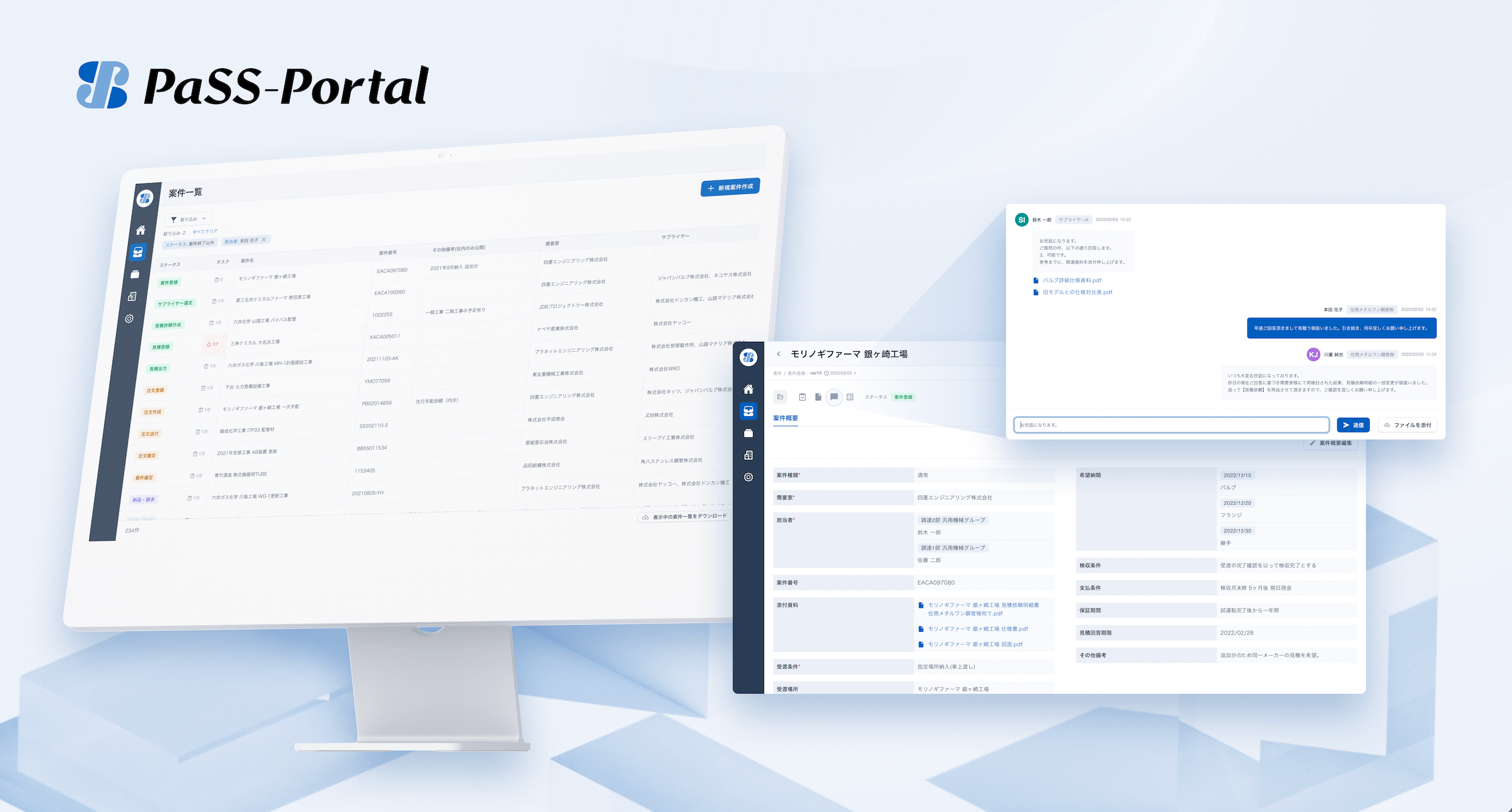 ## Support for ROUTE06
In this project, ROUTE06 provided support in the following areas:
- Support for business plan review
- Service design of "PaSS-Portal
- Provision and customization of API platform "Plain" for enterprise
- UI/UX design and implementation
- Concept and service logo creation/direction
- Support for initial user adoption
## About "PaSS-Portal", a quotation/ordering platform
### Functions and features of "PaSS-Poral
#### 1. One-stop provision of quotation, order receipt/placement, delivery and invoicing functions
Centralized management of quotations, orders, delivery statuses, and invoicing on a secure cloud-based platform. Real-time sharing between distributors and suppliers is possible. In addition, it is also possible to download each item of information and a list of projects in Excel format.
#### 2. Centralized management of deal and transaction data on the cloud
Without developing a linkage with core systems or installing applications on PC terminals, users can centrally manage and check quotation information, related files, communication history, and transaction status for multiple suppliers connected to a deal in the cloud. Suppliers can also view a list of transactions requested by distributors, allowing both parties to monitor transaction progress and reducing the time and effort needed to track changes or updates to transaction terms and details.
#### 3. Automatic display of the latest status of transactions
The system manages and displays the revision and update history of transactions in chronological order, so that the latest information can be accurately grasped without any hassle, and valuable transaction information, which was previously closed to individual staff members, can be shared within the organization.
#### 4. Task registration for each deal
A "memorandum," which is conventionally written on a sticky note and pasted on the desk of the person in charge, can be linked to a case and registered as an individual task of the person in charge. This allows for sharing and visualization of "what needs to be done next," which contributes to quicker response and prevention of omissions.
#### 5. Online communication function
Online communication can be easily carried out using chat. By replacing conventional communication via e-mail, telephone, or fax with chat, you can flexibly communicate with suppliers at any time, in addition to supporting prompt communication.
## Support for ROUTE06
In this project, ROUTE06 provided support in the following areas:
- Support for business plan review
- Service design of "PaSS-Portal
- Provision and customization of API platform "Plain" for enterprise
- UI/UX design and implementation
- Concept and service logo creation/direction
- Support for initial user adoption
## About "PaSS-Portal", a quotation/ordering platform
### Functions and features of "PaSS-Poral
#### 1. One-stop provision of quotation, order receipt/placement, delivery and invoicing functions
Centralized management of quotations, orders, delivery statuses, and invoicing on a secure cloud-based platform. Real-time sharing between distributors and suppliers is possible. In addition, it is also possible to download each item of information and a list of projects in Excel format.
#### 2. Centralized management of deal and transaction data on the cloud
Without developing a linkage with core systems or installing applications on PC terminals, users can centrally manage and check quotation information, related files, communication history, and transaction status for multiple suppliers connected to a deal in the cloud. Suppliers can also view a list of transactions requested by distributors, allowing both parties to monitor transaction progress and reducing the time and effort needed to track changes or updates to transaction terms and details.
#### 3. Automatic display of the latest status of transactions
The system manages and displays the revision and update history of transactions in chronological order, so that the latest information can be accurately grasped without any hassle, and valuable transaction information, which was previously closed to individual staff members, can be shared within the organization.
#### 4. Task registration for each deal
A "memorandum," which is conventionally written on a sticky note and pasted on the desk of the person in charge, can be linked to a case and registered as an individual task of the person in charge. This allows for sharing and visualization of "what needs to be done next," which contributes to quicker response and prevention of omissions.
#### 5. Online communication function
Online communication can be easily carried out using chat. By replacing conventional communication via e-mail, telephone, or fax with chat, you can flexibly communicate with suppliers at any time, in addition to supporting prompt communication.
 The current functionality assumes that the selection of suppliers and the assessment of quotations are based on the experience and judgment of each person in charge, but in the future, by utilizing the accumulated transaction data, "optimal suggestions based on past transactions" will be output, thereby contributing to further efficiency and quality improvement in transaction brokerage operations. In the future, we are considering evolving the system into a platform that contributes to further streamlining and improving the quality of transaction brokerage operations.
### Product design that focuses on the needs of distributors and is convenient for suppliers
In streamlining the vast number of transactions among a small number of buyers and suppliers, it is common practice to link the mission-critical systems of each company through EDI (Electronic Data Interchange). However, midstream distribution companies that mediate transactions among a large number of buyers and suppliers have been using conventional methods such as e-mail and fax for many years because of the large amount of development man-hours required for system integration between companies, making it difficult to introduce EDI.
In recent years, "Web-EDI quotation/ordering tools" that do not require core system integration and can be accessed from a browser have been developed, but these tools are mainly designed for procurement departments of manufacturing companies, which are in a position to request suppliers to communicate with them using such tools based on their own procurement details masters. There are also "sales support tools" that enable registration, management, and sharing of work-in-process projects, as well as accumulation and reference of past projects, for intra-organizational use, but these tools are unlikely to lead to labor savings, and for distributors who deal with a huge volume of transactions on a daily basis, they are likely to increase their workload. However, it is difficult to save labor, and there is a concern that it may increase the workload for distributors who deal with a huge volume of transactions every day.
PaSS-Portal is designed to address these challenges by prioritizing the needs and convenience of midstream distributors and suppliers.
As with general Web-EDI, suppliers who use "PaSS-Portal" can register transaction details in "PaSS-Portal," while suppliers who do not use "PaSS-Portal" can receive transaction details by e-mail or fax as in the past. For transactions with suppliers who do not use PaSS-Portal, distributors can input transaction details received via email or fax into the system on behalf of their suppliers, enabling implementation without requiring them to adopt the platform.
The main function of "PaSS-Portal" is the "transaction promotion," which is broadly divided into three phases: quotation, order receipt/placement, and delivery/invoicing. The three phases are sequential according to the status of the transaction, but it is not necessary to go through all the steps, and the system is flexible enough to allow users to choose which steps to skip (skip those not used) according to the characteristics of each transaction.
The overall structure of the system covers the entire process from the beginning to the end of a transaction, including quotation, order receipt/placement, and delivery/invoicing. Therefore, once distributors and suppliers start "transaction promotion" on "PaSS-Portal," all related communication can be consolidated and completed on "PaSS-Portal," eliminating the need to use e-mail and faxes, and providing high benefits for distributors and suppliers in terms of labor savings and information storage. This will be highly effective for both distributors and suppliers in terms of labor savings and information storage.
### [Inquiries about PaSS-Portal]
URL: https://pass-portal.jp
## ROUTE06's future focus
According to a report by the Ministry of Economy, Trade and Industry (*1), the domestic B2B-EC market has expanded to approximately 373 trillion yen. On the other hand, the environment surrounding business transactions has been changing dramatically in recent years. In addition to social demands such as decarbonization and SDGs, companies are required to anticipate economic conditions such as rising prices and interest rates. In addition to strengthening relationships with traditional trading partners, there is a growing demand for new software services that leverage digital technologies such as API integration between systems, order and supply platforms, and cloud EDI in order to expand new trading partners located in different industries and regions. In an era that demands transparency, soundness, and sustainability of transactions, ROUTE06 will continue to focus on the development of its enterprise API platform "Plain" in order to provide more user-friendly services to promote DX in business-to-business transactions.
(*1) Ministry of Economy, Trade and Industry, FY2021 Digital Transaction Environment Development Project (market research on e-commerce)
### "Plain" is an API platform for the enterprise.
Plain" is a business API platform for the digital transformation of all types of business transactions, contributing to the vertical launch and continuous service improvement of online marketplaces and other digital businesses, whether B2C or B2B.
URL: https://route06.com/solutions/product/plain
#### [Inquiries about Plain implementation and digital business launch].
ROUTE06 Professional Services Division
info@route06.co.jp
### About Mitsubishi Corporation
name: Mitsubishi Corporation
The current functionality assumes that the selection of suppliers and the assessment of quotations are based on the experience and judgment of each person in charge, but in the future, by utilizing the accumulated transaction data, "optimal suggestions based on past transactions" will be output, thereby contributing to further efficiency and quality improvement in transaction brokerage operations. In the future, we are considering evolving the system into a platform that contributes to further streamlining and improving the quality of transaction brokerage operations.
### Product design that focuses on the needs of distributors and is convenient for suppliers
In streamlining the vast number of transactions among a small number of buyers and suppliers, it is common practice to link the mission-critical systems of each company through EDI (Electronic Data Interchange). However, midstream distribution companies that mediate transactions among a large number of buyers and suppliers have been using conventional methods such as e-mail and fax for many years because of the large amount of development man-hours required for system integration between companies, making it difficult to introduce EDI.
In recent years, "Web-EDI quotation/ordering tools" that do not require core system integration and can be accessed from a browser have been developed, but these tools are mainly designed for procurement departments of manufacturing companies, which are in a position to request suppliers to communicate with them using such tools based on their own procurement details masters. There are also "sales support tools" that enable registration, management, and sharing of work-in-process projects, as well as accumulation and reference of past projects, for intra-organizational use, but these tools are unlikely to lead to labor savings, and for distributors who deal with a huge volume of transactions on a daily basis, they are likely to increase their workload. However, it is difficult to save labor, and there is a concern that it may increase the workload for distributors who deal with a huge volume of transactions every day.
PaSS-Portal is designed to address these challenges by prioritizing the needs and convenience of midstream distributors and suppliers.
As with general Web-EDI, suppliers who use "PaSS-Portal" can register transaction details in "PaSS-Portal," while suppliers who do not use "PaSS-Portal" can receive transaction details by e-mail or fax as in the past. For transactions with suppliers who do not use PaSS-Portal, distributors can input transaction details received via email or fax into the system on behalf of their suppliers, enabling implementation without requiring them to adopt the platform.
The main function of "PaSS-Portal" is the "transaction promotion," which is broadly divided into three phases: quotation, order receipt/placement, and delivery/invoicing. The three phases are sequential according to the status of the transaction, but it is not necessary to go through all the steps, and the system is flexible enough to allow users to choose which steps to skip (skip those not used) according to the characteristics of each transaction.
The overall structure of the system covers the entire process from the beginning to the end of a transaction, including quotation, order receipt/placement, and delivery/invoicing. Therefore, once distributors and suppliers start "transaction promotion" on "PaSS-Portal," all related communication can be consolidated and completed on "PaSS-Portal," eliminating the need to use e-mail and faxes, and providing high benefits for distributors and suppliers in terms of labor savings and information storage. This will be highly effective for both distributors and suppliers in terms of labor savings and information storage.
### [Inquiries about PaSS-Portal]
URL: https://pass-portal.jp
## ROUTE06's future focus
According to a report by the Ministry of Economy, Trade and Industry (*1), the domestic B2B-EC market has expanded to approximately 373 trillion yen. On the other hand, the environment surrounding business transactions has been changing dramatically in recent years. In addition to social demands such as decarbonization and SDGs, companies are required to anticipate economic conditions such as rising prices and interest rates. In addition to strengthening relationships with traditional trading partners, there is a growing demand for new software services that leverage digital technologies such as API integration between systems, order and supply platforms, and cloud EDI in order to expand new trading partners located in different industries and regions. In an era that demands transparency, soundness, and sustainability of transactions, ROUTE06 will continue to focus on the development of its enterprise API platform "Plain" in order to provide more user-friendly services to promote DX in business-to-business transactions.
(*1) Ministry of Economy, Trade and Industry, FY2021 Digital Transaction Environment Development Project (market research on e-commerce)
### "Plain" is an API platform for the enterprise.
Plain" is a business API platform for the digital transformation of all types of business transactions, contributing to the vertical launch and continuous service improvement of online marketplaces and other digital businesses, whether B2C or B2B.
URL: https://route06.com/solutions/product/plain
#### [Inquiries about Plain implementation and digital business launch].
ROUTE06 Professional Services Division
info@route06.co.jp
### About Mitsubishi Corporation
name: Mitsubishi Corporation ## The Day One Box celebrates day one of a new story
At ROUTE06, we want to be a narrative organization where each employee takes the initiative, and their individuality and enthusiasm weave together like a story. New employees are valuable members who will contribute new chapters to ROUTE06's story. To express our gratitude and welcome them for choosing this team, and to congratulate them on the first day of their new story that is about to begin, we deliver "The Day One Box" to them on the day they join the company.
## "The Day One Box vol. 2" theme is wellness
Following the "Remote First" theme of the first edition, "The Day One Box vol. 2" features wellness-themed items that nurture both body and mind. Focusing on the sense of smell, which is the most intuitive of the five senses and evokes a whole-body experience, we selected six aroma oils and a diffuser made from natural wood, which were created with inspiration from ROUTE06's corporate philosophy. We aimed to create a space where people can connect with ROUTE06's values through the scent of natural plants, allowing them to quietly reflect on themselves, even while working in a fully remote environment.
The six aroma oils were designed by MEGUMI FUKATSU, a leading scent designer in Japan who has created fragrances and designed spaces to represent numerous companies and brands, including ANA, Lexus, and Louis Paulsen. The six special aroma oils, both gentle and powerful, were created by combining the scent of natural plants, which varies delicately depending on their origin and extraction method, with the expert perspective of designing like architecture and interior design.
The Day One Box vol. 2" also includes other special tickets to the new route, as in the [previous](https://route06.com/news/13) event: "Welcome Lunch," a casual lunch meeting, and "Welcome Office," where employees who live far away can come to the office whenever they want. Three types of tickets are available: "Welcome Office," which allows you to come to the office, and a ticket that allows you to have dinner with a representative of ROUTE06 at any time, in the hopes that you will feel closer to the founder. All items are enclosed in a special Western-style book box that evokes the beginning of a new story, and were created with special attention to the experience that new employees will have from the time they receive them on their first day until they open the box.
## The Day One Box celebrates day one of a new story
At ROUTE06, we want to be a narrative organization where each employee takes the initiative, and their individuality and enthusiasm weave together like a story. New employees are valuable members who will contribute new chapters to ROUTE06's story. To express our gratitude and welcome them for choosing this team, and to congratulate them on the first day of their new story that is about to begin, we deliver "The Day One Box" to them on the day they join the company.
## "The Day One Box vol. 2" theme is wellness
Following the "Remote First" theme of the first edition, "The Day One Box vol. 2" features wellness-themed items that nurture both body and mind. Focusing on the sense of smell, which is the most intuitive of the five senses and evokes a whole-body experience, we selected six aroma oils and a diffuser made from natural wood, which were created with inspiration from ROUTE06's corporate philosophy. We aimed to create a space where people can connect with ROUTE06's values through the scent of natural plants, allowing them to quietly reflect on themselves, even while working in a fully remote environment.
The six aroma oils were designed by MEGUMI FUKATSU, a leading scent designer in Japan who has created fragrances and designed spaces to represent numerous companies and brands, including ANA, Lexus, and Louis Paulsen. The six special aroma oils, both gentle and powerful, were created by combining the scent of natural plants, which varies delicately depending on their origin and extraction method, with the expert perspective of designing like architecture and interior design.
The Day One Box vol. 2" also includes other special tickets to the new route, as in the [previous](https://route06.com/news/13) event: "Welcome Lunch," a casual lunch meeting, and "Welcome Office," where employees who live far away can come to the office whenever they want. Three types of tickets are available: "Welcome Office," which allows you to come to the office, and a ticket that allows you to have dinner with a representative of ROUTE06 at any time, in the hopes that you will feel closer to the founder. All items are enclosed in a special Western-style book box that evokes the beginning of a new story, and were created with special attention to the experience that new employees will have from the time they receive them on their first day until they open the box.
 ## ORIGINAL AROMA OIL "DEFINE THE ROUTE"
The Latin word "spirare" (to breathe) is the root of inspiration. Deep breathing with the fragrance of natural plants relaxes the body and mind, and gently approaches the creativity that each of us is born with.
Although each of the six aroma oils has a distinct character, they blend harmoniously, creating an even richer and more nuanced fragrance when combined. The blend of high quality essential oils gives the fragrance a clear and fragrant aroma.
The design of the bottle, which aims for genderless cleanliness, logically expresses the intuitive experience evoked by the sense of smell. The original box for the diffuser, made of smooth paper and finely textured tint, is decorated with white foil with soft hexagons that look like a free mixture of your favorite scents. Embark on a journey to discover unexplored worlds with aroma oils that blend with your individuality.
**No.1 Be a disruptor**
A citrus-based oil with the powerful energy of lemongrass and the stimulation of black pepper. Step onto a path you believe in with a passionate changemaker.
**No.2 Act besides**
The clean blue cypress that becomes a large tree of 20m and the unique lavender with depth induce tranquility and calmness in your mind.
**No.3 Build beyond**
Ylang-ylang represents enchanting glamour and the strength of success. With a modern sensibility, it opens up tomorrow and makes you feel as if you are surrounded by happiness.
**No.4 Give first**
Rosemary, which enhances concentration, and cedarwood, which calms the mind, are hard-edged and gentlemanly. The sharp, spicy scent evokes bold courage.
**No.5 Connect anywhere**
Openness like the sun and the expansion of sensibility are expressed in red pulp orange. A fresh fragrance that uplifts the spirit.
**No.6 Go root**
The culmination expressed in the lively botanicals and the ginkgo biloba, called the tree of celebration. It is a strong and growing tree that holds its axis and continues to move forward.
#### Wood diffuser Lin
We selected @aroma's Wood Diffuser Lynn as a partner for aroma oil. Made from natural wood, the expression and individuality of the wood grain and hue, which change gradually with humidity, temperature, and age, make it a good partner for our ever-changing environment.
### Comments
```
Olfactory scents have a real and direct effect on our senses and feelings. The six aromatic oils, derived from a wide variety of plant fragrances, add rich color to the time and space we spend with them, and create a healthy and positive value.
Scenting Designer MEGUMI FUKATSU, A Green Inc.
```
#### About MEGUMI FUKATSU
Scenting Designer, born in Hita City, Oita Prefecture, Japan, spent time in the great outdoors until the age of 18, and in her early 20s, her experience working for an airline company became the starting point for her hospitality. After that, she entered the world of fragrance. He has been involved in the creation of "@aroma" since its launch, and has been involved in numerous kaori production and space design projects for ANA, Louis Paulsen, and others, both in Japan and abroad, for about 20 years. He also works as an aroma plant hunter to discover aroma materials in production areas. In recent years, he has been teaching at universities, giving lectures and seminars to spread this culture. 2020, he established "[A Green](https://agreen.tokyo/)". He is the author of the book "Scenting Design - Kaori Shitsure".
## ORIGINAL AROMA OIL "DEFINE THE ROUTE"
The Latin word "spirare" (to breathe) is the root of inspiration. Deep breathing with the fragrance of natural plants relaxes the body and mind, and gently approaches the creativity that each of us is born with.
Although each of the six aroma oils has a distinct character, they blend harmoniously, creating an even richer and more nuanced fragrance when combined. The blend of high quality essential oils gives the fragrance a clear and fragrant aroma.
The design of the bottle, which aims for genderless cleanliness, logically expresses the intuitive experience evoked by the sense of smell. The original box for the diffuser, made of smooth paper and finely textured tint, is decorated with white foil with soft hexagons that look like a free mixture of your favorite scents. Embark on a journey to discover unexplored worlds with aroma oils that blend with your individuality.
**No.1 Be a disruptor**
A citrus-based oil with the powerful energy of lemongrass and the stimulation of black pepper. Step onto a path you believe in with a passionate changemaker.
**No.2 Act besides**
The clean blue cypress that becomes a large tree of 20m and the unique lavender with depth induce tranquility and calmness in your mind.
**No.3 Build beyond**
Ylang-ylang represents enchanting glamour and the strength of success. With a modern sensibility, it opens up tomorrow and makes you feel as if you are surrounded by happiness.
**No.4 Give first**
Rosemary, which enhances concentration, and cedarwood, which calms the mind, are hard-edged and gentlemanly. The sharp, spicy scent evokes bold courage.
**No.5 Connect anywhere**
Openness like the sun and the expansion of sensibility are expressed in red pulp orange. A fresh fragrance that uplifts the spirit.
**No.6 Go root**
The culmination expressed in the lively botanicals and the ginkgo biloba, called the tree of celebration. It is a strong and growing tree that holds its axis and continues to move forward.
#### Wood diffuser Lin
We selected @aroma's Wood Diffuser Lynn as a partner for aroma oil. Made from natural wood, the expression and individuality of the wood grain and hue, which change gradually with humidity, temperature, and age, make it a good partner for our ever-changing environment.
### Comments
```
Olfactory scents have a real and direct effect on our senses and feelings. The six aromatic oils, derived from a wide variety of plant fragrances, add rich color to the time and space we spend with them, and create a healthy and positive value.
Scenting Designer MEGUMI FUKATSU, A Green Inc.
```
#### About MEGUMI FUKATSU
Scenting Designer, born in Hita City, Oita Prefecture, Japan, spent time in the great outdoors until the age of 18, and in her early 20s, her experience working for an airline company became the starting point for her hospitality. After that, she entered the world of fragrance. He has been involved in the creation of "@aroma" since its launch, and has been involved in numerous kaori production and space design projects for ANA, Louis Paulsen, and others, both in Japan and abroad, for about 20 years. He also works as an aroma plant hunter to discover aroma materials in production areas. In recent years, he has been teaching at universities, giving lectures and seminars to spread this culture. 2020, he established "[A Green](https://agreen.tokyo/)". He is the author of the book "Scenting Design - Kaori Shitsure".
 ---
# ROUTE06 to Sponsor iOSDC Japan 2023
URL: https://route06.com/news/28
[iOSDC Japan 2023](https://iosdc.jp/2023/) is a conference for software engineers, focusing on iOS-related technologies. It will be held from September 1 to 3, 2023, in a hybrid format, combining in-person and online participation.
iOS is the operating system that was created with the first iPhone in June 2007. iOS apps have made a major impact on people's lives and businesses, with the App Store averaging over 747 million app downloads per week in 2022, and developers generating $1.1 trillion in total sales that year[^1].
At ROUTE06, we believe that community is essential for the growth and adoption of technology. The knowledge and insights gained from these communities are crucial for improving product development. ROUTE06, which develops iOS applications as part of its digital transformation support for major companies, has decided to sponsor iOSDC Japan, recognizing its significant influence as a platform for sharing and exchanging knowledge about iOS and related technologies. ROUTE06 remains committed to supporting the engineering community and will continue to contribute to its growth in the future.
Outline of "iOSDC Japan 2023"
---
# ROUTE06 to Sponsor iOSDC Japan 2023
URL: https://route06.com/news/28
[iOSDC Japan 2023](https://iosdc.jp/2023/) is a conference for software engineers, focusing on iOS-related technologies. It will be held from September 1 to 3, 2023, in a hybrid format, combining in-person and online participation.
iOS is the operating system that was created with the first iPhone in June 2007. iOS apps have made a major impact on people's lives and businesses, with the App Store averaging over 747 million app downloads per week in 2022, and developers generating $1.1 trillion in total sales that year[^1].
At ROUTE06, we believe that community is essential for the growth and adoption of technology. The knowledge and insights gained from these communities are crucial for improving product development. ROUTE06, which develops iOS applications as part of its digital transformation support for major companies, has decided to sponsor iOSDC Japan, recognizing its significant influence as a platform for sharing and exchanging knowledge about iOS and related technologies. ROUTE06 remains committed to supporting the engineering community and will continue to contribute to its growth in the future.
Outline of "iOSDC Japan 2023" ## "Your Medicine Box" Overview
White Healthcare's "Your Medicine Box" is a website for selling OTC[^1] and regular medicines to health insurance members (hereafter, "members"), supervised by pharmacists with expertise in the field. Members can conveniently purchase OTC medications online through their health insurance organization.
The platform also offers information to help members better understand the medicines they regularly take, encouraging thoughtful use. In addition, we provide a variety of information to deepen members' understanding of the medicines they themselves usually take without thinking about it.
This project aims to promote self-medication[^2] through "Your Medicine Box," in which members take care of minor physical ailments by themselves, thereby raising their health awareness and increasing opportunities for them to take responsibility for their own health, while contributing to the optimization of health insurance medical costs.
## Background of providing "Your Medicine Box"
In recent years, the rising cost of medical care has been an issue for an increasing number of health insurance companies, which have been dissolved due to deteriorating finances. Approximately 40% of corporate insurance associations have premium rates higher than the 10% Association Health Insurance rate and are considered at risk of dissolution. Since members' medical expenses are supported by health insurance contributions based on the premium rate, an increase in the medical expense burden will require an increase in the premium rate to maintain the balance of health insurance. 111 health insurance associations were dissolved between FY 2008 and FY 2021[^3], and the transition of dissolved health insurance associations to the Association Kenpo will result in a Some estimates indicate that the annual cost to the government may increase by 12 billion yen[^4].
The key to sound health insurance management is how to optimize medical expenses. Health insurers have been working to optimize medical costs by preventing lifestyle-related diseases through the implementation of specific health checkups and specific health guidance, and by promoting the use of generic drugs.
The promotion of self-medication through the use of over-the-counter (OTC) drugs, which is the goal of the "Your Medicine Box" program, is another measure to optimize medical costs that has been attracting attention in recent years. It has been estimated that if patients prescribed prescription drugs switched to OTC drugs with the same active ingredients, it would have the effect of optimizing medical costs by approximately 320 billion yen[^5]. The Ministry of Health, Labour and Welfare also launched the Office for Promotion of Self-Care and Self-Medication in April 2021 to promote the use of these products.
White Healthcare is a pioneer in creating a system that allows members to practice self-medication with peace of mind while utilizing receipt data held by health insurers as a support service for health insurers to implement self-medication health services, and the company's efforts have been recognized by the MHLW The company's efforts have been introduced by the Ministry of Health, Labour and Welfare as an advanced example of how to optimize drug benefits.
## Main features of "Your Medicine Box"
"Your Medicine Box" is available year-round, with medications delivered directly to your home as early as the next day. Beyond purchasing medicines, users can consult with a pharmacist online, find suitable medications using the "Medication Navi" by answering medical questionnaires, and check for signs of serious illness through the "Red Flag Check". You can also use the "Red Flag Check" to check for signs of serious illnesses.
- Purchase of OTC drugs
- OTC Drug Navi" suggests recommended medicines based on symptoms and physical constitution.
- Red Flag Check" checks for signs of serious illness
- Providing consultation services to pharmacists via LINE
- Contents related to medications supervised by pharmacists
- A simulator for estimating Self-Medication Tax Credit
In addition to the provision of the "Your Medicine Box" service, we are also using health insurance receipt data to encourage behavioral change among members who have room for self-medication and to verify the effects of medical cost optimization, which is the outcome of health services.
## "Your Medicine Box" Overview
White Healthcare's "Your Medicine Box" is a website for selling OTC[^1] and regular medicines to health insurance members (hereafter, "members"), supervised by pharmacists with expertise in the field. Members can conveniently purchase OTC medications online through their health insurance organization.
The platform also offers information to help members better understand the medicines they regularly take, encouraging thoughtful use. In addition, we provide a variety of information to deepen members' understanding of the medicines they themselves usually take without thinking about it.
This project aims to promote self-medication[^2] through "Your Medicine Box," in which members take care of minor physical ailments by themselves, thereby raising their health awareness and increasing opportunities for them to take responsibility for their own health, while contributing to the optimization of health insurance medical costs.
## Background of providing "Your Medicine Box"
In recent years, the rising cost of medical care has been an issue for an increasing number of health insurance companies, which have been dissolved due to deteriorating finances. Approximately 40% of corporate insurance associations have premium rates higher than the 10% Association Health Insurance rate and are considered at risk of dissolution. Since members' medical expenses are supported by health insurance contributions based on the premium rate, an increase in the medical expense burden will require an increase in the premium rate to maintain the balance of health insurance. 111 health insurance associations were dissolved between FY 2008 and FY 2021[^3], and the transition of dissolved health insurance associations to the Association Kenpo will result in a Some estimates indicate that the annual cost to the government may increase by 12 billion yen[^4].
The key to sound health insurance management is how to optimize medical expenses. Health insurers have been working to optimize medical costs by preventing lifestyle-related diseases through the implementation of specific health checkups and specific health guidance, and by promoting the use of generic drugs.
The promotion of self-medication through the use of over-the-counter (OTC) drugs, which is the goal of the "Your Medicine Box" program, is another measure to optimize medical costs that has been attracting attention in recent years. It has been estimated that if patients prescribed prescription drugs switched to OTC drugs with the same active ingredients, it would have the effect of optimizing medical costs by approximately 320 billion yen[^5]. The Ministry of Health, Labour and Welfare also launched the Office for Promotion of Self-Care and Self-Medication in April 2021 to promote the use of these products.
White Healthcare is a pioneer in creating a system that allows members to practice self-medication with peace of mind while utilizing receipt data held by health insurers as a support service for health insurers to implement self-medication health services, and the company's efforts have been recognized by the MHLW The company's efforts have been introduced by the Ministry of Health, Labour and Welfare as an advanced example of how to optimize drug benefits.
## Main features of "Your Medicine Box"
"Your Medicine Box" is available year-round, with medications delivered directly to your home as early as the next day. Beyond purchasing medicines, users can consult with a pharmacist online, find suitable medications using the "Medication Navi" by answering medical questionnaires, and check for signs of serious illness through the "Red Flag Check". You can also use the "Red Flag Check" to check for signs of serious illnesses.
- Purchase of OTC drugs
- OTC Drug Navi" suggests recommended medicines based on symptoms and physical constitution.
- Red Flag Check" checks for signs of serious illness
- Providing consultation services to pharmacists via LINE
- Contents related to medications supervised by pharmacists
- A simulator for estimating Self-Medication Tax Credit
In addition to the provision of the "Your Medicine Box" service, we are also using health insurance receipt data to encourage behavioral change among members who have room for self-medication and to verify the effects of medical cost optimization, which is the outcome of health services.
 **[For health insurance companies]**
Inquiries about the introduction of "Your Medicine Box "
selfmed@whitehealthcare.co.jp
## Support for ROUTE06
In this project, ROUTE06 provided support in the following areas
- Support for the study of business strategy for the OTC drug EC platform
- Service and business design support for "Your medicine box"
- UI/UX design and system construction
- Provision of data platform and reports using "Plain," an API platform for enterprises
- Support for service growth and business improvement
## About Plain, an enterprise API platform
Plain" is a business API platform for digital transformation of all types of business transactions, contributing to the vertical launch and continuous service improvement of online marketplaces and other digital businesses, whether B2C or B2B.
URL: https://route06.com/solutions/product/plain
**[Inquiries about Plain implementation and digital business launch]**
Professional Services Division, ROUTE06 Inc.
info@route06.co.jp
[^1]:[薬局・薬店・ドラッグストアなどで処方せん無しに購入できる一般用医薬品](https://www.jsmi.jp/what/)
[^2]:[自分自身の健康に責任を持ち、軽度な身体の不調は自分で手当てすること](https://whitehealthcare.co.jp/business/self-medication/)
[^3]:[大和総研「財政悪化に直面する健康保険組合」](https://www.dir.co.jp/report/research/policy-analysis/human-society/20210824_022483.pdf)
[^4]:[第196回国会 厚生労働委員会 第25号](https://www.shugiin.go.jp/internet/itdb_kaigiroku.nsf/html/kaigiroku/009719620180601025.htm)
[^5]:[セルフメディケーションの日シンポジウム基調講演](https://www.jsmi.jp/special/724/assets/data/2022.pdf)
## About White Healthcare, Inc.
White Healthcare is a joint venture established in July 2020 by Mitsubishi Corporation and Tokio Marine Holdings, Inc. to create the future of healthcare.
The company uses technology and data to provide support to health insurance associations and healthcare professionals who are facing a variety of challenges due to rising healthcare costs associated with a super-aging society. Our goal is to realize a society in which each individual can take action toward his or her own health.
---
# ROUTE06 Appoints Former Increments Director Tomoya Konishi
URL: https://route06.com/news/3
ROUTE06, Inc. is pleased to announce that Tomoya Konishi, previously with Sumisho Computer Systems (now SCSK), went on to found Increments Corporation, where he served as a director Tomoya Konishi has been appointed to the board of directors following a resolution at the general meeting of shareholders. Under the new director, ROUTE06 will strengthen its organizational structure to expand its UX design support services and in-house service development for client companies.
**[For health insurance companies]**
Inquiries about the introduction of "Your Medicine Box "
selfmed@whitehealthcare.co.jp
## Support for ROUTE06
In this project, ROUTE06 provided support in the following areas
- Support for the study of business strategy for the OTC drug EC platform
- Service and business design support for "Your medicine box"
- UI/UX design and system construction
- Provision of data platform and reports using "Plain," an API platform for enterprises
- Support for service growth and business improvement
## About Plain, an enterprise API platform
Plain" is a business API platform for digital transformation of all types of business transactions, contributing to the vertical launch and continuous service improvement of online marketplaces and other digital businesses, whether B2C or B2B.
URL: https://route06.com/solutions/product/plain
**[Inquiries about Plain implementation and digital business launch]**
Professional Services Division, ROUTE06 Inc.
info@route06.co.jp
[^1]:[薬局・薬店・ドラッグストアなどで処方せん無しに購入できる一般用医薬品](https://www.jsmi.jp/what/)
[^2]:[自分自身の健康に責任を持ち、軽度な身体の不調は自分で手当てすること](https://whitehealthcare.co.jp/business/self-medication/)
[^3]:[大和総研「財政悪化に直面する健康保険組合」](https://www.dir.co.jp/report/research/policy-analysis/human-society/20210824_022483.pdf)
[^4]:[第196回国会 厚生労働委員会 第25号](https://www.shugiin.go.jp/internet/itdb_kaigiroku.nsf/html/kaigiroku/009719620180601025.htm)
[^5]:[セルフメディケーションの日シンポジウム基調講演](https://www.jsmi.jp/special/724/assets/data/2022.pdf)
## About White Healthcare, Inc.
White Healthcare is a joint venture established in July 2020 by Mitsubishi Corporation and Tokio Marine Holdings, Inc. to create the future of healthcare.
The company uses technology and data to provide support to health insurance associations and healthcare professionals who are facing a variety of challenges due to rising healthcare costs associated with a super-aging society. Our goal is to realize a society in which each individual can take action toward his or her own health.
---
# ROUTE06 Appoints Former Increments Director Tomoya Konishi
URL: https://route06.com/news/3
ROUTE06, Inc. is pleased to announce that Tomoya Konishi, previously with Sumisho Computer Systems (now SCSK), went on to found Increments Corporation, where he served as a director Tomoya Konishi has been appointed to the board of directors following a resolution at the general meeting of shareholders. Under the new director, ROUTE06 will strengthen its organizational structure to expand its UX design support services and in-house service development for client companies.
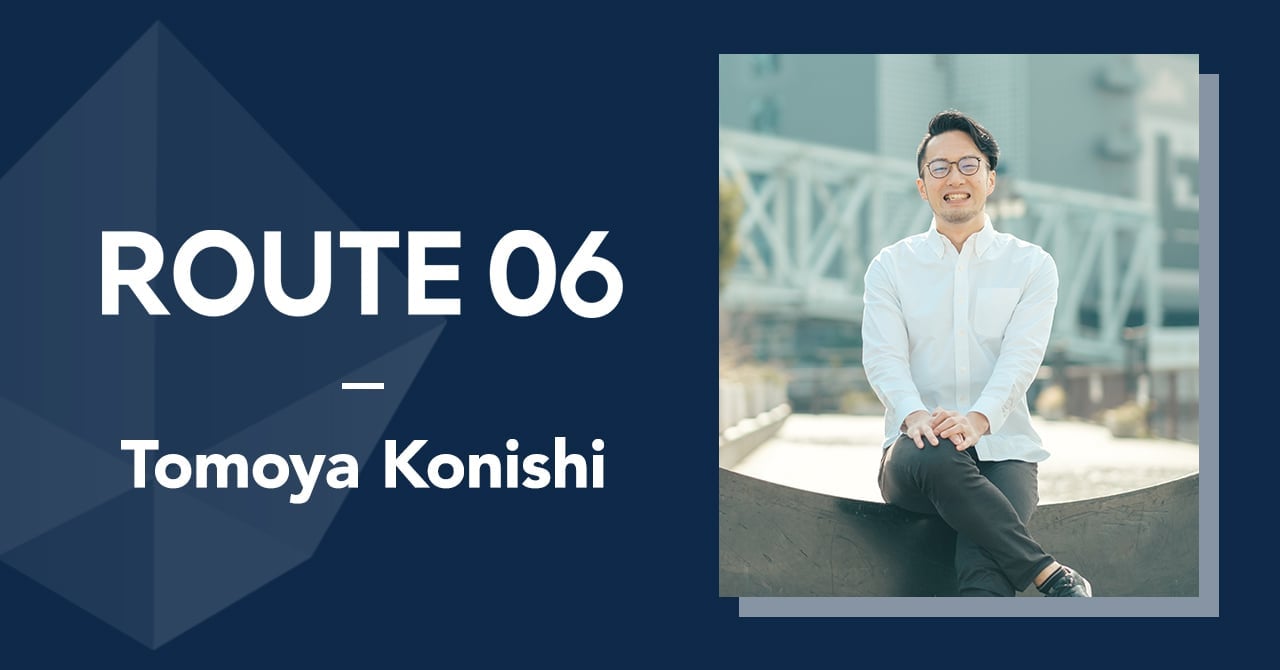 ## Background of inauguration
Founded in January 2020, ROUTE06 aims to bridge the gap between physical and digital worlds. The company was established by veterans from major IT companies, startups, and consulting firms, bringing together expertise in digital product planning, development, and business strategy. We are a professional firm established in January 2020 by members with a wealth of digital product planning, development, and business experience at major IT companies, start-ups, and consulting firms. As a "DX partner that creates the best for our clients," we provide optimal digital solutions for our clients' issues, regardless of industry, sector, or scale.
In today's complex and diversified digital business, not only UX (user experience) for general consumers, but also CX (customer experience) and EX (employee experience) are attracting attention. In the field of digital transformation, designing experiences for all parties involved in business operations plays an extremely important role before systemization and tool implementation, and demand for design solutions from client companies continues to increase. In response to this situation, we are pleased to welcome Tomoya Konishi, previously with Sumisho Computer Systems (now SCSK), went on to found Increments Corporation, where he served as a directorKonishi, a designer and serial entrepreneur who has experience founding and exiting Increments (Qiita) after working in the system integration industry, as a member of the board of directors, and he will contribute more than ever to improving the digital ROI of our client companies. We will contribute to our clients to improve their digital ROI even more than before.
## New Director Profile
Tomoya Konishi (Director)
Tomoya Konishi, previously with Sumisho Computer Systems (now SCSK), went on to found Increments Corporation, where he served as a director. He is also a designer, and is responsible for a wide range of services from concept design and user interviews to implementation. The service he developed has grown to a service that is accessed by millions of people every month. After the company's M&A with a major IT company, he joined ROUTE06 Inc.
---
# ROUTE06 Sponsors Designship 2023
URL: https://route06.com/news/30
Designship is one of the largest design conferences in Japan where leading designers from various industries gather to share their wisdom and thoughts. Since 2018, Designship has been held annually by the Designship Association, which operates with the mission of cultivating design talent that will contribute to the next generation of industries.
ROUTE06 is dedicated to delivering comprehensive and practical business support to help client companies create new corporate value. With a team of talented designers, we contribute significantly to improving outcomes through the development of digital platforms for major companies and creative projects that reflect the ROUTE06 brand.
We chose to sponsor this year’s event because we recognize the importance of Designship as an annual design festival that provides an opportunity to explore cutting-edge design and engage with leading designers.
ROUTE06 will continue to contribute to the designer community.
### ["Designship 2023"](https://design-ship.jp/2023)
## Background of inauguration
Founded in January 2020, ROUTE06 aims to bridge the gap between physical and digital worlds. The company was established by veterans from major IT companies, startups, and consulting firms, bringing together expertise in digital product planning, development, and business strategy. We are a professional firm established in January 2020 by members with a wealth of digital product planning, development, and business experience at major IT companies, start-ups, and consulting firms. As a "DX partner that creates the best for our clients," we provide optimal digital solutions for our clients' issues, regardless of industry, sector, or scale.
In today's complex and diversified digital business, not only UX (user experience) for general consumers, but also CX (customer experience) and EX (employee experience) are attracting attention. In the field of digital transformation, designing experiences for all parties involved in business operations plays an extremely important role before systemization and tool implementation, and demand for design solutions from client companies continues to increase. In response to this situation, we are pleased to welcome Tomoya Konishi, previously with Sumisho Computer Systems (now SCSK), went on to found Increments Corporation, where he served as a directorKonishi, a designer and serial entrepreneur who has experience founding and exiting Increments (Qiita) after working in the system integration industry, as a member of the board of directors, and he will contribute more than ever to improving the digital ROI of our client companies. We will contribute to our clients to improve their digital ROI even more than before.
## New Director Profile
Tomoya Konishi (Director)
Tomoya Konishi, previously with Sumisho Computer Systems (now SCSK), went on to found Increments Corporation, where he served as a director. He is also a designer, and is responsible for a wide range of services from concept design and user interviews to implementation. The service he developed has grown to a service that is accessed by millions of people every month. After the company's M&A with a major IT company, he joined ROUTE06 Inc.
---
# ROUTE06 Sponsors Designship 2023
URL: https://route06.com/news/30
Designship is one of the largest design conferences in Japan where leading designers from various industries gather to share their wisdom and thoughts. Since 2018, Designship has been held annually by the Designship Association, which operates with the mission of cultivating design talent that will contribute to the next generation of industries.
ROUTE06 is dedicated to delivering comprehensive and practical business support to help client companies create new corporate value. With a team of talented designers, we contribute significantly to improving outcomes through the development of digital platforms for major companies and creative projects that reflect the ROUTE06 brand.
We chose to sponsor this year’s event because we recognize the importance of Designship as an annual design festival that provides an opportunity to explore cutting-edge design and engage with leading designers.
ROUTE06 will continue to contribute to the designer community.
### ["Designship 2023"](https://design-ship.jp/2023) Design Bazaar is an in-person event focused on fostering design-driven collaboration.
We are excited to welcome Mr. Hiroaki Kawanobu, Country Manager of Figma Japan, as a special guest to discuss Figma's approach to product development.
Other panelists include leading designers from M3, Visional, and DeNA, who will talk about the role of design leaders in their organizations and the fusion of design and engineering.
## Event Introduction
- Date: Tuesday, October 24, 2023
- Time: 《Doors open》18:00 p.m.《Performance》18:30〜22:00 p.m.※After Party will be held from 21:00 p.m.
- Method of the event: Offline / Registration for archived streaming will be announced at a later date (tentative).
- Number of participants: 100 (pre-registration, first-come-first-served basis)
- Venue: THE CORE KITCHEN/SPACE
- Registration URL: https://lu.ma/design-bazaar_20231024
- Special gift: A special gift will be offered only to those who come on the day of the event.
## Program
Design Bazaar is an in-person event focused on fostering design-driven collaboration.
We are excited to welcome Mr. Hiroaki Kawanobu, Country Manager of Figma Japan, as a special guest to discuss Figma's approach to product development.
Other panelists include leading designers from M3, Visional, and DeNA, who will talk about the role of design leaders in their organizations and the fusion of design and engineering.
## Event Introduction
- Date: Tuesday, October 24, 2023
- Time: 《Doors open》18:00 p.m.《Performance》18:30〜22:00 p.m.※After Party will be held from 21:00 p.m.
- Method of the event: Offline / Registration for archived streaming will be announced at a later date (tentative).
- Number of participants: 100 (pre-registration, first-come-first-served basis)
- Venue: THE CORE KITCHEN/SPACE
- Registration URL: https://lu.ma/design-bazaar_20231024
- Special gift: A special gift will be offered only to those who come on the day of the event.
## Program
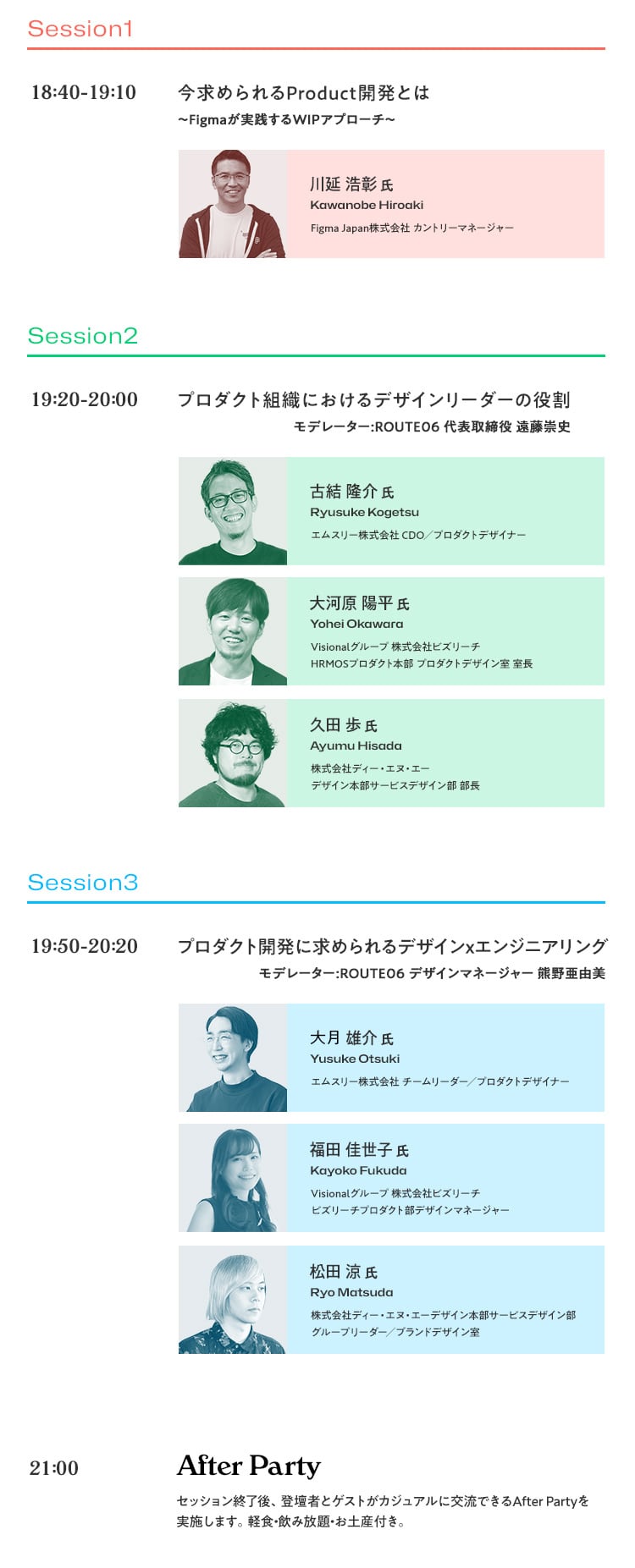 ## About the Speakers
**Hiroaki Kawanobu, Country Manager, Figma Japan K.K.**
```
After graduating from Shimonoseki City University with a degree in Economics, Mr. Kawanobu joined Kanematsu Electronics Corporation. After that, he went to the U.S. and completed his MBA (majoring in Entrepreneurship) at the University of Victoria, Canada. After returning to Japan, he worked at Brightcove from March 2011 in various capacities, including marketing and sales, and was appointed SVP and President of the company after serving as the GM of Korean operations. In January 2022, he was appointed as Figma's Country Manager in Japan, strongly empathizing with Figma's vision "to make design accessible to all". He is a father of two, born in Aichi, Japan, and loves futsal and traveling.
```
**Ryusuke Furukuni, Chief Design Officer (CDO)/Product Designer, M3 Inc.**
```
Graduated from Osaka University of Arts, Department of Imaging Arts. He was in charge of team management at BizReach Inc. as a Designer Success mainly in the communication design office and human resources of design organization. Engaged in organizational development and product design. Assumed the position of CDO in April 2021.
```
**Yohei Okawara, General Manager, Product Design Office, HRMOS Product Division, Bizreach, Inc.**
```
After graduating from university, Yohei worked for a production company and as a freelancer before helping to launch ``note''. In 2018, he joined BizReach Inc. and is currently in charge of product design for the "HRMOS" series. He is currently responsible for the product design of the HRMOS series.
```
**Ayumu Hisada, Director of Service Design Department, Design Division, DeNA Co.**
```
Ayumu Hisada joined a production company in Kyoto as a fresh graduate as a designer. He then moved to Tokyo and worked as a UX designer at a web production company affiliated with an advertising agency, where he designed and designed numerous corporate sites and apps. Currently, he is working as a product designer for "GO", a cab app, while working in management and organizational development at DeNA's Design Division.
```
**Yusuke Otsuki, Team Leader / Product Designer, M3 Inc.**
```
Graduated from Chiba University Graduate School of Design Science. He was involved in a wide range of design work at a manufacturer, including UI/UX design, interaction design, and visioning. Joined M3 in 2020. In 2020, he joined M3, where he worked as a product designer, mainly in charge of electronic medical record design. From the electronic medical record itself to mobile apps, he is promoting significant design updates while focusing on ease of use for physicians.
```
**Kayoko Fukuda, Design Manager, BizReach Product Department, BizReach Corporation, Visional Group**
```
In 2018, after graduating from Musashino Art University with a degree in Craft and Industrial Design, she joined Bizreach Inc. as a new graduate. In August 2023, he was appointed Design Manager, leading the design and planning areas.
```
**Ryo Matsuda, Group Leader, Service Design Department, Design Division / Brand Design Office, DeNA Co.**
```
After working as a designer and art director at a publishing company and Hakuhodo i-studio, he joined DeNA. As a lead designer of Manga Box, he was in charge of UI/UX design and art direction of creative works, and as an art director of Pococha, he was in charge of Event, Prize, and UI/UX design. Currently, he is involved in the development of Voice Pococha as manager and lead designer.
```
---
# ROUTE06 to Sponsor Kaigi on Rails 2023
URL: https://route06.com/news/33
Kaigi on Rails is a web-focused technical conference designed for both beginners and advanced users.
Kaigi on Rails aims to make technical conferences more accessible. While it primarily focuses on Rails, it also covers a wide range of web-related topics such as front-end development and protocols.
At ROUTE06, we believe that community is essential for the growth and adoption of technology. The knowledge and insights gained from these communities are crucial for improving product development. Several members of ROUTE06 began their journey into web development and programming through Rails and its community, and they are now active as software engineers.
With this background, we decided to sponsor Kaigi on Rails 2023, recognizing its importance as a platform for sharing and exchanging knowledge on Rails and related technologies.
ROUTE06 will continue to contribute to the engineering community.
## "Kaigi on Rails 2023"
Date: Friday, October 27, 2023 - Saturday, October 28, 2023
## About the Speakers
**Hiroaki Kawanobu, Country Manager, Figma Japan K.K.**
```
After graduating from Shimonoseki City University with a degree in Economics, Mr. Kawanobu joined Kanematsu Electronics Corporation. After that, he went to the U.S. and completed his MBA (majoring in Entrepreneurship) at the University of Victoria, Canada. After returning to Japan, he worked at Brightcove from March 2011 in various capacities, including marketing and sales, and was appointed SVP and President of the company after serving as the GM of Korean operations. In January 2022, he was appointed as Figma's Country Manager in Japan, strongly empathizing with Figma's vision "to make design accessible to all". He is a father of two, born in Aichi, Japan, and loves futsal and traveling.
```
**Ryusuke Furukuni, Chief Design Officer (CDO)/Product Designer, M3 Inc.**
```
Graduated from Osaka University of Arts, Department of Imaging Arts. He was in charge of team management at BizReach Inc. as a Designer Success mainly in the communication design office and human resources of design organization. Engaged in organizational development and product design. Assumed the position of CDO in April 2021.
```
**Yohei Okawara, General Manager, Product Design Office, HRMOS Product Division, Bizreach, Inc.**
```
After graduating from university, Yohei worked for a production company and as a freelancer before helping to launch ``note''. In 2018, he joined BizReach Inc. and is currently in charge of product design for the "HRMOS" series. He is currently responsible for the product design of the HRMOS series.
```
**Ayumu Hisada, Director of Service Design Department, Design Division, DeNA Co.**
```
Ayumu Hisada joined a production company in Kyoto as a fresh graduate as a designer. He then moved to Tokyo and worked as a UX designer at a web production company affiliated with an advertising agency, where he designed and designed numerous corporate sites and apps. Currently, he is working as a product designer for "GO", a cab app, while working in management and organizational development at DeNA's Design Division.
```
**Yusuke Otsuki, Team Leader / Product Designer, M3 Inc.**
```
Graduated from Chiba University Graduate School of Design Science. He was involved in a wide range of design work at a manufacturer, including UI/UX design, interaction design, and visioning. Joined M3 in 2020. In 2020, he joined M3, where he worked as a product designer, mainly in charge of electronic medical record design. From the electronic medical record itself to mobile apps, he is promoting significant design updates while focusing on ease of use for physicians.
```
**Kayoko Fukuda, Design Manager, BizReach Product Department, BizReach Corporation, Visional Group**
```
In 2018, after graduating from Musashino Art University with a degree in Craft and Industrial Design, she joined Bizreach Inc. as a new graduate. In August 2023, he was appointed Design Manager, leading the design and planning areas.
```
**Ryo Matsuda, Group Leader, Service Design Department, Design Division / Brand Design Office, DeNA Co.**
```
After working as a designer and art director at a publishing company and Hakuhodo i-studio, he joined DeNA. As a lead designer of Manga Box, he was in charge of UI/UX design and art direction of creative works, and as an art director of Pococha, he was in charge of Event, Prize, and UI/UX design. Currently, he is involved in the development of Voice Pococha as manager and lead designer.
```
---
# ROUTE06 to Sponsor Kaigi on Rails 2023
URL: https://route06.com/news/33
Kaigi on Rails is a web-focused technical conference designed for both beginners and advanced users.
Kaigi on Rails aims to make technical conferences more accessible. While it primarily focuses on Rails, it also covers a wide range of web-related topics such as front-end development and protocols.
At ROUTE06, we believe that community is essential for the growth and adoption of technology. The knowledge and insights gained from these communities are crucial for improving product development. Several members of ROUTE06 began their journey into web development and programming through Rails and its community, and they are now active as software engineers.
With this background, we decided to sponsor Kaigi on Rails 2023, recognizing its importance as a platform for sharing and exchanging knowledge on Rails and related technologies.
ROUTE06 will continue to contribute to the engineering community.
## "Kaigi on Rails 2023"
Date: Friday, October 27, 2023 - Saturday, October 28, 2023  ROUTE06, Inc. (headquarters: Chiyoda-ku, Tokyo, CEO: Takafumi Endo, hereafter: ROUTE06) has announced the appointment of Kohei Minami as Chief Financial Officer (CFO).
By welcoming Minami as executive officer, who has expertise in accounting, finance, and M&A, we strive to enhance our corporate value through sincere communication with stakeholders, in addition to upgrading our business management system.
## Background of the appointment
ROUTE06 is a digital transformation (DX) partner for large enterprises that strives to create new business opportunities and economic value by leveraging their existing assets. We do this by providing support from our team of digital business startup professionals and our API platform "Plain" for enterprises.
To date, we have supported the launch and growth of digital businesses of large enterprises, including Mitsubishi Corporation's "PaSS-Portal" estimate and order-receiving platform and Whitehealthcare's "Anata no Kusuribako" (Your Medicine Box) OTC drug and household medicine sales site.
Our newly appointed CFO Kohei Minami is a professional with experience in finance at audit firms, M&A advisory firms, and the investment division of company. Since joining ROUTE06 in 2022, in addition to finance, business development, and marketing, he also oversees corporate department such as human resources, accounting, and legal as the General Manager of Corporate Division.
Minami has contributed to the enhancement of our business management system by leading the design of the corporate decision record (CDR) internal decision system and the daily operations report (DOR) man-hour management system. Through his appointment to CFO, he will work to strengthen management accounting and corporate governance in anticipation of future enterprise business expansion, as well as to create discontinuous growth opportunities through the planning and execution of financial strategies including capital and business alliances.
## Comment from Kohei Minami, Executive Officer and CFO
I am thrilled to have been appointed Executive Officer and CFO of ROUTE06, Inc. ROUTE06 celebrated its fifth year in business in January 2024. As a DX partner that "Define the route." to the future together with our clients, we have built up a track record of support for large enterprises by providing the API platform "Plain" and professional services. As CFO, I will contribute to ROUTE06's medium- to long-term growth and strongly meet the expectations of our stakeholders through our mission of executing disciplined investment and financing and strengthening our corporate structure in order to realize scaled business growth and a new form as a large corporation.
---
# ROUTE06 to Sponsor RubyKaigi 2024
URL: https://route06.com/news/37
Ruby is a programming language used by companies like GitHub, Shopify, and Airbnb, often in conjunction with the Ruby on Rails framework. RubyKaigi is the world's largest international conference dedicated to discussing the future of Ruby. This year, RubyKaigi will take place at the Naha Arts Theater in Naha City, Okinawa, with Ruby's creator, Yukihiro Matsumoto, delivering the keynote speech.
ROUTE06, Inc. (headquarters: Chiyoda-ku, Tokyo, CEO: Takafumi Endo, hereafter: ROUTE06) has announced the appointment of Kohei Minami as Chief Financial Officer (CFO).
By welcoming Minami as executive officer, who has expertise in accounting, finance, and M&A, we strive to enhance our corporate value through sincere communication with stakeholders, in addition to upgrading our business management system.
## Background of the appointment
ROUTE06 is a digital transformation (DX) partner for large enterprises that strives to create new business opportunities and economic value by leveraging their existing assets. We do this by providing support from our team of digital business startup professionals and our API platform "Plain" for enterprises.
To date, we have supported the launch and growth of digital businesses of large enterprises, including Mitsubishi Corporation's "PaSS-Portal" estimate and order-receiving platform and Whitehealthcare's "Anata no Kusuribako" (Your Medicine Box) OTC drug and household medicine sales site.
Our newly appointed CFO Kohei Minami is a professional with experience in finance at audit firms, M&A advisory firms, and the investment division of company. Since joining ROUTE06 in 2022, in addition to finance, business development, and marketing, he also oversees corporate department such as human resources, accounting, and legal as the General Manager of Corporate Division.
Minami has contributed to the enhancement of our business management system by leading the design of the corporate decision record (CDR) internal decision system and the daily operations report (DOR) man-hour management system. Through his appointment to CFO, he will work to strengthen management accounting and corporate governance in anticipation of future enterprise business expansion, as well as to create discontinuous growth opportunities through the planning and execution of financial strategies including capital and business alliances.
## Comment from Kohei Minami, Executive Officer and CFO
I am thrilled to have been appointed Executive Officer and CFO of ROUTE06, Inc. ROUTE06 celebrated its fifth year in business in January 2024. As a DX partner that "Define the route." to the future together with our clients, we have built up a track record of support for large enterprises by providing the API platform "Plain" and professional services. As CFO, I will contribute to ROUTE06's medium- to long-term growth and strongly meet the expectations of our stakeholders through our mission of executing disciplined investment and financing and strengthening our corporate structure in order to realize scaled business growth and a new form as a large corporation.
---
# ROUTE06 to Sponsor RubyKaigi 2024
URL: https://route06.com/news/37
Ruby is a programming language used by companies like GitHub, Shopify, and Airbnb, often in conjunction with the Ruby on Rails framework. RubyKaigi is the world's largest international conference dedicated to discussing the future of Ruby. This year, RubyKaigi will take place at the Naha Arts Theater in Naha City, Okinawa, with Ruby's creator, Yukihiro Matsumoto, delivering the keynote speech.
 At ROUTE06, Ruby is used in the development of applications for the Plain enterprise API platform. Additionally, several ROUTE06 team members began their programming journeys with Ruby and are now active as software engineers.
ROUTE06 will continue to support the development of the engineering community.
## Summary of RubyKaigi 2024
Date: May 15, 2024 (Wed) - May 17, 2024 (Fri)
At ROUTE06, Ruby is used in the development of applications for the Plain enterprise API platform. Additionally, several ROUTE06 team members began their programming journeys with Ruby and are now active as software engineers.
ROUTE06 will continue to support the development of the engineering community.
## Summary of RubyKaigi 2024
Date: May 15, 2024 (Wed) - May 17, 2024 (Fri) TSKaigi 2024 is a technical conference focused on TypeScript, catering to both beginners and experienced engineers. It will explore a wide range of topics, including the language's characteristics, ecosystem, examples of its use in various application areas, team development, tool development, and more. Since the outbreak of COVID-19, there have been no large-scale TypeScript events in Japan, leading to a lack of forums for sharing knowledge. In response, TSKaigi 2024 was launched by volunteers with the goal of sharing knowledge and experiences, fostering new discoveries, and promoting the exchange of ideas among those working with TypeScript. This year marks its first event.
## Background of ROUTE06 sponsorship
According to GitHub's "The State of Open Source Software," TypeScript is the third most popular language across all open-source projects on the platform, with users increasing by 37% year-on-year. At ROUTE06, TypeScript plays a crucial role in various aspects of product development, including front-end development for Plain, our enterprise API platform. This is why we have chosen to support the inaugural TSKaigi 2024.
## Event Outline
Date: Saturday, May 11, 2024
TSKaigi 2024 is a technical conference focused on TypeScript, catering to both beginners and experienced engineers. It will explore a wide range of topics, including the language's characteristics, ecosystem, examples of its use in various application areas, team development, tool development, and more. Since the outbreak of COVID-19, there have been no large-scale TypeScript events in Japan, leading to a lack of forums for sharing knowledge. In response, TSKaigi 2024 was launched by volunteers with the goal of sharing knowledge and experiences, fostering new discoveries, and promoting the exchange of ideas among those working with TypeScript. This year marks its first event.
## Background of ROUTE06 sponsorship
According to GitHub's "The State of Open Source Software," TypeScript is the third most popular language across all open-source projects on the platform, with users increasing by 37% year-on-year. At ROUTE06, TypeScript plays a crucial role in various aspects of product development, including front-end development for Plain, our enterprise API platform. This is why we have chosen to support the inaugural TSKaigi 2024.
## Event Outline
Date: Saturday, May 11, 2024  ## Features of "CHOOSEBASE SHIBUYA"
CHOOSEBASE SHIBUYA is a media-driven OMO store that offers a dynamic shopping experience, continuously introducing customers to new brands and products[^2]." The store proposes the next generation of "encountering meaning and buying will" (EC site opens today, September 1, and the real store is scheduled to open on September 2).
The OMO store system, which integrates in-store and EC systems and operations, allows customers to freely move back and forth between online and offline. The OMO store is a rare example in the department store sector of a complete inventory linkage between stores and EC, and pursues a customer-oriented purchasing experience in which customers can purchase products they have seen in stores online after returning home, or receive products purchased online at the store.
Sogo & Seibu also adopted the RaaS format for the first time. By taking care of all operations other than system registration and delivery of products for sale, we have created a system that makes it easy for brands with little experience in opening brick-and-mortar stores to open their own stores.
### Main features of "CHOOSEBASE SHIBUYA"
- Contactless checkout system integrated with digital catalogs
- In-store data analysis (traffic/visits/purchases) using AI cameras
- Complete real-time inventory linkage between in-store and EC
- Receiving/delivery system including BOPIS and in-store delivery
- Data platform integrating in-store/EC/Web media
## Features of "CHOOSEBASE SHIBUYA"
CHOOSEBASE SHIBUYA is a media-driven OMO store that offers a dynamic shopping experience, continuously introducing customers to new brands and products[^2]." The store proposes the next generation of "encountering meaning and buying will" (EC site opens today, September 1, and the real store is scheduled to open on September 2).
The OMO store system, which integrates in-store and EC systems and operations, allows customers to freely move back and forth between online and offline. The OMO store is a rare example in the department store sector of a complete inventory linkage between stores and EC, and pursues a customer-oriented purchasing experience in which customers can purchase products they have seen in stores online after returning home, or receive products purchased online at the store.
Sogo & Seibu also adopted the RaaS format for the first time. By taking care of all operations other than system registration and delivery of products for sale, we have created a system that makes it easy for brands with little experience in opening brick-and-mortar stores to open their own stores.
### Main features of "CHOOSEBASE SHIBUYA"
- Contactless checkout system integrated with digital catalogs
- In-store data analysis (traffic/visits/purchases) using AI cameras
- Complete real-time inventory linkage between in-store and EC
- Receiving/delivery system including BOPIS and in-store delivery
- Data platform integrating in-store/EC/Web media
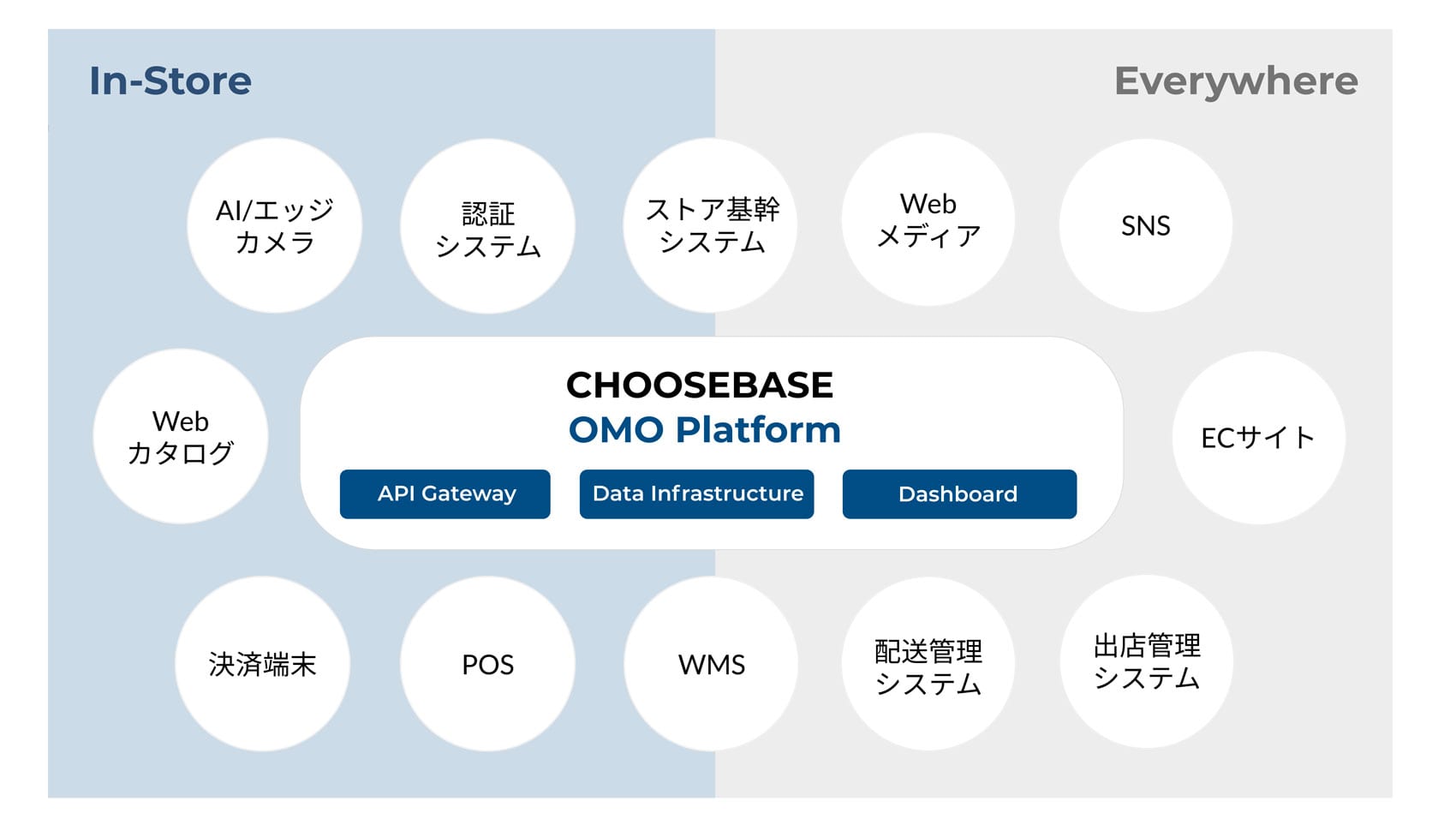

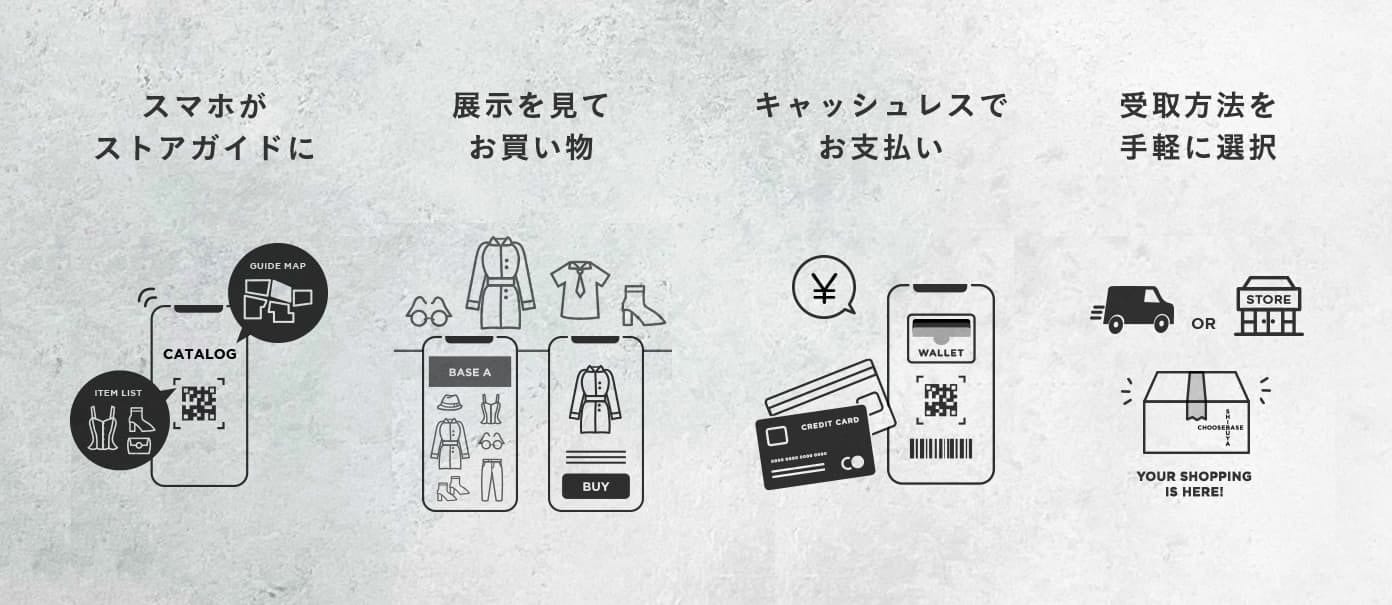
 MEX will commence operation from December 20th as an online service serving as the gateway to Mitsubishi Materials' E-Scrap exchange, which possesses the world's largest acceptance and processing capacity. MEX is expected to promote the recycling of E-Scrap, which is known as an urban mine, and contribute to the expansion of Mitsubishi Materials' metal recycling business globally. Note that this project is the first achievement of the Business DX in MMDX (Mitsubishi Materials Digital Business Transformation), the digitization strategy they pursue.
## The expanding E-Scrap market
E-Scrap is the discarded circuit boards from home appliances, personal computers, smartphones, etc., and it contains high concentrations of gold, silver, copper, palladium and other valuable metals.
The demand for resources is increasing globally while on the other hand development of new mines is difficult, so utilizing the dormant E-Scrap in cities is essential for securing metal resources going forward [^1]. In recent years, along with the improvement in the recycling rate in each country around the world against the background of rising environmental awareness, the amount of E-Scrap processed domestically expanded by approximately three times over the ten years until 2018 and going forward the utilization of E-Scrap is projected to expand worldwide [^2].
MEX will commence operation from December 20th as an online service serving as the gateway to Mitsubishi Materials' E-Scrap exchange, which possesses the world's largest acceptance and processing capacity. MEX is expected to promote the recycling of E-Scrap, which is known as an urban mine, and contribute to the expansion of Mitsubishi Materials' metal recycling business globally. Note that this project is the first achievement of the Business DX in MMDX (Mitsubishi Materials Digital Business Transformation), the digitization strategy they pursue.
## The expanding E-Scrap market
E-Scrap is the discarded circuit boards from home appliances, personal computers, smartphones, etc., and it contains high concentrations of gold, silver, copper, palladium and other valuable metals.
The demand for resources is increasing globally while on the other hand development of new mines is difficult, so utilizing the dormant E-Scrap in cities is essential for securing metal resources going forward [^1]. In recent years, along with the improvement in the recycling rate in each country around the world against the background of rising environmental awareness, the amount of E-Scrap processed domestically expanded by approximately three times over the ten years until 2018 and going forward the utilization of E-Scrap is projected to expand worldwide [^2].

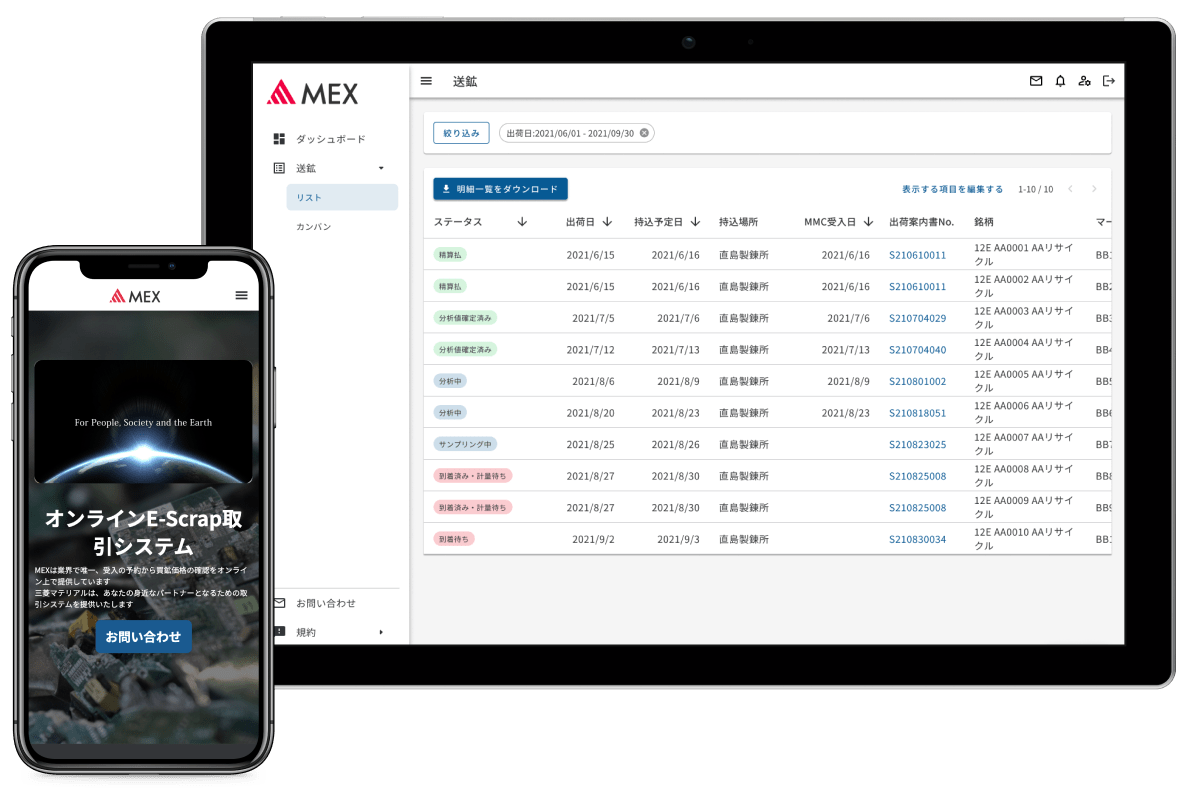
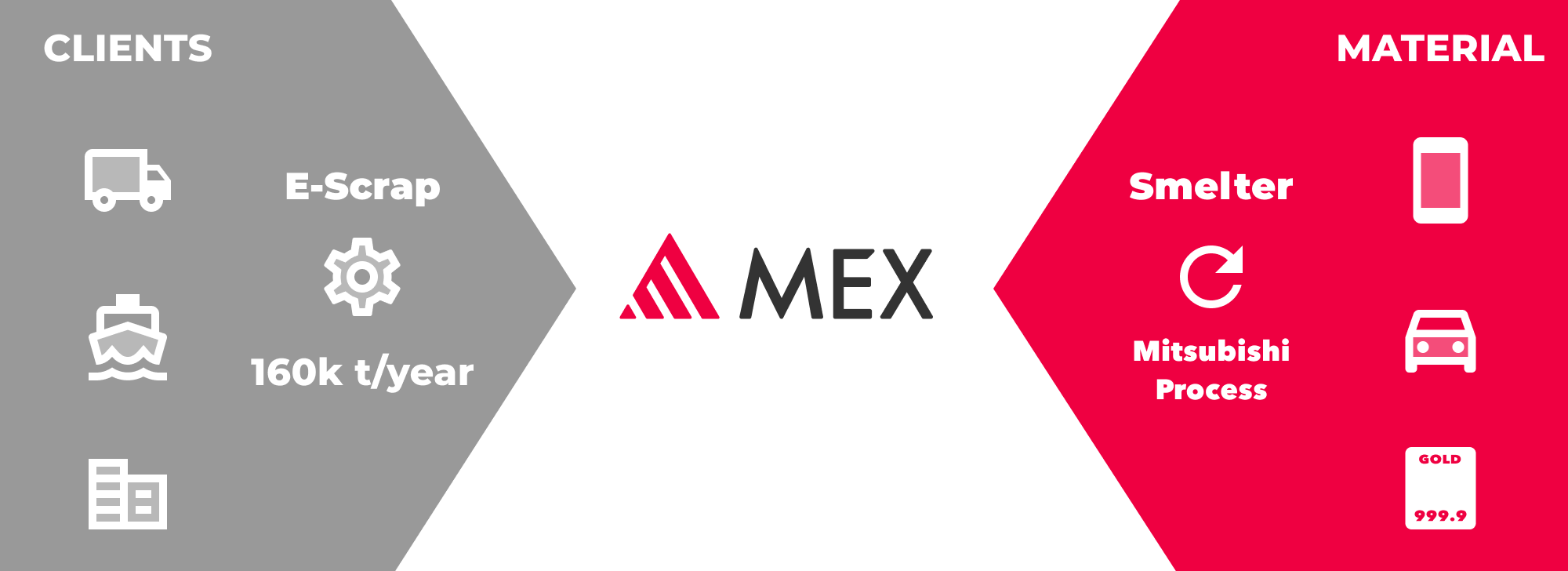
 With the rapid advancement of digital technology, companies across all industries are racing to develop innovative business models. To maintain and strengthen competitiveness, businesses must swiftly embrace digital transformation (DX) [^1]. One of the means to execute "offensive DX" [^2], which is to create new sales or further activate existing business transactions through the use of digital technology, is to create a platform for business transactions.
With the launch of this marketplace for parts procurement, we aim to realize smoother transactions between buyers and suppliers and create new customer value.
## Details of Support
ROUTE06's comprehensive support for this marketplace launch includes:
- Marketplace service design
- Development and provision of the underlying system
- UI/UX design and implementation
With the rapid advancement of digital technology, companies across all industries are racing to develop innovative business models. To maintain and strengthen competitiveness, businesses must swiftly embrace digital transformation (DX) [^1]. One of the means to execute "offensive DX" [^2], which is to create new sales or further activate existing business transactions through the use of digital technology, is to create a platform for business transactions.
With the launch of this marketplace for parts procurement, we aim to realize smoother transactions between buyers and suppliers and create new customer value.
## Details of Support
ROUTE06's comprehensive support for this marketplace launch includes:
- Marketplace service design
- Development and provision of the underlying system
- UI/UX design and implementation